
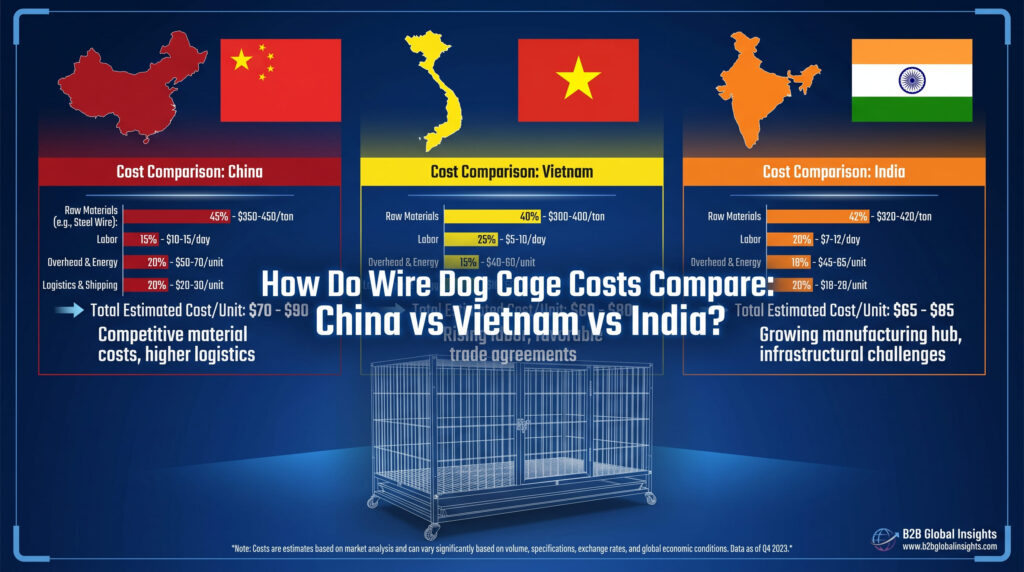
How Do Wire Dog Cage Costs Compare: China vs Vietnam vs India?

A US importer recently asked us point-blank: “Your Ningbo factory is quoting $26.50 per cage. I found a Vietnam factory quoting $24.00. Should I switch my entire supply chain to Southeast Asia?” It’s a fair question — and one we hear at least twice a month as the global “China Plus One” sourcing narrative gains momentum.
With rising labor costs in China and shifting global tariff structures, many pet product brands are actively exploring alternative manufacturing bases. However, comparing headline FOB prices between countries is like comparing airline ticket prices without checking baggage fees, seat selection charges, and layover times. The number on the surface rarely tells the whole story.
This guide provides a transparent, itemized cost comparison between manufacturing wire dog cages in China, Vietnam, and India. We break down the hidden costs of supply chain maturity, quality control differences, logistics realities, and the “soft costs” of managing suppliers in emerging markets — factors that often wipe out the initial labor savings found outside China.
What Are the Labor Cost Differences?

When buyers look to move production out of China, labor cost arbitrage is almost always the primary motivation. The logic sounds simple: Vietnamese welders earn 24% less per hour, so cages should cost 24% less. But the hourly wage is only half the equation — labor efficiency dictates the actual cost per finished unit.
Wages vs. Efficiency (2026 Data)
Here is how labor translates into actual cage production costs across the three regions:
| Country | Average Hourly Wage (Welders) | Daily Output (per worker) | Labor Cost per Cage | Relative Efficiency |
|---|---|---|---|---|
| China (Coastal) | $3.80 | 35 cages | $0.87 | 100% (Baseline) |
| Vietnam (North) | $2.90 | 28 cages | $0.83 | 80% |
| India (West) | $2.10 | 22 cages | $0.76 | 63% |
Why Lower Wages Don’t Equal Lower Costs
The table reveals a crucial insight: Vietnam’s 24% wage advantage shrinks to just a $0.04 per cage advantage after adjusting for efficiency. India’s 45% wage advantage compresses to $0.11. Here’s why:
- Experience gap: Chinese welders in established cage factories average 5-8 years of tenure. They know the exact heat settings and pressure needed to spot-weld 4.0mm wire without burn-through. Vietnamese workers average 1-3 years; Indian workers often under 2 years in this specific niche.
- Rework rates: Less experienced workers produce more defective welds that need to be ground off and re-done, consuming time and materials. Chinese rework rates run 2-4%; Vietnam 5-8%; India 8-12%.
- Equipment utilization: Chinese factories have optimized their production lines over decades. A single Chinese welder operates a semi-automated jig that positions wires precisely. Many Vietnamese and Indian factories still rely on fully manual positioning, which is slower and less consistent.
At our Ningbo factory, our core welding team has an average tenure of 6 years. When we run cost analyses for clients considering Vietnam, we show them the per-unit labor cost rather than the per-hour wage. The actual labor savings on a finished cage is about $0.04 — nowhere near enough to justify the disruption of switching your entire supply chain to an unproven factory 2,000 kilometers away.
How Do Raw Material Costs Compare?

Wire dog cages are material-heavy products. Steel wire, tubing, and powder coating account for roughly half the total cost of the item. This is where established manufacturing hubs retain a massive, often decisive advantage.
Supply Chain Maturity and Material Pricing
| Material Component | China | Vietnam | India | Supply Chain Notes |
|---|---|---|---|---|
| Steel Wire (per ton) | $1,850 | $1,920 | $1,900 | China is the world’s largest steel producer. Vietnam imports a significant portion from China, adding freight and tariffs. |
| Powder Coating (per kg) | $6.80 | $7.50 | $7.20 | China has massive domestic chemical industries. Emerging hubs often rely on imported premium powders. |
| Plastic Trays (per unit) | $1.20 | $1.50 | $1.40 | Chinese injection molding infrastructure is vastly superior, keeping mold and unit costs low. |
The “Made in Vietnam” Material Reality
China’s mature ecosystem means a cage factory in Zhejiang province has steel mills, powder coating suppliers, and plastic injection molding plants all within a 100km radius. Raw materials arrive at the factory gate within 24-48 hours of ordering.
In Vietnam, the reality is starkly different. Many Vietnamese wire cage factories operate as “assembly hubs” rather than true integrated manufacturers. They import the raw steel wire — or even pre-cut, pre-bent wire panels — from China, weld them locally to claim “Made in Vietnam” origin status, and then export the finished goods. This model adds an entire layer of cross-border freight, customs duties, and lead time to the raw materials before the first cage is even assembled.
What About Total Manufacturing Costs?
When you combine labor, materials, factory overhead, and quality control buffers into a single comparison, the playing field levels out surprisingly — and revealingly — fast.
Complete Factory Cost Comparison (36-inch Standard Cage)
| Cost Item | China (Ningbo) | Vietnam (Haiphong) | India (Mumbai) |
|---|---|---|---|
| Direct Materials | $14.70 | $15.40 | $15.20 |
| Direct Labor | $4.20 | $3.80 | $3.50 |
| Factory Overhead | $5.10 | $4.50 | $4.20 |
| Quality/Rework Cost | $0.80 | $1.20 | $1.50 |
| Total Factory Cost | $24.80 | $24.90 | $24.40 |
| Factory Margin | $1.70 | $1.60 | $1.60 |
| Final FOB Price | $26.50 | $26.50 | $26.00 |
The Verdict on Factory Costs: The total factory cost across all three regions is nearly identical (within a 2% variance). Vietnam’s labor advantage is entirely wiped out by higher material import costs and slightly higher defect-driven rework expenses. India appears $0.50 cheaper on paper, but higher quality control risks often eat into that margin quickly through returns and warranty claims downstream.
When the US importer showed us the $24.00 Vietnam quote versus our $26.50 price, we immediately asked to see the competitor’s spec sheet. The “equivalent” Vietnamese cage used 3.5mm wire instead of our 4.0mm standard, and the powder coating was a single-layer electrophoresis rather than our dual-layer powder coat. That $2.50 “savings” was actually a material downgrade worth $3.80 in quality reduction. The client stayed with us.
How Do Logistics and Shipping Costs Differ?

FOB price is only the beginning. To evaluate true sourcing costs, you must look at the total logistics chain required to move the goods from the factory gate to your warehouse in the US or Europe.
Freight and Infrastructure Comparison (To US West Coast)
| Origin Port | Avg Sea Freight (40HQ) | Transit Days | Port Efficiency & Reliability |
|---|---|---|---|
| Ningbo, China | $2,800 | 14-18 days | Excellent. Multiple weekly sailings, automated terminals, highly reliable. |
| Haiphong, Vietnam | $2,500 | 18-22 days | Good. Growing capacity, but prone to congestion during peak season. |
| Mumbai, India | $3,200 | 25-30 days | Fair. Longer transit, fewer direct routes, occasional strike and congestion risks. |
The Hidden Logistics Costs
Beyond the base ocean freight rate, several additional logistics factors disproportionately impact emerging market sourcing:
- Inland transport: In China, the highway and rail network to major ports like Ningbo and Shanghai is world-class. In Vietnam, moving goods from inland factories to Haiphong port can add 1-2 days and $200-400 per container in truck fees. In India, inland logistics are notoriously unpredictable.
- Container availability: Major Chinese ports have abundant empty container supply. Smaller Vietnamese and Indian ports sometimes face container shortages, adding 3-5 day delays while waiting for equipment.
- Documentation speed: Chinese customs clearance for exports is highly digitized and typically completes in 24 hours. Vietnamese and Indian customs processes can take 2-4 days, adding lead time to every shipment.
What Are the Quality and Reliability Differences?

The hidden cost of sourcing from emerging markets is often found in the defect rate and the administrative burden of managing the supplier relationship.
Defect Rate Comparison (Client-Reported Data)
We tracked feedback from several large B2B clients who dual-source cages from both our Chinese facility and factories in Southeast Asia. Here are the average defect rates they reported across 2024-2025:
- China (Established Tier-1/2 Factories): 0.8% – 2.1% defect rate
- Vietnam (Growing Factories): 1.5% – 3.5% defect rate
- India (Developing Factories): 2.5% – 5.0% defect rate
The Financial Impact of Higher Defect Rates
A defect rate difference that looks small on paper becomes expensive at scale:
| Metric | China (1.5% avg) | Vietnam (2.5% avg) | India (3.75% avg) |
|---|---|---|---|
| Order Size | 1,000 units | 1,000 units | 1,000 units |
| Defective Units | 15 | 25 | 38 |
| Cost per Defect (return + replacement) | $40 | $40 | $40 |
| Total Defect Cost | $600 | $1,000 | $1,520 |
| Defect Cost per Unit (spread across order) | $0.60 | $1.00 | $1.52 |
When you add the defect cost per unit back to the FOB price, India’s $0.50 “savings” disappears entirely and actually becomes a $1.02 premium. Vietnam’s identical FOB price becomes $0.40 more expensive than China. Quality is not a “nice to have” — it is a hard financial variable.
The “Soft Costs” of Sourcing from Emerging Markets
Chinese manufacturers have decades of experience dealing with Western buyers. They understand ASTM standards, Amazon FBA packaging requirements, and English communication is generally fluid. The administrative “soft costs” of sourcing from emerging markets include:
- More intensive QC requirements: Many buyers hiring third-party inspectors (SGS, QIMA) for every shipment from Vietnam/India, adding $300-500 per inspection
- Slower communication: Language barriers and time zone differences increase email response times from 12 hours (China) to 24-48 hours (Vietnam/India)
- Compliance learning curve: Factories in emerging markets may not understand REACH, Prop 65, or Amazon FNSKU labeling requirements without extensive hand-holding
- Travel costs: Buyers feel compelled to fly QC staff for on-site audits more frequently with new, unproven suppliers
Which Country Offers the Best Value? (Decision Matrix)
So, should you move your wire dog cage production out of China? The answer depends entirely on your specific business priorities.
Sourcing Strategy Matrix
| Your Primary Business Priority | Best Sourcing Choice | Why? |
|---|---|---|
| Lowest absolute paper cost | India | Viable only if you have a robust, on-the-ground QC team to catch the higher defect rates before shipping. |
| Tariff mitigation (US Buyers) | Vietnam | If US Section 301 tariffs on Chinese metal goods increase heavily, Vietnam becomes the necessary choice despite material inefficiencies. |
| Best quality-to-cost balance | China | Unmatched supply chain maturity, lowest defect rates, and fastest time-to-market. |
| Risk Diversification (Volume Buyers) | China (70%) + Vietnam (30%) | Large buyers (>20 containers/year) should maintain primary volume in China while developing a secondary supply line in SE Asia to hedge against geopolitical risk. |
When clients ask us “should I switch to Vietnam?” our honest answer is: not yet for cost reasons, but possibly for risk diversification. If your business does fewer than 500 cages per shipment, the switching cost alone ($3,000-5,000 in new samples, factory audits, and trial order inefficiencies) exceeds the maximum savings you could achieve over an entire year. Keep your primary supply in China; test Vietnam with 20-30% of your volume only if you have a genuine geopolitical or tariff concern.
FAQ: China vs Vietnam vs India Manufacturing
Conclusion: The “China Plus One” Reality
When analyzing wire dog cage manufacturing costs across Asia, the data clearly shows that China’s mature supply chain ecosystems currently outweigh the raw labor cost advantages of Vietnam or India.
While an hourly wage of $2.90 in Vietnam sounds appealing compared to $3.80 in China, the necessity of importing raw steel, combined with lower worker efficiency, higher defect rates, and more expensive quality management, results in an almost identical — or even higher — total landed cost. Furthermore, China’s superior port infrastructure and massive shipping volume ensure faster, more reliable transit times to Western markets.
The primary reason to shift wire dog cage production to Southeast Asia today is geopolitical risk mitigation and tariff avoidance, not pure manufacturing cost reduction. For B2B buyers looking for the most stable, highest-quality, and ultimately most cost-effective sourcing strategy, China remains the undisputed heavy-duty champion of the wire dog cage industry.
External References: Statista: Manufacturing Wages in China | World Bank Logistics Performance Index
