
FCL vs LCL Shipping: How to Choose the Right Container for Your Dog Crate Order
Stage 2 of the Logistics Series — Container loading math, cost comparison, and the break-even point.
1. What Are FCL and LCL? The Two Basic Paths for Ocean Freight
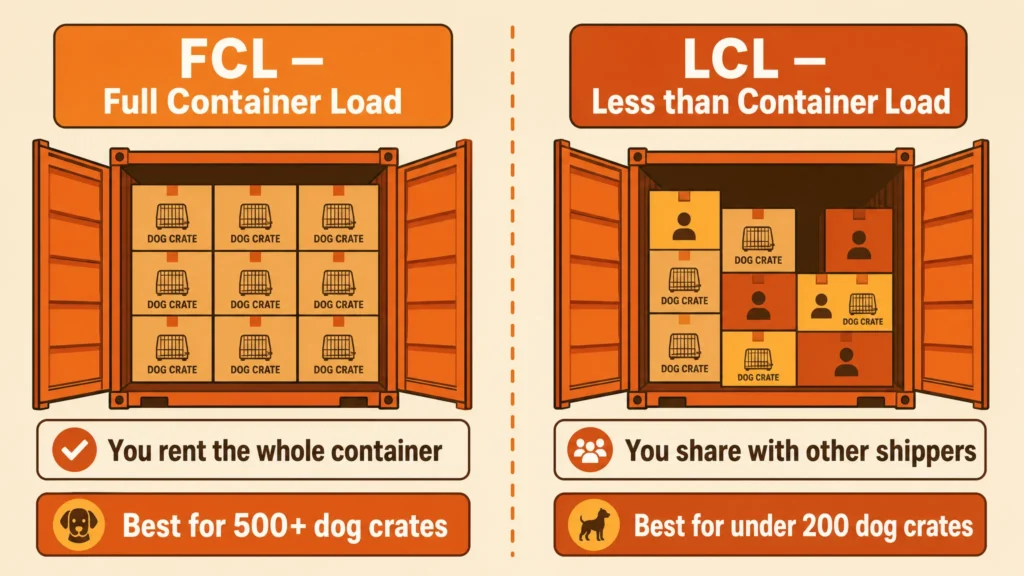
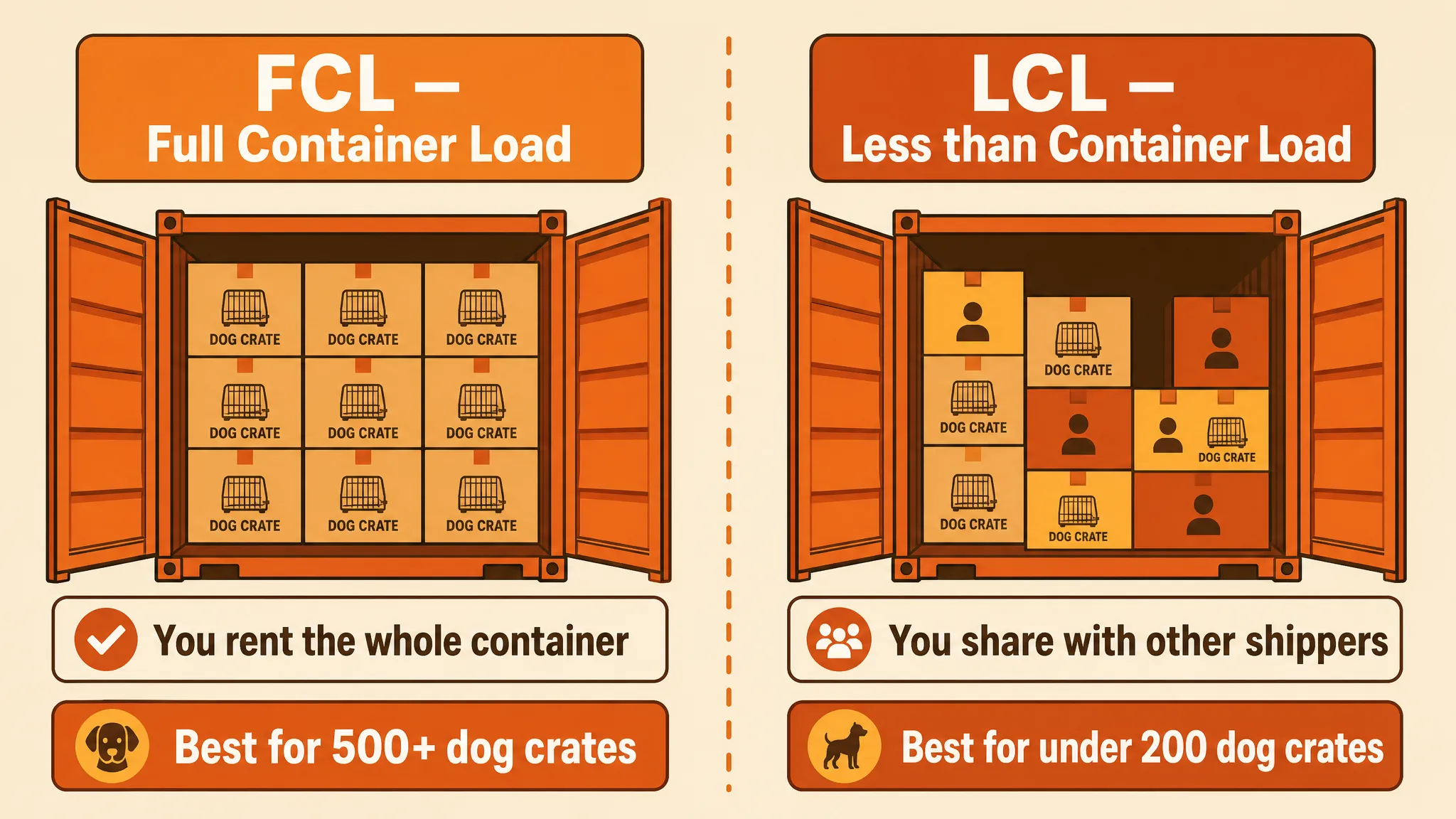
When your dog crates leave the Ningbo port, they take one of two roads. FCL means Full Container Load — you rent the entire container, and your crates fill it (or come close). LCL means Less than Container Load — your cargo shares a container with other buyers’ orders.
At our Ningbo facility, we’ve shipped both ways for 15 years. Here is what actually matters:
- FCL (Full Container Load): Your order occupies the whole container. You pay for the container, not per CBM. Best for large volumes.
- LCL (Less than Container Load): Your cargo consolidates with others in one container. You pay per CBM. Best for smaller shipments.
2. 20ft vs 40ft Container: How Many Dog Crates Actually Fit?
This is the calculation we do most often with clients. The answer depends on one number: how much space each dog crate takes in cubic meters. At 0.08 CBM per dog crate:
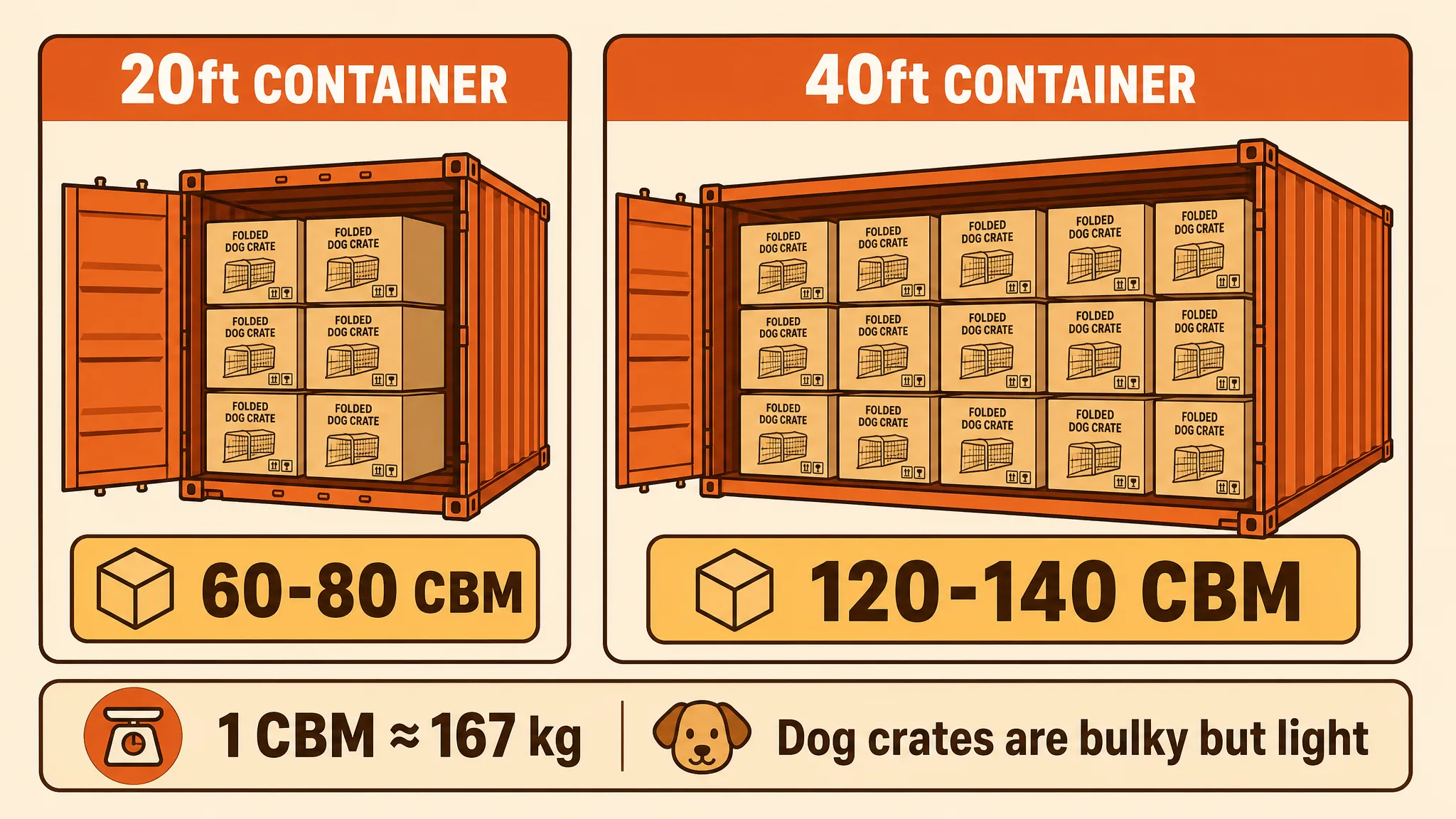
- 20ft container capacity: ~60–80 CBM usable. At 0.08 CBM per crate, that is approximately 700–900 dog crates.
- 40ft container capacity: ~120–140 CBM usable. At 0.08 CBM per crate, that is approximately 1,400–1,800 dog crates.
20ft container actual usable capacity is 60–80 CBM, 40ft is 120–140 CBM. Always reserve 10% safety margin — crates need room for forklift movement during loading and unloading.
The formula is simple:
Container capacity (CBM) ÷ per-unit CBM = number of crates
Example: 70 CBM (20ft) ÷ 0.08 CBM (per crate) = 875 crates
Calculation exercise you can replicate: Take your order quantity. Multiply by 0.08. Divide by your target container capacity. That tells you if you need a 20ft, 40ft, or can split the order.
3. FCL vs LCL Cost Structure: What You Actually Pay
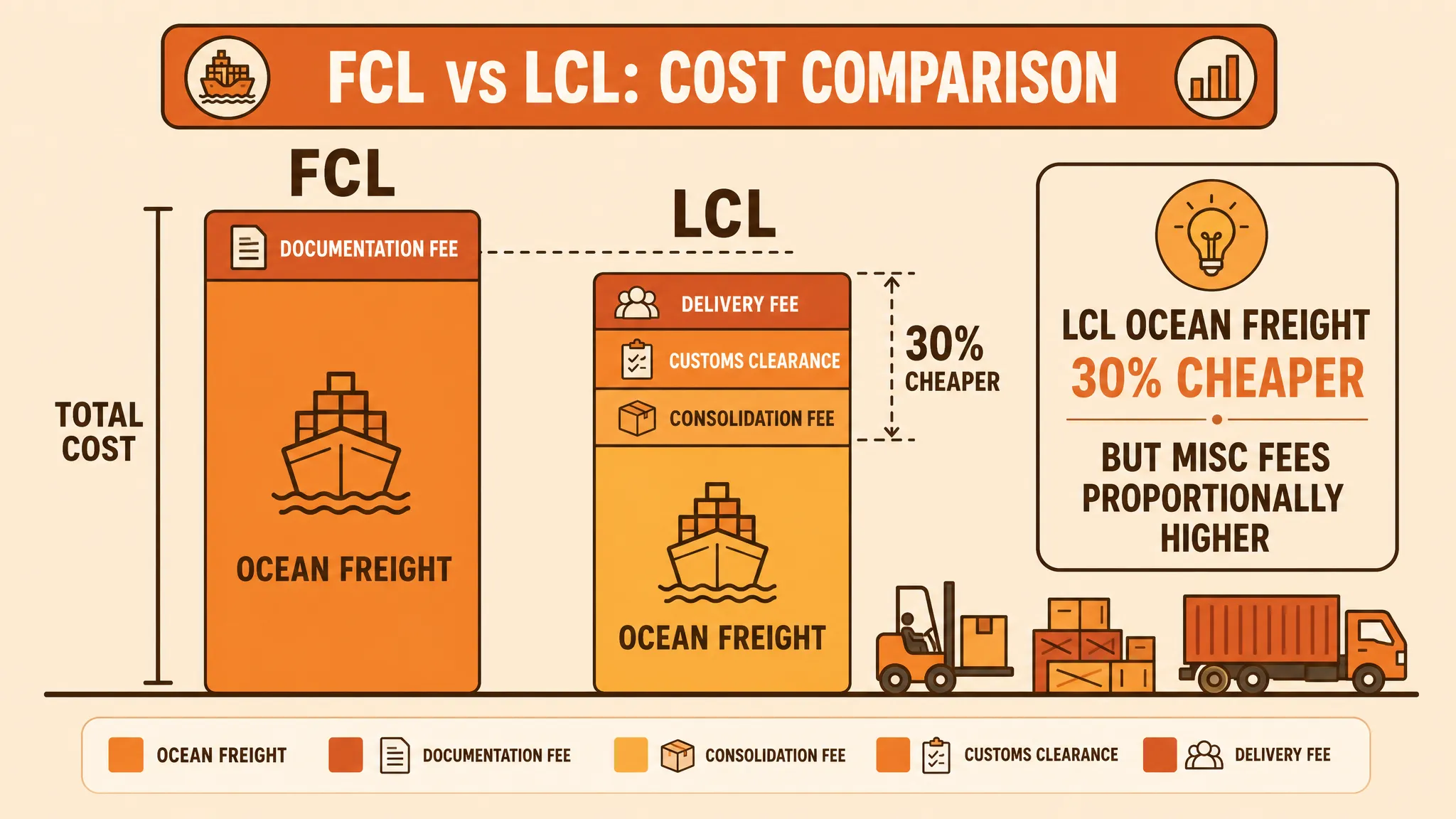
Here is where most buyers get surprised. FCL looks expensive. LCL looks cheap. The reality is different once you see the full cost picture.
FCL cost structure:
- Ocean freight (flat rate per container)
- Origin port charges (THC, documentation)
- Destination port charges (DDC, AMS, ISPS)
- Customs broker fee (~$500 typical)
- Delivery to your warehouse
LCL cost structure:
- Ocean freight (charged per CBM)
- Origin port charges
- CFS handling fee (Consolidation facility charge)
- Merge fee (combining multiple shipments)
- Destination CFS handling fee
- Destination port charges (DDC, AMS, ISPS)
- Deconsolidation fee (unloading your portion)
- Customs broker fee
- Delivery to your warehouse
Freight forwarder “all-in rates” often exclude destination port DDC, AMS, ISPS. Always ask for an ALL IN quote. The forwarder will not volunteer this information.
4. Case Study: 500 Dog Crates — FCL or LCL?
Client order: 500 dog crates. Each crate = 0.08 CBM. Total volume = 40 CBM.
Question: Which container type should they book?
500 crates × 0.08 CBM = 40 CBM total
40ft container capacity: 120–140 CBM
20ft container capacity: 60–80 CBM
Result: 40 CBM fits in a 20ft container. You could book a 20ft FCL.
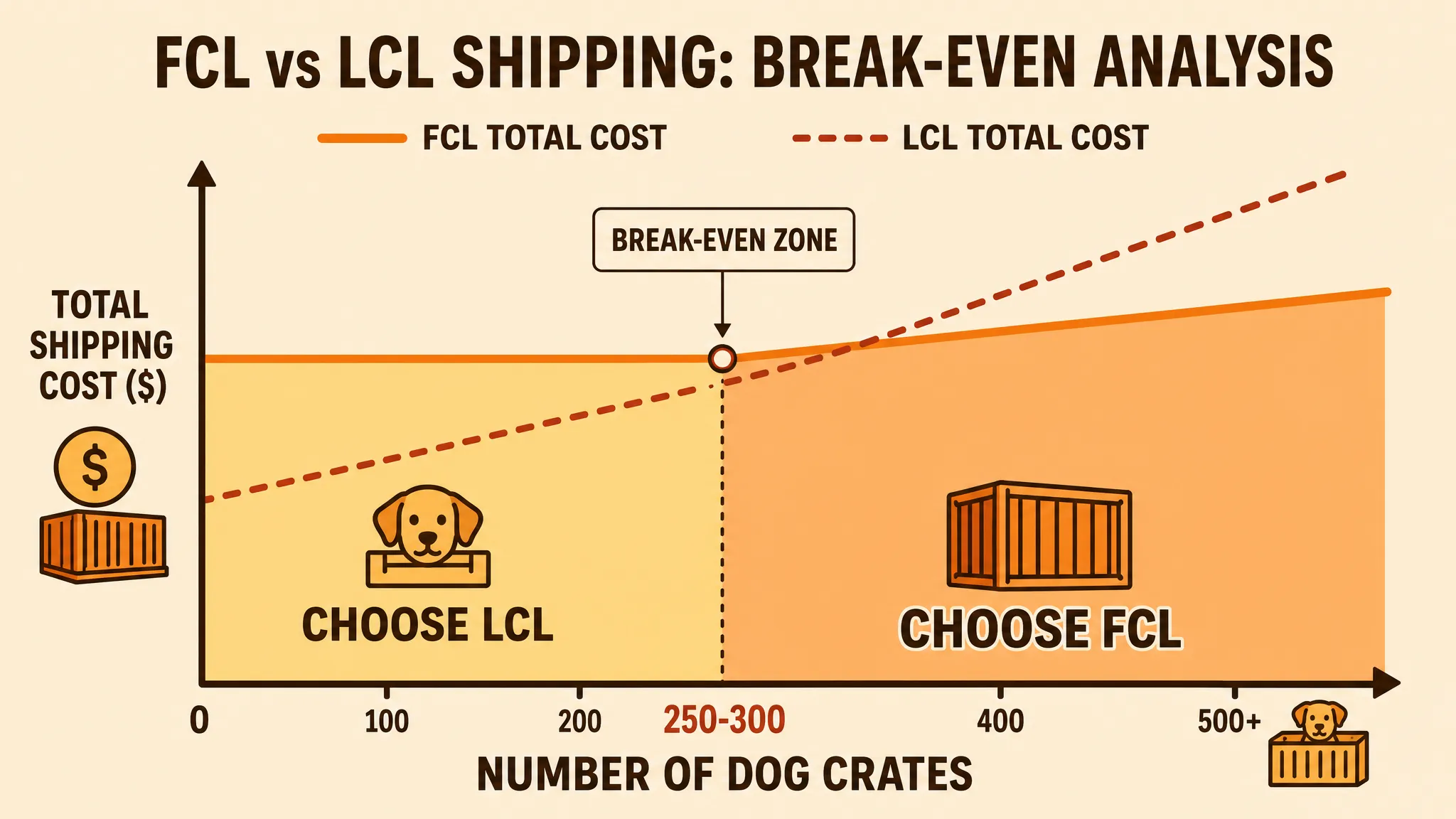
But wait — is FCL the right choice at 500 units? The break-even point is approximately 400–500 units for a single SKU. At 500 units, you are right at the threshold.
- FCL 20ft quote: $2,800 ocean freight + $600 misc = $3,400 total
- LCL quote: $1,600 ocean freight + $1,400 misc = $3,000 total
LCL was $400 cheaper — even with the higher misc fees. But the forwarder had existing consolidation space that week. That does not always happen.
5. The Break-Even Point: When Does FCL Actually Save You Money?
The break-even point: approximately 400–500 units for a single SKU. Below this volume, LCL is more economical if the forwarder has consolidation space. Above this volume, FCL becomes the better value.
Why does the break-even work this way?
FCL charges a flat container rate. LCL charges per CBM. The ocean freight difference (30% cheaper for LCL) gets eaten by misc fees that are 2–3x the FCL proportion.
The math:
- 32 CBM at LCL: ~$50/CBM ocean freight × 32 = $1,600 + $800 misc = $2,400
- 32 CBM at FCL 20ft: flat $2,200 + $600 misc = $2,800
LCL wins by $400 at 400 units. But add more units and FCL pulls ahead:
- 600 units (48 CBM): LCL = $3,200. FCL 20ft = $2,800. FCL wins.
- 700 units (56 CBM): LCL = $3,600. FCL 20ft = $2,800. FCL wins by $800.
For mixed SKUs: Calculate each SKU volume separately. Total volume cannot exceed container capacity. Mixed shipping increases customs complexity — factor in extra clearance time.
6. FCL vs LCL Decision Checklist: 6 Questions Before You Book
Use this checklist before booking your container. We run through it with every client at our Ningbo facility.
1. What is your total order volume in CBM?
Formula: Order quantity × per-unit CBM. Dog crate standard = 0.08 CBM per unit.
2. Are you above or below the 400–500 unit break-even?
Below: Check if forwarder has open consolidation space. LCL may work.
Above: FCL is likely the better value.
3. What are the ALL-IN quotes — not just ocean freight?
Request DDC, AMS, ISPS, CFS handling, merge fees. The low ocean rate means nothing if misc fees triple the total.
4. Is your pickup schedule flexible?
LCL consolidation takes 2–3 extra days. Customs clearance time US ~3–5 days, Europe ~5–10 days. Build buffer time into your inventory plan.
5. Are your shipping marks standardized?
Irregular shipping marks cause destination port customs delays of 3–5 days. Use standard case count + order number format.
6. Do you need third-party inspection?
Inspection service fee is ~$200–$500 per session. If booking LCL with consolidation, inspection logistics become more complex.
Summary table:
| Container Type | Best For |
|---|---|
| FCL | 500+ units; predictable scheduling; simpler customs |
| LCL | Under 400 units; forwarder has open consolidation space; flexible timing |
Pitfall Prevention Checklist
- Only looking at ocean freight numbers: LCL quote looks much lower than FCL, but destination port misc fees are 2–3x FCL proportion. Ask for ALL IN quote.
- Assuming LCL without checking consolidation space: At 300–400 units, ask forwarder if they have existing consolidation space. Sometimes they do.
- Miscalculating box count: Reserve 10% safety margin. Use formula CBM ÷ per-unit volume = container loading.
Frequently Asked Questions
Is FCL or LCL better for dog crates?
Depends on volume. At 400–500+ units, FCL is more economical. Below this volume, LCL is more flexible but higher misc fees.
How many dog crates fit in a 20ft container?
At 0.08 CBM per crate, approximately 700–900 units. Formula: 70 CBM ÷ 0.08 CBM = 875 crates.
What hidden fees does LCL consolidation have?
LCL misc fees are 2–3x FCL proportion, including destination CFS handling fee, pickup fee, merge fee, and deconsolidation fee. Always request ALL IN quote.
What is the most economical shipping method for low volumes?
Below break-even point (400–500 units), use LCL if consolidation space is available. For samples or very small orders, consider courier or air freight.
How to calculate multiple SKUs mixed in one container?
Calculate each SKU volume separately. Total volume cannot exceed container capacity. Mixed shipping increases customs complexity — factor in extra clearance time.
