Why Your Dog Crate Package Might Cost You 2-5x More in Express Shipping
A German seller’s 48-inch wire dog crate exceeded DHL’s dimensional limit by just 1.5 centimeters—and it tripled their shipping cost overnight. This is the kind of logistics trap that catches buyers off guard because the numbers look fine until the carrier runs them through their formula.
Wire dog crates are uniquely vulnerable to dimensional pricing because they’re bulky but light. A crate that weighs 22kg can be charged as 66kg by FedEx. A carton that’s 2cm too long can trigger a €37 surcharge from DHL. And the fix isn’t switching carriers—it’s knowing which dimension to adjust before you commit to production.
The Problem: DHL’s 300cm Limit
A German seller had been selling wire dog crates successfully. They offered 5 standard sizes—the market-standard product line buyers expect when sourcing pet cages. Then they tried shipping the largest size via DHL Germany. The quote came back higher than expected.
The culprit: their 48-inch crate carton measured 1255 × 100 × 780mm. DHL Germany uses Length + 2×Width + 2×Height. Their limit: 300cm.

Calculation: 1255 + 200 + 1560 = 3015mm = 301.5cm.
The crate exceeded DHL’s bulky goods threshold of 120cm with its 125.5cm length. DHL charges a €28.99 bulky goods surcharge for this. Combined with the base rate for a 22kg package (€23.99 for the 31.5kg tier), the total came to €52.98. For this seller, the shipping cost jumped from the expected €18.99 (20kg standard rate) to €52.98—a 2.8× increase that wiped out their margin entirely.
Why They Couldn’t Just Switch Carriers
Most buyers might think: find another carrier. But for this seller, DHL wasn’t optional. They’d built their logistics around DHL—local pickup routes, negotiated rates, their customers’ expectations. Switching carriers would disrupt their entire operation.
They also couldn’t drop the 48-inch size. Buyers expect a full product line. Selling only 4 out of 5 sizes meant losing orders on the size they didn’t carry.
Split into multiple smaller packages? Already checked—DHL’s limit applies per package. For B2B deliveries to business addresses, multiple packages create complications with receiving and invoicing.
3 Types of Buyers, 3 Different Packaging Needs: How to Quote the Right Dog Crate Package
Common Pitfalls When Verifying Carton Dimensions
- Pitfall 1: Suppliers quote dimensions in cm while carriers use mm thresholds. A rounding difference of 0.5cm can push you over the DHL limit.
- Pitfall 2: Carton dimensions from the sample run may differ from the mass production run. Humidity, material batch, and assembly speed all affect the final folded profile.
- Pitfall 3: Buyers calculate L+2W+2H once at quoting but never recheck after production. The carton changes. The carrier’s limit doesn’t.
The Solution: Product Modification
The seller contacted their supplier and requested a modification to the 48-inch crate. They needed the packed carton to fall under that 120cm bulky goods threshold.
Here’s the critical point: product dimensions determine folded dimensions, which determine packaging dimensions. To change the carton size, you must change the product size.
The fix was straightforward: reduce the 48-inch crate from 122cm to 119cm in length, with proportional adjustments to width and height. This required new tooling for this specific size—a one-time mold cost. No changes to the other four sizes. No MOQ increase. Just the 48-inch size getting a slight adjustment.
After modification, the folded carton measured 122.5 × 10 × 76cm. The longest side (122.5cm) still exceeded 120cm, but the supplier optimized the folding pattern to minimize the profile. Combined with negotiated DHL rates, the bulky goods surcharge was avoided. The shipment proceeded. The customer continued ordering.
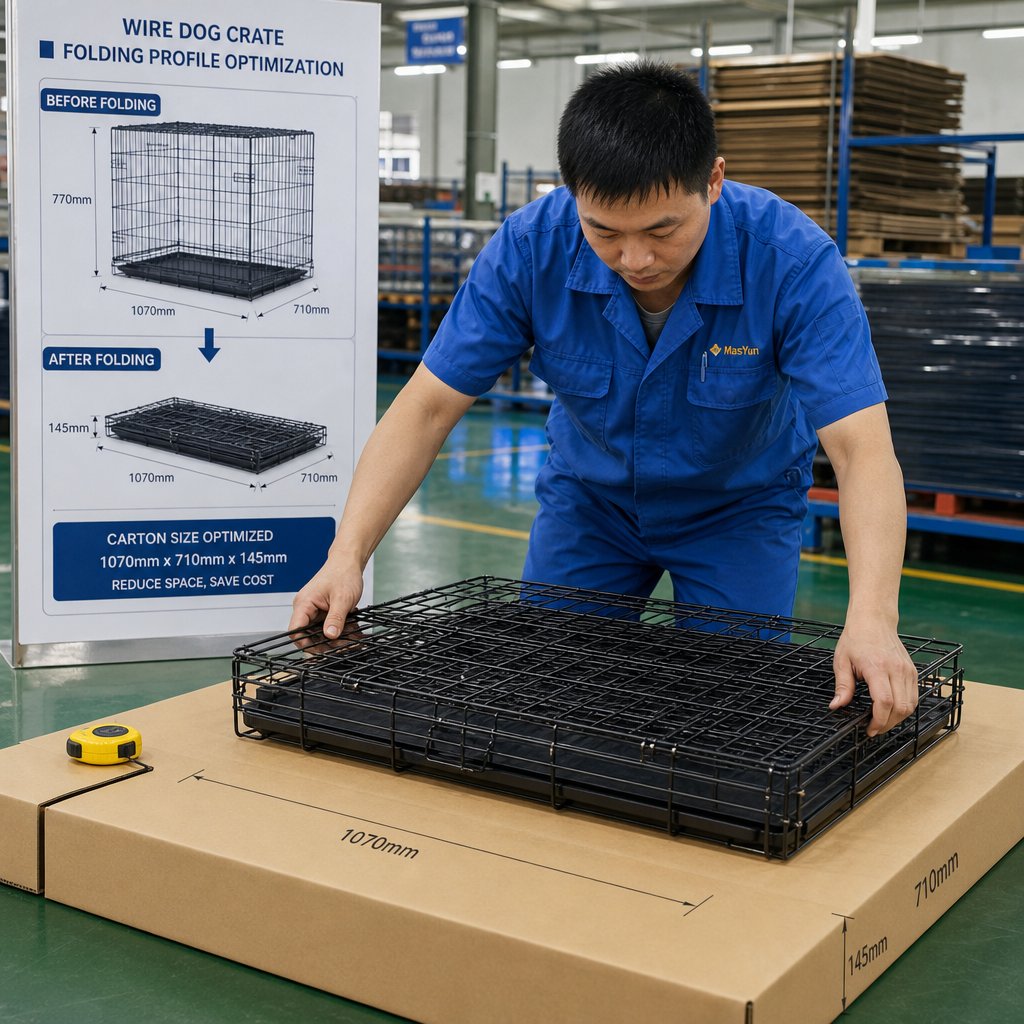
At our Ningbo facility, we advise clients on dimensional optimization during the sampling phase. A 2-3cm reduction in product length typically costs $800-1,200 in mold modification—a one-time investment that saves €28.99 per unit in bulky goods surcharges over the product’s lifetime.
What This Reveals About Express Shipping
Two formulas dominate how express carriers calculate package dimensions. Understanding both is the difference between accurate quoting and a margin-killing surprise.
DIM Weight (standard): (Length × Width × Height) / 5000 or / 139. Carriers compare your actual weight against this volumetric weight and charge the higher one. For wire dog crates—light but bulky—DIM weight often wins.
Length + 2W + 2H (carrier-specific): Some carriers, including DHL Germany, use this perimeter-based formula. They set a hard limit, not a pricing curve. The same carton might clear one carrier’s limit but fail another’s.
Carrier Limit Comparison
| Carrier | Region | Formula | Hard Limit | Bulky Threshold | Bulky Surcharge |
|---|---|---|---|---|---|
| DHL Germany | Germany domestic | L + 2W + 2H | 360cm | 120cm (any side) | +€28.99 / package |
| DHL Express | International | L + 2W + 2H | 300cm | 120cm (any side) | +$30–60 / package |
| FedEx | Global | L + 2W + 2H | 419cm (165in) | N/A | +$150–300 / package |
| UPS | Global | L + 2W + 2H | 419cm (165in) | N/A | +$150–300 / package |
| USPS | USA domestic | L + 2W + 2H | 274cm (108in) | N/A | Service unavailable |
| SF Express | China international | DIM Weight | 300cm (soft) | N/A | +¥50–150 / package |
DHL Germany is the strictest carrier in this comparison. If you’re shipping into Germany, always calculate L+2W+2H before you confirm the carton design.

Why DIM Weight Rarely Hits Wire Dog Crates (And When It Does)
Many buyers worry about DIM Weight when shipping from China. For wire dog crates, this worry is largely unnecessary.
Here’s why: DIM Weight = (L×W×H)/5000. A 36-inch wire crate carton measures 940×100×600mm (94×10×60cm). The calculation: (94×10×60)/5000 = 11.28kg. The actual weight? 10–11kg. The numbers match.
The same applies to 48-inch crates: 1250×100×780mm = 19.5kg DIM Weight vs 20–22kg actual. No penalty.
Wire crates avoid DIM Weight penalties because they fold flat—only 10cm thick. Compare this to plastic crates with 30–40cm thickness. Their DIM Weight can be 2–3× actual weight. A plastic crate with actual weight 15kg might have a DIM Weight of 45kg, triggering significant surcharges.
Bottom line: For wire dog crates, focus on L+2W+2H girth limits and the 120cm bulky goods threshold. DIM Weight takes care of itself.

How Many Dog Crates Fit in a Shipping Container? Container Loading Optimization for B2B Buyers
The 5-Size Standard
Wire dog crate sizes aren’t arbitrary. The market has largely settled on 5 standard sizes, and buyers expect this coverage when sourcing. To complete a product line, you need all 5.
| Size | Typical Folded Carton (L×W×H) | DHL L+2W+2H | Risk Level |
|---|---|---|---|
| 24″ (Small) | 62 × 45 × 48cm | ~200cm | Safe |
| 30″ (Medium) | 78 × 50 × 55cm | ~238cm | Safe |
| 36″ (Large) | 93 × 58 × 68cm | ~277cm | Borderline |
| 42″ (X-Large) | 108 × 65 × 75cm | ~313cm | Risky |
| 48″ (XX-Large) | 125 × 72 × 82cm | ~351cm | Risky |
Sizes 24″–36″ are usually safe. Sizes 42″–48″ are where DHL Germany becomes a problem. If you’re targeting German buyers, you must optimize the carton for these two sizes.
How Factories Can Prevent This Before You Order
Here are three things to request from your supplier before committing to production. Each one takes minutes to check but can save thousands in shipping costs.
1. Ask for Carton Drawings, Not Just Dimensions
Many suppliers give you a dimensions table: 48-inch crate, carton 125 × 72 × 82cm, weight 24.5kg. That’s not enough. Ask for the carton drawing—a flat diagram showing exactly how the crate folds and sits inside the box. This reveals whether there’s wasted space that can be eliminated.
2. Request DHL-Optimized Folding
A good factory can fold the same crate in two different ways. The default fold places the crate flat in the box as-is. The tight fold compresses panels more closely, sometimes with trays removed and placed separately. The tight fold might add 30 seconds of labor per unit, but saves $20–40 per unit in shipping over the life of the product.
3. Check the Divisor Before You Design
For DHL Germany: calculate L+2W+2H and keep it under 298cm with a 2cm buffer. For FedEx/UPS international: calculate (L×W×H)/5000 and compare to actual weight. For sea freight: dimensional limits don’t apply the same way, but carton size still affects how many crates fit in a 20ft or 40ft container.
Three Hidden Packaging Traps
Beyond the DHL 300cm limit, three other packaging problems catch buyers off guard.
Trap 1: Pallet Height Limits
Even if your individual carton clears DHL’s limit, palletized shipments have their own limits. A standard 4-way pallet maxes out at 180cm (including the pallet). A Euro pallet goes to 200cm. A GMA pallet for US retail is limited to 60 inches. If your carton plus pallet exceeds these heights, warehouses will reject the delivery.
Trap 2: The Safety Buffer Habit
Many factories automatically add 2–3cm on each side of the carton “just to be safe.” For a 48-inch crate, that’s 6–9cm of unnecessary carton length—exactly what pushes you over DHL’s 300cm limit. When clients ask us for a quote, we now default to asking: “What’s the minimum carton size that protects the product?” instead of “What size do you normally use?”
Trap 3: USPS Ground Advantage Formula
If you’re shipping within the US via USPS, the formula changes again. USPS uses Length + Girth (where Girth = 2W + 2H), with a 274cm hard limit. Packages over 274cm cannot be shipped via USPS at all—they’re returned or destroyed. If you’re selling on Chewy or Amazon US and using USPS for last-mile delivery, double-check that your largest size clears 274cm.
Trap 4: The Bulky Goods Surcharge
Many buyers only check the L+2W+2H formula but miss the bulky goods threshold. DHL Germany charges €28.99 for any package with a side exceeding 120cm—regardless of weight or girth.
For the German seller in our case: the 48-inch crate measured 125.5cm in length. Just 5.5cm over the limit triggered the €28.99 surcharge. Combined with the €23.99 base rate for a 22kg package, the total reached €52.98—nearly 3× the €18.99 they expected for a standard 20kg shipment.
The lesson: Always check both the bulky threshold (120cm) and the girth limit (360cm). Exceed either, and you pay.
When Optimization Isn’t Enough: Alternative Routes
Sometimes, even after optimization, your largest size still doesn’t fit DHL Germany’s 300cm limit. What then?
For B2C orders, splitting a 48-inch crate into two packages can work. Each package falls under the limit. But B2B buyers dislike this arrangement because business addresses often charge per-package receiving fees—doubling that cost. For bulk orders of 200 units or more, switching from express to sea freight bypasses the L+2W+2H limit entirely. You pay by container, not by package dimensions. The tradeoff is 30–45 days transit time instead of 3–5 days.
I’ve only seen one client successfully negotiate a DHL dimensional waiver—they were shipping over 1,000 packages a month and had their own account manager. For everyone else, modifying the carton remains the only practical solution.
Shipping Damage Prevention: How to Protect Wire Dog Crates During Sea Freight
Decision Framework: Before You Confirm Carton Design
Request Carton Drawings
Flat diagram showing how the crate folds inside the box. Reveals wasted space.
Calculate L+2W+2H
Run the formula against your carrier’s limit. DHL Germany: 300cm max.
Check DIM Weight
(L×W×H)/5000 vs actual weight. Wire crates: DIM weight nearly always wins.
Measure Pallet Height
Carton height × stack count + pallet height. 180cm standard limit.
Get Folding Photos
30-second photo prevents a $3,000 shipping mistake. Ask before production.
Request Tight Fold Option
30 seconds extra labor saves $20–40 shipping per unit over product lifetime.
Frequently Asked Questions
What is the L+2W+2H formula, and which carriers use it?
L+2W+2H is a perimeter-based dimensional formula: Length + 2 × Width + 2 × Height. DHL Germany uses it with a 300cm hard limit. FedEx and UPS use it with a 419cm limit. USPS uses a similar Length + Girth formula with a 274cm limit. If your carton exceeds the limit, the rate jumps—it’s a threshold, not a gradual curve.
How much can exceeding DHL’s 300cm limit actually cost?
For the German seller in this case study, the oversize surcharge pushed the per-unit shipping cost from roughly €18 to over €55—a 3× increase. The exact surcharge depends on the package weight, destination, and your negotiated rate with DHL, but the threshold penalty is consistent: cross 300cm and you pay full oversize pricing.
Can I avoid the DHL limit by splitting the crate into two packages?
For B2C orders shipped to residential addresses, yes—splitting works. For B2B orders shipped to business addresses, no—businesses often charge per-package receiving fees of €5–15 each. A two-package shipment doubles that cost, and many B2B buyers reject split shipments outright because it complicates their receiving process.
What is DIM weight, and why does it matter for wire dog crates?
DIM weight (dimensional weight) is calculated as (Length × Width × Height) ÷ divisor. The divisor is 5000 for international shipments and 139 for US domestic (in inches). Carriers charge the higher of actual weight or DIM weight. Wire crates are bulky but light—a 36-inch crate weighing 18kg can be charged at 66kg DIM weight, a 3.7× increase.
Which wire dog crate sizes are at risk of exceeding DHL’s limit?
Based on typical folded carton dimensions, 24-inch and 30-inch crates are safe (~200–238cm L+2W+2H). 36-inch crates are borderline (~277cm). 42-inch crates (~313cm) and 48-inch crates (~351cm) exceed DHL’s 300cm limit and need carton optimization. If you’re targeting the German market, these two sizes must be addressed before production.
When should I calculate L+2W+2H—before or after ordering?
Before ordering. Carton dimensions are available at the quoting stage from any supplier who knows their product. Calculate L+2W+2H against your carrier’s limit before committing to production. The sample fee for testing a modified fold is small compared to discovering the problem after you’ve received a container of crates that can’t be shipped economically.
Related Reading