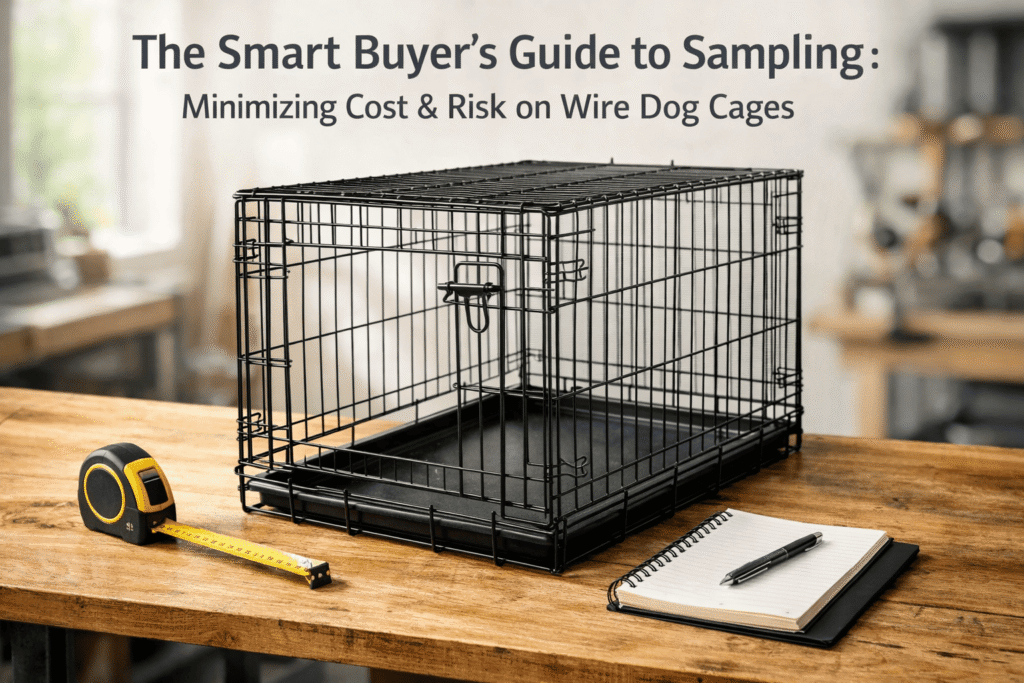
For every pet brand owner or buyer sourcing from overseas, the moment of truth arrives not with a full container load, but with a single, lonely wire dog cage sample sitting in your warehouse. This sample represents a significant upfront investment of time, money, and hope—an investment that, if mismanaged, can evaporate into thin air, leaving you with costly delays and a flawed product. The excitement of a new supplier can quickly turn into frustration when the sample is wrong, the shipping costs are astronomical, or hidden compliance issues surface.
You’re not just paying for a crate; you’re paying for international freight, customs clearance, and the labor to evaluate it. A poor sampling process acts as a silent tax on your business, eroding margins and delaying launches. A strategic, risk-managed approach transforms sampling from a necessary evil into a powerful due diligence tool, ensuring your final bulk order is built on a foundation of confidence, not costly assumptions. The goal is no longer just to “get a sample,” but to validate a partnership with maximum efficiency and minimum exposure.
The High Cost of Getting It Wrong: A Sample Reality Check
- Supplier Failure: Sample is perfect, but the supplier can’t scale or meet deadlines for production.
- Specification Mismatch: The received crate doesn’t match what you envisioned in quality, dimensions, or finish.
- Logistics Blowout: Unexpected duties, handling fees, or multi-week shipping delays derail your timeline.
- Compliance Oversight: The sample passes your visual check but fails later lab tests for materials safety (e.g., lead in coating, zinc whiskers).
Result: An average waste of $300-$800+ per failed sampling cycle, plus 4-8 weeks of lost time.
Risk #1: Selecting the Wrong Supplier to Sample From
Requesting a sample is a vote of confidence. Casting that vote before proper due diligence is your first major risk. A polished website and quick reply don’t equate to manufacturing prowess.
Pre-Sample Supplier Vetting Checklist
- ✓ Business Verification: Check business license (via provider like Dun & Bradstreet) and years in operation.
- ✓ Specialization: Do they focus on pet products or metal fabrication? Ask for a portfolio of similar wire crate orders.
- ✓ Audit Reports: Request summaries of recent BSCI, Sedex, or ISO audits if compliance is critical for your retailers.
- ✓ Communication Quality: Are responses detailed and professional, or vague and templated?
- ✓ Client References: Ask for contacts at 1-2 other international brands they supply (be prepared for NDAs).
- ✓ Red Flag Check: Pressure for immediate payment, unwillingness to use secure payment channels (e.g., PayPal for samples), or inability to provide a clear factory address.
Risk #2: Ambiguous Specifications Leading to Mismatched Samples
The phrase “standard wire dog cage” is a recipe for disappointment. Gauge thickness, coating type, weld smoothness, and door mechanism tolerances all vary wildly. Your sample request must eliminate interpretation.
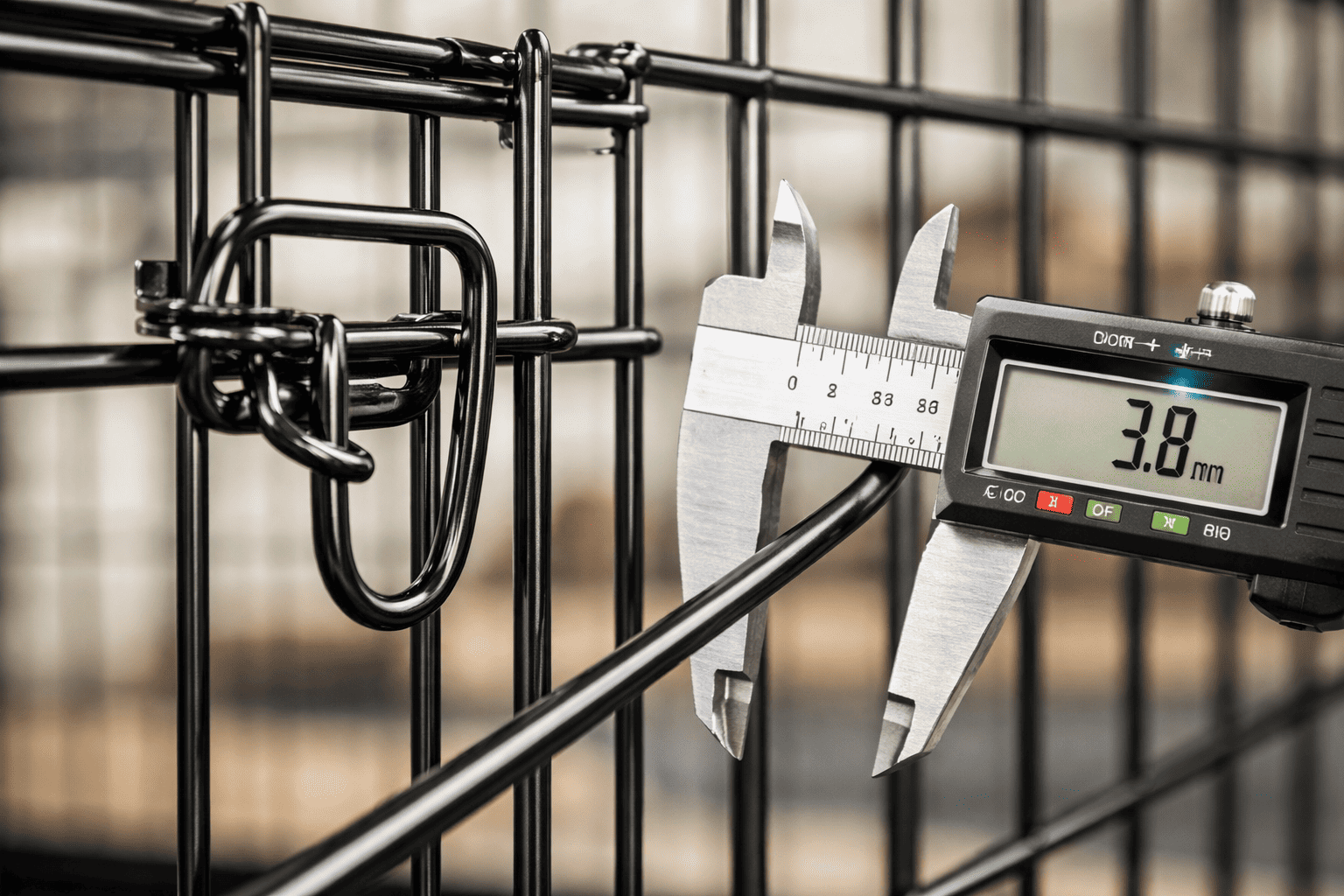
The Solution: A Sample Specification Sheet. This is not the same as your production PO. It’s a concise, visual document sent before the sample is made. It should include:
- Technical Drawings: CAD files or dimensioned sketches with explicit tolerances (e.g., “Panel spacing: 2.5” ±0.1”).
- Material Specs: Steel grade (e.g., Q235), wire gauge (e.g., 4mm), coating type (e.g., electrostatic epoxy powder coat, RAL color code).
- Reference Samples/Photos: “Make the latch mechanism identical to the one in attached Photo A.” “Match the black matte finish of this provided swatch.”
- Critical Function Tests: “Door must open/close smoothly 1,000 times in testing.” “No sharp edges or burrs detectable by a fabric drag test.”
Risk #3: Logistics Nightmares and Unexpected Charges
This is where a $50 sample becomes a $300 liability. Shipping a bulky, heavy wire crate via courier (DHL, FedEx) is simple but often the most expensive option, with duties billed directly to you later.
Navigating the Sample Logistics Maze
Option A: Express Courier (DHL/FedEx/UPS)
Best for: Speed (3-7 days), single crates, high-value/time-sensitive projects.
Cost Driver: Dimensional weight. Crates are large, so you pay for volume, not just actual weight.
Hidden Risk: “Door-to-door” doesn’t mean duty-free. You will receive a bill for customs duties, taxes, and courier brokerage fees after delivery.
Option B: Air Freight + Customs Broker
Best for: Multiple sample units, when you have a regular freight forwarder.
Cost Driver: Chargeable weight & terminal fees. Requires you to hire a customs broker separately.
Hidden Risk: More complex paperwork (Air Waybill, Commercial Invoice). Delays if your broker isn’t proactive.
Pro Tip: Always ask the supplier for the sample’s packaged dimensions and weight (in cm and kg) and the declared value they will use on the commercial invoice. Use this to get a pre-shipment estimate from your forwarder or the DHL/FedEx online calculator.
| Shipping Method | Estimated Freight Cost | Typical Transit Time | Who Handles Customs? | Best For Buyers Who… |
|---|---|---|---|---|
| Express Courier | $180 – $350 | 3-7 Days | Courier (Fees apply) | Need speed, value convenience, ship single units. |
| Air Freight + Broker | $120 – $250 + Broker Fee | 7-14 Days | Your Customs Broker | Have a forwarder relationship, ship multiple samples, prioritize cost control. |
| Sea Freight (LCL) | $50 – $150 | 25-40 Days | Your Customs Broker | Have zero time urgency, are sampling extremely large/heavy crates. |
Risk #4: Overlooking Quality & Compliance in the Evaluation
A sample that looks good can still be a compliance nightmare. Your inspection must go beyond aesthetics to material integrity and regulatory adherence.
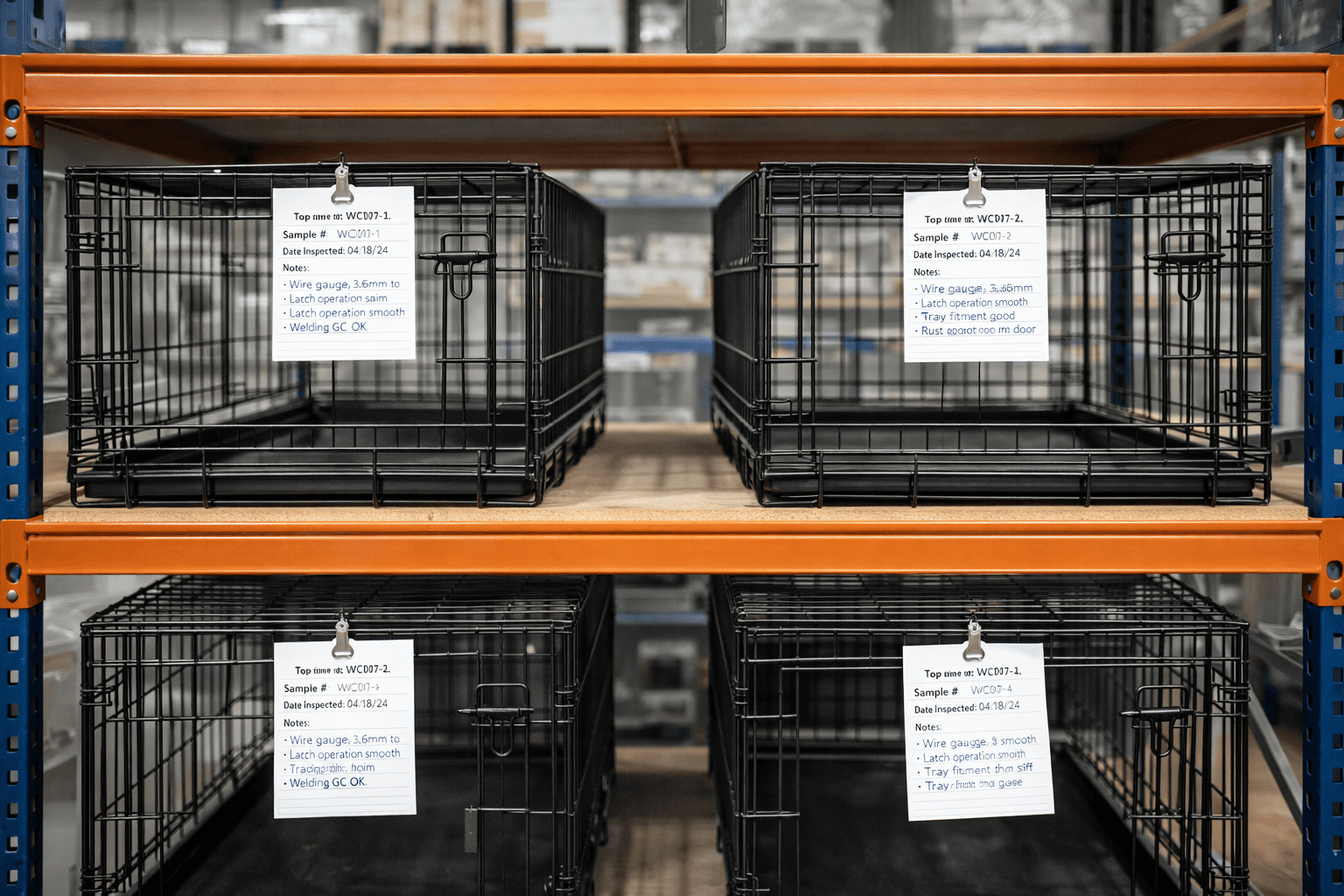
The Hands-On Inspection Protocol
1. Unboxing & Packaging: Is the crate secure, free of shipping damage? Packaging reflects care for product integrity.
2. Visual & Tactile Check:
- Welds: Smooth, consistent, free of splatter. Weak welds crack under stress.
- Coating: Even coverage, no thin spots, chips, or “orange peel” texture. Rub with a white cloth – is there color transfer?
- Edges: All wire ends must be smoothly capped or filed. Run a piece of pantyhose over surfaces – it shouldn’t snag.
- Door & Latch: Operate 50 times. Smooth action? Secure, rattle-free lock?
3. Verification & Documentation:
Demand a Material Certificate (MTC) or Test Report from a reputable lab (e.g., SGS, Intertek) for:
Key Compliance Tests for Wire Crates
Safety & Durability
- ✔ Load/Bite Resistance: Simulates dog chewing/pushing.
- ✔ Cycle Testing: Door/latch operation thousands of times.
- ✔ Tip-Over Stability: Especially for large, top-heavy models.
Material & Chemical
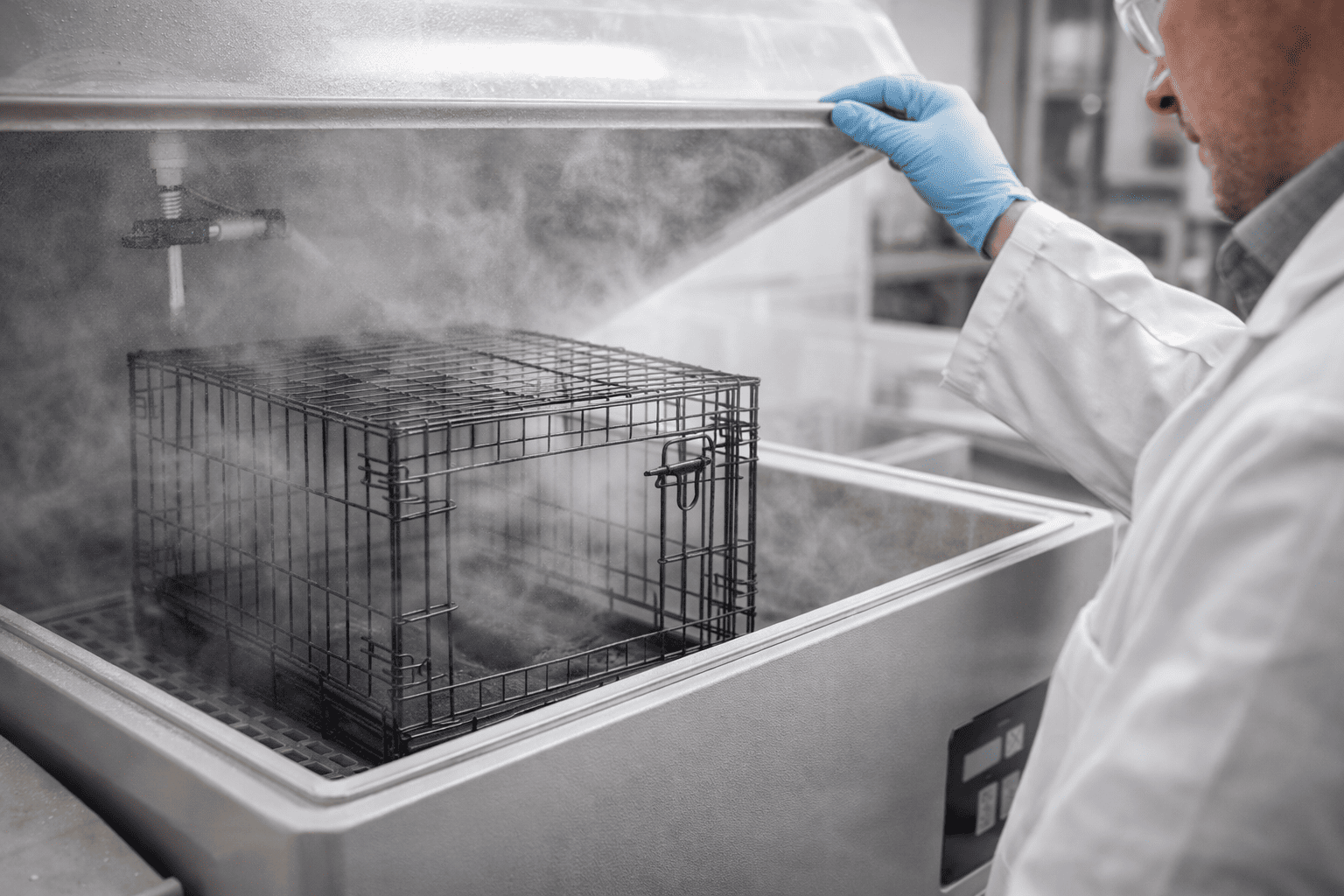
- ✔ Salt Spray Test: Checks coating corrosion resistance (e.g., 500+ hours).
- ✔ Heavy Metals (Lead, Cadmium): Critical for CPSIA compliance in the US.
- ✔ REACH/SVHC: Restricts hazardous substances in the EU market.
Risk #5: Poor Negotiation & Wasting the Sample Opportunity
The sample’s arrival marks the start of the most critical negotiation phase. Your findings are your leverage. Don’t just say “it’s good” or “it’s bad.” Provide structured feedback.
🔄 If the Sample FAILS
Strategy: Collaborative Problem-Solving
Present defects with photos/videos. Ask: “What is your root cause analysis and corrective action plan?” The speed and quality of their response is a huge indicator of future partnership viability.
✅ If the Sample PASSES
Strategy: Lock in Terms
Use your satisfaction to negotiate: Prototype pricing for the first production run, improved payment terms (e.g., 30% deposit vs. 50%), or a reduction in MOQ. The supplier is most eager to close the deal at this moment.
⚠️ If It’s MARGINAL
Strategy: Conditional Proceed
“We can proceed with a trial order if you can guarantee in writing that points X and Y will be corrected to match our spec sheet in mass production.” Get concessions to mitigate the remaining risk.
| Post-Sample Scenario | Your Negotiation Leverage | Primary Goal | Risk if Not Secured |
|---|---|---|---|
| Perfect Sample | High. They’ve proven capability and you’re ready to order. | Lock in favorable pricing & terms for the first production run. | Paying higher “new customer” rates on the bulk order. |
| Sample Requires Minor Revisions | Medium. You have specific, fixable requests. | Get a written commitment (and revised sample if needed) for the fixes before proceeding. | Bulk order contains the same flaw, leading to rejects or returns. |
| Failed Sample, New Supplier Needed | Low (with this supplier). High (with the market). | Minimize time/money loss. Apply learned lessons to vet the next supplier faster. | Repeating the same mistakes, extending product development cycle indefinitely. |
Conclusion: Building a Repeatable, Low-Risk Sampling Process
The smart buyer doesn’t see each sample in isolation. They build a system. This guide has walked you through mitigating the five major risks. Your final step is to create a standard operating procedure (SOP) checklist for your team that encompasses vetting, spec creation, logistics planning, inspection, and negotiation. This turns sampling from a chaotic expense into a disciplined, value-generating pillar of your supply chain management.
By investing in a rigorous process upfront, you ensure that every sample moves you decisively closer to a successful, profitable product launch—or gives you the clear data to walk away before a major investment. That is the true power of smart sampling.
External Resources & Further Reading:
- U.S. International Trade Administration: Guide to Importing Samples – Official guidance on customs procedures for samples.
- Intertek: Pet Product Testing & Certification – Overview of key compliance tests for pet goods.
- ICC: Incoterms® 2020 Rules – Official resource for understanding shipping responsibilities (FOB, EXW, DAP, etc.).