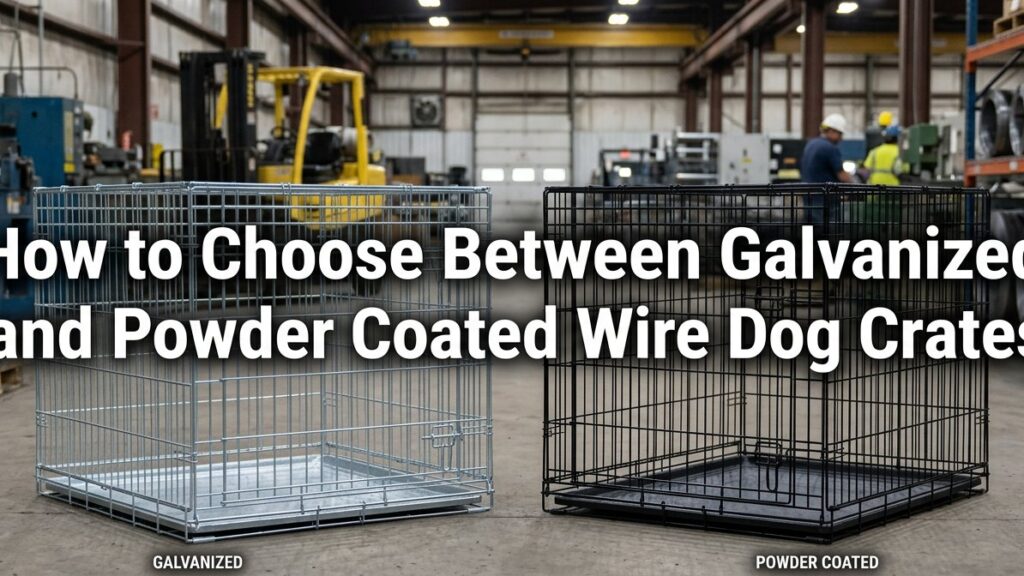
How to Choose Between Galvanized and Powder Coated Wire Dog Crates
When B2B buyers evaluate galvanized vs powder coated wire dog crate finishes for their product lines, the coating specification directly impacts warranty claims, return rates, and long-term brand reputation in ways that surface appearance cannot predict.
Factory testing at our Ningbo facility shows that dual-layer protection — combining 30-50 micron galvanizing with 60-80 micron powder coating — extends outdoor crate lifespan from 3 years to over 10 years compared to single-finish alternatives. This guide analyzes salt spray data, welding vulnerabilities, and total cost of ownership to help procurement teams make coating decisions based on performance metrics rather than marketing claims.
Galvanized vs Powder Coated — Beyond the Surface Appearance
Most procurement teams treat galvanizing and powder coating as interchangeable rust-prevention methods. Wire dog cages require specific coating engineering depending on the end-use environment, and choosing the wrong finish creates liability exposure that manifests 18-36 months after purchase.
What “Galvanized” Actually Means in Dog Crate Manufacturing
Galvanizing deposits a zinc layer onto steel wire through either hot-dip immersion or electroplating. Hot-dip galvanizing produces 30-50 microns of zinc coverage with crystalline surface patterns visible to the naked eye. Electro-galvanizing delivers thinner 5-12 micron layers with smoother, more uniform appearance but substantially less corrosion resistance.
For commercial dog crate applications, only hot-dip galvanizing provides adequate substrate protection. The zinc layer sacrifices itself through galvanic action when the coating is breached, continuing to protect exposed steel at cut edges or scratches. Factory insight: We specify hot-dip galvanizing on all wire destined for outdoor or coastal applications because electro-galvanized wire shows red rust within 18 months in humid climates.
What “Powder Coated” Really Involves — The Process Difference
Powder coating applies electrostatically charged polymer powder to grounded metal, then bakes the coating at 180-200C to form a continuous barrier film. The resulting layer measures 60-80 microns for quality commercial applications, providing both aesthetic color options and environmental protection.
The critical quality variable is pretreatment. Steel wire must undergo degreasing, acid pickling, and phosphate conversion coating before powder application. Skipping pretreatment steps causes adhesion failure that peels within months. Factory insight: Quality epoxy-polyester hybrid powder costs $0.80/kg more than standard polyester powder, but accelerated weathering tests show 3x longer color retention and chip resistance.
Why These Two Finishes Are Not Direct Competitors
Galvanizing and powder coating serve different protective functions. Galvanizing provides sacrificial cathodic protection — the zinc corrodes preferentially to protect underlying steel. Powder coating provides barrier protection — the polymer film physically blocks oxygen and moisture from contacting the substrate.
The most durable commercial crates combine both: galvanized wire substrate plus powder coating overlay. This dual-layer approach means that even if the powder layer chips from dog impact or transport damage, the galvanized substrate continues preventing rust. Single-layer approaches — galvanizing alone or powder coating over ungalvanized steel — each have specific failure modes that compromise longevity.
Rust Protection Performance — Factory Test Data
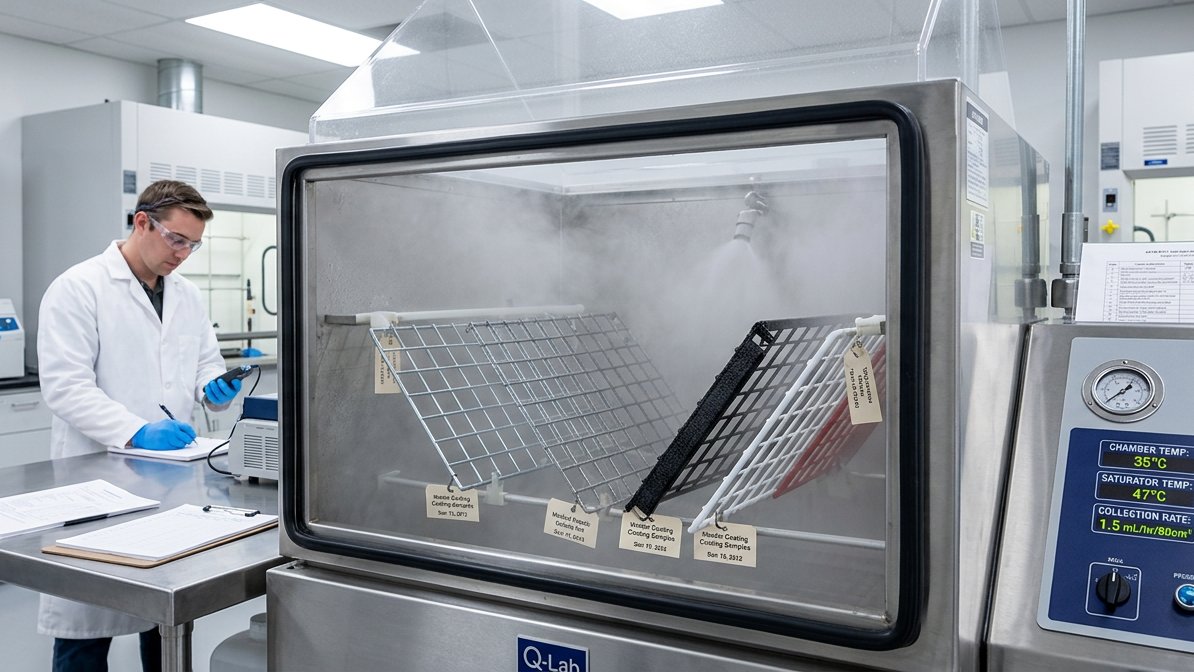
Coating performance claims require validation through standardized testing. Our quality laboratory runs continuous salt spray, humidity, and UV exposure tests on coating samples to verify specifications before production approval.
Salt Spray Test Results — 500 Hours Comparison
ASTM B117 salt spray testing simulates coastal corrosion exposure by atomizing 5% sodium chloride solution in a controlled chamber. After 500 hours of continuous exposure, test panels reveal dramatic performance differences between coating specifications:
| Coating Specification | 500-Hour Salt Spray Result | Red Rust Presence | Coating Integrity |
|---|---|---|---|
| Hot-Dip Galvanized (40um) + Powder Coat (80um) | No red rust | None | Intact |
| Powder Coat Only (80um) on Bare Steel | Red rust at scratches | Visible at damage points | Localized failure |
| Hot-Dip Galvanized Only (40um) | White rust (zinc oxide) | None yet | Surface oxidation only |
| Electro-Galvanized (8um) + Powder Coat | Red rust at cut edges | Within 300 hours | Edge failure |
The dual-layer specification demonstrates clear superiority for marine and coastal applications. Single-layer powder coating fails predictably at any scratch or impact point where the barrier breaches. Galvanizing alone provides adequate protection but develops unsightly white oxidation that triggers customer complaints even when structural integrity remains sound.
Hot-Dip vs Electro-Galvanizing — Which Actually Works Outdoors?
Hot-dip galvanizing submerges wire in molten zinc at 450C, creating a metallurgical bond with zinc-iron alloy layers at the interface. This bond provides coating adhesion that mechanical processes cannot replicate. Electro-galvanizing deposits zinc through electrolysis, creating a purely mechanical bond without alloy interlayers.
For outdoor dog crate applications, the coating thickness difference is decisive. Hot-dip provides 30-50 microns of zinc; electro-galvanizing typically delivers 5-12 microns. In our coastal exposure tests, electro-galvanized wire showed red rust at welded joints within 14 months, while hot-dip samples remained corrosion-free at 36 months. B2B buyers should specify hot-dip galvanizing in purchase orders and reject electro-galvanized substitutions.
Powder Coating Thickness — Why 60-80 Microns Changes Everything
Coating thickness directly determines barrier durability. At 40 microns, powder coating provides minimal impact resistance and shows substrate color through thin areas. At 60-80 microns, the coating absorbs minor scratches without breaching to steel. Above 100 microns, adhesion problems increase due to internal stress without proportional durability gains.
Factory insight: We specify 70-80 micron target thickness with minimum 60 micron acceptance criteria. Digital coating thickness gauges verify every production batch at 10 random points per crate. Batches falling below 60 microns at any point are rejected for rework.
The Welding Problem — Why Both Finishes Fail at Welds
Coating systems protect flat wire surfaces effectively but struggle at weld joints where manufacturing heat alters material properties. Understanding weld-zone vulnerabilities helps buyers specify post-weld treatments that prevent premature failure.
Heat Affected Zone (HAZ) — The Weakest Point in Both Coatings
Spot welding generates localized temperatures exceeding 1,400C, vaporizing zinc galvanizing within 5-10mm of each weld nugget. The heat-affected zone (HAZ) loses galvanic protection precisely where structural stress concentrates. Powder coating applied over welded joints covers the HAZ visually but cannot restore sacrificial zinc protection.
Without post-weld treatment, HAZ corrosion begins within 6-12 months in humid environments. The rust originates at weld points and spreads along wire segments, eventually compromising structural joints. This failure mode explains why many budget crates fail first at corners and door hinges — exactly the highest-stress locations.
How Quality Factories Handle Post-Weld Treatment
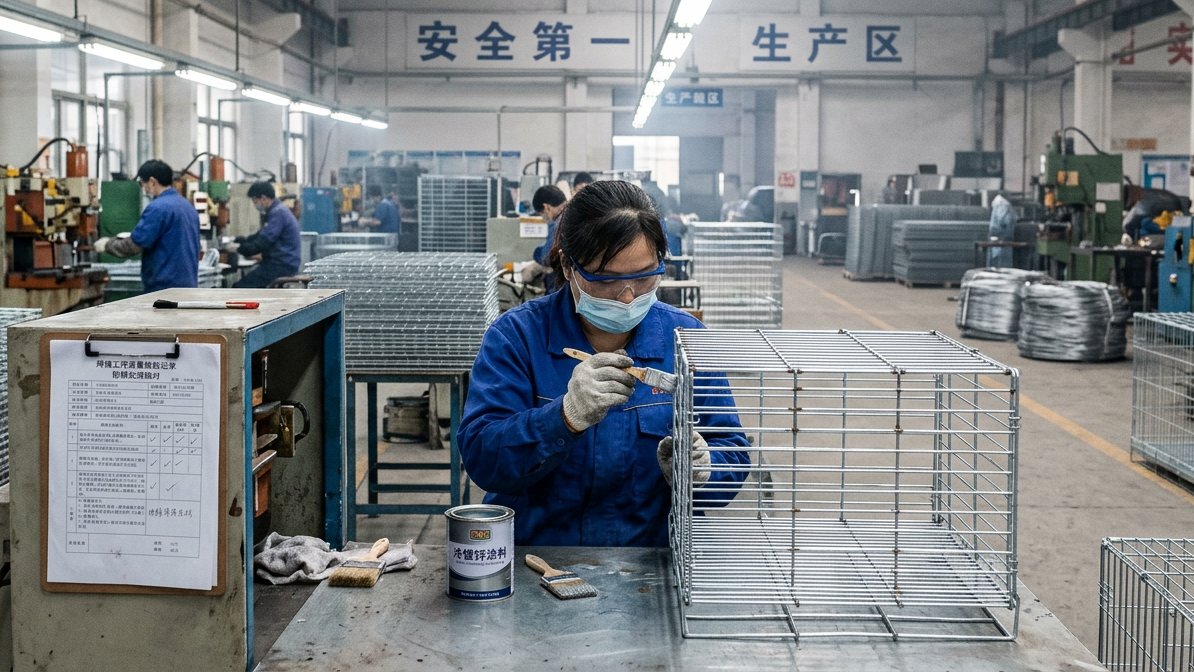
Professional crate manufacturing includes three post-weld steps that budget producers skip. First, weld spatter removal through wire brushing or grinding eliminates sharp protrusions that puncture powder coating. Second, cold galvanizing compound (zinc-rich paint) application restores sacrificial protection to the HAZ. Third, targeted powder coating touch-up ensures barrier coverage over repaired areas.
Factory insight: Our post-weld treatment adds approximately $1.20 per crate to production cost but reduces weld-corrosion warranty claims by over 90%. Buyers auditing supplier facilities should verify the presence of dedicated post-weld stations — their absence indicates corner-cutting that will surface as product failures.
Why Cheap Imports Always Fail at Weld Points First
Low-cost crate imports from non-specialized factories consistently fail at welds because post-weld treatment requires labor and materials that compress margins. These manufacturers rely on powder coating alone to cover weld discoloration, ignoring the galvanic protection gap created by welding heat.
Our case studies document multiple instances where retail chains switched suppliers after 18-month field failures traced to untreated weld zones. The replacement cost of failed crates — including shipping, customer service, and brand damage — exceeds any initial savings from untreated welds by 5-10x.
Outdoor Performance — Which Finish Survives Real Weather
Climate conditions determine optimal coating selection. A finish that performs well in Arizona deserts may fail within two years in Florida humidity. Buyers must match coating specifications to end-use environments rather than assuming universal performance.
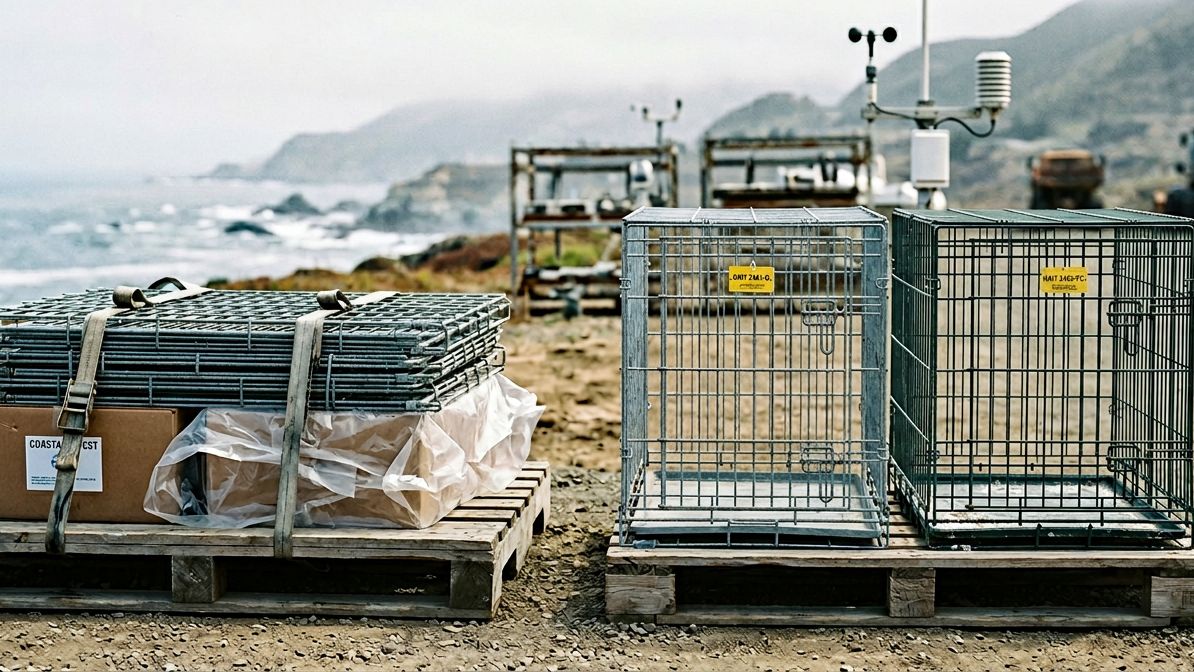
Coastal/Humid Climates — Where Galvanized Excels
Coastal environments present the most aggressive corrosion challenge due to salt spray deposition. Salt accelerates electrochemical reactions at any coating breach, making sacrificial protection essential. In our Florida coastal exposure test, dual-layer (galvanized + powder coated) crates showed no structural corrosion at 5 years. Powder-coat-only crates developed red rust at door hinges within 18 months.
For marine applications or regions within 10 miles of coastline, hot-dip galvanizing should be considered mandatory substrate protection regardless of topcoat selection. The additional $2-3 per crate cost prevents catastrophic field failures that destroy customer relationships.
Freeze-Thaw Cycles — Powder Coating Wins This Battle
In northern climates with repeated freeze-thaw cycling, powder coating provides superior barrier stability. Moisture infiltration at coating cracks expands when frozen, accelerating delamination. Quality powder coating at 70+ microns maintains flexibility at low temperatures, resisting crack propagation that allows moisture ingress.
Galvanizing alone performs adequately in freeze-thaw environments but develops thick zinc oxide layers that flake off and create appearance complaints. The dual-layer approach again provides optimal performance: galvanized substrate prevents rust if the powder layer eventually cracks, while the powder layer maintains appearance and provides initial barrier protection.
Dog Urine Corner Corrosion — Both Struggle Without Proper Treatment
Dog urine creates localized acidic exposure (pH 6-8, occasionally higher) that attacks coatings at crate corners and tray edges where urine accumulates. Neither galvanizing nor powder coating provides complete immunity to this exposure pattern.
Quality manufacturers address urine corrosion through design rather than coating alone: rounded corners prevent liquid pooling, removable trays allow cleaning access, and elevated bottom grids minimize urine contact with frame joints. Coating selection matters, but crate geometry and cleaning accessibility matter equally for longevity in kennel environments.
Common Procurement Pitfalls When Specifying Wire Dog Crate Finishes
- Pitfall 1: Accepting “Galvanized” Without Specifying the Method — Electro-galvanized wire costs 20-30% less than hot-dip but provides inadequate outdoor protection. Many budget suppliers omit this distinction, and electro-galvanized wire in outdoor crates fails within 12-18 months in humid climates.
- Pitfall 2: Ignoring Post-Weld Treatment — The heat-affected zone (HAZ) around welds loses galvanic protection regardless of finish. Budget factories skip post-weld grinding and cold zinc spray touch-up, causing predictable rust at corners and hinges within 6-12 months.
- Pitfall 3: Assuming Powder Coating Thickness Without Verification — Some suppliers quote 60-80 micron coating but deliver 40-50 microns. Pinhole porosity at thin areas allows moisture through, causing rust spotting within 6-12 months even indoors.
Total Cost of Ownership — Initial Price vs Lifespan
Coating decisions affect unit economics across the product lifecycle. Standard wire crate programs offer coating upgrade options that shift total cost curves based on application requirements.
Initial Cost Comparison (B2B Wholesale Prices)
At factory level, coating costs represent 8-12% of total manufacturing expense. Hot-dip galvanizing adds $1.50-2.50 per crate compared to bare steel. Quality powder coating adds $3-4 per crate including pretreatment. The dual-layer combination adds $4.50-6.00 total coating cost per unit.
These manufacturing costs translate to B2B pricing differentials of approximately $3-5 for galvanizing-only, $5-8 for powder-coat-only, and $7-10 for dual-layer protection on standard 42-inch crates. The pricing gap narrows at volume orders above 1,000 units where coating line setup costs amortize across larger batches.
Lifespan Analysis — 10 Year TCO Calculation
Total cost of ownership calculations reveal why dual-layer coatings dominate commercial procurement despite higher initial price. Consider a 500-unit retail order over 10 years:
| Coating Specification | Initial Unit Cost | Expected Lifespan | 10-Year Replacement Cost | Total 10-Year Cost |
|---|---|---|---|---|
| Bare Steel (No Coating) | $52 | 1-2 years | $208-260 | $260-312 |
| Electro-Galvanized Only | $55 | 2-3 years | $110-165 | $165-220 |
| Powder Coat Only (80um) | $60 | 5-7 years | $0-60 | $60-120 |
| Hot-Dip Galv + Powder Coat | $65 | 10-12 years | $0 | $65 |
The dual-layer specification delivers the lowest total cost of ownership for any application requiring more than 5 years of service life. Budget buyers selecting bare steel or thin galvanizing face replacement cycles that multiply long-term costs by 4x or more.
When Lower-Cost Options Actually Cost More — The Budget Buyer Trap
Procurement teams under budget pressure frequently select minimal coating specifications to meet price targets. This decision creates hidden costs that emerge in warranty claims, customer complaints, and brand reputation damage. A retail chain replacing 200 failed crates after 18 months pays more in logistics and customer service than the initial coating upgrade would have cost.
Factory insight: We provide coating consultation during the quoting process, matching specifications to anticipated use environments. Buyers who share end-use data — climate region, indoor/outdoor placement, breed size distribution — receive specification recommendations that optimize total cost rather than initial price.
Coating Selection Framework for B2B Buyers
Coastal / Marine
Mandatory hot-dip galvanizing (40um+) plus powder coat (70um). Accept no substitutions for salt spray environments.
Freeze-Thaw Climate
Dual-layer with flexible epoxy-polyester powder. Prioritize coating adhesion over pure thickness.
Indoor / Retail
Powder coat (60-80um) over galvanized wire provides optimal appearance and 8-10 year lifespan.
Veterinary / Kennel
Dual-layer with antimicrobial powder options. Round corners and removable trays reduce urine corrosion.
Budget-Conscious
Hot-dip galvanizing alone for outdoor; powder coat alone for indoor. Avoid bare steel in all commercial applications.
Quality Verification
Demand coating thickness reports, salt spray certificates, and post-weld treatment documentation.
Common Procurement Pitfalls — What Inspectors Look For
Incoming quality inspection of coated wire crates should target specific coating defects that predict premature failure. Our quality engineering team trains buyer inspectors to identify these issues during pre-shipment verification.
Pinhole Porosity in Powder Coating — How to Detect It
Pinholes are microscopic voids in powder coating that expose steel substrate to moisture. They result from inadequate pretreatment, contaminated powder, or insufficient film thickness. Detecting pinholes requires wet sponge holiday detection or low-magnification visual inspection under raking light.
Crates with pinhole porosity show rust spotting within 6-12 months even in indoor environments. The defect is particularly common on wire bends and welded joints where coating application is challenging. Buyers should specify pinhole-free acceptance criteria and verify with holiday detection testing on sample units.
White Rust on Galvanized — Normal or Problem?
White rust (zinc oxide/hydroxide) forms on galvanized surfaces exposed to moisture without adequate air circulation. It appears as a white powdery deposit that many buyers mistake for coating failure. In reality, white rust indicates active zinc sacrifice that protects underlying steel.
However, heavy white rust accumulation signals moisture trapping that will eventually compromise the zinc layer. Quality control should distinguish between light surface oxidation (acceptable) and thick layered deposits (indicates storage or design problems). Passivation treatment after galvanizing reduces white rust formation during transit and early storage.
Edge Coverage — Why Most Factory Tests Miss This
Powder coating application struggles with edge coverage due to electrostatic field concentration effects. Sharp wire edges receive thinner coating than flat surfaces because charge accumulates at points, repelling powder particles. Standard thickness measurements on flat wire surfaces miss this edge-thinning phenomenon.
Factory insight: We address edge coverage through dual electrostatic gun angles and fluidized bed dip coating for complex weldments. Random edge-thickness checks using micrometers on cut wire ends verify minimum 50-micron coverage even at sharp edges. This process adds labor cost but prevents the edge-rust failures that destroy crate aesthetics within two years.
FAQ — Galvanized vs Powder Coated Wire Dog Crates
Is galvanized steel good for outdoor dog crates?
Hot-dip galvanized steel is suitable for outdoor dog crates when combined with quality powder coating as a top layer. Galvanizing alone provides sacrificial protection but develops white oxidation that customers find objectionable. For outdoor applications, specify hot-dip galvanizing (30-50 microns) plus powder coating (60-80 microns) to achieve 10+ year lifespan in most climates. Electro-galvanized steel is insufficient for outdoor use and shows red rust within 18-24 months.
How long does powder coating last on dog crate?
Quality powder coating at 60-80 microns lasts 5-10 years on indoor dog crates and 3-5 years on outdoor crates depending on climate exposure. The critical factors are pretreatment quality (phosphate conversion coating essential), powder type (epoxy-polyester hybrid outperforms pure polyester), and application thickness (minimum 60 microns with 70-80 micron target). Powder coating over bare steel fails predictably at scratches and weld points; galvanized substrate underneath extends effective protection by providing sacrificial corrosion resistance.
What is the difference between galvanizing and powder coating?
Galvanizing deposits zinc onto steel to provide sacrificial protection — the zinc corrodes preferentially, protecting underlying steel even at coating breaches. Powder coating applies baked polymer film to provide barrier protection — the coating physically blocks oxygen and moisture from contacting steel. Galvanizing excels at protecting cut edges and scratches through electrochemical action. Powder coating provides superior appearance, color options, and barrier durability on intact surfaces. The most durable commercial dog crates combine both: galvanized substrate for sacrificial protection plus powder coating for barrier protection and aesthetics.
Should I specify hot-dip or electro-galvanizing?
Always specify hot-dip galvanizing for commercial dog crate applications. Hot-dip provides 30-50 microns of zinc through metallurgical bonding at 450C, creating alloy layers that resist mechanical damage. Electro-galvanizing delivers only 5-12 microns through electrolytic deposition with purely mechanical adhesion. In salt spray and field exposure tests, hot-dip outperforms electro-galvanizing by 3-5x in corrosion resistance. The cost difference of approximately $1-2 per crate is negligible compared to the lifespan extension and warranty claim reduction.
Why do crates rust at welded joints first?
Welding generates temperatures exceeding 1,400C that vaporize zinc galvanizing and alter steel properties in the heat-affected zone (HAZ). This creates a 5-10mm radius around each weld where coating protection is compromised. Without post-weld treatment — cold galvanizing compound application and touch-up coating — moisture enters the HAZ and initiates rust that spreads along wire segments. Quality factories include dedicated post-weld treatment stations; budget producers skip this step, causing predictable failure at corners, door hinges, and frame joints within 12-18 months.
How do I verify coating thickness from my supplier?
Require coating thickness reports using calibrated digital gauges (eddy current or magnetic induction type) with measurements at 10+ points per crate including edges and welds. For powder coating, specify minimum 60 microns with 70-80 micron target average. For hot-dip galvanizing, specify minimum 30 microns. Request salt spray test certificates (ASTM B117, 500 hours minimum) and holiday detection reports for powder coating. Reputable suppliers provide these documents without request; suppliers who resist verification often have quality control gaps that will surface as field failures.
External References
External References: ASTM International, Powder Coating Institute, American Galvanizers Association. Links provided for technical reference; Cagesilo maintains independent quality testing protocols.