Who Buys Wire Dog Crates: Amazon FBA vs Wholesale vs Retail
Last updated: May 2026 | Reading time: 10 min | By Cagesilo Factory Team
Amazon FBA sellers think about margins and review counts. Wholesale distributors think about volume and logistics. Retail chains think about certifications and payment terms. These are not the same buyer. If you do not know which buyer type you are—or which type you are talking to—you will price wrong, spec wrong, and lose the deal. This guide explains how the three buyer types differ on the metrics that matter: order size, margin requirements, lead time expectations, and the hidden costs that do not show up in the per-unit price.
Understanding buyer types is not just about sales strategy. It is about building a sustainable business model. The buyers who fail often fail because they chose the wrong channel for their capital structure, not because the product was wrong or the market was too small.
The Three Buyer Types: A Comparison
At our facility, we see three distinct buyer profiles. Here is how they differ on the dimensions that matter for sourcing decisions:
| Factor | Amazon FBA | Wholesale | Retail Chain |
|---|---|---|---|
| Order Size | 200-1,000 units | 500-2,000 units | 2,000-10,000 units |
| Price Sensitivity | Medium (25-40% margin needed) | High (compete on price) | Low (value reliability) |
| Lead Time | 45-60 days to Amazon | 30-45 days | 60-90 days |
| Certifications | Amazon requirements only | Usually none | ISO, BSCI, SEDEX often required |
| Payment Terms | T/T 30-50% deposit | T/T 40% deposit | L/C or net-30 |
Amazon FBA Sellers: The Numbers Behind the Channel
Amazon FBA is the most common buyer type we see at our facility, particularly among new buyers entering the market. Here is the financial reality that does not always appear in the optimistic “sell on Amazon” narratives:

- Gross margin on Amazon: 25-40% for wire dog crates in the $80-150 price range is achievable, but the average is lower for new sellers without established review portfolios
- FBA fees eat 25-35% of gross margin—the fulfillment fee, storage (especially during peak season), and referral fees compound to reduce net margin significantly
- Net margin after FBA: typically 15-25% if you manage inventory well, but returns and defective products can shave an additional 3-5% off net margin
- Capital requirements: First inventory run of 500 units at $22-28 landed cost requires $11,000-14,000 in product alone, plus FBA inbound shipping, plus the cost of advertising to generate initial reviews
Factory Insight: When buyers ask us “what price should I aim for on Amazon?”, we ask them first: “What is your landed cost?” Buyers who land at $25-30 per unit can compete comfortably at $89-99 retail. Those who land at $35+ need to price at $120+ and that is a harder sell. The landed cost number—not the FOB price—is the starting point for your Amazon pricing strategy. Learn how to calculate landed cost in our pricing guide.
One trend we are seeing: FBA sellers are increasingly asking about BSCI certification even though Amazon does not require it. Why? Because private label sellers are using certifications as a marketing differentiator on their listings. “BSCI Audited Factory” in the product description is a trust signal that can improve conversion rate, particularly for buyers competing on quality rather than price.
Wholesale Distributors: Volume Game
Traditional wholesale buyers purchase for resale to smaller retailers, pet stores, farm supply chains, and independent pet boutiques. Their priorities are fundamentally different from FBA sellers:

- Price per unit is everything — Wholesale buyers make money on volume, and their customers are even more price-sensitive than they are. A $1 per unit difference on a 1,000-unit order is $1,000 in margin. This creates intense price negotiation pressure.
- Consistency across batches — Wholesale buyers cannot explain to their retail customers why this shipment’s crate color looks slightly different from the last one. Same quality, every shipment, or their own customers complain. This is non-negotiable.
- Lead time reliability — Their customers expect 30-day delivery. If the factory delays, the wholesale buyer takes the heat from their retail accounts. Late delivery to a wholesale buyer can mean lost shelf space.
Factory Insight: Wholesale buyers negotiate harder on price but are more flexible on specs. One buyer told us: “I do not care if it is 3.0mm or 3.2mm wire, as long as every shipment is the same spec.” That signal is useful in negotiation. If a buyer is flexible on specifications, that flexibility has value and can be traded for better pricing.
Wholesale buyers also care more about payment terms than FBA sellers. T/T 40% deposit with balance against shipping documents is common. Some buyers with established credit may negotiate net-30 or even net-45 terms, which has real cash flow implications for the factory—and for your own business model.
Retail Chains: The High-Barrier Channel
Retail chains—Petco, Petsmart, regional chains—represent the highest barrier to entry but also the most stable, high-volume demand once you are in:

- Certification requirements: Usually ISO 9001 minimum, BSCI or SEDEX common, sometimes third-party lab testing to specific standards (EN 1930 for Europe, ASTM for US). Budget 3-6 months and $5,000-15,000 in compliance costs to get retail-ready.
- Lead time: Retail buyers plan 90-120 days ahead. Your production must align with their seasonal buys—Q1 for spring/summer, Q3 for holiday. Missing the buying window means waiting another season.
- Payment terms: Net-30 to Net-60 is common. Cash flow impact is significant—you are essentially financing the retailer’s inventory for up to 60 days.
- Barcode/Label requirements: Retailers require specific UPC/EAN barcodes and custom inner packaging with retail-ready labeling. Factor in packaging customization costs of $0.50-2 per unit for retail-specific packaging.
⚠️ Watch Out: Many new buyers try to pitch retail chains before they are ready. Getting rejected by Petco does not just waste time—it can damage your reputation in the industry. The retail buying community is small and connected. A premature pitch that goes badly can follow you. Build Amazon presence first, then approach retail with sales history and operational proof.
Key Decision Factors: Which Channel to Target
Start on Amazon FBA
Best if: You have $30K+ to invest, can wait 6-12 months for reviews to build, and are comfortable managing Amazon’s fee structure. FBA is the proving ground for new private label brands.
Start with Wholesale
Best if: You have existing retail relationships or can offer price points under $60 per unit. Wholesale rewards efficiency and consistency. Lower margin but faster initial sales velocity than FBA.
Target Retail Chains
Best if: You already have certifications, capital for net-30 payment terms, and 2-3 years to build the relationship. Retail is a long-term strategy, not an entry channel for new brands.
What Buyers at Each Channel Actually Ask
The first question a buyer asks reveals their priority and sophistication. Here is what we hear at each channel:

Amazon FBA buyers ask:
“What is your sample price and how long does it take to get to Amazon warehouse?” — They are thinking about speed to market and sample testing before committing to bulk production. They care about the sample-to-production consistency question.
Wholesale buyers ask:
“What is your MOQ and what is the price at 500 units / 1,000 units?” — They want the price grid immediately. They are calculating margin at different volume tiers and will often try to lock in annual volume commitments for better pricing.
Retail buyers ask:
“Do you have BSCI? Can you provide third-party testing?” — The certification folder comes first, product second. If you cannot produce the compliance documentation immediately, the conversation is over. Learn about factory evaluation criteria for retail-ready suppliers.
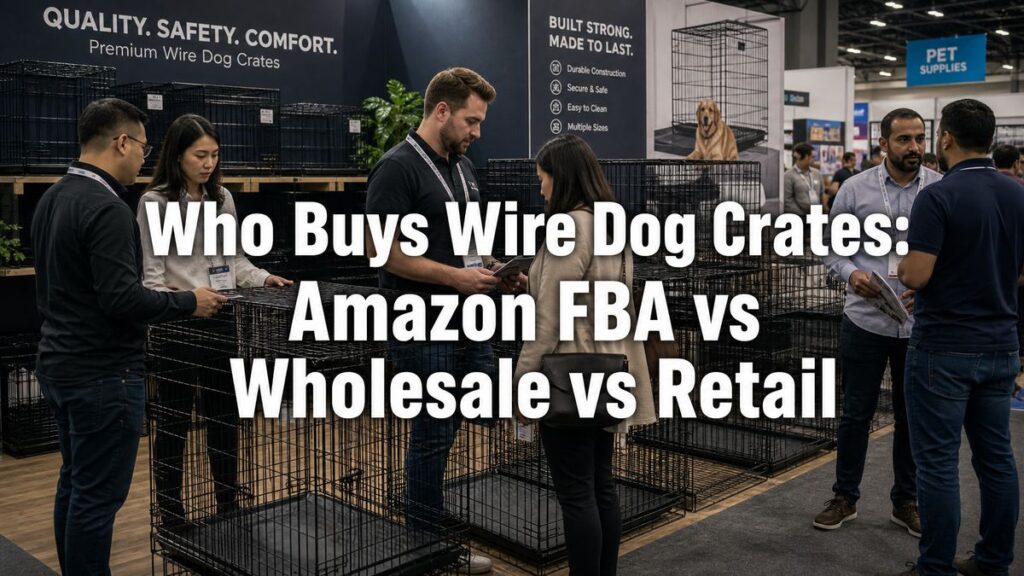
Factory Insight: When we visit trade shows, we structure our booth conversation differently for each type. FBA sellers want to talk product specs and sample process. Wholesale buyers want a price grid—immediately. Retail buyers want our certifications folder first, product second. Knowing which type you are speaking to changes the entire conversation structure.
FAQ: Buyer Types and Channel Selection
How much capital do I need to start selling wire dog crates on Amazon FBA?
A realistic first order for a new FBA seller is 300-500 units. At a landed cost of $25-30 per unit (FOB $22 + shipping + duties), that is $7,500-15,000 in product. Add FBA inbound shipping ($500-1,500), initial PPC advertising to generate first reviews ($1,000-3,000), and you should budget $15,000-25,000 for your first inventory run plus operating costs. Buyers who underbudget for the review-building phase are the ones who run out of capital before they reach escape velocity.
How does wholesale buying differ from FBA in terms of day-to-day operations?
FBA requires active listing optimization, PPC advertising, review management, and inventory forecasting across Amazon’s system. Wholesale requires building retailer relationships, managing purchase orders, fulfilling to multiple retail DCs, and handling chargebacks and deductions. FBA is a marketing and logistics game. Wholesale is a relationship and operations game. The skill sets are different—know which one matches your strengths. Learn about market dynamics in our market size guide.
Can I work with multiple buyer types simultaneously?
Yes, but carefully. Many established buyers eventually split channels—FBA for direct-to-consumer margin, wholesale for volume and steady cash flow, retail for brand credibility. The risk is trying to serve all three before you have operational maturity in any one. Our recommendation: master one channel first, prove the unit economics, then expand. Attempting to be everything to everyone at launch is how you end up with unsold inventory across three channels and a cash flow crisis.
What certifications do I actually need to sell wire dog crates?
It depends entirely on your channel. Amazon FBA has no mandatory certifications for wire dog crates—their requirements are about product safety and labeling, not factory audits. Wholesale typically requires nothing beyond basic business documentation. Retail chains—Petco, Petsmart, major regional retailers—typically require ISO 9001 and BSCI or SEDEX social compliance audits. European retail adds EN 1930 safety standard compliance. BSCI is increasingly seen as a marketing differentiator even on Amazon, where it is not required. Learn about market-specific certification requirements.
Related Reading
External References