
FOB vs Landed Price: The Complete Cost Breakdown Between Factory and Door
Stage 1 of the Logistics Series — Understand every cost between FOB and your warehouse door.
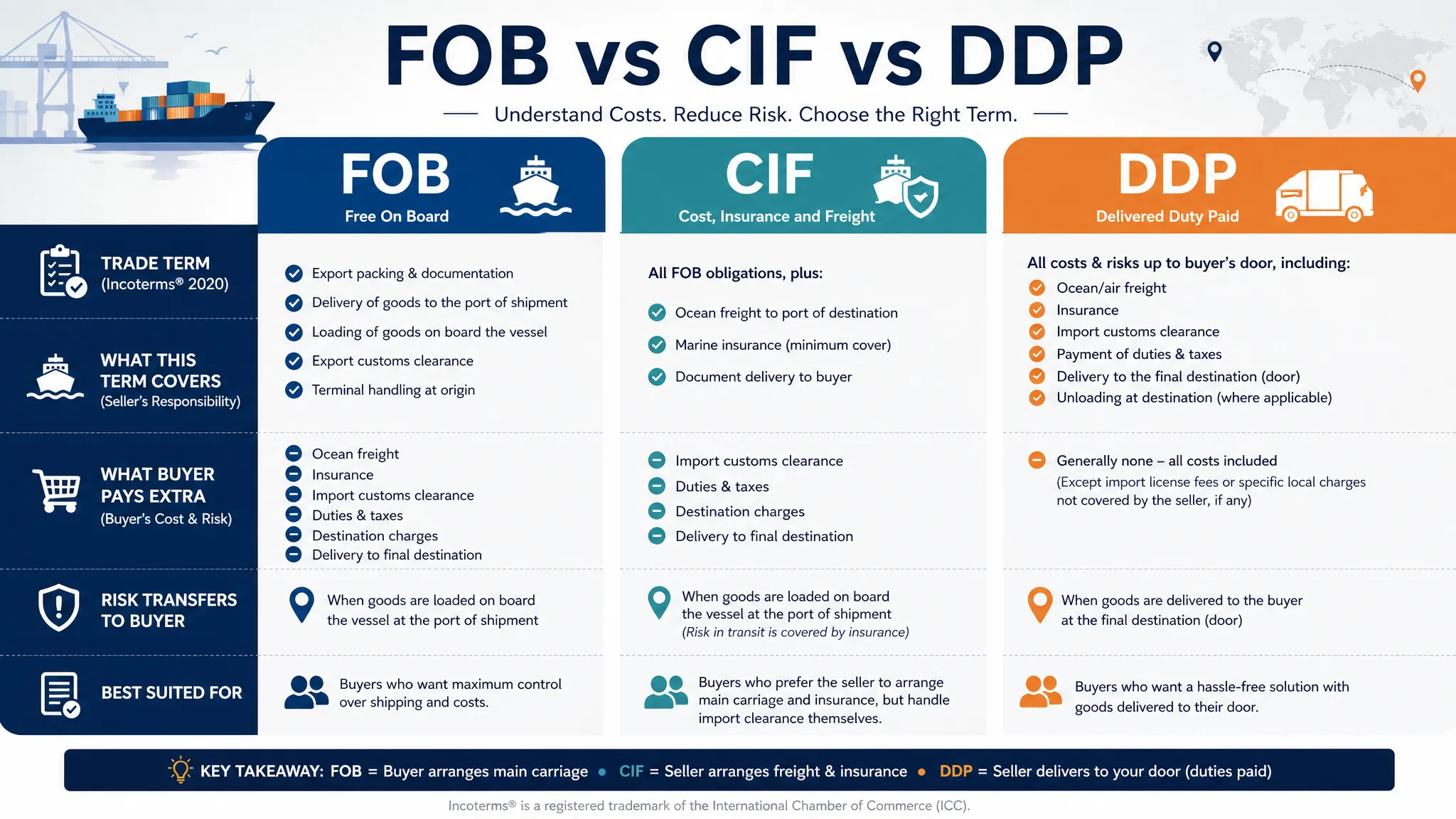
1. The Real Meaning of FOB Price
Supplier quotes you an FOB price. You sign. Then the invoice lands — and it is bigger than expected. Sound familiar?
Here is what most buyers miss on first read: FOB stands for Free On Board. Per INCOTERMS 2020, FOB price only includes all charges from the factory to before loading aboard the ship at the departure port. That is it. Nothing more.
The buyer pays for everything after the cargo clears the ship’s rail at the port of departure. Ocean freight. Marine insurance. Destination port fees. Customs duties. Delivery to your warehouse. All of it — separate.
Compare it this way:
| Trade Term | What It Covers | What You Pay Extra |
|---|---|---|
| FOB | Factory to departure port, before loading | Freight, insurance, duties, delivery |
| CIF | Cost + Freight + Insurance to destination port | Duties, demurrage, delivery |
| DDP | Door-to-door, duties paid | Almost nothing |
FOB price is not your procurement price. FOB only covers factory to departure port. A low FOB quote from one supplier may not be cheaper than a higher FOB quote from another — once you add freight and fees.
When suppliers push FOB quotes, they are handing you the cheapest leg of the journey and keeping the rest off their books. That is not a trick — it is how international trade works. But if you do not understand it, you will budget wrong and get surprises.
2. FOB to Departure Port Costs
Even the “F” in FOB — the part the supplier is supposed to cover — has fee layers. Here is what you are actually paying for when a supplier quotes FOB Ningbo:
| Fee Item | Who Pays | Typical Range |
|---|---|---|
| Factory handling & loading | Supplier | Included in FOB |
| Inland transport to departure port | Supplier | Included in FOB |
| Port cargo loading fee | Supplier | Included in FOB |
| Export customs clearance | Supplier | Included in FOB |
| Documentation fee | Buyer or Supplier | $50–$150 |
One thing that catches buyers off guard: documentation fees. The supplier handles export clearance, but BL fees, certificate of origin fees, and container receiving fees often land on the buyer’s side of the invoice. Ask your supplier to itemize the FOB quote before you sign. A clean FOB quote should show every included charge.
The goal is not to eliminate these fees. They are legitimate costs. The goal is to see them clearly before you commit, so your budget does not blow up later.
3. How Ocean Freight Is Calculated
Ocean freight is where the next layer of cost hits. And the biggest misconception here: buyers assume freight is charged by weight.
It is not.
Ocean freight is charged by volume — measured in CBM (cubic meters). Not by weight. 1 CBM is roughly 167 kg of cargo volume. Ocean carriers charge per cubic meter because ship space is measured in volume, not scale weight. A 200 kg crate of dog crates takes up far more room than a 200 kg crate of steel bolts.
Freight rates fluctuate with season, fuel cost, and demand
. The quote you get in January may not hold in July. When you budget for a container shipment, always add a buffer of 10–15% to the ocean freight line.
| Container Size | Actual Capacity (CBM) | Best For |
|---|---|---|
| 20ft Container | 60–80 CBM | Smaller orders, tighter budgets |
| 40ft Container | 120–140 CBM | Larger orders, better per-unit freight |
20ft container actual capacity is roughly 60–80 CBM. 40ft container roughly 120–140 CBM. These are real usable numbers — not the theoretical maximum. Plan your order volume against real capacity, not optimistic estimates.
When you see a freight forwarder quote “ocean freight $2,800 per 20ft container,” that is the base ocean leg. It is a real number. But it is not the full freight picture.
4. Hidden Charges at Destination Port
This is where buyers get burned. Not on the ocean freight number — on everything that happens after the ship arrives at the destination port.
Here are the charges the freight forwarder will not volunteer:
| Charge | What It Is | Typical Cost |
|---|---|---|
| DDC (Destination Delivery Charge) | Delivery from port to warehouse or consignee | $100–$400 per container |
| AMS (American Manifest System Fee) | US customs manifest filing fee | $30–$60 per bill of lading |
| ISPS (Ship Security Charge) | International ship security protocol fee | $15–$40 per container |
| THC (Terminal Handling Charge) | Loading/unloading at destination port terminal | $75–$200 per container |
| Demurrage | Storage after free days expire at port | $50–$150 per day after 3 free days |
| Detention | Container held beyond allowed time | $50–$150 per day |
Freight forwarder “all-in rates”
often exclude destination port DDC, AMS, and ISPS. A forwarder quoting $2,600 ocean freight while competitors quote $2,800 may not be cheaper overall — they may just be deferring destination charges.
Destination port demurrage starts after 3 free days at $50–150/day. If your cargo arrives and your truck is not ready to pick up, you pay storage. Plan your pickup logistics before the ship sails.
Ask your freight forwarder for an “ALL IN” rate — one number that includes everything from port arrival to delivery at your warehouse. If a forwarder cannot give you that, treat their quote as incomplete.
5. Tariffs and Other Taxes
Once your cargo clears customs, you pay import duties. This is where the math gets country-specific.
Customs broker fees are typically a fixed fee plus a percentage of cargo value, around $500 total for a standard freight clearance. If a broker quotes you $200, ask what is included — some quotes exclude inspection or additional filing fees.
Duty rates depend on your product’s HS Code. Dog crates typically fall under a general category — but misclassification can be expensive.
The duty calculation itself is straightforward:
Import Duty = Declared Value × Duty Rate
| Market | Dog Crate Duty Rate | Notes |
|---|---|---|
| United States | 8.5% | Applied to declared cargo value |
| Europe | Varies by country | Check destination country specific rate |
US import duty on dog crates is 8.5%. Europe varies by country. When you calculate landed price, apply the correct rate for your destination market. A 5% difference in duty rate on a $50,000 order is $2,500 extra — real money.
One more thing about customs value: some buyers declare the procurement price to customs, but customs may appraise based on selling price or transaction value. Under-declaring to reduce duty is illegal and carries serious consequences.
Customs clearance time — US roughly 3–5 days, Europe roughly 5–10 days. Factor this into your inventory planning. If your goods are sitting at port waiting for customs while demurrage accumulates, the delay is costing you double.
Self-clearing is cheaper than using a freight forwarder for customs clearance but more troublesome. If you have a licensed customs broker in-house, self-clear. If not, budget the broker fee and sleep better at night.
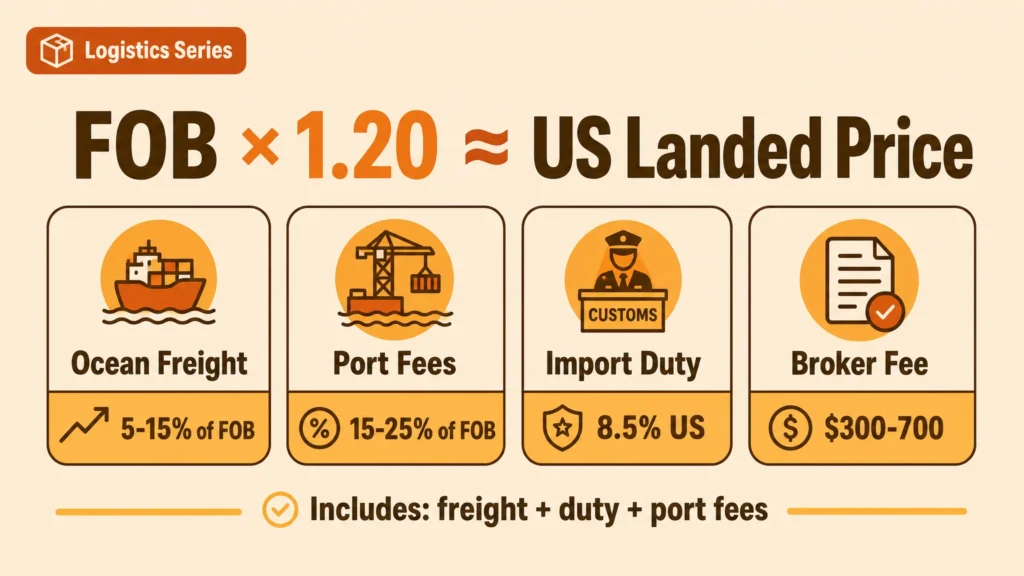
6. Landed Price Quick-Reference Formula
All the above adds up. Here is the number you came for: how do you estimate landed price quickly, in the field, when a supplier gives you an FOB quote?
FOB × 1.20 ≈ US Landed Price
Includes freight + duty + destination port fees
European landed price runs slightly higher:
FOB × 1.25 ≈ European Landed Price
Higher duty rates and longer clearance times add cost
Here is the full cost stack, broken down:
| Cost Layer | Typical Share of FOB | Notes |
|---|---|---|
| Ocean Freight | 5–15% of FOB | Seasonal; add 10–15% buffer |
| Marine Insurance | 0.1–0.3% of declared value | Usually minor |
| Destination Port Charges | 15–25% of FOB | Most missed charge |
| Import Duty (US) | 8.5% of declared value | US 8.5% duty rate |
| Customs Broker Fee | $300–$700 fixed | Per shipment |
Add them all up, and you are at roughly 20–25% above FOB
for the US market. That is your real procurement cost. Not the FOB number your supplier puts on the invoice.
LCL (Less than Container Load) consolidation is 30% cheaper on ocean freight but misc fees are proportionally higher. Per-unit costs may not differ much from full container. Calculate both before deciding.
Inspection service fee is roughly $200–$500 per session. If you are importing high-value dog crates, third-party inspection at origin is cheap insurance against quality surprises at destination.
Letter of credit settlement costs 1–2% more than T/T. If your supplier requires L/C, factor that premium into your cost model. T/T is cheaper if your supplier trusts you enough.
Pitfall Prevention Checklist
- Only comparing FOB prices: A low supplier FOB price does not mean low procurement cost — add freight + duty + misc fees for true cost. Prevention: Ask supplier to quote CIP or DDP for easier comparison.
- Only looking at ocean freight numbers: Forwarder quoting low ocean freight may add DDC, AMS, ISPS at destination. Prevention: Ask for ALL IN rate, or request full fee schedule clearly.
- Underestimating duties via low cargo value declaration: Customs may appraise based on selling price, resulting in additional duty and penalties. Prevention: Understand customs appraisal mechanism; reserve duty budget based on higher value.
Frequently Asked Questions
Q1: What is the difference between FOB price and landed price?
FOB is factory price — buyer pays freight, insurance, and duties separately. CIF includes freight and insurance to destination port. DDP is true door-to-door price with duties paid. FOB is the starting point; landed price is everything after.
Q2: Is ocean freight calculated by weight or volume?
By volume (CBM). 1 CBM ≈ 167 kg. Dog crates have large volume but relatively light weight — volume calculation actually works in buyers’ favor for this product category.
Q3: What destination port charges do freight forwarders not tell you about?
DDC (Destination Delivery Charge), AMS (American Manifest System fee), ISPS (Ship Security charge), THC (Terminal Handling Charge), and demurrage fees after free days expire. Ask for an ALL IN rate to see the full picture.
Q4: How do I roughly estimate import duty?
Duty = Declared Value × Duty Rate. US dog crates are roughly 8.5%. Europe varies by destination country. Apply the correct rate for your market and always check the current rate before shipping.
Q5: How do I quickly estimate landed price?
FOB × 1.20 ≈ US landed price. This includes ocean freight, destination port charges, and import duty. FOB × 1.25 covers European landed price. These multipliers are reference ranges — actual costs vary with freight rates and destination port.
Continue Reading – Logistics Series
- FCL vs LCL ShippingHow Many Dog Crates Fit in a 20ft/40ft Container? — Container loading math, CBM calculation, and real case studies.
- Shipping Routes from ChinaHow to Calculate Import Duties for US and Europe — HS Code classification, duty rate lookup, and penalty avoidance.
- How to Choose a Reliable Freight ForwarderHow to Compare Total Costs and Choose a Freight Forwarder — Quote breakdown, comparison method, and red flags.
