
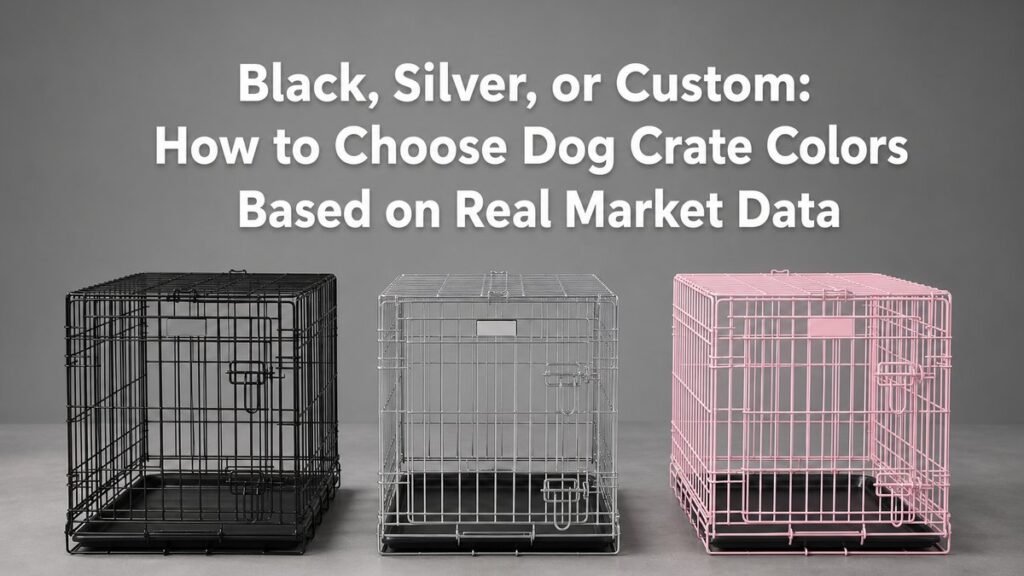
Black, Silver, or Custom: How to Choose Dog Crate Colors Based on Real Market Data
Color is not a visual afterthought—it is a commercial signal to your customer. Black accounts for 80% of our production because it is cheaper to coat, easier to sell, and generates fewer color-related complaints than any other option. But this does not mean black is always the right choice for your brand or market.
This is the data-driven guide to wire dog crate color selection. Silver holds 5% of our output and occupies a specific niche—European premium retail and buyers targeting a metallic aesthetic. Custom pastel colors account for the remaining 15%, driven almost entirely by DTC brands and retail chains. Here is what the numbers actually mean for your purchasing decision.
The Real Numbers — What Our Production Data Actually Shows
Here is the production breakdown from our Ningbo facility in 2025:
| Color Category | Share of Production | MOQ | Price Premium |
|---|---|---|---|
| Black | 80% | 300 units | Base price |
| Silver | 5% | 300 units | Base price |
| Custom colors (pink, lavender, light blue, orange) | 15% | 500 units | +10% |

The 80% figure for black is not accidental—it is the result of decades of market feedback. Black powder coating is the most mature process in our facility. Raw materials are locally sourced and stable, equipment settings are optimized, and our quality team has refined the process over thousands of units. This translates to predictable quality and consistent color matching batch after batch.
Silver at 5% looks small, but it is a deliberate segment. It is not that silver is unpopular—it is that buyers who choose silver have a specific reason: European premium retail, architectural aesthetics, or customers who perceive silver as higher-end than black.
Custom colors at 15% are growing. This segment did not exist at this scale five years ago. The growth is driven by DTC brands building color identities and retail chains demanding brand-specific finishes.
Why Black Dominates — The Business Case
When a buyer asks us whether to choose black, we run the numbers with them before giving advice. Here is the logic that keeps black at 80%:
- Cost efficiency: Black is the lowest-risk coating process. The pigment is stable, the application settings are well-established, and the failure rate is below 0.3%. This is not marginal—it affects your landed cost.
- Market acceptance: Black sells across all channels. Amazon FBA, wholesale, retail chains—it does not matter. Black is the default fallback for buyers who are uncertain.
- Complaint rate: At our facility, black generates roughly 0.3 color-related complaints per 100 units. Custom colors? That climbs to 1.2-1.5 per 100 units when the color is non-standard. The gap is not in product quality—it is in the complexity of managing a non-standard color through a production run.
- Inventory risk: Black has no trend risk. A black dog crate ordered today will still be orderable in two years. The same cannot be said for “lavender” or “rose gold.”

But here is the important caveat: black dominance is a commercial fact, not a recommendation. If your brand positioning requires differentiation—if you are selling premium, if your target customer makes a purchasing decision based on aesthetics—following the 80% trend may work against you. The question is not “what is popular” but “what serves my brand.”
One more practical consideration: black has the shortest lead time of any color in our facility. Because the process is optimized and the powder is always in stock, black orders typically move through production 2-3 days faster than custom color orders. For time-sensitive replenishment orders—especially Amazon FBA with its inventory velocity requirements—this is a meaningful operational advantage that compounds over multiple shipments.
When Silver Makes Sense for Your Market
Silver is not a compromise color. It is a deliberate choice with a specific commercial rationale. In our data, silver buyers fall into three categories:
| Buyer Type | Why They Choose Silver | Typical Order Volume |
|---|---|---|
| European Premium Retail | Silver signals higher-end than black; aligns with store aesthetics | 500+ units |
| Architectural / Design-Focused Brands | Metallic finish complements modern interior design trends | 300-800 units |
| Buyers Targeting Senior Pet Owners | Silver reads as “cleaner” and less industrial than black in retail displays | 200-500 units |

We recently worked with a Scandinavian pet products brand that explicitly rejected black for their premium line. Their reasoning: black reads as utilitarian in their retail environment, which is designed around natural materials and light colors. Silver was the natural choice. For them, it was not a trend—it was brand consistency.
Is silver right for you? Ask yourself two questions: (1) Is my target customer making a purchase decision that is influenced by aesthetics? (2) Does silver communicate the right message compared to my competitors? If both answers are yes, silver is worth the slightly higher attention cost of standing out from the 80%.
Beyond Black and Silver — Custom Colors That Actually Sell
Custom colors—pink, lavender, light blue, orange, and similar pastel tones—represent 15% of our production. But this 15% is not random. It is concentrated in specific buyer segments:
- DTC brands: Building a recognizable color identity is a core brand strategy for direct-to-consumer pet brands. A signature color makes your product memorable and your brand Instagram-worthy.
- Retail chains: Large retailers like Target and Buy Buy Baby have color requirements that align with seasonal collections or store aesthetics. These are planned well in advance and involve dedicated production runs.
- Premium niche brands: Pet boutiques and specialty retailers often require colors that differentiate from mass-market offerings. The premium positioning justifies the 10% cost increase.
Common Mistakes When Choosing Colors Beyond Black and Silver
- Assuming custom colors are easy to add: Pink, lavender, and light blue require a 500-unit MOQ and a 10% price premium. This is not a cosmetic addition—it is a production commitment.
- Launching multiple custom colors simultaneously: Each color requires separate inventory, separate SKU management, and separate QC attention. We recommend testing one custom color with black as the control before expanding.
- Ignoring the 15-day sample approval cycle: Custom colors require more rounds of sample approval than standard colors because the tolerance for color variation is lower when the color itself is unusual.
If you are considering a custom color, start by asking: is my order volume above 500 units? If not, the economics do not work. The second question is: can I afford the 10% premium while maintaining my margin? If the answer to both is yes, the next step is a color consultation with your factory to confirm powder availability and sample lead time.
Color Selection by Market — US, Europe, and Australia
Color preferences are not universal. Here is what our order data shows by major English-speaking market:
| Market | Dominant Color | Secondary Preference | Notes |
|---|---|---|---|
| United States | Black (85%+) | Silver | Amazon FBA heavily favors black; functional aesthetic dominates |
| Europe (UK, Germany, Scandinavia) | Black (60%) | Silver (20%), Matte Black | Higher premium perception for silver and matte finishes; color tolerance tighter |
| Australia | Black (80%) | Silver | Similar to US market; wholesale and retail driven |
| DTC / Premium Brands (Global) | Custom Pastels (growing) | Silver | Color as brand identity; willing to pay 10% premium |

We have a client in Sydney who imports black crates for his wholesale business. When he tried introducing silver as a secondary SKU, his Australian retail buyers rejected it—too industrial for the local market perception. He switched to matte black for the premium segment and black for the standard, and both SKUs now sell through. The lesson: market data is a starting point, not a destination.
Choosing the Right Color for Your Business — Decision Framework
Before you finalize your color decision, run it through this framework:
Color Selection Decision Framework
Amazon FBA, Standard Product
Go with black. The 80% data is your friend. Lower cost, fewer complaints, faster sell-through.
Premium Retail / Brand Differentiation
Consider silver or a custom pastel. The 10% premium is absorbed by your margin if your positioning supports it.
European Premium Channel
Silver or matte black commands a premium perception. Avoid standard glossy black if shelf aesthetics matter.
Testing New Color Markets
Start with black to establish baseline sell-through, then introduce a custom color on a single SKU. Use data, not intuition.
If you can articulate why your color choice serves your target customer and your margin structure, you are ready. If you are defaulting to black because “that is what everyone does,” pause and run the framework above.
FAQ: Wire Dog Crate Color Market Preferences
What is the most popular dog crate color on Amazon?
Black dominates Amazon FBA dog crate sales, accounting for approximately 80-85% of our Amazon-related shipments. The primary reasons are commercial: lower cost, proven sell-through, and fewer color-related complaints. However, the most popular color is not necessarily the right color for your brand. If you are selling premium or using aesthetics as a differentiator, silver or a custom color may serve you better despite the higher volume of black sales.
Are silver dog crates more expensive?
No. Silver and black are both classified as standard colors at our facility. Both carry the same base price and the same 300-unit MOQ. Silver appears in only 5% of our production not because it is expensive—it is because the market demand is lower. If your target market perceives silver as premium or it aligns with your brand aesthetic, the economics are identical to black.
What other colors can I choose besides black?
Beyond black and silver, we offer custom colors including pink, lavender, light blue, and orange. These pastel tones represent about 15% of our production and are primarily purchased by DTC brands and retail chains. Custom colors require a 500-unit MOQ (higher than standard colors) and carry a 10% price premium. If your order is below 500 units, the economics of custom colors typically do not work without either increasing your order or accepting a disproportionate per-unit cost.
Do different countries prefer different dog crate colors?
Yes. The US market heavily favors black—around 85% of our US-bound shipments are black. European markets show more openness to silver and matte finishes, with silver accounting for roughly 20% of our European shipments. Australia tracks similarly to the US market. DTC and premium brands globally are the growth driver for custom pastel colors, regardless of geography. Market data should inform your decision, but your own customer feedback is the final arbiter.
Can I offer multiple colors in one order?
Technically yes, but it increases cost and complexity. Each color requires separate powder setup, separate quality control, and separate tracking through production. For orders under 1,000 units, we generally recommend picking one primary color and proving market demand before expanding. If you are a large retail chain requiring multiple colors per season, dedicated production runs with forward planning can manage the complexity—it is a question of scale and planning horizon.

