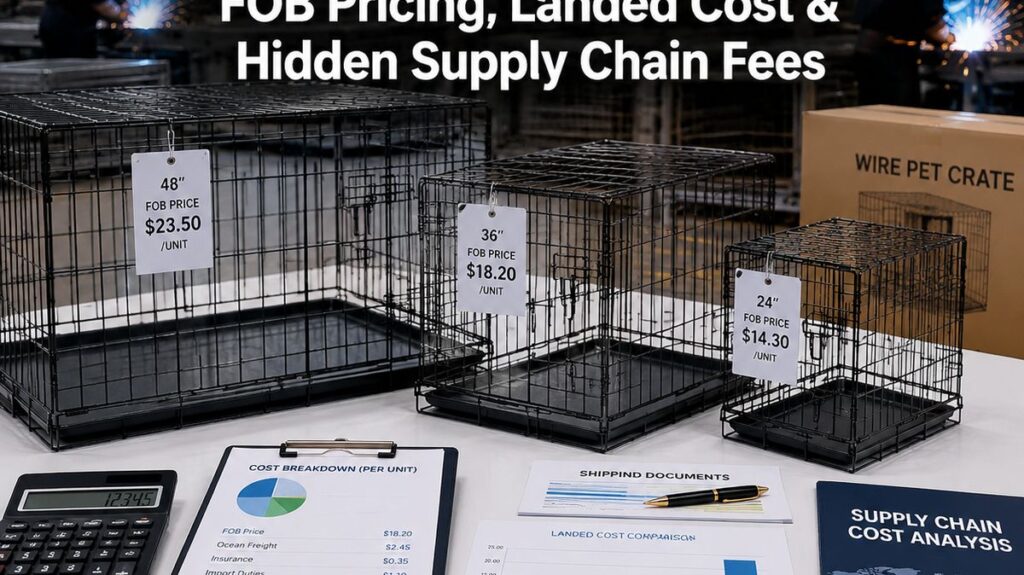
Annual Wire Pet Crate Cost Report: FOB Pricing, Landed Cost & Hidden Supply Chain Fees
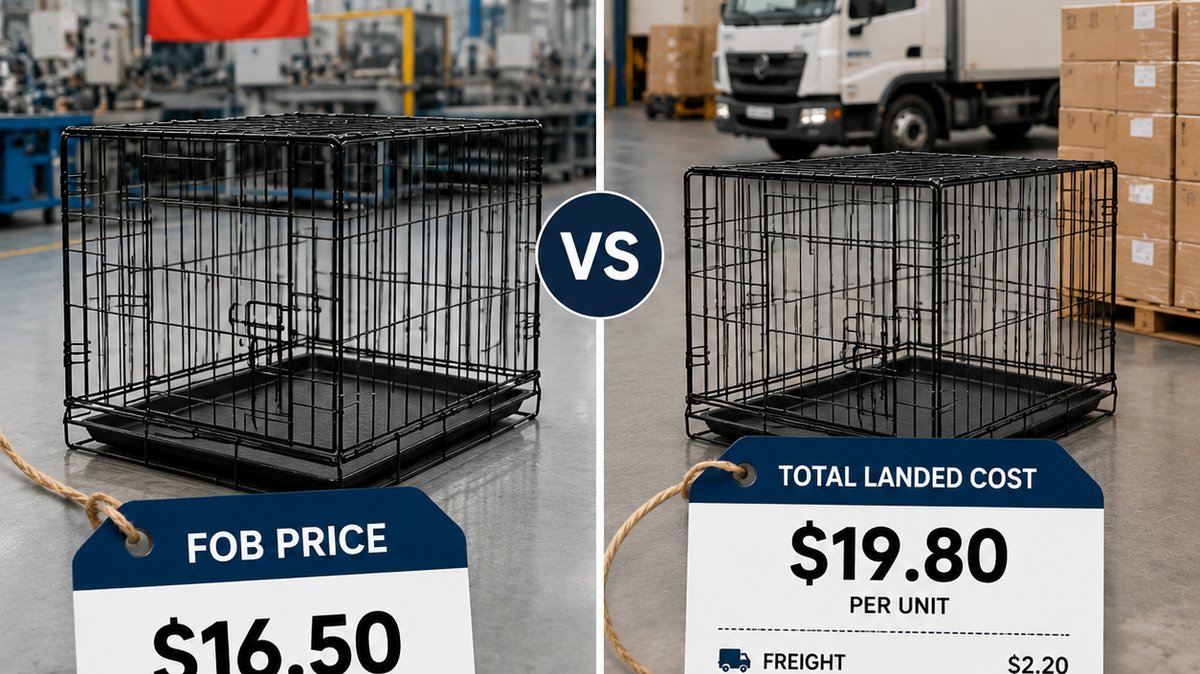
When you receive an FOB quote of $16.50 per unit, what is your instinctive reaction? Many buyers accept the “low price” immediately, only to discover after delivery that the actual cost per unit is $19.80 — freight and tariffs ate into the margin. Wire pet crate costs are not as simple as the FOB quote.
This report is the second in Cagesilo’s annual procurement analysis series. If you are comparing supplier quotes or preparing to negotiate with a factory, this report will help you understand: where costs are hidden, which expenses should not be cut, and how to avoid hidden traps in your contract. 2026 Wire Pet Crate Annual Market Report: Global Market Size, Trends & Procurement Guide Wire Pet Crate Annual Buyer Profile Report: Who Is Buying? 4 Procurement Behaviors from Amazon FBA to Retail Chains
Wire Pet Crate Cost Breakdown — What’s Inside That $20 Quote?
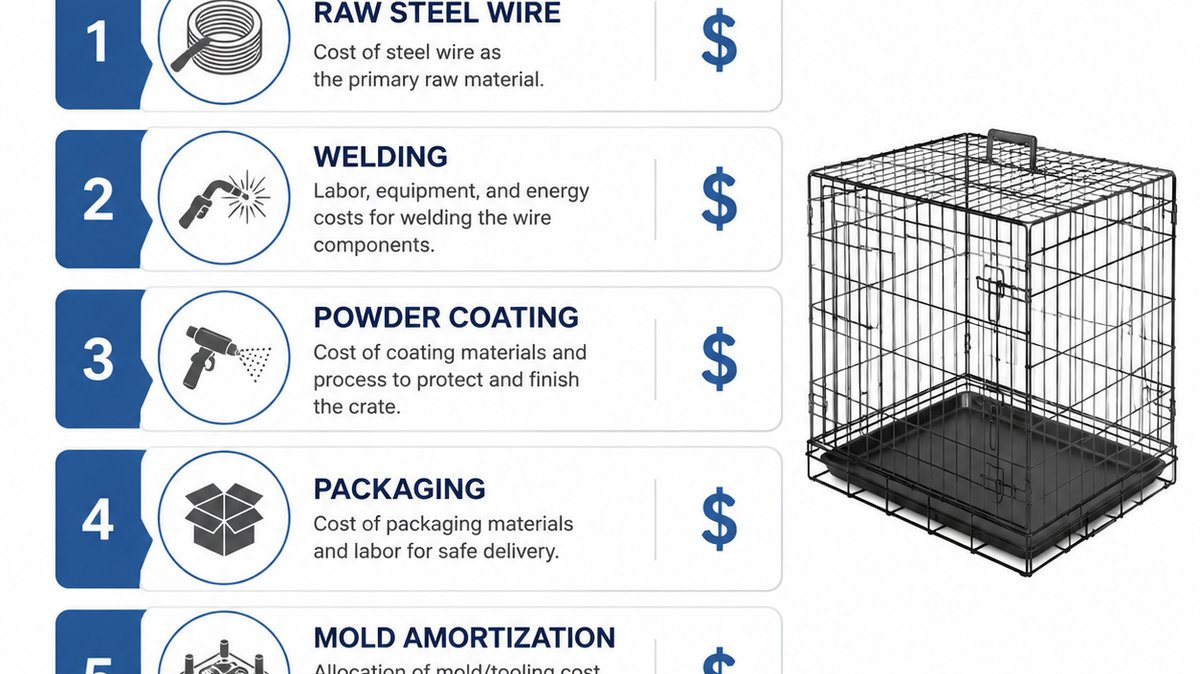
Behind that $20/unit FOB quote are five cost components stacking up:
At our factory, wire dog crate (36″ double door) FOB pricing typically ranges from $15.86 to $20.86 per unit — this wide range reflects differences in raw material grade, welding quality, surface treatment process, and packaging standards. Understanding what drives this range helps you avoid both the “too cheap to be true” trap and overpaying for features you don’t need.
Component 1: Raw Materials (Wire Steel)
Wire steel is the single largest cost item, typically accounting for 35-45% of the FOB price. Common gauges include 3.0mm, 3.5mm, and 4.0mm. Each 0.5mm increase in wire gauge raises the per-unit cost by approximately $0.80-1.20. If you see an unusually low quote, the first thing to confirm is: which gauge is specified in the contract?
Component 2: Processing (Welding + Forming)
Welding process directly affects product strength and durability. Automated welding lines vs. manual welding differ by approximately $0.50-1.00/unit in cost, but defect rates differ by 3-5%.
Component 3: Surface Treatment (Powder Coating / Electroplating)
Black epoxy powder coat is the mainstream process, costing approximately $1.50-3.00/unit. Cheaper processes may use lead-containing paint, creating environmental compliance risks.
Component 4: Packaging
Standard export carton packaging costs approximately $0.30-0.80/unit. Gift box packaging required by retail chains doubles the cost but can significantly improve conversion rates on Amazon.
Component 5: Mold Amortization
Each product mold set costs approximately $3,000-8,000. For a 1,000-unit order, mold fee amortization is about $3-8/unit; for a 5,000-unit order, it drops to $0.60-1.60/unit.
| Accessory Type | FOB Price Add-on | Notes |
|---|---|---|
| Handle | $0.20 – $0.50/unit | Plastic or metal, depending on design |
| Divider | $2.00 – $6.00/unit | Adjustable dividers are premium accessories |
| Bottom Panel | $3.00 – $8.00/unit | Plastic vs metal bottom panel makes a big difference |
| Plastic Tray | $2.00 – $5.00/unit | Standard plastic vs antimicrobial material |
FOB vs. Landed Cost — Why the Lowest FOB Quote Can Be the Most Expensive
The biggest cognitive trap in B2B procurement is treating the FOB price as the final cost.
At our factory, CBM (Cubic Meter) has a dramatic impact on freight costs: a 48″ crate measures 0.0979 m³ versus 0.0564 m³ for a 36″ crate — that’s 73% more CBM per unit — this means if you’re comparing a 48″ quote at $18.50 FOB against a 36″ quote at $17.00 FOB, the per-unit freight difference might make the “cheaper” 48″ actually cost more delivered.
Landed Cost Formula:
Landed Cost = FOB Price + Freight + Import Duty + Insurance + Unloading + Drayage + Customs Broker Fee
Real Case Study: The Lowest FOB Quote Cost $3.30 More Per Unit
An Amazon FBA seller received two quotes: Supplier A quoted $16.50/unit (36″), Supplier B quoted $15.20/unit (48″). The seller chose B. Two months after warehouse delivery, he discovered: the buyer selected the lowest FOB quote but ended up paying $3.30 more per unit due to excessive CBM — the 48″ crate’s higher CBM meant fewer units per container, driving freight costs up by $1.80/unit, plus higher deconsolidation fees. His “cheaper” quote cost him $3,300 more on a 1,000-unit order.
Lesson: Always request CBM data from suppliers and calculate landed cost yourself.
Common Pitfalls When Comparing Wire Crate Quotes
- Pitfall 1: Comparing FOB prices without CBM data — a 48″ crate may show lower FOB but higher freight cost per unit due to 73% more CBM.
- Pitfall 2: Ignoring dimensional weight vs actual weight — carriers charge by whichever is higher.
- Pitfall 3: Forgetting import duty: most Chinese wire crates face 15-25% import duty in US/EU markets, which significantly affects true landed cost.
MOQ Negotiation: What Price Can You Get at 200 Units?
Minimum Order Quantity is the first threshold in B2B procurement.
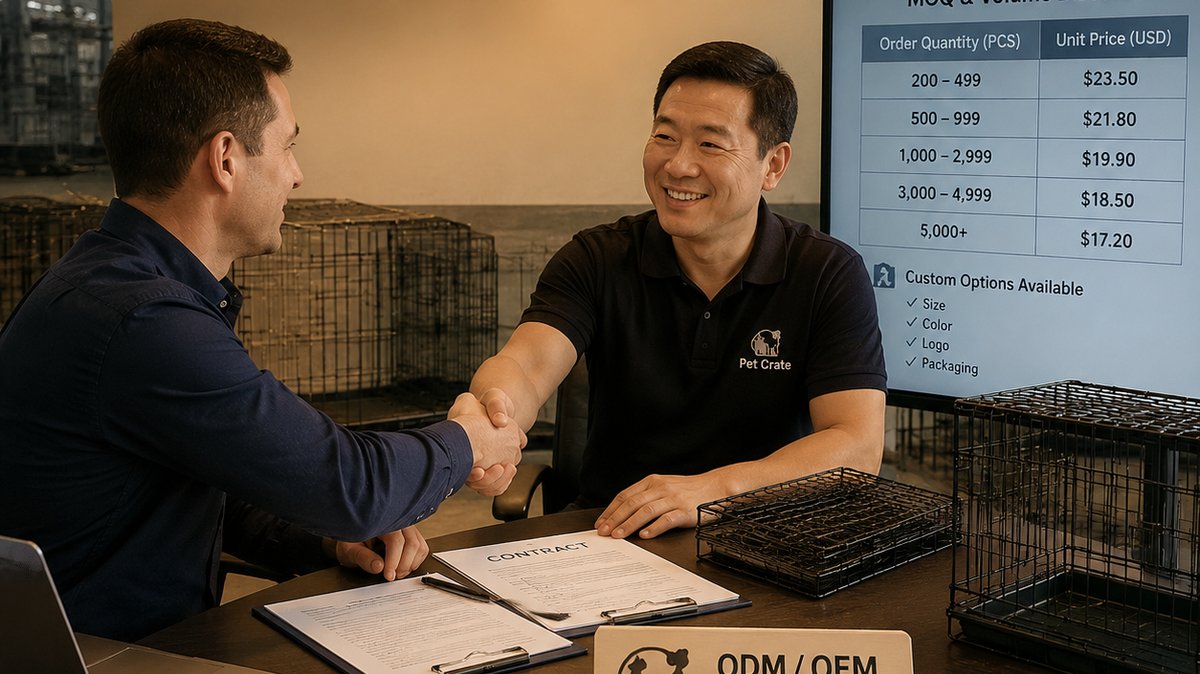
At our factory, standard MOQ ranges from 200-500 units for existing models, and 500+ units for custom specifications — this means if you’re ordering 200 units, you’re likely at the floor of their acceptable range, which affects both unit price and production scheduling priority. Understanding where your quantity falls in their MOQ structure helps you negotiate from a position of knowledge.
Stock Model MOQ: 200-300 Units
Factory existing molds and standard colors typically have an MOQ of 200 units. Some factories accept 200 units as a starting point, but pricing will be approximately 5-8% higher than MOQ 300+ quotes.
Custom Model MOQ: 500+ Units (Negotiable)
Custom colors, custom logos, and custom sizes typically require 500+ units as a starting MOQ. Negotiation strategy: paying the mold development fee (approximately $2,000-5,000) can reduce MOQ to 200-300 units. This may look like an extra cost, but amortized over a 1,000-unit order, it only adds $2-5 per unit while giving you customization capability and lower inventory risk.
| Order Volume | Estimated Price Discount | Lead Time | Negotiation Leverage |
|---|---|---|---|
| 200-300 units | Base Price | 25-35 days | Accept mold amortization fee in exchange for lower MOQ |
| 500-1,000 units | Base price -8~12% | 30-40 days | Place orders early to lock in price and capacity |
| 2,000+ units | Base price -15~20% | 40-50 days | Annual framework agreement with quarterly orders |
Lead Time Reality Check — What’s Behind Those 25–45 Day Quotes
When a supplier tells you “lead time is 30 days,” what’s behind that number?
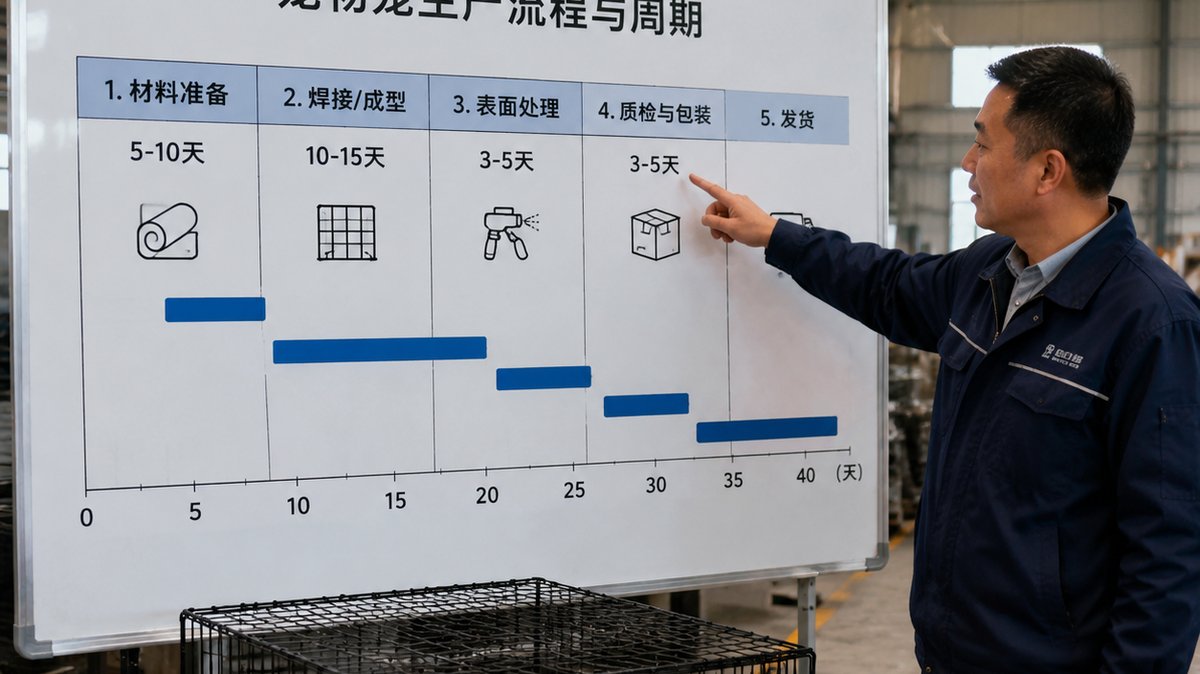
At our factory, production lead time for standard wire dog crates ranges from 25-45 days depending on customization level and seasonal demand — but this is only the production time. The full procurement cycle includes material preparation (5-10 days), production (15-25 days), quality inspection (2-3 days), packaging (2-3 days), and port logistics (3-7 days). Understanding this breakdown helps you plan buffer time and avoid last-minute sourcing disasters.
Lead Time Breakdown:
1. Material Preparation (5-10 days): Wire steel, coating raw materials, and accessories procurement. During peak season when raw materials are tight, this may extend to 15 days.
2. Drawing + Forming + Welding (10-15 days): Core production processes. Factories with higher automation can compress this to 10 days.
3. Surface Treatment (3-5 days): Phosphating, powder spraying, curing. Black epoxy powder coating requires 3-4 days for curing.
4. QC + Packaging (3-5 days): Full QC inspection + export packaging.
Peak vs. Off-Season Difference
Made-in-China factory data shows peak season lead times extend to 45+ days while off-season can compress to 15 working days — if you’re sourcing for Amazon Prime Day (July), you need to place your order by February-March at the latest. For Holiday Season (December), aim for April-May.
Expedited Options
Most factories offer expedited service at $0.50-1.50 additional per unit, which can compress lead time by 7-10 days. However, expedited production does not guarantee quality—compressed timelines often mean skipping certain QC steps.
Payment Terms — Is a 30% Deposit Reasonable?
Standard payment terms are a basic clause in B2B procurement, but the cash flow pressure behind them is often underestimated.
At our factory, our standard payment terms are 30% deposit + 70% balance before shipment — for orders exceeding $50,000, we typically require LC at sight. This structure protects the factory’s material procurement costs while giving buyers confidence that the goods will be completed before final payment. Understanding industry-standard payment terms helps you negotiate from knowledge rather than ignorance.
Standard Payment Structure:
– 30% Deposit: Paid when placing the order, locking in production capacity and raw material prices.
– 70% Balance Before Shipment: Full payment settled before goods are loaded onto vessel/truck.
LC at Sight for Large Orders
For orders exceeding $50,000, factories typically require Letter of Credit at sight. LC at sight provides payment security to the factory while the buyer receives documentation (B/L, inspection report) before the bank releases funds — this is standard for cross-border transactions above $50K and typically adds $300-800 in bank fees.
Negotiation Floor: Is 20%/80% Negotiable?
Some factories accept 20% deposits, especially for long-term cooperative clients or when backed by a letter of credit. However, reducing the deposit means the factory bears greater risk, and they will price this risk premium into the unit cost (typically adding 2-3%).
Avoiding Sample Pitfalls — 5 Steps to Identify the Golden Sample Trap
Sample passes, mass production fails—this is the most common tragedy in B2B procurement.
At our factory, the “golden sample trap” occurs when factory owners personally hand-polish and perfect samples that cannot be replicated on the production line — this is why we always recommend requesting production-line samples rather than accepting hand-finished display pieces. The visual difference might be imperceptible, but structural differences (wire gauge, welding strength, coating thickness) can be significant.
Root Cause of the Golden Sample Trap: Factory owners personally hand-polish and perfect samples to win orders. During mass production, ordinary workers use standard processes, and the quality gap becomes immediately apparent.
5 Steps to Identify the Golden Sample Trap:
1. Request production line information: Ask which production line and which shift produced the sample. If they hesitate, be wary.
2. Request a 50-unit pilot run: Not just 1 sample, but 50 units randomly sampled. If 3 or more out of 50 have quality issues, the production line is unstable.
3. Request wire gauge records: Every coil of wire steel has incoming records. The wire gauge of the sample and mass production must be consistent.
4. Test weld point strength: Bend the weld points by hand. Are the sample welds stronger than mass production? A difference in strength indicates different processes.
5. Conduct salt spray testing: 48-hour salt spray testing can expose corrosion resistance issues with cheap coatings.
Common Pitfalls During Sample Approval
- Pitfall 1: Accepting a single hand-finished sample without requesting production-line samples — this is the #1 cause of “sample passed, mass production failed.”
- Pitfall 2: Not testing wire gauge — a 4.0mm sample with 3.6mm production wire is a safety hazard and causes product failure.
- Pitfall 3: Skipping coating adhesion tests — cheap powder coat will peel within 6 months, leading to Amazon returns.
Hidden Fees to Write into Your Contract — Avoiding $300-500 Disputes
The root cause of many procurement disputes is unclear hidden fee clauses in the contract.
At our factory, inspection fee disputes are common — when both buyer and factory assume the other pays, the $300-500 per inspection incident becomes a contentious point — this is why we insist all inspection terms be explicitly written into the Purchase Order before signing. Who pays for third-party inspection (SGS, Bureau Veritas)? What are the standards for passing or failing? These must be defined upfront.
Inspection Fees: Who Pays and How
Third-party inspection fees (SGS / Bureau Veritas) are typically $300-500 per inspection. This must be clearly stated in the contract: inspection fees are prepaid by the buyer and ultimately borne by the responsible party. If factory quality issues cause rework, the factory pays the inspection fee.
Rework / Remake Fees: What Are the Standards?
If an entire batch fails AQL inspection, how are rework fees calculated? $1–3 per unit is an industry standard, but the contract must clearly define what constitutes a non-conforming unit (AQL 2.5 standard is recommended).
Storage Fees: How to Calculate When Goods Sit Beyond X Days
If the buyer does not pick up goods after completion, storage fees start calculating from day 31. We recommend clearly stating in the contract: goods detained at the factory beyond 30 days, storage fees are $5-10/day/container.
Delay Penalties: How Much Per Day Late
If delivery is delayed, deducting 0.5-1% of the contract amount per day of delay is a common clause. However, note: force majeure (typhoons, customs delays) requires separate exemption clauses.
| Hidden Fee Type | Industry Standard | Recommended Contract Language |
|---|---|---|
| Third-Party Inspection Fee | $300-500/inspection | Buyer prepays, responsible party ultimately bears cost |
| Rework / Remake Fee | $1-3/unit | Determine responsibility per AQL 2.5 standard |
| Storage Detention Fee | $5-10/day/container | Starts from day 31 after completion |
| Delivery Delay Penalty | 0.5-1%/day | Capped at 10% of contract value, excluding force majeure |
| Mold Modification Fee | $200-500/change | Non-quality modifications borne by buyer |
Certifications & Compliance — Export Checklist
Different target markets have different compliance requirements for pet crate products.
At our factory, the most common export certifications for wire pet crates are BSCI, ISO 9001, and Sedex for social compliance — these form the baseline requirements for working with European and American retailers and wholesalers. Without these, you will be filtered out during pre-screening by most serious buyers. Additional market-specific certifications add 2-6 weeks to your qualification timeline.
North American Market
ASTM F404 is the standard for children’s plastic playpens. Wire dog crates are typically not subject to this constraint. However, if children may have access to the dog crate, additional edge safety assessment is needed. Amazon listings require CPSIA test reports.
European Market
REACH (Registration, Evaluation, Authorization and Restriction of Chemicals) and EN 71 (Toy Safety) are essential for entering Europe. IATA compliant crate standards are necessary for air transport. European market compliance requires REACH, EN 71, and IATA compliant standards — plan for 2-4 months additional qualification time compared to standard export.
Australia
Australian Standards AS 4874 is a mandatory standard. Australia has special requirements for pet crate ventilation area and door lock safety.
Social Compliance Certifications (All Markets)
BSCI / Sedex / ISO 9001 are the “tickets” to enter European and American retail channels. Without these certifications, procurement departments at Costco, Walmart, and Target won’t even open your inquiry.
Decision Framework
Key Takeaways
Always Compare Landed Cost, Never Just FOB
CBM data + freight + duty = true cost. A 48″ crate may be cheaper FOB but more expensive landed.
Samples Must Be Production-Line Samples
Request a 50-unit pilot run. Reject hand-finished “golden samples.” Keep wire gauge records and conduct salt spray tests.
Write All Hidden Fees into the Contract
Inspection/rework/storage/delay penalties—all in writing. Verbal agreements equal nothing.
Place Orders 5-6 Months Before Peak Season
Prime Day: 4-5 months ahead. Holiday Season: 6 months ahead. Peak season lead times can reach 45+ days.
Frequently Asked Questions
What factors affect wire dog crate pricing?
Wire dog crate pricing is driven by 5 cost components: raw materials (wire steel at 35-45% of cost), manufacturing (welding and forming), surface treatment (powder coating), packaging, and mold amortization. For 36″ double door models, FOB pricing typically ranges from $15.86 to $20.86 per unit. Accessories like handles ($0.20-0.50), dividers ($2-6), and bottom panels ($3-8) add to the base price. When comparing quotes, always ask for the full specification breakdown including wire gauge, coating type, and packaging method.
What is typical MOQ for wire pet crate from China?
Standard MOQ for existing models ranges from 200-500 units, while custom specifications typically require 500+ units. At 200 units you’re at the floor of acceptable orders — expect pricing 5-8% higher than MOQ 300+ orders. For custom colors or logos, paying the mold development fee ($2,000-5,000) can reduce MOQ to 200-300 units. For 2,000+ unit orders, pricing can be 15-20% below base, but requires 40-50 day lead times and annual framework agreements.
How to calculate landed cost for wire dog crate?
Landed Cost = FOB Price + Freight + Import Duty + Insurance + Unloading + Customs Broker + Drayage. The critical variable most buyers miss is CBM: a 48″ crate has 73% higher CBM (0.0979 vs 0.0564 m³) than a 36″ crate. This means fewer units per container and higher freight costs per unit. Always request CBM data from suppliers and calculate: (FOB price × quantity) + (freight per CBM × total CBM) + (duty rate × FOB value) = true landed cost per unit.
What payment terms do Chinese factories typically offer?
Standard payment terms are 30% deposit + 70% balance before shipment. For orders exceeding $50,000, Letter of Credit at sight (LC at sight) is commonly required, which adds $300-800 in bank fees. Some factories accept 20%/80% for established customers, but this typically comes with a 2-3% price premium. Consider your cash flow: the 30/70 structure means you’ll have significant cash tied up in production for 25-45 days plus ocean freight time (2-4 weeks to US West Coast).
How long does wire dog crate production take?
Standard production lead time is 25-45 days from deposit receipt. This includes material preparation (5-10 days), production (15-25 days), quality inspection (2-3 days), and packaging (2-3 days). Peak season (January-June) can extend to 45+ days; off-season may compress to 15 working days. For Amazon Prime Day (July), place orders by February-March. For Holiday Season (December), target April-May. Expedited production (+$0.50-1.50/unit) can cut 7-10 days but may compromise quality inspection rigor.
What hidden costs affect wire crate total cost?
Six hidden costs to budget for: (1) Third-party inspection: $300-500 per incident, specify who pays in contract; (2) Rework/rejection fees: $1-3/unit if AQL standards aren’t met; (3) Storage fees: $5-10/day/cabinet after 30 days post-production; (4) Delay penalties: 0.5-1% per day of delay, capped at 10% of contract value; (5) Mold modification fees: $200-500 per change if specs evolve; (6) LC fees: $300-800 for letters of credit on orders over $50K. Every single one of these should be explicitly defined in your Purchase Order before signing.