

How to Stock Wire Dog Crates That Actually Sell: A B2B Guide to Consumer Selection Logic
Every wrong-size wire dog crate sitting in a warehouse represents a consumer who chose wrong — and an importer who guessed instead of analyzed. This guide maps exactly how end consumers select wire dog crates by breed, use case, and living situation, so B2B buyers stock product lines that match real demand, not assumptions. For a broader overview of wire dog crate sourcing fundamentals, start with our homepage guide.
The most expensive crate in your inventory is not the one with the highest unit cost. It is the one that does not sell. And the #1 reason crates do not sell is that they do not match what end consumers are actually looking for. A 48-inch heavy-duty crate makes sense for the 8% of consumers who own giant breeds. A 24-inch budget crate works for the apartment-dwelling small-dog owner. Stock the wrong mix, and you pay warehouse costs on inventory that crawls. Below: who buys which crate, why, and how to build a product line that matches real consumer demand patterns.
The Consumer Selection Decision: What B2B Importers Need to Know
#1 Decision Factor
Dog’s adult breed/size — not current weight. Return data shows that consumers who buy by puppy weight return crates at approximately 3x the rate of those who buy by adult breed projection.
#2 Decision Factor
Use case — training vs. containment vs. travel. A training buyer needs a divider panel; a travel buyer needs foldable portability. Same crate size, completely different feature set.
#3 Decision Factor
Living situation — apartment, house, multi-dog. Apartment dwellers need compact/foldable crates with aesthetic appeal. House owners prioritize durability and size.
#1 Return Reason
Wrong size. Not wrong color, not wrong brand — wrong size. Industry return data suggests that an estimated 80% of size-related returns could be prevented with accurate breed-specific sizing guidance at the point of sale.
The Breed-Size Matrix: Which Crates Sell to Which Dog Owners
The average consumer does not shop for a “36-inch wire dog crate.” They shop for “a crate for my Labrador.” The inch label means nothing to them. The breed match means everything. Importers who structure their product listings and inventory around breed compatibility, not just inches, sell more crates and generate fewer returns.
| Crate Size | Typical Breeds | Consumer Profile | Est. Demand Share | Key Feature to Stock |
|---|---|---|---|---|
| 24″ (61cm) | Chihuahua, Yorkie, Shih Tzu, Toy Poodle, Maltese | Apartment dwellers, first-time owners, seniors | ~12% | Compact fold, quiet latch, aesthetic finish |
| 30″ (76cm) | Beagle, Corgi, French Bulldog, Cocker Spaniel, Pug | Urban/suburban, mid-size breed enthusiasts | ~18% | Divider panel, easy-clean tray |
| 36″ (91cm) | Border Collie, Boxer, Pit Bull, Australian Shepherd | Active families, suburban homeowners | ~28% | Double door, divider panel, reinforced welds |
| 42″ (107cm) | Golden Retriever, Labrador, German Shepherd, Husky | Families with large breeds, suburban/rural | ~30% | Heavy-duty construction, escape-proof latch |
| 48″ (122cm) | Great Dane, Mastiff, Saint Bernard, Irish Wolfhound | Giant breed specialists, professional kennels | ~12% | Extra-heavy gauge, reinforced floor, bulk pricing |
Factory Insight: 36-inch and 42-inch wire dog crates together account for nearly 60% of global unit volume. These are the two sizes every importer must stock — and where feature differentiation has the biggest impact. Retail platform data shows that a 36-inch crate with a divider panel and double door can outsell a basic 36-inch crate by roughly 3:1 on major e-commerce platforms. The remaining sizes serve specific consumer segments that need targeted marketing, not just shelf space.
Use Case: Why the Same Consumer Buys Different Crates for Different Purposes
A single consumer may need multiple wire dog crates for different purposes: a training crate for home, a foldable crate for travel, a heavy-duty crate for the car. Importers who understand use-case segmentation can sell multiple crates to the same customer, increasing lifetime value without spending more on acquisition.
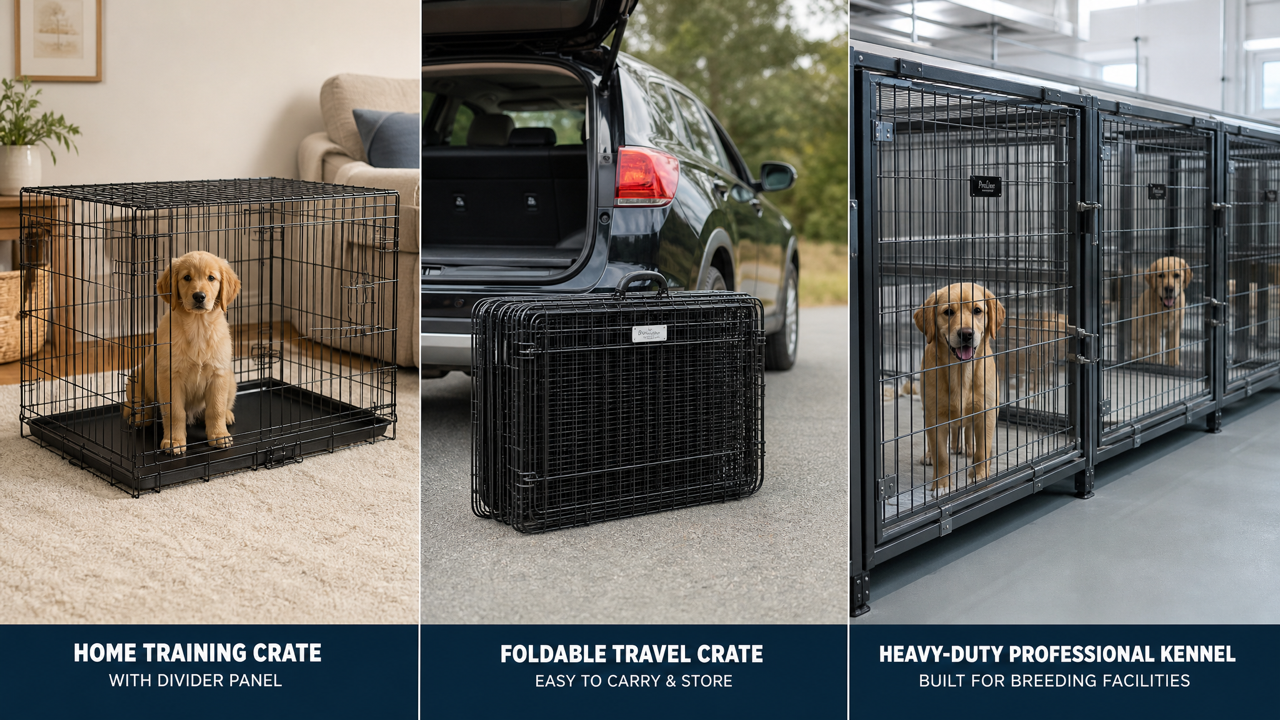
Use-Case Segmentation: One Consumer, Multiple Crates
Home Training Crate — The primary purchase. Double door, divider panel, locking tray. 36″–42″ for most breeds. This is the core product in any consumer’s crate collection.
Travel/Portable Crate — Foldable, lightweight, compact. Often one size smaller than the home crate. Consumers who bought a 42″ home crate may also buy a 36″ travel crate.
Professional/Show Crate — Used by breeders, competitors, and boarding facilities. Heavy-duty construction, stackable design, chemical-resistant surfaces. This is a separate B2B sub-market with its own buying patterns.
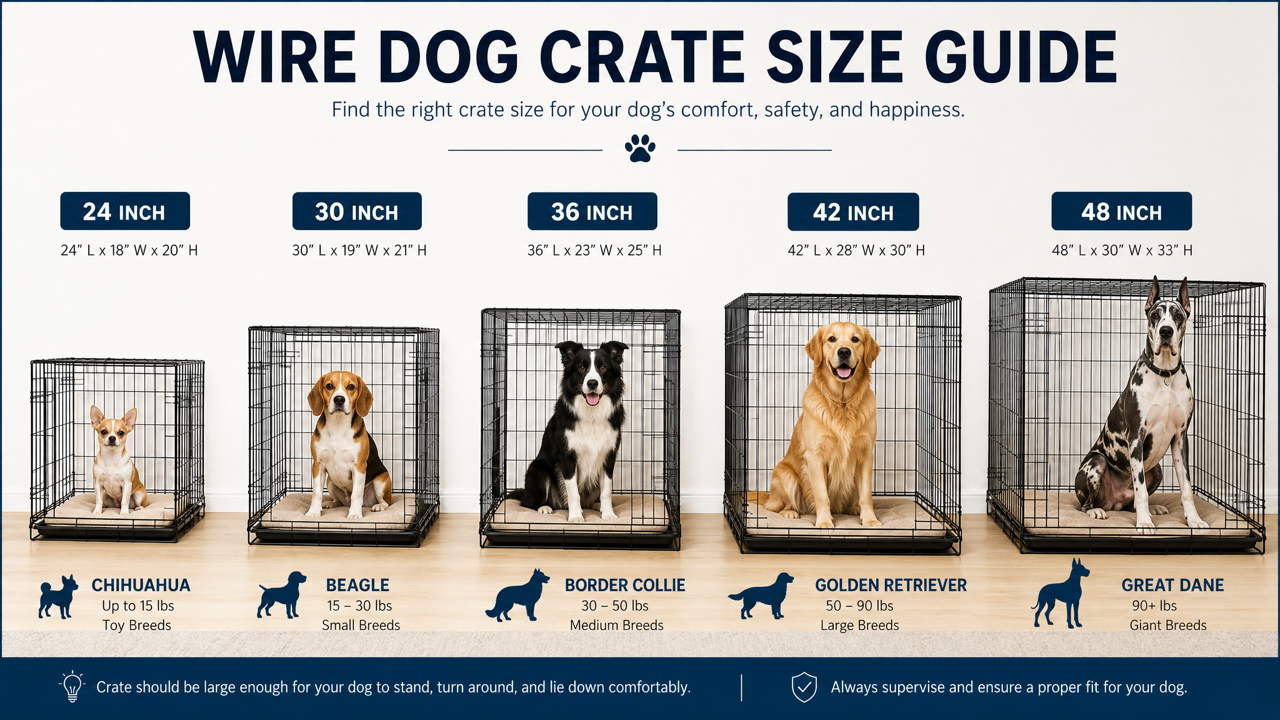
Wire dog crate size-to-breed matching — the key to reducing returns
The Three Most Common Consumer Selection Mistakes — and What They Mean for Your Product Line
Understanding why consumers return crates matters as much as understanding why they buy them. Each return reason is a signal that your product line — or your product listing — is missing something.
Mistake 1: Buying by Current Weight, Not Adult Breed Size
The consumer error: A new puppy owner buys a 24-inch crate because their 8-week-old Golden Retriever puppy weighs 12 pounds. Three months later, the dog outgrows the crate. One-star review. Return request.
Your fix: Every product listing must include “adult breed fit” guidance, not just current weight ranges. Example: “Fits adult dogs up to 25 lbs — ideal for full-grown Beagles, Corgis, and French Bulldogs.” If you sell a 24-inch crate, explicitly state which breeds it will NOT fit as adults.
Mistake 2: Choosing a Crate That Is Too Large
The consumer error: A consumer buys a 48-inch crate for their Beagle because “bigger is better.” The dog uses one corner as a bathroom because the crate space exceeds its den-instinct comfort zone. Housebreaking training fails.
Your fix: Include a sizing guide that emphasizes proper fit — crate length should equal dog’s nose-to-tail length plus 10–15cm, not more. Oversized crates undermine training. If you sell divider panels, promote them as the solution for puppies in adult-sized crates.
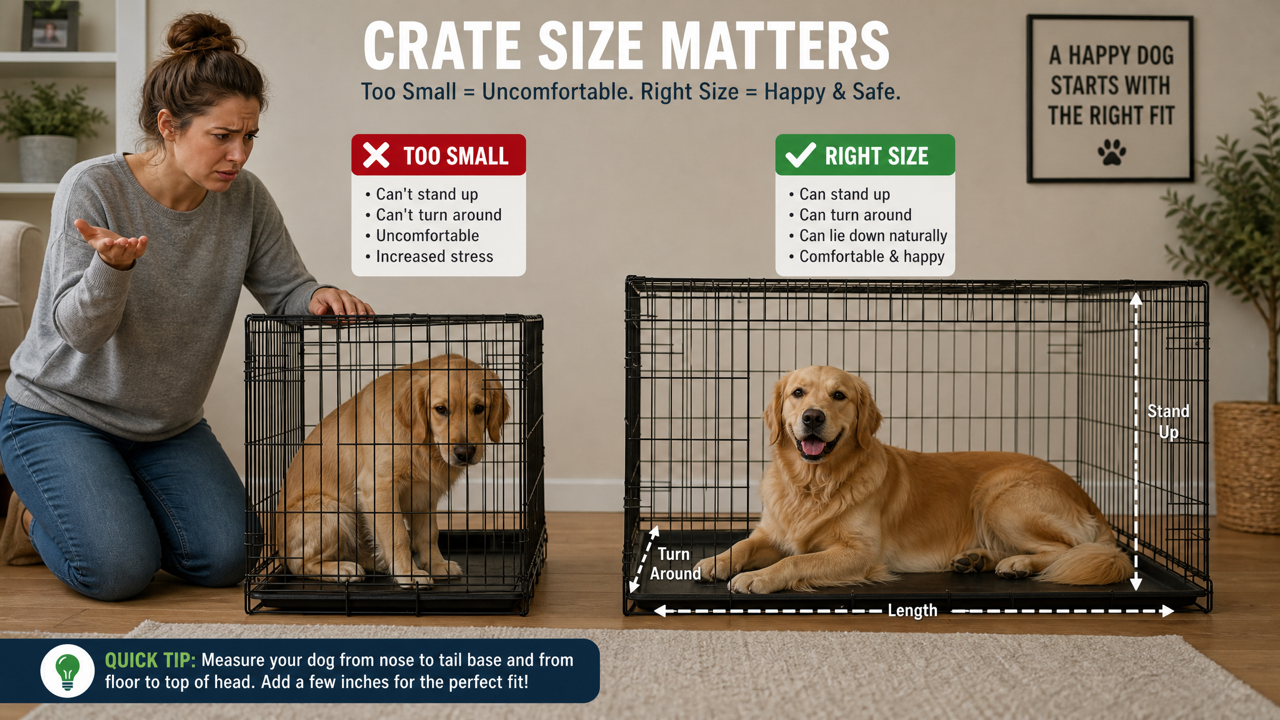
Common wire dog crate sizing mistakes — and how to prevent them in your product line
Mistake 3: Ignoring Door Placement in Room Layout
The consumer error: A consumer buys a single-door crate, brings it home, and discovers the door faces the wrong direction for their room layout. The crate is now awkwardly positioned and the consumer is unhappy — even though the product itself is fine.
Your fix: Stock double-door crates for the training segment. For budget single-door models, include a room-layout diagram showing optimal placement. A small piece of consumer education prevents a large number of avoidable returns.
Consumer Personas: Who Buys Which Crate and Why
Not all consumers approach the same purchase from the same angle. A first-time dog owner buying a crate for a new puppy has completely different priorities than a professional breeder buying crates in bulk. Importers who understand these personas can structure product lines and marketing to serve each segment without spreading themselves too thin.
| Consumer Persona | Crate Priority | Price Sensitivity | What to Stock for This Persona |
|---|---|---|---|
| First-Time Puppy Owner | Divider panel, easy assembly, positive reviews, clear sizing guide | Medium | 30″–36″ with divider panel, training guide included. Will pay for features that simplify the experience. |
| Apartment Dweller | Compact/foldable, quiet operation, aesthetic design, space-efficient | Medium-High | 24″–30″, dark/neutral finishes, silent-close latch. Prioritize appearance and noise — these buyers live next to their crates. |
| Experienced Large-Breed Owner | Durability, escape-proof, heavy-duty construction | Low | 42″–48″, heavy gauge wire (5.0mm+), reinforced latches. Function over form — these buyers know what they need. |
| Multi-Dog Household | Multiple sizes, stackable option, consistent design across sizes | Medium | Full size range with matching design. Bundle pricing. Stackable compatibility is a strong upsell. |
| Professional/Bulk Buyer | Durability, volume pricing, stackability, chemical resistance | Very Low | Heavy-duty product line, bulk/volume pricing tiers. Consistent quality across reorders is more important than price. |
Factory Insight: First-time puppy owners consistently generate the highest return rate — and the highest repeat purchase rate — of any consumer segment. They return the wrong-size crate, then buy the right one from the same brand if the product quality impressed them. Think of first-time buyer returns as an acquisition channel, not a failure. Include a “size exchange guide” in every puppy-crate package and make the exchange process painless. The lifetime value of a satisfied first-time buyer who upgrades through your product line as their dog grows more than covers the cost of one exchange.
Building a Product Line That Matches Consumer Demand
A well-structured wire dog crate product line does not offer every size and every feature. That is how you get inventory bloat and slow-moving SKUs. It offers the right sizes with the right features for the right segments. Here is a recommended product line structure for B2B importers targeting consumer retail, based on the demand data above.
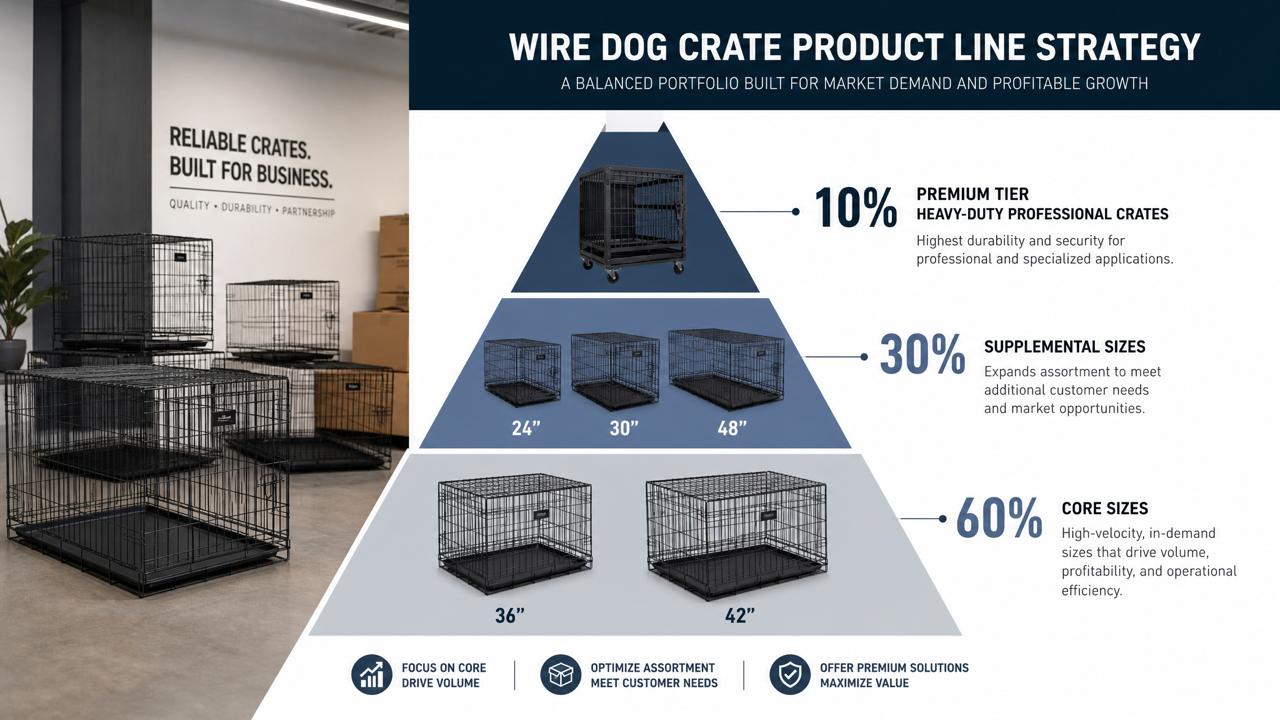
Recommended product line structure: core sizes with feature variants, supported by supplemental sizes
Recommended Product Line Structure
Core (60% of inventory investment): 36″ + 42″ crates. Stock two variants of each: Standard (single door, basic coating — budget segment) and Training (double door, divider panel, silent latch, reinforced welds — mid/premium segment). These two sizes in these two variants will cover the majority of consumer demand.
Supplemental (30% of inventory): 24″ + 30″ + 48″ crates. One variant each, positioned for specific consumer personas — compact apartment crate, mid-size family crate, giant-breed specialist crate.
Professional (10% of inventory): Heavy-duty versions of 36″/42″/48″ for kennel, shelter, and breeder buyers. Stackable design, chemical-resistant coating, volume pricing.
FAQ: Wire Dog Crate Selection for B2B Importers
The wire dog crate market rewards importers who understand what consumers actually look for, not what suppliers claim is popular. 36-inch and 42-inch training-grade crates are the core of any successful product line. Feature differentiation — divider panels, double doors, silent latches — separates inventory that sells from inventory that sits. And breed-specific sizing guidance, not generic weight charts, prevents the single largest cause of returns. Build your product line around what consumers search for. The margin difference pays for the quality upgrade many times over. For importers ready to source a training-focused crate lineup, our factory inquiry page outlines available specs and MOQs.
