
What Makes a Wire Dog Crate Sell? Training-Driven Features B2B Buyers Must Source
Sixty-four percent of dog owners buy wire crates for training. Not for containment. Not for travel. For training. And a $2.53 billion global crate market is growing at 4.4% a year toward $3.90 billion. If your crates have the seven training-grade features those buyers search for, you sell. If they don’t, you compete on price — and that math gets worse every year.
Here’s what that means: 59% of dog owners use a crate, and 64% bought theirs for training. Training is not a niche. It is the mainstream. The crate rotting on a warehouse shelf is almost always the one missing the features those buyers wanted. Below, we break down the training-driven market, the seven features that move inventory versus the ones that don’t, the professional endorsements that actually influence purchase decisions, and the regional patterns that tell you where to send what.
The Training-Driven Wire Dog Crate Market at a Glance
Global Market
$2.53B → $3.90B
by 2035, 4.4% CAGR
Training Motivated
64%
of all crate purchases
Vets Recommend Crates
58%
2nd-most influential purchase factor
Online Sales
61%
of pet products purchased online
The 7 Features That Separate Selling Crates from Sitting Inventory
A training-friendly wire dog crate is not defined by the word “training” on the box. It is defined by seven specific engineering features — the ones trainers, veterinarians, and experienced dog owners look for. Crates that have them sell. Crates that don’t end up in the “returns” pile. Market data backs this up: 54% of consumers prefer compact/foldable designs, 52% prioritize comfort, and 46% want durable metal. All three are served by the features below.
| # | Feature | Why It Matters for Sales | Factory Cost Add | Return Impact |
|---|---|---|---|---|
| 1 | Adjustable Divider Panel | Allows crate to grow with puppy — eliminates need for multiple purchases. Single most searched training feature. | $1.20–1.80 | Very High |
| 2 | Double-Door Configuration | Front + side access enables flexible placement during training. Commands 20-30% retail price premium over single-door. | $0.80–1.50 | Medium |
| 3 | Silent-Close Latch | Loud snaps startle training dogs — undermines positive association. Rubber-dampened latch costs $0.10 extra; prevents “scared my dog” reviews. | $0.10–0.15 | High |
| 4 | Locking Removable Tray | Prevents dog from pushing tray out from underneath. Locking clip on one short side (front); opposite short side is factory-sealed. Tray slides forward and is secured by the front clip. | $0.15–0.30 | Very High |
| 5 | Rounded Door Frame Edges | Dogs enter/exit dozens of times daily during training. Sharp edges cause injuries, negative reviews, potential liability. | $0.05–0.10 | Medium |
| 6 | Reinforced Weld Joints | Training dogs test every connection point. Standard welds fail under repeated stress — reinforced welds (4x4mm at hinge points) are the trainer standard. | $0.20–0.40 | High |
| 7 | Corrosion-Resistant Coating | Urine, saliva, and cleaning chemicals destroy cheap coatings within months. 72-hour salt spray test (ASTM B117) is the training-grade minimum. | $0.30–0.60 | Very High |
Bottom Line: $2.80–4.85 Per Crate
Total incremental factory cost to upgrade from standard to full training-grade specification. On a crate retailing at $35–90, this is 3–14% of retail price — and the return rate reduction alone typically pays for it. Importers should prioritize the “very high” return-impact features first: locking tray, coating, divider panel.
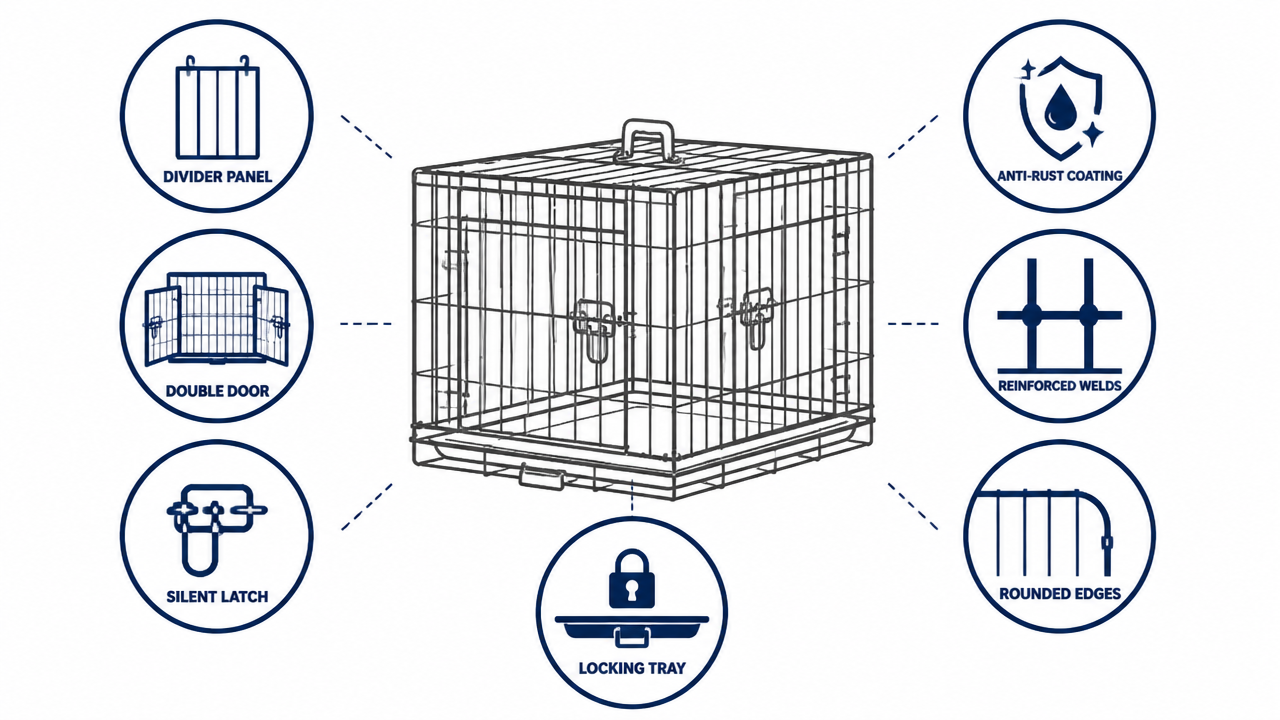
The seven training-grade features — a complete B2B sourcing checklist
What Veterinarians and Trainers Actually Recommend — The Professional Endorsement Factor
Professional endorsements are the second-most influential factor in consumer crate purchases after price. A 2025 survey found that 58% of veterinarians recommend crate use for safety, recovery, and behavioral management. But generic “vet recommended” labels on a box mean nothing without specific, verifiable features. Here is what they actually check — and what belongs in your purchase orders.
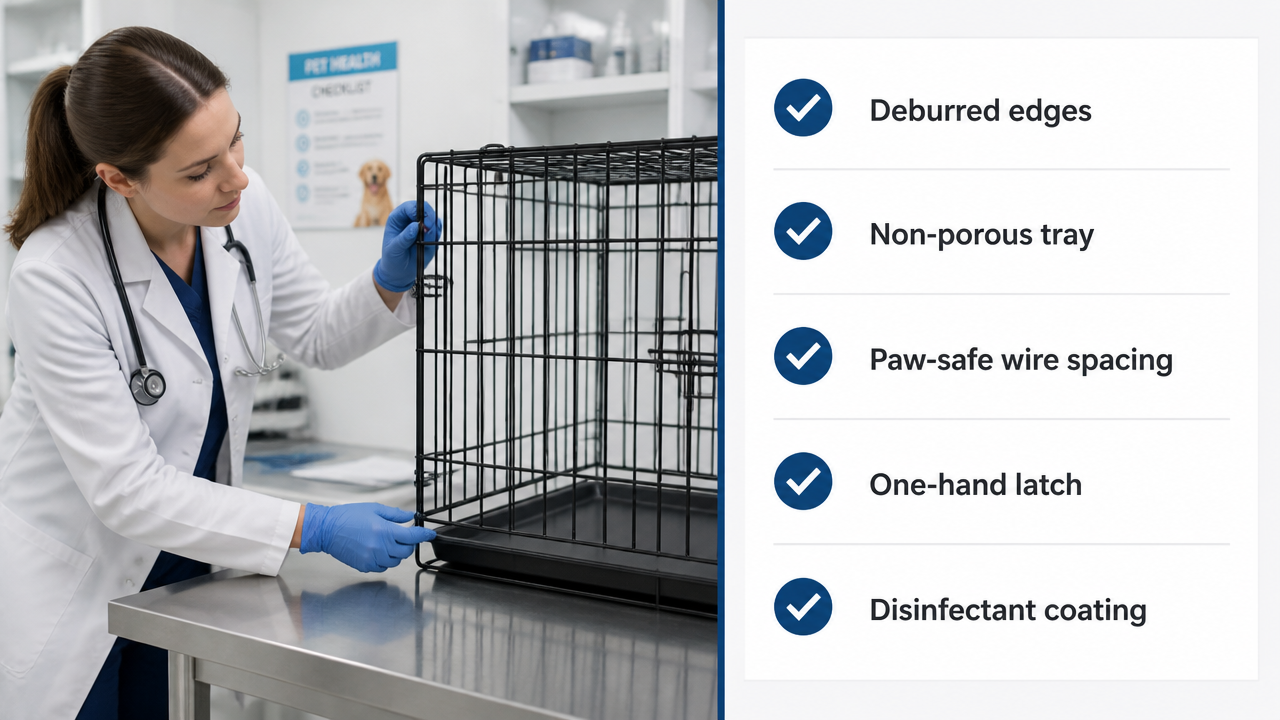
Veterinarian Requirements
All interior surfaces deburred. White-glove test on every weld, wire end, and door edge. Any sharp point = reject.
Non-porous removable tray. Fully immersible for disinfection. ABS plastic or coated steel.
Wire spacing for paw safety. Max 2.5cm for small breeds, max 4.0cm for large. Prevents entrapment.
One-handed latch operation. ≤5kg force. Critical when holding a patient.
Disinfectant-resistant coating. Must withstand quaternary ammonium cleaners without degradation.
Factory Insight: Professional dog trainers operating boarding facilities and shelters represent a distinct high-volume B2B sub-segment (20-500+ crates per order). These buyers care about durability over aesthetics: stackability, chemical-resistant surfaces, and reinforced latches. Meet their spec and they reorder annually — stable institutional revenue that complements consumer retail sales.
Regional Demand: Where Training Crates Sell and What to Stock
Training-driven crate demand varies significantly by region. Importers who stock the same product line globally are leaving money on the table. Regional differences in training culture, pet ownership, and e-commerce penetration create distinct product requirements. Below, what to stock where.
| Region | Share | Top-Selling Training Crate Profile | Key Note for Importers |
|---|---|---|---|
| North America | 38% | 36″–48″, double door, divider panel, heavy-duty variants for working dogs | Mature market. Feature completeness is table stakes — compete on quality, not price. |
| Europe | 27% | 30″–36″, eco-coating, EU REACH compliant, welfare-compliant minimum sizing | Regulatory minefield. Verify EU size standards before shipping — they differ from NA. |
| Asia-Pacific | 26% ↗ | 24″–36″, compact/foldable, 51% online purchase, fast-rising training awareness | Fastest growth. Urban apartment market — compact, feature-rich designs win here. |
| Middle East & Africa | 9% | Basic functional crates, price-sensitive, training awareness developing | Entry-level opportunity. Competitive price points, basic training features. |
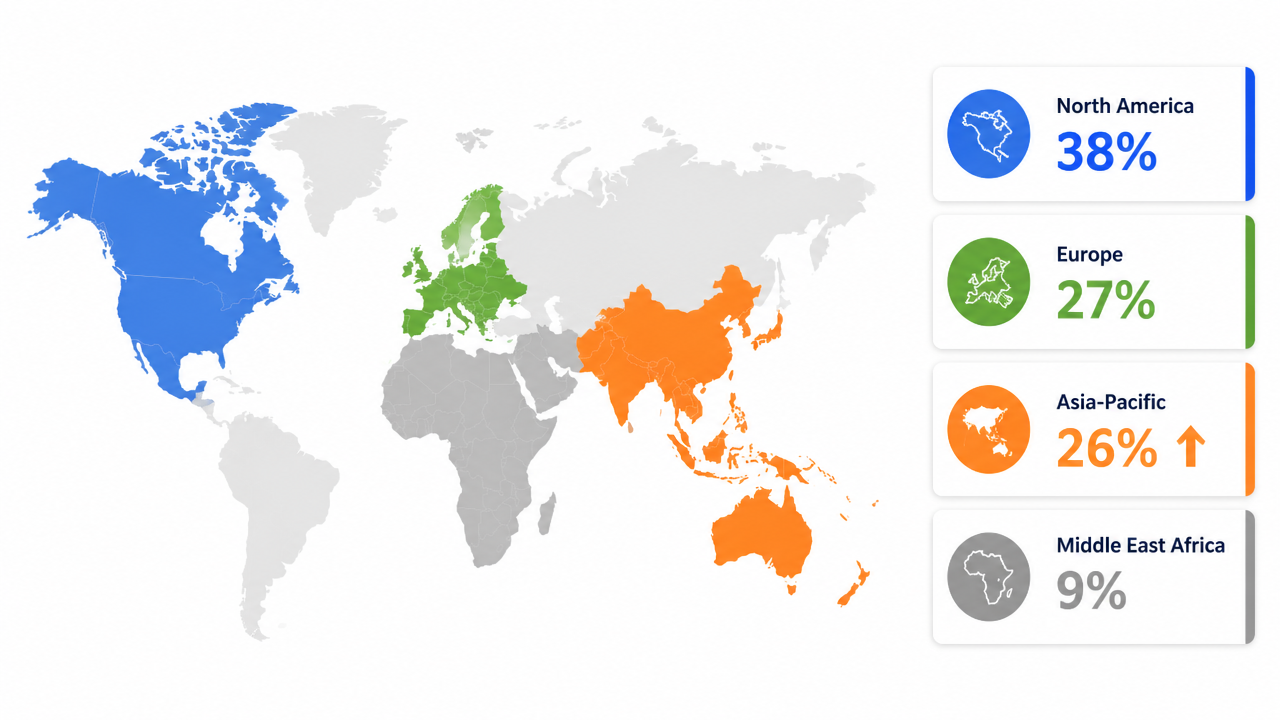
Regional training crate demand breakdown — source: Global Growth Insights 2026
Factory Insight: Asia-Pacific buyer inquiries for training-compatible features (divider panels, double doors, secure latches) are up 22% year-over-year, tracking the region’s rapid urbanization and pet humanization trend. Importers entering this market should lead with compact, feature-rich designs, not basic models. North America tells a different story: crates with comfort features (cover hooks, quiet latches) grew 22%, while heavy-duty demand (5.0mm+ wire) grew 18%. Two completely separate buyer segments. Two distinct product lines.
Three Pitfalls That Kill Training Crate Sales (and How to Avoid Them)
Pitfall 1: “Training Crate” Labels on Standard Products
The problem: Many suppliers market standard crates as “training crates” with zero design differentiation. Buyers discover the deception when returns pile up.
Quick check: Verify divider panel (spring steel clips, not sheet metal), double-door, and rounded door edges are physically present — not just listed on the spec sheet.
PO language: “Training crate must include adjustable divider panel with spring steel clips (min 1.5mm) and double-door configuration — not standard crate with ‘training’ label.”
Pitfall 2: Divider Panel Clips That Bend After One Week
The problem: Thin sheet-metal divider clips bend permanently after 3-5 adjustments. A puppy owner adjusts the divider weekly — 20+ times during growth. Bent clips become a safety hazard.
Quick check: Press firmly on each clip and verify spring-back. Spring steel clips (1.5mm minimum) are the training-grade standard.
PO language: “Divider panel clips must be spring steel, min 1.5mm thickness, with 90-day deformation warranty.”
Pitfall 3: Tray Lock on the Wrong Side
The problem: Trays without a proper locking clip on the accessible short side can be dislodged when a dog pushes forward. The correct design has a locking clip on one short side (front); the opposite short side is factory-sealed so the tray can only slide out from the clip side. Crates with clips on the long side, or with no lock at all, are the leading cause of “my dog escaped” returns.
Quick check: Push tray from inside with 15kg force. If it lifts more than 5mm, the lock is inadequate.
PO language: “Removable tray must have locking clip on one short side; opposite short side factory-sealed. Tray must not lift more than 5mm under 15kg internal force.”
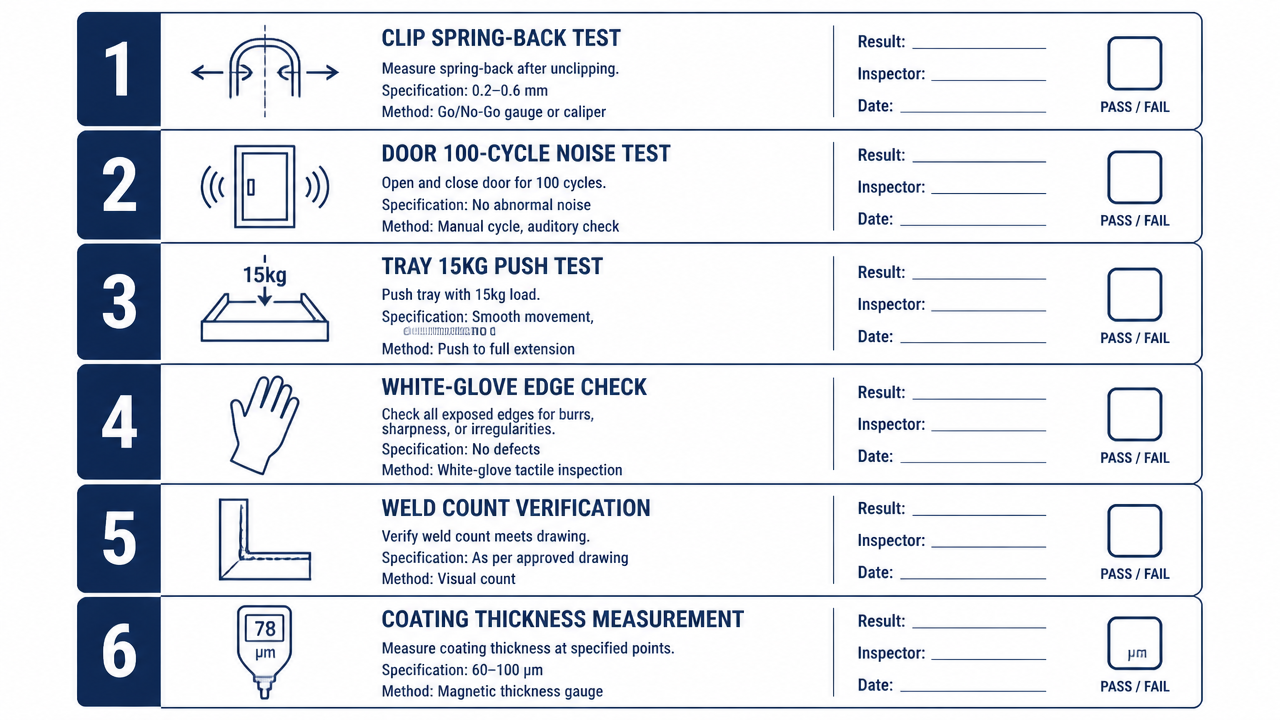
Six-point factory QC checklist for verifying training-grade wire dog crate specifications
FAQ: Training-Driven Wire Dog Crate Sourcing
The wire dog crate market is $2.53 billion and growing. Sixty-four percent of those purchases are training-driven. If you stock the seven features in this guide, you know what will sell. If you skip them, you’re guessing — and paying warehouse costs on inventory that doesn’t move. Build for the 64%.