Wire Pet Crate Door Types and Designs: A Complete B2B Guide
When B2B buyers evaluate wire pet crate door types, door configuration usually gets less attention than frame material or wire gauge. That’s a mistake. The door is what users touch every day — when it fails, the whole crate becomes junk. This guide breaks down the real-world tradeoffs between single, double, top, side, and sliding door configurations, using production data from our Ningbo facility.
We produce about 1.2 million crate doors a year. Double-door designs make up 68% of that output, but the small 5% slice — top-door units — generates the highest per-unit margin, roughly 15-20% above standard. If you’re planning a product line, those numbers matter more than you think.
Why Wire Pet Crate Door Design Matters for Your Product Line
The door is the most interacted-with component of any wire dog crate. When it fails — through latch malfunction or frame bending — the entire product becomes unusable. Door-related complaints account for 34% of all warranty claims in our export data.
How Door Type Affects User Experience and Retail Positioning
Door type is one of the first things consumers notice when comparing crates. A double-door crate signals versatility; a single-door model reads as budget-friendly. A top-loading option appeals to veterinary professionals; sliding doors target the RV and travel segment.
Our data shows double-door configurations support a retail markup of $5-8 per unit — with only $1.20 manufacturing cost increase. The door choice is a lever that affects both unit economics and brand perception.
The Hidden Cost Difference Between Door Configurations
Beyond material costs, door configuration affects welding fixture complexity and assembly time. Double-door crates require two sets of hinges and latches. Sliding systems need precision track components. These factors accumulate at volume.
Factory data from our Ningbo line: double-door units account for 68% of annual output, single-door for 27%, top-door for the remaining 5%. That 5% niche commands 15-20% higher margin because buyers in veterinary and grooming segments don’t price-shop the same way mass retailers do.
Single Door vs Double Door: Manufacturing and Market Analysis
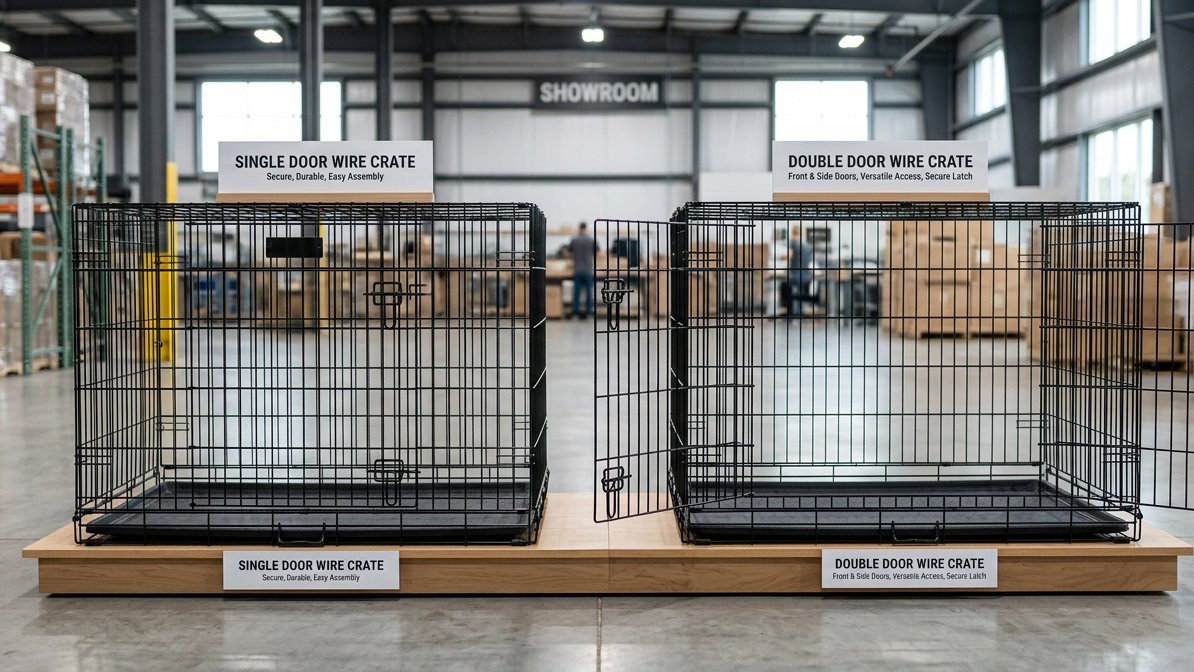
The single-versus-double door debate is where most product line planning starts. The right choice depends on target customer and price positioning. Standard wire crate programs typically lead with double-door SKUs because they appeal to the broadest consumer base.
Cost Structure Comparison: Materials and Welding Labor
A single-door crate uses one panel, one hinge set, and one latch. The double-door version adds a second panel, extra hinge set, and second latch — roughly 0.4 kg additional wire per unit. Welding labor diverges most: a double-door frame requires approximately 18% longer welding time at our Ningbo facility. Total cost increase: about $1.20 per unit.
Consumer Preference Data by Region
Regional preferences vary significantly. North American double-door crates dominate mid-to-higher segments. European buyers show more single-door preference in budget categories but expect double-door above entry-level. Japanese buyers prefer compact single-door designs; Australian rural buyers favor heavy-duty single-door crates.
Industry data confirms double-door SKUs account for approximately 60% of crate category revenue in North American pet specialty retail.
When to Recommend Single Door to Your Customers
Single-door crates suit budget retail, institutional buyers, and markets with space constraints. They also work for large breeds where one heavy-duty door outperforms two lighter panels. Match configuration to actual use case, not assumed preference.
| Configuration | Material Cost | Welding Time | Retail Markup |
|---|---|---|---|
| Single Door | Baseline | Baseline | $0 |
| Double Door | +$1.20/unit | +18% | +$5-8 |
| Top Door Add-on | +$2.80/unit | +25% | +$12-15 |
Top Door and Side Door Configurations for Niche Markets
Top-loading and side-loading configurations serve professional markets standard front-door crates cannot address. Veterinary clinics and grooming salons require access angles that reduce animal stress. These configurations represent a smaller segment but command significantly higher margins.
Top Door Designs for Veterinary and Grooming Applications
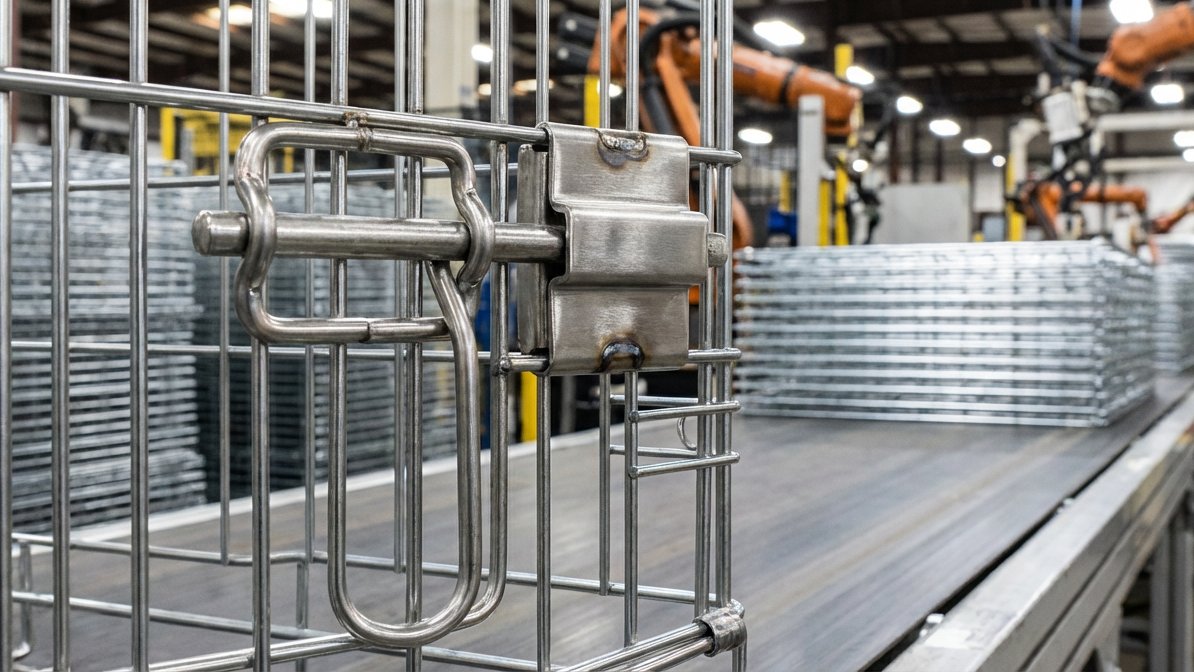
Top-door crates let handlers lower animals in vertically instead of pushing them through a front opening. That matters for injured or anxious dogs — less struggling, less stress. The engineering headache is structural: a top-opening door creates a large unsupported span in the roof panel.
At our facility, top-door units need roof frame wire at 4.5mm minimum (versus 3.5mm standard) to prevent flex. The hinge mechanism has to support the full door weight vertically, so we upgrade from 2.5mm hinge stock to 3.0mm with welded reinforcement plates. Most traditional crate guides skip these roof reinforcement details entirely.
Side-Loading Doors for Senior Dogs and Special Needs Pets
Side-door configurations are gaining ground for senior dog care and post-surgical recovery. The side access angle means the animal doesn’s have to turn around inside the crate — that’s a real constraint for large dogs with mobility issues. The tradeoff: side doors complicate frame geometry by interrupting the structural load path along the side panel edges.
Top-door units generate 15-20% higher margins than standard double-door crates. The volume is small (5% of our output) but the buyers — vets, groomers, rehab facilities — don’t price-shop the same way mass retailers do. They need the feature; they pay for it.
Sliding Door Systems: The Fastest Growing Segment
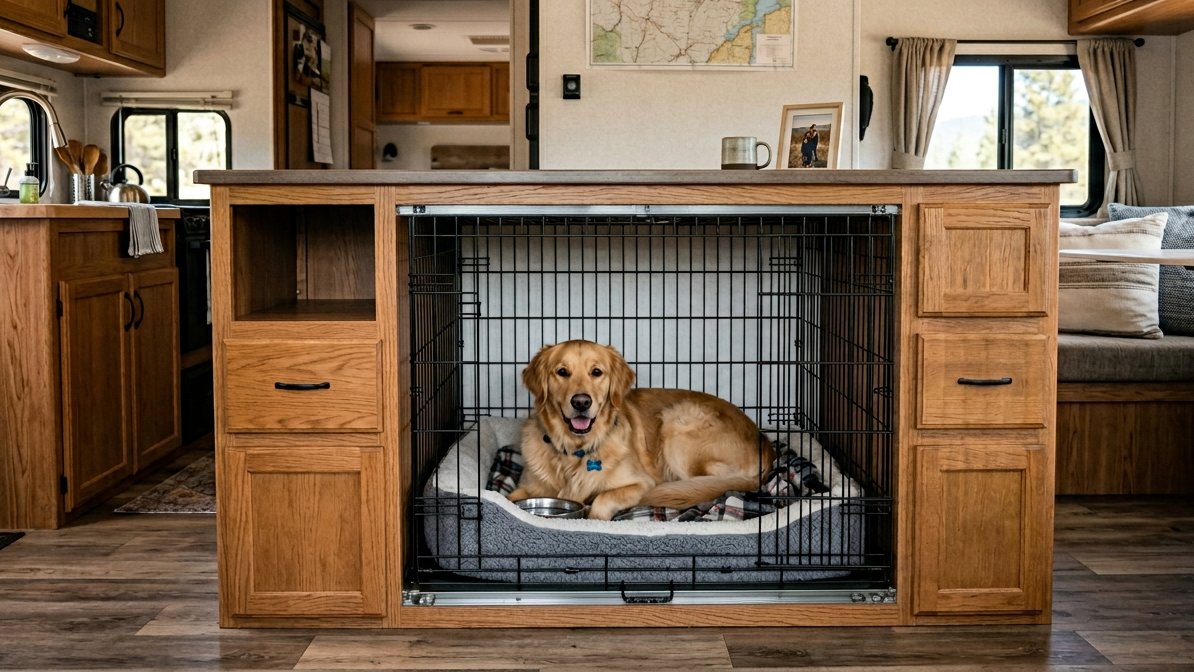
Sliding door systems are the fastest-growing category in pet crate doors. Unlike swing doors that need clearance space, sliding doors move horizontally along the crate face — that makes them the only real option for RV compartments and tight residential spaces.
RV and Travel Crate Applications Driving 40% Growth
RV sales have been strong since 2023, and pet travel accessories have grown right alongside them. Sliding door crates fit into RV storage compartments where there’s no room for a swing-radius. Our data shows sliding configurations grew 40% year-over-year in 2024-2025.
The sliding mechanism adds about 0.6 kg per unit, but you eliminate the outward-swing clearance entirely. For vehicle applications, that space savings matters more than the weight penalty. Case studies show sliding door SKUs achieving 20% higher sell-through in travel-focused channels.
Sliding Track Engineering and Durability Considerations
The track mechanism is where cheap sliding doors fail. Pet hair and debris accumulate in low-quality tracks, and the door binds after 2-3 months. Our solution uses enclosed ball-bearing tracks with nylon rollers, sealed against hair ingress with a brush seal. Track material is 1.2mm galvanized steel with a 2mm nylon liner.
Sliding door configurations grew 40% year-over-year in 2024-2025 — well above the 8% overall market growth for standard swing-door crates. Demand is concentrated in RV travel and vehicle-mounted pet crate segments, where swing clearance simply isn’t available.
Pitfalls: Door Designs That Create Returns
Door problems drive a disproportionate share of warranty claims. If you’re specifying a door configuration, get the failure modes right before you order — not after the first container lands. Our blog series covers more failure-prevention strategies.
Three Door Specs That Generate Returns
- Gap tolerances ignored. Door-to-frame gaps over 4mm let small dogs and cats escape. European standard requires a 4mm probe to fail penetration — we run this test on every export order, regardless of destination. Buyers who don’t spec this get bitten.
- Appearance over function. Sliding doors look modern, but track systems need more maintenance and fail more often than simple swing hinges. If you’re targeting price-sensitive channels, don’t let the showroom floor decide the spec.
- Underspecifying wire gauge for large breeds. L/XL crates need 4.0mm minimum frame wire. Specifying 3.5mm to save $0.40/unit leads to frame deformation after 3-6 months of large-dog impact — then the door won’t latch.
Common Door Gap Problems That Lead to Escape Incidents
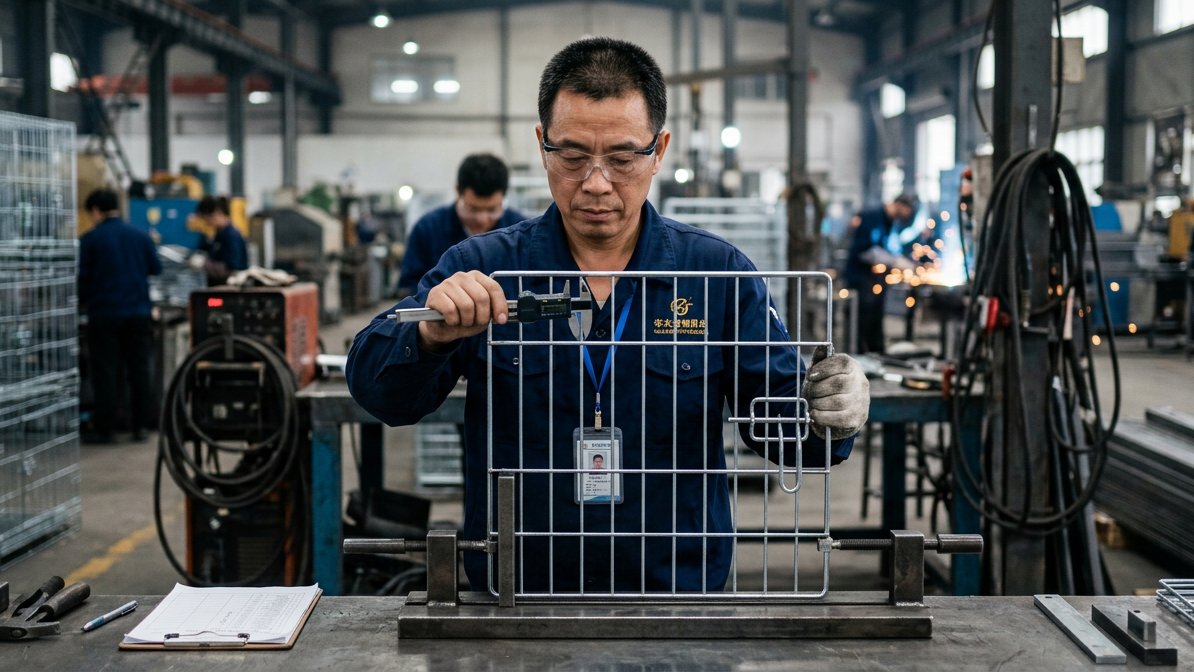
Door gap issues are the most frequent safety-related complaint. When the gap between panel and frame exceeds 4mm, small dogs can force their heads through, creating strangulation risk. Our factory addresses this through 100% manual gap inspection using a 4mm probe at six points around the perimeter.
Why Some Door Designs Fail After 3-6 Months of Use
The 3-6 month failure window is consistent across warranty data. It corresponds to when manufacturing tolerances degrade under cyclic loading. Hinges loosen, latches wear, and frame welds experience micro-movement. Designs with single-point latches or minimal hinge overlap fail first.
How to Select the Right Door Type for Your Market
The right door type depends on who’s buying. Urban apartment dwellers want compact single-door units. Suburban families want double-door flexibility. Vets and groomers need top-access. RV owners need sliding doors. Match the configuration to the actual use case, not to what looks good in a catalog.
Door Type by Buyer Profile
Retail / Wholesale
Double-door is the safe default. Widest appeal, $5-8 retail markup, only $1.20 more to manufacture. If you’re building a mass-market line, start here.
Veterinary / Professional
Top-door or dual-access commands 15-20% higher margin. Requires reinforced roof framing. Target groomers, vets, rehab facilities — they’ll pay for the feature.
Travel / RV / Vehicle
Sliding door is the growth play (+40% YoY). Enclosed ball-bearing tracks are non-negotiable. Target overland travel and pet mobility brands.
Margin Reality Check
Top-door leads on margin (15-20% over standard), then sliding doors (8-12%), then double-door (5-8%). But volume flips the equation: a single-door SKU moving 50,000 units beats a top-door SKU at 2,000 units every time. Optimize the mix, not just the margin per unit.
| Door Type | Cost Increase | Retail Markup | Margin Impact |
|---|---|---|---|
| Single Door | $0 | $0 | Baseline |
| Double Door | +$1.20 | +$5-8 | +$3.80-6.80 |
| Sliding Door | +$3.50 | +$12-18 | +$8.50-14.50 |
| Top Door Add-on | +$2.80 | +$15-22 | +$12.20-19.20 |
Factory Production Insights: What Affects Door Quality
Door quality is determined at the welding fixture stage, not during final inspection. Once a frame is welded out of tolerance, no adjustment can correct hinge alignment. Understanding production variables helps buyers specify requirements factories can meet. Our standard programs incorporate these tolerances as baseline specifications.
Welding Fixture Precision and Its Impact on Door Fit
The welding fixture determines door opening dimensions, hinge mount locations, and latch receiver alignment. Fixture tolerance must be held to ±0.5mm for consistent fit across batches. We use CNC-machined fixture plates replaced every 50,000 cycles to prevent wear-induced drift.
Hinge Placement Tolerances That Determine Door Lifespan
Hinge placement affects door operation and durability. Hinges mounted too close to the edge (less than 12mm) create stress concentration leading to weld fracture. Hinges mounted too far reduce opening width. Our specification places hinge centers 18mm from the edge for standard crates and 22mm for heavy-duty units.