
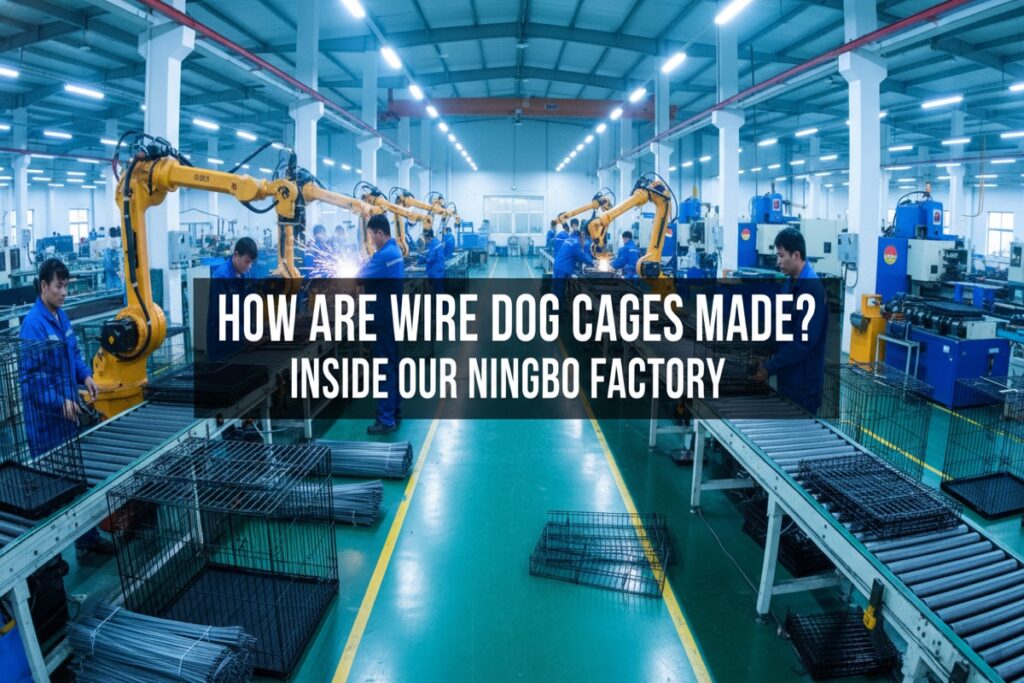
How Are Wire Dog Cages Actually Made? Inside a Ningbo Factory

In our experience running a wire dog cage factory in Ningbo, the most common question from first-time importers is: “Can I see exactly how you make these cages from start to finish?” Last month, a US importer visited our Yuyao facility and spent an entire day on our production floor. What he discovered changed his understanding of why quality cages take 35-45 days to produce—and why rushing the process compromises durability.
This guide takes you inside our Ningbo manufacturing facility to show you the complete wire dog cage production process. You’ll see the 7 stages every cage goes through, understand why each step matters for quality, and learn what separates a cage that lasts 10 years from one that fails in 2.
Understanding the manufacturing process helps you make better sourcing decisions, set realistic expectations for lead times, and identify quality issues before they become expensive problems.
What Are the 7 Stages of Wire Dog Cage Manufacturing?

Wire dog cage manufacturing follows a systematic 7-stage process. Each stage has specific quality control checkpoints, and skipping or rushing any stage compromises the final product’s integrity.
| Stage | Duration | Time % | Key Activities |
|---|---|---|---|
| 1. Raw Material Preparation | 1-2 days | 10% | Steel wire procurement, quality inspection, storage |
| 2. Wire Cutting & Bending | 2-3 days | 15% | Precision cutting, panel forming, dimension verification |
| 3. Panel Welding | 3-4 days | 20% | Spot welding, weld quality inspection, strength testing |
| 4. Frame Assembly | 2-3 days | 15% | Frame construction, door installation, hardware fitting |
| 5. Surface Treatment | 4-5 days | 25% | Degreasing, powder coating, curing, cooling |
| 6. Component Installation | 1-2 days | 10% | Tray installation, latch fitting, final assembly |
| 7. Quality Inspection & Packaging | 1 day | 5% | Final QC, packaging, labeling, warehouse storage |
Total production time: 15-20 days of actual manufacturing (the remaining 15-25 days in our 35-45 day lead time covers material procurement, scheduling, and shipping preparation).
What We Usually See at Our Yuyao Facility
This dual-line approach is why we can maintain our 35-45 day lead time even when handling both standard and custom orders. Factories that mix everything on one line often face unpredictable delays.
How Does Wire Cutting and Panel Fabrication Work?

The foundation of cage quality starts with precise wire cutting and panel formation. This stage determines the structural integrity and dimensional accuracy of the finished product.
Wire Gauge Selection and Material Inspection
Before cutting begins, we verify the wire gauge matches the order specifications. Our standard cages use 4.0mm diameter wire, but we stock multiple gauges for different applications:
| Wire Gauge | Diameter | Application | Strength Rating |
|---|---|---|---|
| 4.5mm | Extra Thick | XL breeds, commercial use | Extra Heavy Duty (150+ kg load) |
| 4.0mm | Thick (Our Standard) | Large breeds, standard use | Heavy Duty (120 kg load) |
| 3.5mm | Medium | Medium breeds | Standard Duty (90 kg load) |
| 2.8mm | Thin | Small breeds, light use | Light Duty (60 kg load) |
| 2.0mm | Very Thin | Dividers, accessories only | Lightweight (30 kg load) |
We use 4.0mm as our standard for 30-42 inch cages. This gauge provides optimal balance between strength, weight, and cost. Thinner wire saves money upfront but leads to structural issues over time.
Precision Cutting Process
Our CNC wire cutting machines cut to ±2mm tolerance. This precision matters because:
- Panels must align perfectly during welding
- Doors need consistent gaps for smooth operation
- Stackable cages require exact dimensions
- Replacement parts must be interchangeable
Each panel goes through dimensional verification before moving to the welding stage. Panels outside tolerance are rejected and recut.
We once had a client request 3.0mm wire for 42-inch cages to save $1.50 per unit. Three months later, 8 cages had bent doors from dogs pushing against them. The $100 they ‘saved’ cost them $400 in replacements plus damaged reputation. Now we refuse orders that compromise structural integrity, even if it means losing the sale.
What Happens During the Welding Process?

Welding is where wire panels transform into structural cages. The quality of welds directly determines how long a cage will last and how much force it can withstand.
Welding Technique and Quality Standards
We use resistance spot welding for all wire dog cage panels. Each weld point must meet these standards:
- Weld penetration: 60-80% of wire diameter
- Weld spacing: Every intersection point (no skipped welds)
- Weld appearance: Smooth, consistent, no burn-through
- Strength test: Must withstand 50kg pull force without separation
A standard 36-inch cage panel has approximately 120-150 weld points. Every single one matters for structural integrity.
Common Welding Defects We Screen For
| Defect Type | Cause | Impact | Our Rejection Rate |
|---|---|---|---|
| Incomplete Weld | Insufficient heat/pressure | Weak joint, potential failure | 1.5% |
| Burn-Through | Excessive heat | Weakened wire, sharp edges | 0.5% |
| Misalignment | Panel positioning error | Dimensional inaccuracy | 0.8% |
| Skipped Weld | Operator error | Structural weak point | 0.3% |
Our overall welding rejection rate is 2-3%. Rejected panels are either reworked (if the defect is minor) or scrapped (if structural integrity is compromised).
What We Usually See
Last quarter, we identified that 60% of coating defects originated from one specific welding station where burn-through created rough surfaces. We replaced the equipment and retrained the operator—rejection rate dropped from 2.1% to 0.8% within two weeks.
It’s better to catch welding issues here than after coating. We reject about 2-3% of panels at this stage—usually due to inconsistent weld spacing or incomplete penetration. Fixing a weld defect costs us $2 in labor. Fixing it after powder coating costs $15 because we have to strip the coating, re-weld, and re-coat.
How Does Surface Treatment Protect Wire Dog Cages?

Surface treatment is the most time-consuming stage (25% of production time) but also the most critical for long-term durability. This is where we protect the steel from rust and give the cage its finished appearance.
Why We Use Powder Coating
We switched from electroplating to powder coating 5 years ago for three reasons:
- Superior rust resistance: 60-80 micron coating thickness vs 8-12 microns for e-plating
- Environmental compliance: No heavy metals, meets EU REACH standards
- Durability: Resists chipping, scratching, and UV degradation better than plating
The trade-off is time—powder coating requires a 4-5 day process including preparation, application, curing, and cooling.
The 5-Step Powder Coating Process
| Step | Duration | Purpose | Quality Check |
|---|---|---|---|
| 1. Degreasing | 30 min | Remove oils, contaminants | Water break test |
| 2. Phosphate Treatment | 20 min | Improve coating adhesion | Visual inspection |
| 3. Powder Application | 15 min | Electrostatic powder coating | Thickness measurement |
| 4. Curing | 20 min at 180-200°C | Powder melting and bonding | Temperature monitoring |
| 5. Cooling & Inspection | 2-3 hours | Solidification, quality check | Visual + thickness test |
Total time per batch: 4-6 hours, but we can only run 2-3 batches per day due to oven capacity and cooling requirements.
Coating Quality Standards
Every coated cage must meet these specifications:
- Thickness: 60-80 microns (measured with digital gauge)
- Adhesion: Pass cross-hatch tape test (no peeling)
- Coverage: 100% coverage, no bare spots
- Appearance: Smooth finish, no orange peel or runs
- Color consistency: ΔE < 2.0 (color difference measurement)
Our coating rejection rate is 1-2%. Most rejections are due to uneven thickness or surface defects. Rejected cages are stripped and re-coated.
We switched to powder coating after a client’s shipment to Florida developed rust spots within 6 months. The humid coastal climate exposed the weakness of our old e-coating process. Now 90% of our US orders specify powder coating, and we haven’t had a rust complaint in 3 years.
What Quality Checks Happen During Production?

Quality control isn’t a single checkpoint at the end—it’s integrated into every production stage. We have 5 inspection points where cages can be rejected and reworked.
Our 5-Point Quality Control System
| Checkpoint | What We Check | Rejection Rate | Action Taken |
|---|---|---|---|
| After Welding | Weld quality, panel dimensions, structural integrity | 2-3% | Rework welds or scrap panel |
| After Coating | Surface finish, coating thickness, color consistency | 1-2% | Strip and re-coat |
| Final Assembly | Fit, function, door operation, hardware installation | 0.5-1% | Adjust or replace components |
| Pre-Packing | Complete inspection against order specs | 0.2% | Final fixes or replacement |
| Random Audit | Sample from finished goods (5% of batch) | <0.1% | Process improvement if issues found |
Cumulative rejection rate: 3.7-6.2% across all checkpoints. This means for every 100 cages we start, 4-6 don’t meet our standards and require rework or replacement.
What Happens to Rejected Cages?
We categorize defects into three levels:
- Minor defects (70% of rejections): Cosmetic issues, easily reworked. Examples: coating thickness slightly below spec, minor door alignment issues. These are fixed and re-inspected.
- Major defects (25% of rejections): Functional issues requiring significant rework. Examples: welding defects, dimensional errors. These go back to the appropriate production stage.
- Critical defects (5% of rejections): Structural or safety issues that cannot be economically repaired. These are scrapped, and the steel is recycled.
What We Usually See
Last quarter, we noticed that door alignment issues spiked on Mondays. Investigation revealed that our door installation jig wasn’t being properly calibrated after weekend shutdown. We implemented a Monday morning calibration check, and Monday rejection rates dropped to match other weekdays.
Two months ago, we discovered a batch of 200 cages had door alignment issues during final inspection. Instead of shipping and hoping the client wouldn’t notice, we spent 3 extra days fixing every single unit. The client never knew there was an issue—but we learned to add an extra alignment check right after door installation.
How Long Does Wire Dog Cage Production Actually Take?
Understanding production timing helps you plan orders realistically and avoid costly rush situations.
Standard Production Timeline (35-45 Days)
| Phase | Duration | Percentage | Variables |
|---|---|---|---|
| Order Confirmation | 1-2 days | 3% | Payment processing, specs finalization |
| Material Procurement | 7-10 days | 20% | Steel availability, supplier lead time |
| Production Setup | 2-3 days | 6% | Tooling preparation, line scheduling |
| Manufacturing | 15-20 days | 43% | Order quantity, complexity |
| Quality Control | 3-5 days | 11% | Inspection depth, rework needs |
| Packaging | 2-3 days | 6% | Packaging type, labeling requirements |
| Warehouse & Shipping Prep | 3-5 days | 11% | Documentation, container booking |
| Total Standard Lead Time | 35-45 days | 100% | For orders of 300-1000 pcs |
Our standard lead time of 35-45 days isn’t arbitrary—it’s based on 10 years of production data. We’ve optimized every phase, but some steps simply can’t be rushed without compromising quality.
Why We Can’t Deliver in 20 Days
Clients sometimes ask for 20-day delivery. Here’s why that’s not realistic for quality production:
- Material procurement alone takes 7-10 days: We don’t stockpile steel because specifications vary by order (wire gauge, quantity, coating requirements)
- Powder coating requires 4-5 days: This includes preparation, application, curing, and cooling. The curing process cannot be accelerated without compromising coating quality
- Quality control takes 3-5 days: Rushing inspections means defects slip through
- We need buffer time for unexpected issues: Equipment maintenance, material quality variations, weather affecting coating (humidity impacts powder adhesion)
Factories promising 20-day delivery are either:
- Using pre-made stock (which may not match your exact specifications)
- Skipping quality control steps
- Using thinner materials or inferior coatings
- Overcommitting and will actually deliver late
We once had a client who needed 500 units in 25 days for a trade show. We ran overtime shifts (16 hours/day for 2 weeks) and delivered on day 24. But we charged a 15% premium, and we made it clear this was an exception. Rush orders disrupt our entire production schedule and affect other clients’ deliveries.
What Happens If There’s a Quality Issue During Production?
Even with rigorous quality control, issues occasionally arise. How we handle them separates professional manufacturers from unreliable ones.
Our Problem Resolution Process
When we discover a quality issue during production:
- Immediate containment: Stop production of affected units, quarantine suspect inventory
- Root cause analysis: Identify what caused the issue (material defect, equipment malfunction, operator error, process deviation)
- Corrective action: Fix the root cause, not just the symptom
- Rework or replacement: Affected units are either repaired or scrapped depending on severity
- Verification: Re-inspect corrected units and monitor next batch closely
- Client communication: If the issue affects delivery timing, we notify the client immediately with updated timeline
Real Examples of Issues We’ve Handled
Coating adhesion problem (2 months ago): A batch of 150 cages showed coating bubbling during final inspection. Investigation revealed our degreasing solution had degraded. We stripped all affected cages, replaced the degreasing solution, and re-coated them. Added 4 days to delivery, but we absorbed the cost and notified the client proactively.
Dimensional variance (last quarter): Random audit found 3 cages in a 500-unit order were 1 inch shorter than specified. We traced it to a worn cutting blade. We replaced the blade, re-cut panels for the 3 affected cages, and inspected the entire batch. No additional cages were affected.
Door latch defect (6 months ago): A supplier sent us a batch of latches with weak springs. We caught it during assembly when doors wouldn’t stay closed properly. We rejected the entire latch shipment, sourced replacements from our backup supplier, and added 3 days to production. The client was informed and appreciated our transparency.
We have a policy: if we know we’ll be delayed by more than 3 days due to a quality issue, we notify the client immediately with the reason and new ETA. Transparency builds trust. Last year, we had a coating equipment breakdown that would have delayed 5 orders by 7 days. We rented backup equipment from another factory and kept the delay to just 2 days. It cost us extra, but we maintained our delivery commitments.
FAQ: Wire Dog Cage Manufacturing Process
Conclusion: Why Manufacturing Process Transparency Matters
Understanding how wire dog cages are actually made gives you the knowledge to make better sourcing decisions and set realistic expectations.
Key takeaways from our Ningbo manufacturing process:
- 7 stages, 35-45 days: Quality production cannot be rushed. Each stage has specific time requirements that ensure structural integrity and durability.
- 5 quality checkpoints: We reject 3.7-6.2% of units during production to maintain standards. This is normal for quality-focused manufacturing.
- 4.0mm wire is our standard: This gauge provides optimal balance of strength (120kg load capacity), durability, and cost for most applications.
- Powder coating takes 4-5 days: But it provides superior rust resistance (60-80 microns) compared to electroplating (8-12 microns).
- Transparency builds trust: We welcome factory visits, provide detailed production updates, and communicate proactively when issues arise.
The manufacturing process we’ve described isn’t unique to our factory—it’s what quality wire dog cage production looks like. Factories offering significantly shorter lead times or lower prices are cutting corners somewhere, whether it’s thinner wire, inferior coatings, or skipped quality checks.
When evaluating suppliers, ask to see their production floor. A manufacturer confident in their process will welcome your visit. One who makes excuses or only shows you a showroom may be hiding quality issues.
We’ve been manufacturing wire dog cages in Ningbo for over 10 years. The process we’ve described is the result of continuous improvement—learning from mistakes, investing in better equipment, and training our team. We’re proud to show clients our production floor because we have nothing to hide. Quality takes time, but it’s worth it.
External References: ISO 9001 Quality Management Standards | Powder Coating Institute | American Welding Society
