
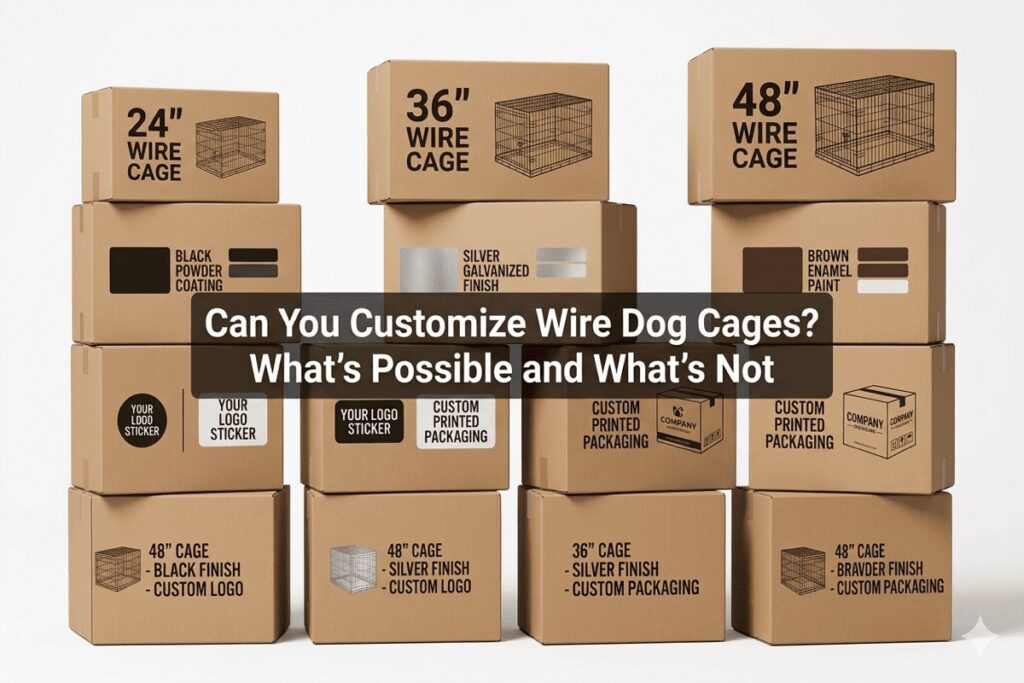
Can You Customize Wire Dog Cages? What’s Possible and What’s Not
At our Ningbo facility, we typically see that about 15-20% of orders involve some level of customization—but these custom orders generate over 30% of our profits. A UK retailer once asked us: “Can you make a 33-inch cage with a side door, custom color, and our logo?” The answer was yes—but with specific MOQ requirements and lead time implications.
Many buyers assume customization is either impossible or prohibitively expensive. The reality is more nuanced. Some modifications are straightforward and add minimal cost. Others require significant tooling investment that only makes economic sense at higher volumes. Understanding this distinction helps you plan realistic custom orders that balance your specific needs with production economics.
This guide reveals exactly what’s possible in wire dog cage customization, the MOQ requirements for each type of modification, and—equally important—what requests we decline and why. You’ll learn how to structure custom orders that meet your needs without breaking your budget or extending lead times unnecessarily.
What Types of Wire Dog Cage Customization Do We Offer?

We categorize customization into four levels based on complexity, tooling requirements, and MOQ. Each level has different cost impacts and lead time implications.
| Customization Level | MOQ | Price Impact | Lead Time Impact | Examples |
|---|---|---|---|---|
| Level 1: Size Modification | 300 pcs | +5-10% | +5-7 days | Custom length/width/height |
| Level 2: Color/Finish Change | 500 pcs | +8-12% | +7-10 days | Custom RAL/Pantone colors |
| Level 3: Feature Addition | 300-500 pcs | +10-20% | +10-14 days | Extra door, divider, wheels |
| Level 4: Complete Custom Design | 1000 pcs | +25-40% | +15-20 days | New structure, unique features |
Why these MOQ requirements exist: Each customization level involves fixed costs (tooling, setup, materials procurement, quality testing) that must be spread across enough units to make economic sense. We’ll break down these costs in detail later in this guide.
What We Usually See at Our Factory
Level 1 customizations are easiest because we just adjust our cutting templates—the rest of the production process stays the same. Level 4 customizations require new tooling and prototyping, which is why we need higher MOQ to justify the investment.
The sweet spot for most buyers is Level 1 or 2 customization with 500-piece orders. This balances flexibility with reasonable costs.
A German pet supply distributor approached us in 2022 after losing $15,000 on a failed order from another factory. They had ordered 500 custom-colored cages with a cheap supplier, but 15% arrived with rust issues within three months. We took over their account, explained why our powder coating process requires 500-piece MOQ minimum for custom colors, and delivered their first 800-piece order with zero quality complaints over three years. They now purchase 8 containers annually from us. The lesson: Customization without proper quality control is expensive for everyone.
How Does Size Customization Work?

Size modification is our most common customization request, accounting for roughly half of all custom orders. It’s also the most straightforward to implement.
Standard vs Custom Size Ranges
Our standard sizes are 24″, 30″, 36″, 42″, and 48″ (length). But we can produce any size within these parameters:
| Dimension | Standard Options | Custom Range | Increment |
|---|---|---|---|
| Length (L) | 24″, 30″, 36″, 42″, 48″ | 20″ – 54″ | 1 inch |
| Width (W) | 18″, 22″, 24″, 28″ | 16″ – 32″ | 1 inch |
| Height (H) | 20″, 24″, 28″, 32″ | 18″ – 36″ | 1 inch |
Structural limitations: While we can technically make any size within these ranges, certain dimensions create structural concerns:
- Width < 18 inches: Door functionality compromised, difficult for dogs to turn around
- Width > 32 inches: Panel stability issues with our standard 4.0mm wire
- Height > 36 inches: Excessive material waste, shipping cube inefficiency
- Aspect ratios > 3:1: Door alignment problems, structural weak points
Why Buyers Request Custom Sizes
The most common reasons for size customization:
- Shipping cost optimization (50% of requests): Adjusting dimensions by 1-2 inches can change shipping tier for last-mile delivery, saving $2-5 per unit
- Regional market preferences (30%): Different countries favor different sizes—what sells in Germany doesn’t always match US preferences
- Space constraints (15%): Retail floor space or customer home dimensions
- Specific breed requirements (5%): Greyhounds need length, Bulldogs need width
Last year, a US Amazon seller discovered that reducing their 36-inch cage by just 1.5 inches allowed them to ship via a cheaper parcel tier, saving $4.20 per unit in last-mile delivery costs. At 2,000 units monthly, that’s $100,800 annual savings—far exceeding the 8% customization premium they paid. However, we had to reject another client’s request for a 52-inch cage only 16 inches wide. The 3.25:1 aspect ratio would have created structural instability, with doors that wouldn’t align properly during shipping. We compromised at 24-inch width, which maintained integrity while still accommodating greyhounds.
What Color and Finish Options Are Available?
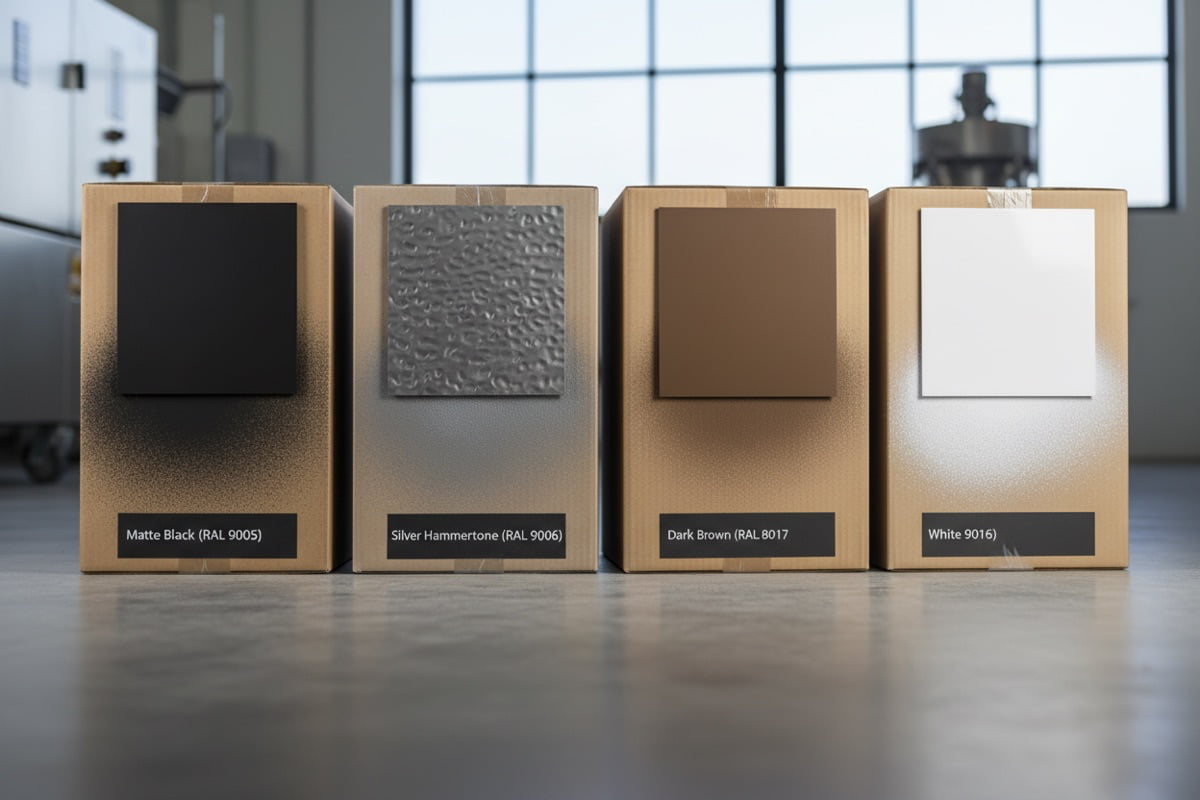
Color customization is our second most common request. While our standard colors satisfy most buyers, some markets or brands require specific colors for product differentiation.
Standard vs Custom Color Options
| Color Type | Options | MOQ | Lead Time | Price Impact |
|---|---|---|---|---|
| Standard Colors (In Stock) | Matte Black, Silver Hammertone | 300 pcs | Standard | Baseline |
| Standard Alternative Colors | Dark Brown, White, Gray | 300 pcs | +3-5 days | +3-5% |
| Custom RAL Colors | Any RAL color code | 500 pcs | +7-10 days | +8-12% |
| Pantone Matching | Brand-specific colors | 500 pcs | +10-12 days | +10-15% |
Why custom colors require higher MOQ: Powder coating suppliers have minimum order quantities (typically 25kg per color). A 25kg bag of powder coats approximately 450-550 cages depending on size. Orders below this threshold mean we absorb the cost of unused powder.
Color Matching Process
For custom colors, we follow this procedure:
- Color specification: Client provides RAL code, Pantone reference, or physical sample
- Powder procurement: We order custom powder from our supplier (7-10 days)
- Sample approval: We coat 2-3 sample panels and send photos/physical samples for approval
- Production: Once approved, we proceed with full batch
- Color consistency: We maintain color records for repeat orders
Color consistency challenges: Achieving exact color matches across batches is difficult due to variables like powder lot variations, curing temperature, and panel preparation. We specify ΔE < 2.0 (color difference measurement) as acceptable variance, which is industry standard for powder coating.
What We Usually See
For custom colors, we’ve done everything from “Amazon Blue” (RAL 5015) for a private label brand to champagne gold for a luxury pet furniture company. One client wanted three different colors (black, brown, white) in the same 500-piece order—we explained this would require three separate 500-piece batches, so they consolidated to just black.
The most challenging custom color we’ve done was matching a specific shade of rose gold. It took three sample iterations to get the metallic effect right.
We learned our most expensive color lesson in 2021 when a luxury pet furniture company requested a specific rose gold metallic finish. Three sample iterations and 18 days later, we finally matched their requirements—but the powder coating supplier charged us triple for the custom metallic formulation. The 500-piece order barely broke even after all the setup costs. Now, when clients request unusual metallics or specialty finishes, we quote 15% premium instead of our standard 8-12% for custom RAL colors. One client wanted three different colors (black, brown, white) in the same 500-piece order—we explained this would require three separate 500-piece batches, so they consolidated to black and brown, reaching 600 pieces total split 50/50.
Can You Add Custom Features to Wire Dog Cages?

Feature customization ranges from simple additions (extra accessories) to complex modifications (structural changes). Feasibility depends on engineering requirements and production complexity.
Common Feature Customization Requests
| Feature | Feasibility | MOQ | Cost Impact | Lead Time Impact |
|---|---|---|---|---|
| Extra Door (side/top) | Easy | 300 pcs | +$3-5/unit | +5 days |
| Removable Divider | Easy | 300 pcs | +$4-6/unit | +5 days |
| Caster Wheels (4pcs) | Medium | 300 pcs | +$6-8/unit | +7 days |
| Feeding Door/Opening | Medium | 500 pcs | +$5-7/unit | +10 days |
| Custom Latch Design | Hard | 1000 pcs | +$8-12/unit | +15 days |
| Flat-Pack Design | Very Hard | 2000 pcs | +$15-20/unit | +20 days |
Why Some Features Have Higher MOQs
Easy modifications (300 pcs MOQ): These use existing production processes and standard components. For example, removable dividers use the same wire panels and welding techniques as our main product—we just add clips and cut a few extra panels.
Medium modifications (500 pcs MOQ): These require sourcing new components or adjusting assembly processes. Feeding doors need specialized hinges and latches that we don’t stock—minimum order from hardware suppliers is typically 500 pieces.
Hard modifications (1000+ pcs MOQ): These require custom tooling, engineering validation, or partnerships with specialized suppliers. Electronic locks, for instance, require working with electronics manufacturers and integrating their components into our cages.
Our most painful customization failure involved a stainless steel cage request in 2020. The client wanted premium 304 stainless for a veterinary hospital chain. We lacked experience with stainless welding techniques, and the panels warped severely during production. The entire 200-unit batch required rework, costing us $3,200 in lost materials and labor. We completed the order at a loss but learned our lesson: unfamiliar materials require prototype validation first. Today, we decline stainless steel requests unless the client accepts 1000-piece MOQ to justify the tooling investment and process development. On the simpler side, a recent client said “Can’t you just add wheels? It’s only four bolts.” Those wheels needed to support 120kg, mount securely to our tube frame, and include locking mechanisms. We sourced industrial casters, designed mounting brackets, ran load tests—2 weeks of development and 500-piece MOQ to justify the tooling. What seemed “simple” required serious engineering.
What About Private Label and Branding?

Private label services are increasingly popular as buyers build their own brands rather than reselling generic products. We offer multiple branding options depending on budget and desired permanence.
Branding Methods and Requirements
| Branding Type | Method | MOQ | Setup Cost | Unit Cost | Permanence |
|---|---|---|---|---|---|
| Logo Sticker | Printed adhesive label | 300 pcs | $50 | +$0.20 | Removable |
| Laser Engraving | Permanent metal mark | 500 pcs | $200 | +$0.80 | Permanent |
| Custom Packaging Box | Printed color box | 500 pcs | $300-500 | +$2.50 | N/A |
| Hang Tag | Printed card with string | 300 pcs | $100 | +$0.30 | Removable |
| User Manual | Custom printed booklet | 500 pcs | $200 | +$0.50 | N/A |
Logo Placement Options
Common locations for logo placement:
- Front panel: Most visible, best for brand awareness
- Top panel: Visible when stored/stacked
- Door latch plate: Subtle but permanent location
- Plastic tray: Requires tray mold customization (MOQ 2000+ pcs)
Amazon FBA-Specific Branding
For Amazon sellers, we provide:
- FNSKU label application: We can apply Amazon labels before shipping (+$0.15/unit)
- Amazon-compliant packaging: Poly bag packaging, suffocation warnings, barcode placement
- Prep services: Taping, bubble wrap, case pack configuration
What We Usually See
We’ve helped about 15 brands develop from generic resellers to private label businesses. The typical path: Start with stickers → Add custom packaging → Upgrade to engraving → Eventually develop unique cage features.
One client went from selling 200 generic cages per month to 800 private label cages per month within 18 months. The key was consistent branding across product, packaging, and Amazon listing.
We’ve guided approximately 15 brands from generic resellers to private label businesses. The typical progression: start with logo stickers (300 pcs MOQ), add custom packaging (500 pcs), upgrade to laser engraving (500 pcs), eventually develop unique cage features (1000+ pcs). One standout client went from selling 200 generic cages monthly to 800 private label units within 18 months. Their breakthrough came when we helped them design custom hang tags with QR codes linking to training videos—simple addition, huge brand differentiation. Another client’s “Amazon Blue” (RAL 5015) branding became so recognizable that competitors started copying it. The key insight: consistent branding across product, packaging, and listing creates value that generic products cannot match.
Why Do You Have MOQ Requirements for Customization?

MOQ requirements aren’t arbitrary—they reflect real economic thresholds where customization becomes viable for both buyer and manufacturer.
Fixed Cost Breakdown by Customization Type
| Cost Component | Level 1 (Size) | Level 2 (Color) | Level 3 (Feature) | Level 4 (Design) |
|---|---|---|---|---|
| Tooling/Setup | $200 | $400 | $800 | $2000 |
| Custom Materials Procurement | $100 | $600 | $500 | $1200 |
| Quality Testing/Validation | $150 | $300 | $500 | $1000 |
| Production Line Disruption | $200 | $300 | $600 | $1500 |
| Total Fixed Costs | $650 | $1600 | $2400 | $5700 |
| MOQ (Break-even) | 300 pcs | 500 pcs | 500 pcs | 1000 pcs |
| Fixed Cost per Unit @ MOQ | $2.17 | $3.20 | $4.80 | $5.70 |
Why Small-Batch Customization Doesn’t Work
Let’s use a real example to illustrate the economics:
Scenario: Client wants 50 custom cages with unique door design (Level 3 customization)
Cost breakdown:
- Fixed costs: $2,400 (tooling, materials, testing, disruption)
- Variable costs: $18/unit × 50 = $900
- Total cost: $3,300
- Cost per cage: $66
At standard 500-piece MOQ:
- Fixed costs: $2,400
- Variable costs: $18/unit × 500 = $9,000
- Total cost: $11,400
- Cost per cage: $22.80
The difference: $66 vs $22.80 per cage—a 189% cost increase for small batch. Most buyers find this economically unviable.
1. Start with standard products to test market, scale to custom once validated
2. Combine multiple SKUs to reach total MOQ (e.g., 200 pcs of size A + 300 pcs of size B)
3. Partner with other buyers to split a custom order
4. Use post-production customization (stickers, packaging) instead of product modifications
A Canadian startup once insisted on 50 custom cages with unique door latches for their “beta launch.” We explained the math: tooling and setup costs alone were $2,400. At 50 units, fixed costs added $48 per cage. At our 500-piece MOQ, that drops to $4.80 per cage—a $43.20 difference per unit. They initially went to a competitor who accepted the small order, but paid $68 per cage versus our $26 at MOQ. Six months later they returned, having learned that “low MOQ customization” often hides costs in quality shortcuts or inflated unit pricing. We started them at 300 pieces with logo stickers, then scaled to 600 with color customization once demand validated. The economic logic is straightforward: customization requires fixed investments that must be amortized across sufficient volume.
What Customization Requests Do You Decline?
Not all customization requests are feasible or advisable. We decline roughly 10% of custom inquiries for these reasons:
Technical Impossibility
Example 1: Structural integrity concerns
- Request: 52-inch cage that’s only 16 inches wide (for greyhounds)
- Problem: This 3.25:1 aspect ratio creates excessive panel flex. Doors won’t align properly, and the cage could twist during shipping
- Solution offered: 52″L × 24″W maintains structural integrity while accommodating the breed
Example 2: Material limitations
- Request: Iron content below 50% for customs classification
- Problem: Wire dog cages require minimum 60% iron content for structural welding. Below this threshold, welds fail under stress
- Resolution: We declined this request as technically impossible
Economic Infeasibility
Small quantity with high complexity:
- Complete redesign for 100 units
- Custom molded plastic components for 200 units
- Flat-pack design for 300 units (requires complete re-engineering)
These requests have fixed costs of $3,000-8,000 that can’t be absorbed at low volumes.
Quality/Safety Risks
Compromising structural integrity for cost savings:
- Using 2.0mm wire for 48-inch cage (our engineering minimum is 4.0mm)
- Removing reinforcement bars to save weight
- Using cheaper coatings that don’t pass our salt spray testing
We refuse these requests even if the buyer insists—our reputation depends on product durability.
Unrealistic Lead Times
Custom design delivered in 2 weeks when realistic timeline is 6 weeks. We’d rather lose the order than overpromise and disappoint.
We recently declined a 500-piece order for a non-standard cage measuring 38″×20″×26″. The client was surprised—we had accepted their size request, why refuse now? The issue: no matching plastic tray existed for these dimensions. Custom tray molds cost $8,000-12,000, requiring 2,000+ piece orders to justify. The alternative—using a smaller 36″ tray—left a 2-inch gap that customers would complain about. We offered two solutions: adjust to our standard 36″ length with existing tray, or increase order to 2,000 pieces for custom tray tooling. They chose the 36″ standard and placed 800 pieces. This illustrates why we ask about tray requirements early in custom size discussions—dimensions are only part of the equation.
FAQ: Wire Dog Cage Customization
Conclusion: Making Customization Work for Your Business
Wire dog cage customization offers powerful opportunities for product differentiation and brand building, but success requires understanding the economic and technical realities behind MOQ requirements and cost structures.
Key takeaways for custom wire dog cage sourcing:
- MOQ 300-1000 pieces depending on complexity: These thresholds reflect real fixed costs that must be spread across sufficient units
- 15-20% of our orders involve customization: But these custom orders generate 30%+ of profits due to differentiation premium
- Start simple, scale complexity: Begin with Level 1-2 customization (size, color), progress to Level 3-4 (features, redesign) as volumes grow
- Sample approval is critical: 2-3 prototype units prevent expensive mistakes on full production runs
- Some requests we decline: Technical impossibility, safety concerns, or economic infeasibility mean roughly 10% of custom inquiries don’t proceed
The most successful custom cage programs follow a clear path: validate demand with standard products (300-500 pieces), add simple branding (stickers, packaging), transition to color customization (500 pieces), and finally invest in feature development or complete redesigns (1000+ pieces) once market fit is proven.
Customization isn’t about making everything possible—it’s about finding the right balance between your specific needs, production economics, and market opportunity. Understanding these constraints helps you structure requests that meet your goals without breaking budgets or creating unrealistic expectations.
After handling hundreds of custom orders, our core advice is simple: validate before customizing. About 60% of successful custom clients follow the same path—start with 300-500 standard pieces to test market response, then layer in customization once demand proves sustainable. The most expensive mistake we see is investing in Level 4 custom designs before confirming market fit. One client spent $15,000 on tooling for a “revolutionary” cage design that sold poorly. They would have learned the same lesson with $2,000 in 3D renderings and sample units. Conversely, our most successful custom client started with basic logo stickers, gradually added custom packaging, then invested in unique features only after hitting 1,000+ monthly units. Customization amplifies success—it doesn’t create it. Start standard, validate demand, then customize what the market has already proven it wants.
External References: RAL Color Chart | Pantone Color Matching System
