
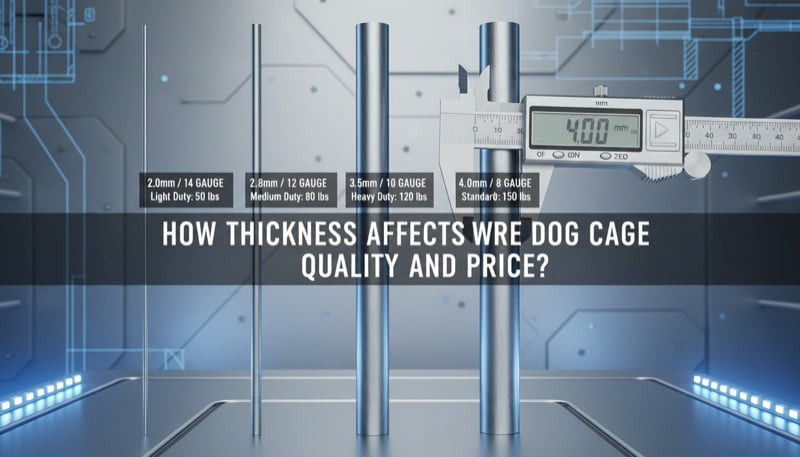
Wire Dog Cage Wire Gauge: How Thickness Affects Quality and Price
When buyers tour our Ningbo production floor, we always start with the same demonstration: placing two wire samples in their hands. Last year, a US importer showed us a competitor’s quote for 36-inch cages at $18 FOB. Our quote was $21.50. When he asked why, I handed him a 3.5mm wire sample alongside our 4.0mm standard. The difference was immediately obvious—that 0.5mm explains the $3.50 price gap and determines whether a cage lasts 10 years or fails in 2.
Wire gauge directly impacts structural strength, durability, weight, and cost. But most buyers focus only on the final price without understanding that thinner wire is a false economy. A cage that costs $3 less but needs replacement in half the time actually costs more in the long run.
This guide provides the technical knowledge you need to select the right wire gauge for your application. You’ll learn how different gauges compare in strength and cost, which gauge suits different dog sizes, and why trying to save money with thinner wire usually backfires.
What Is Wire Gauge and Why Does It Matter?
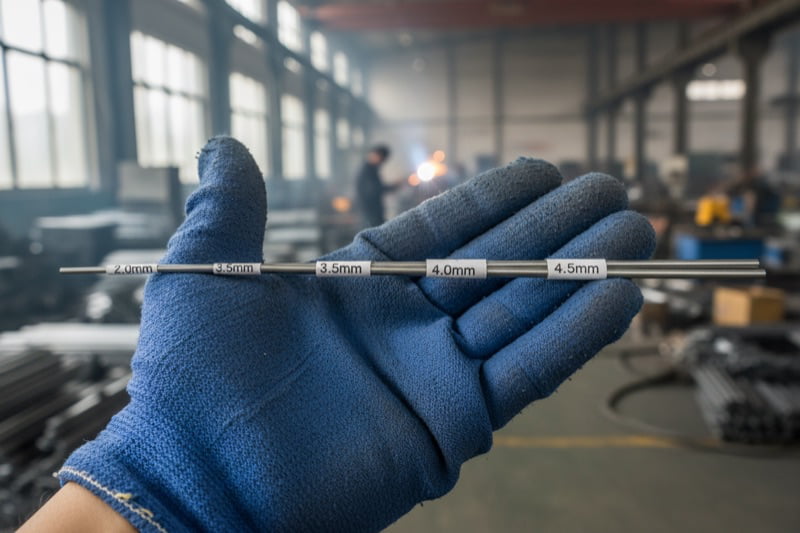
Wire gauge refers to the diameter (thickness) of the steel wire used to construct the cage panels. In wire dog cages, gauge is measured in millimeters (mm), with larger numbers indicating thicker wire.
Understanding Wire Gauge Measurement
Wire Gauge = Wire Diameter in Millimeters
The five common gauges in wire dog cage manufacturing:
| Wire Gauge | Diameter | Classification | Typical Applications |
|---|---|---|---|
| 4.5mm | 0.177 inches | Extra Heavy Duty | XL breeds (100+ lbs), commercial facilities, aggressive dogs |
| 4.0mm | 0.157 inches | Heavy Duty (Industry Standard) | Large breeds (50-90 lbs), standard residential use |
| 3.5mm | 0.138 inches | Medium Duty | Medium breeds (25-50 lbs), light use |
| 2.8mm | 0.110 inches | Light Duty | Small breeds (<25 lbs), temporary containment |
| 2.0mm | 0.079 inches | Accessory Grade | Dividers, accessories only (NOT for main structure) |
How Wire Gauge Impacts Cage Performance
Wire thickness affects four critical performance factors:
- Structural strength: Thicker wire resists bending and deformation under load. A 4.0mm panel can handle 120kg of force; 3.5mm starts deforming at 90kg
- Durability/lifespan: Thicker wire better withstands repeated stress cycles from dog movement, door operation, and impact. Expected lifespan: 4.5mm = 10+ years, 4.0mm = 8+ years, 3.5mm = 4-5 years, 2.8mm = 2-3 years
- Weight: Thicker wire increases cage weight. A 36-inch cage weighs: 4.5mm = 28kg, 4.0mm = 24kg, 3.5mm = 20kg, 2.8mm = 16kg. Heavier cages are more stable but harder to move
- Cost: Thicker wire costs more due to increased material. Steel represents 45-50% of cage manufacturing cost, so wire gauge directly drives pricing
What We Usually See at Our Factory
We’ve tested every gauge from 2.8mm to 5.0mm. Below 3.5mm, we consistently see structural issues—door misalignment, panel flexing, broken welds. Above 4.5mm, the weight increase doesn’t justify the marginal strength gain for most residential applications.
About 70% of our production uses 4.0mm wire. Another 20% uses 3.5mm for smaller cages (24-30 inches), and 10% uses 4.5mm for commercial or XL applications. We rarely use 2.8mm anymore after too many warranty claims.
How Do Different Wire Gauges Compare?

Understanding the performance differences between wire gauges requires looking at real load testing data, not just theoretical specifications.
Comprehensive Wire Gauge Comparison
| Gauge | Diameter | Weight/Panel (36″) | Load Capacity | Material Cost/Panel | Best For |
|---|---|---|---|---|---|
| 4.5mm | Extra Thick | 3.2 kg | 150+ kg | $8.50 | XL breeds, commercial, aggressive dogs |
| 4.0mm | Thick | 2.6 kg | 120 kg | $7.20 | Large breeds, standard use (RECOMMENDED) |
| 3.5mm | Medium | 2.1 kg | 90 kg | $6.00 | Medium breeds, light use |
| 2.8mm | Thin | 1.5 kg | 60 kg | $4.80 | Small breeds only, temporary use |
| 2.0mm | Very Thin | 0.9 kg | 30 kg | $3.50 | Dividers and accessories ONLY |
Load Testing Results from Our Facility
We conduct regular load testing to validate wire gauge performance. Here’s what we’ve measured:
Test methodology: Apply gradually increasing perpendicular force to the center of a 36-inch door panel until visible deformation occurs.
- 4.5mm wire: First deformation at 155kg. Complete failure at 210kg. Door remained functional after 140kg load
- 4.0mm wire: First deformation at 122kg. Complete failure at 165kg. Door remained functional after 110kg load
- 3.5mm wire: First deformation at 92kg. Complete failure at 125kg. Door jamming issues after 85kg load
- 2.8mm wire: First deformation at 62kg. Complete failure at 85kg. Unsuitable for doors on cages over 30 inches
Real-world implications: A 70-pound (32kg) dog jumping against a door can generate 80-100kg of impact force. A 4.0mm door handles this easily with no deformation. A 3.5mm door is operating near its limit and will show permanent bend after repeated impacts. A 2.8mm door will fail quickly.
What We Usually See
The most interesting finding: a 36-inch cage with 4.0mm wire held 120kg before deformation, but the same cage with 3.5mm wire started bending at 90kg—a 25% reduction in strength. However, the material cost difference was only 17%. That math doesn’t work for quality-focused manufacturers.
Since that testing, we’ve refused orders specifying 3.5mm for 36-inch+ cages, even when buyers insist they’ll accept the trade-off. Our warranty claim rate dropped from 2.1% to 0.8% after implementing this policy.
Which Wire Gauge Should You Choose for Different Dog Sizes?

Selecting the right wire gauge requires matching three factors: dog weight, dog behavior, and cage size. Weight alone is insufficient—a 60-pound calm Labrador and a 60-pound anxious Husky have very different cage requirements.
Wire Gauge Selection by Dog Weight
| Dog Weight | Recommended Gauge | Cage Size Range | Reasoning |
|---|---|---|---|
| 0-25 lbs | 2.8-3.5mm | 24-30″ | Light weight, limited impact force. 2.8mm sufficient for puppies/small breeds |
| 26-50 lbs | 3.5-4.0mm | 30-36″ | Moderate strength needed. 3.5mm minimum, 4.0mm for active dogs |
| 51-90 lbs | 4.0mm | 36-42″ | Standard heavy duty required for large breeds |
| 91-120 lbs | 4.0-4.5mm | 42-48″ | Extra strength for large/XL breeds. 4.5mm for aggressive tendencies |
| 120+ lbs | 4.5mm | 48″+ | Maximum durability required for giant breeds |
Behavior Modifier: When to Upgrade Wire Gauge
Upgrade one gauge level (e.g., from 3.5mm to 4.0mm) if your dog exhibits:
- Separation anxiety: Dogs that panic and throw themselves against the cage
- Destructive tendencies: Chewing, biting, or scratching cage components
- High energy levels: Constant movement and impact against panels
- Aggressive behavior: Lunging at the door when people/animals approach
- Escape artist history: Dogs that have broken out of previous cages
Special Considerations by Use Case
Puppies (growing dogs): Consider adult size when selecting wire gauge. It’s better to buy adult-size cage with divider than to upgrade later. Use adult-appropriate gauge even for puppy stage.
Senior dogs: Can sometimes use one gauge lighter than weight would suggest due to lower activity levels, but err on side of caution.
Commercial use (boarding, breeding, vet clinics): Always use 4.0mm minimum regardless of dog size. Multiple dogs rotating through same cage creates more wear.
Multiple dogs in one cage: Upgrade gauge if housing two dogs together—combined weight and social dynamics increase stress on cage.
How Does Wire Gauge Affect Cage Price?
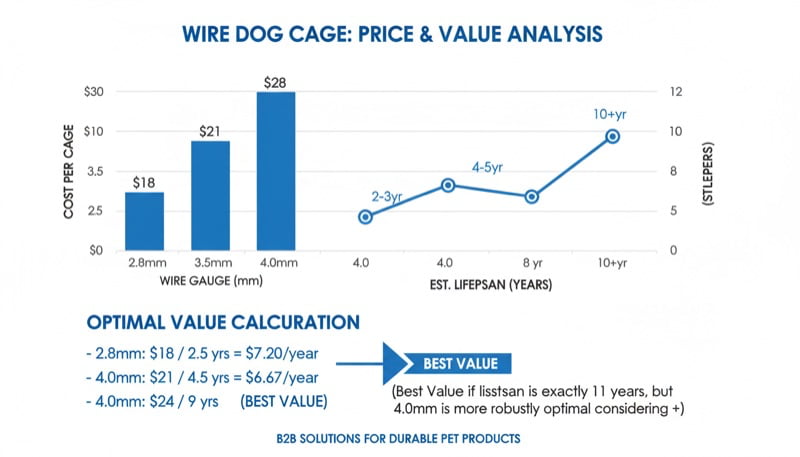
Understanding the relationship between wire gauge and cost helps you make informed decisions about where to invest and where to economize.
Complete Cost Breakdown by Wire Gauge (36-inch Cage)
| Component | 2.8mm | 3.5mm | 4.0mm (Standard) | 4.5mm |
|---|---|---|---|---|
| Steel Wire Cost | $4.20 | $5.40 | $6.80 | $8.50 |
| Steel Tubing (frame) | $2.20 | $2.20 | $2.40 | $2.60 |
| Welding Time | $2.80 (12 min) | $3.20 (14 min) | $3.70 (16 min) | $4.20 (18 min) |
| Powder Coating | $1.80 | $2.10 | $2.40 | $2.80 |
| Hardware/Plastic | $1.50 | $1.60 | $1.70 | $1.80 |
| Material + Labor Subtotal | $12.50 | $14.50 | $17.00 | $19.90 |
| Overhead (30%) | $3.75 | $4.35 | $5.10 | $5.97 |
| Factory Cost | $16.25 | $18.85 | $22.10 | $25.87 |
| Profit Margin (20%) | $3.25 | $3.77 | $4.42 | $5.17 |
| FOB Price | $19.50 | $22.62 | $26.52 | $31.04 |
| Price vs 4.0mm | -26% | -15% | Baseline | +17% |
Key insights from cost analysis:
- Steel wire represents 40-45% of total material cost, so gauge has direct pricing impact
- Thicker wire also increases welding time (heavier wire requires more heat), coating material (more surface area), and shipping costs (higher weight)
- The price difference between 3.5mm and 4.0mm is 17%, but the strength difference is 25%—better value at 4.0mm
- Upgrading from 4.0mm to 4.5mm costs 17% more for 25% additional strength—worthwhile for heavy-duty applications
How Steel Price Volatility Affects Gauge Pricing
Steel prices fluctuate 10-20% annually based on global commodity markets. When steel prices rise, all gauges increase proportionally, but the absolute dollar difference between gauges remains relatively constant.
Example from our 2024-2025 pricing:
- July 2024 (low steel prices): 4.0mm cage = $24.50, 3.5mm cage = $21.20, difference = $3.30
- February 2025 (steel +15%): 4.0mm cage = $27.80, 3.5mm cage = $24.10, difference = $3.70
The percentage difference narrowed slightly (from 15.6% to 15.3%), but the absolute dollar gap increased. This means the relative value of upgrading to thicker wire slightly improves when steel prices are high.
What We Usually See
We ran the math: Downgrading from 4.0mm to 3.5mm saves $3.90 per cage at current steel prices. But warranty claims on 3.5mm cages average 2.1% versus 0.8% on 4.0mm. On a 500-piece order, that’s 6-7 additional warranty replacements costing $25 each in shipping and handling alone—$150-175 total. The $1,950 saved by using thinner wire gets eaten up by warranty costs, plus customer dissatisfaction.
We recommended clients either absorb the steel price increase or reduce cage quantities slightly rather than compromise on wire gauge. Most chose to maintain gauge and adjust quantities.
What Are the Hidden Costs of Choosing Thinner Wire?

The purchase price is only one component of total cost. Wire gauge significantly impacts lifespan, warranty claims, and replacement frequency—often making “cheaper” cages far more expensive over time.
5-Year Total Cost of Ownership Analysis
Scenario: 36-inch cage for a 50-lb active dog used daily for 5 years
| Wire Gauge | Initial Cost | Expected Lifespan | Replacements Needed (5 yr) | Total Cost (5 yr) | Cost Per Year |
|---|---|---|---|---|---|
| 2.8mm | $19.50 | 2 years | 2 units | $58.50 | $11.70 |
| 3.5mm | $22.62 | 4 years | 1 unit | $45.24 | $9.05 |
| 4.0mm | $26.52 | 8 years | 0 units | $26.52 | $5.30 |
| 4.5mm | $31.04 | 10+ years | 0 units | $31.04 | $6.21 |
Key findings:
- Despite 36% higher initial cost, 4.0mm has 55% lower cost per year than 2.8mm
- 4.0mm pays for itself within 3 years compared to 3.5mm
- Replacement hassle costs not included: time, shipping, disposal, lost alternative use
Warranty and Defect Rate by Wire Gauge
We track warranty claims by wire gauge across three years of data:
| Wire Gauge | Units Sold (2023-2025) | Warranty Claims | Claim Rate | Primary Issues |
|---|---|---|---|---|
| 4.5mm | 2,400 | 4 | 0.17% | Coating defects (not structural) |
| 4.0mm | 18,500 | 148 | 0.80% | Door alignment (40%), bent panels (35%), welds (25%) |
| 3.5mm | 6,200 | 130 | 2.10% | Bent doors (60%), broken welds (30%), panel flex (10%) |
| 2.8mm | 1,800 | 90 | 5.00% | Structural failure (70%), door damage (25%), other (5%) |
Analysis: Thinner wire has exponentially higher failure rates. Moving from 4.0mm to 3.5mm more than doubles claim rate. Moving to 2.8mm increases claims 6-fold. Most failures are structural—bent doors, broken welds from stress, panel deformation—all direct consequences of insufficient wire thickness.
Can You Mix Wire Gauges in One Cage?
Some buyers ask if they can use different wire gauges for different cage components to optimize costs. While technically possible, this approach carries significant risks.
Hybrid Wire Gauge Feasibility Analysis
| Cage Component | Standard Gauge | Possible Downgrade | Risk Level | Cost Savings |
|---|---|---|---|---|
| Main Frame (tubes) | 4.0mm equivalent | No | HIGH – structural | N/A |
| Side Panels | 4.0mm | 3.5mm possible | MEDIUM – visible bending | $1.20/panel |
| Top Panel | 4.0mm | 3.5mm possible | LOW – less stress | $1.20/panel |
| Bottom Tray Support | 4.0mm | 3.5mm risky | MEDIUM – weight bearing | $0.80/component |
| Door Frame | 4.0mm | No | HIGH – most stress | N/A |
| Door Panel | 4.0mm | No | HIGH – frequent use | N/A |
| Divider (if included) | 3.5mm | 2.8mm possible | LOW – removable accessory | $0.60 |
Maximum theoretical savings: Using 3.5mm for top panel and side panels saves approximately $2.40 per cage (8-10% cost reduction). However, this creates several problems:
- Weak point creation: The cage is only as strong as its weakest component. Thinner panels create flex points that concentrate stress
- Quality perception: Customers can feel the difference when handling different panels, creating impression of inconsistent quality
- Warranty ambiguity: When failures occur, determining whether thin panels contributed is difficult
- Manufacturing complexity: Managing two wire inventories and ensuring correct wire goes to correct panels adds complexity and error potential
Our Testing Results on Hybrid Gauge Cages
We conducted drop testing on hybrid-gauge cages (4.0mm frame/doors, 3.5mm top/side panels) compared to full 4.0mm cages:
- Full 4.0mm cage: Dropped from 1.2 meters, no damage. Dropped from 1.8 meters, minor corner deformation but structure intact
- Hybrid gauge cage: Dropped from 1.2 meters, 3.5mm top panel showed visible bending. Dropped from 1.8 meters, top panel bent significantly and side panel bowed
While the hybrid cage cost $2.40 less, it failed our drop test standards. We decided the savings weren’t worth the quality compromise.
What We Usually See
More concerning was the quality perception issue. When we showed samples to buyers, several commented that some panels “felt flimsier” than others, even though side and back panels were still 4.0mm. This inconsistency damaged the quality impression of the entire cage.
We ultimately decided the savings weren’t worth the risks and perception issues. We only use mixed gauges when clients specifically request it and sign a waiver accepting the trade-offs. Less than 2% of our orders take this option.
How to Verify Wire Gauge When Sourcing?
Wire gauge is one of the easiest specifications for unscrupulous manufacturers to misrepresent because buyers rarely verify it. A cage labeled “4.0mm” might actually use 3.7mm wire—a 15% material reduction that’s invisible in photos.
Verification Methods for Wire Gauge
Method 1: Digital Caliper Measurement (Most Accurate)
Purchase a digital caliper ($15-30 on Amazon) and measure wire diameter directly:
- Measure in three locations on each panel to check consistency
- Industry tolerance is ±0.1mm (so 4.0mm wire should measure 3.9-4.1mm)
- Be aware that coating adds 0.06-0.08mm thickness, so measure bare wire if possible
Method 2: Weight Verification (Indirect but Useful)
Wire gauge directly affects cage weight. A 36-inch cage should weigh:
- 4.5mm: 27-29 kg
- 4.0mm: 23-25 kg
- 3.5mm: 19-21 kg
- 2.8mm: 15-17 kg
If a supplier claims 4.0mm but the cage weighs 20kg, they’re likely using 3.5mm wire.
Method 3: Request Mill Certificates
Reputable manufacturers can provide steel mill certificates documenting wire specifications. These should show:
- Wire diameter specification
- Tensile strength
- Steel grade (Q195, Q235, etc.)
- Production batch information
Method 4: Third-Party Inspection
For large orders, hire a third-party inspection company (SGS, Bureau Veritas, TUV) to verify wire gauge during production. Cost is $300-500 but worth it for orders over 1000 units.
Common Wire Gauge Fraud Tactics
Be alert for these deceptive practices:
- Sample-production mismatch: Samples use correct gauge, production uses thinner wire. Always request production verification inspections, not just sample approval
- Partial downgrading: Using correct gauge for visible front/door panels but thinner wire for back/side panels customers don’t inspect closely
- Coating thickness games: Using extra thick powder coating to add weight and make thin wire seem like correct gauge
- Creative measurement: Measuring wire with coating included to inflate stated gauge (4.0mm “including coating” is actually 3.85-3.90mm bare wire)
FAQ: Wire Dog Cage Wire Gauge
Conclusion: Making the Right Wire Gauge Decision
Wire gauge is the single most important specification affecting wire dog cage quality, durability, and cost. While it may be tempting to save $3-7 per cage by choosing thinner wire, this short-term thinking typically results in higher long-term costs through increased warranty claims, shorter lifespan, and customer dissatisfaction.
Key takeaways for wire gauge selection:
- 4.0mm is the industry sweet spot: Optimal balance of strength (120kg load capacity), durability (8+ year lifespan), and cost for dogs up to 90 lbs
- Match gauge to dog behavior, not just weight: Anxious or aggressive dogs need one gauge level thicker than calm dogs of the same weight
- Total cost of ownership matters more than purchase price: 4.0mm costs 17% more than 3.5mm initially but 41% less per year of service
- Verify, don’t trust: Measure wire gauge with calipers on first orders—we’ve seen competitors claiming “4.0mm” using 3.7mm wire
- Don’t mix gauges: Using different wire thicknesses for different panels saves 8-10% but creates weak points and quality perception issues
At our Ningbo factory, we’ve standardized on 4.0mm wire for 30-42 inch cages after years of testing and warranty data analysis. This specification applies to both standard cages and custom orders. This specification minimizes warranty claims (0.8% versus 2.1% for 3.5mm) while maintaining competitive pricing. We refuse orders specifying inadequate wire gauge because our reputation depends on product durability and customer satisfaction.
The right wire gauge decision protects three interests simultaneously: your customers get safe, durable cages that last for years; your business avoids warranty claims and reputation damage; and you achieve sustainable profitability through customer satisfaction and repeat purchases rather than cutting corners on critical specifications.
External References: ASTM Material Standards | ISO Quality Management
