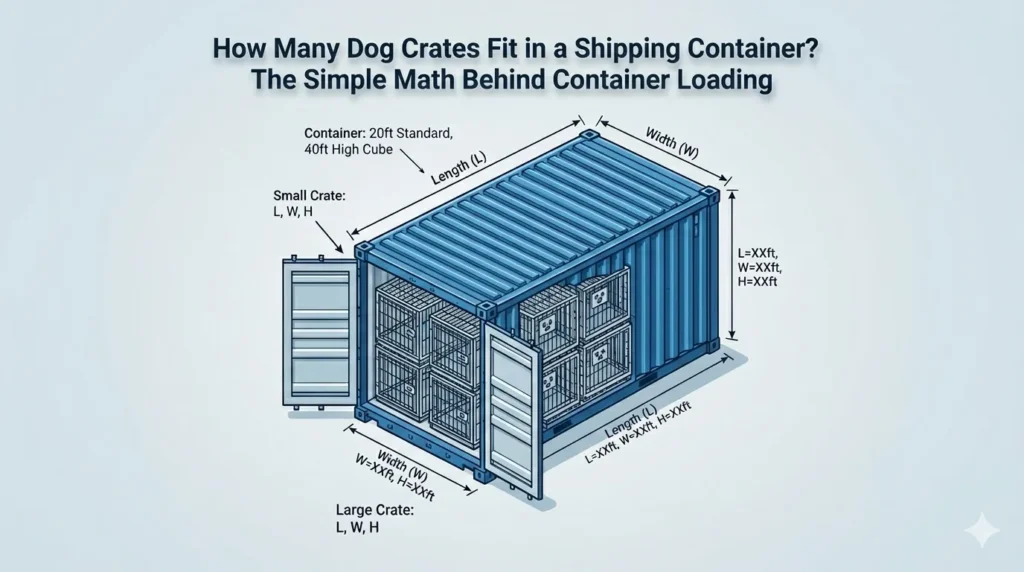
How Many Dog Crates Fit in a Shipping Container? The Simple Math Behind Container Loading
A buyer once ordered 600 units of 42-inch crates and asked for two 20GP containers. We told him one 40HC would fit. He saved about $1,200 in freight — and got the same number of crates.
The math behind that decision: divide the container volume by the carton volume. That’s the only formula you need. What matters is plugging in the right numbers.
Common Pitfalls When Calculating Container Loading
- Pitfall 1: Using product dimensions instead of carton dimensions. The crate itself is smaller than the carton. Calculate with the outer carton size — the product size gives you a number that’s 10-15% too high.
- Pitfall 2: Not leaving room for loading clearance. A container is never 100% full. That’s why we use 26/56/66 CBM instead of 28/58/68. Plan for 5-8% loading buffer.
- Pitfall 3: Choosing the wrong container size. Under-ordering means paying for empty container space. Over-ordering means a second shipment you didn’t budget for. Know your per-container quantity before you commit to an order.
Why Loading Calculation Matters Before You Order
Knowing your per-container quantity does two things for your business.
First, it tells you how many units to order. If you sell 200 crates a month and one 40HC holds 844 units of 42-inch crates, that’s about 4 months of inventory. You can plan your cash flow and warehouse space before the order leaves our factory.
Second, it tells you when to reorder. Ocean freight takes 30-45 days. If you know a container lasts 4 months, you place the next order at the 3-month mark. No stockouts, no rush fees, no air freight emergencies.
The Formula: Simple Division
Here’s the only formula you need:
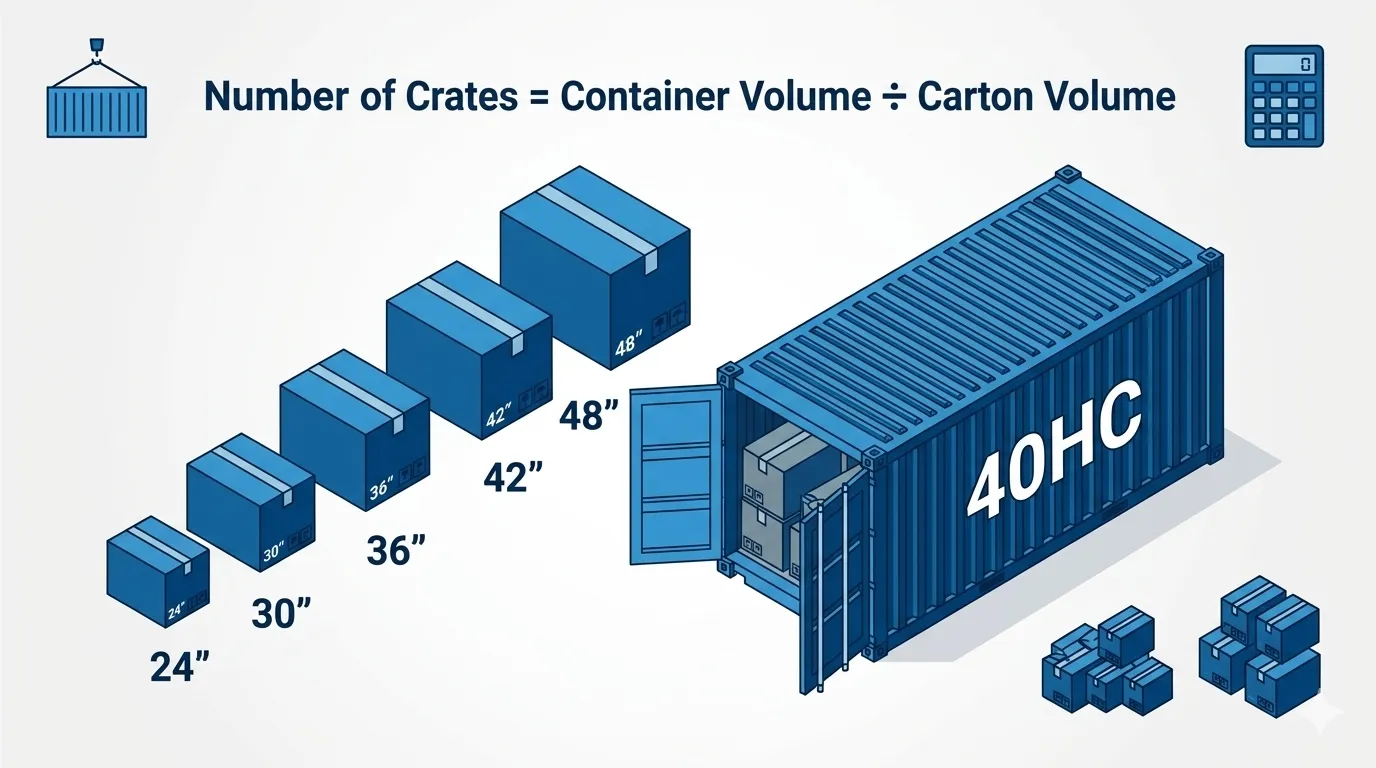
Number of crates = Container volume ÷ Carton volume
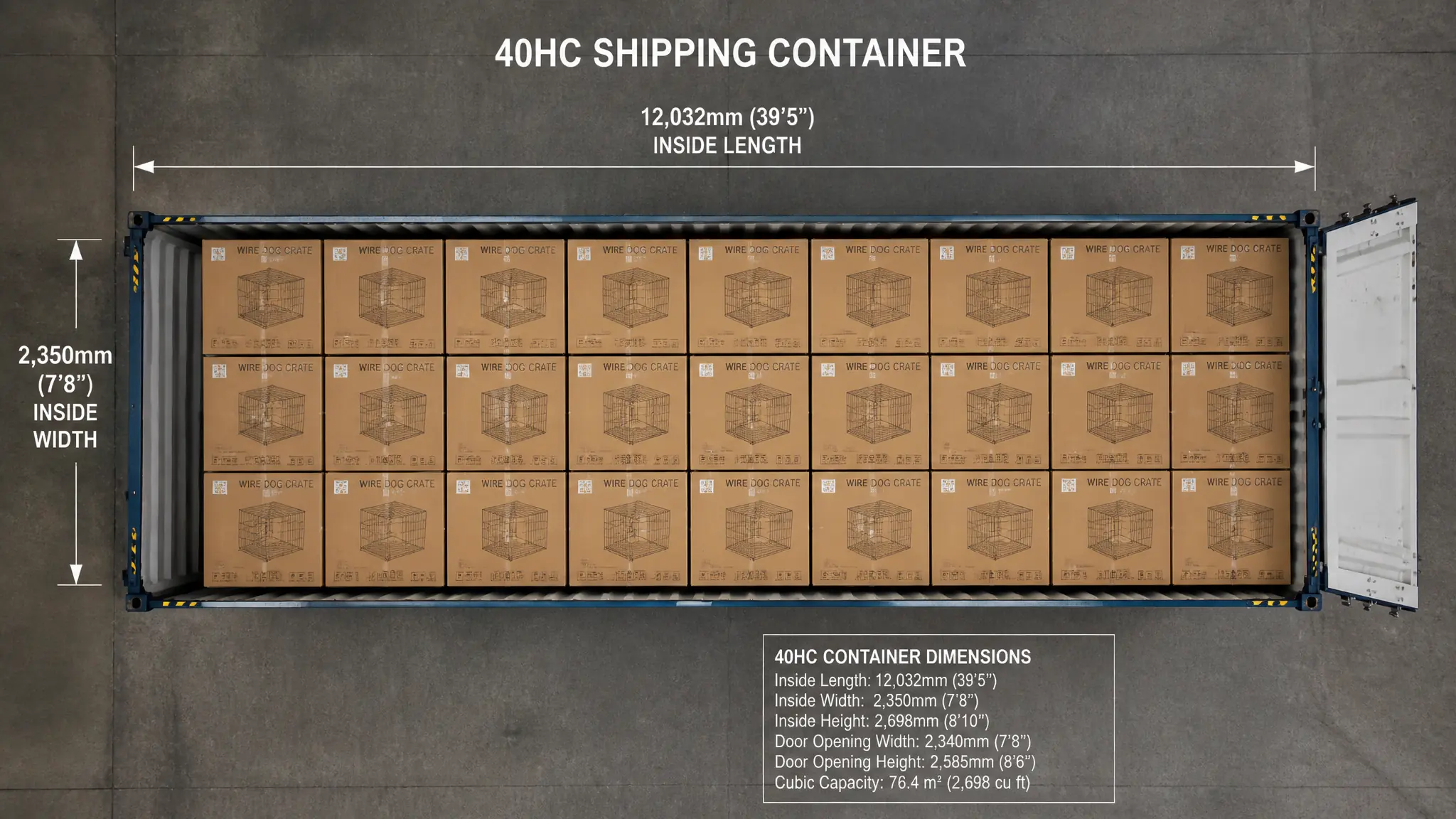
The container volumes we use are conservative. We take the actual container capacity and subtract 2 CBM for loading clearance:
| Container Type | Actual Volume | Calculation Volume |
|---|---|---|
| 20GP | ~28 CBM | 26 CBM |
| 40GP | ~58 CBM | 56 CBM |
| 40HC (40HQ) | ~68 CBM | 66 CBM |
The 2 CBM buffer accounts for the space between cartons, the container door mechanism, and the fact that no loading is perfectly tight. Better to tell a buyer 332 units and deliver 335 than to promise 340 and deliver 332.
Real Numbers: How Many Crates Per Container
Using the actual carton dimensions from our standard product line, here are the per-container quantities for every size:
| Crate Size | Carton (L×W×H mm) | Volume (CBM) | 20GP (26 CBM) | 40GP (56 CBM) | 40HC (66 CBM) |
|---|---|---|---|---|---|
| 24-inch | 640×100×477 | 0.0305 | ≈852 | ≈1,836 | ≈2,164 |
| 30-inch | 795×100×510 | 0.0405 | ≈642 | ≈1,383 | ≈1,630 |
| 36-inch | 940×100×600 | 0.0564 | ≈461 | ≈993 | ≈1,170 |
| 42-inch | 1085×100×720 | 0.0781 | ≈332 | ≈716 | ≈844 |
| 48-inch | 1255×100×780 | 0.0979 | ≈265 | ≈571 | ≈673 |
These numbers are based on single-size orders. Mixed-size orders: add up the volumes of each size group and divide by the container volume. The math works the same way.
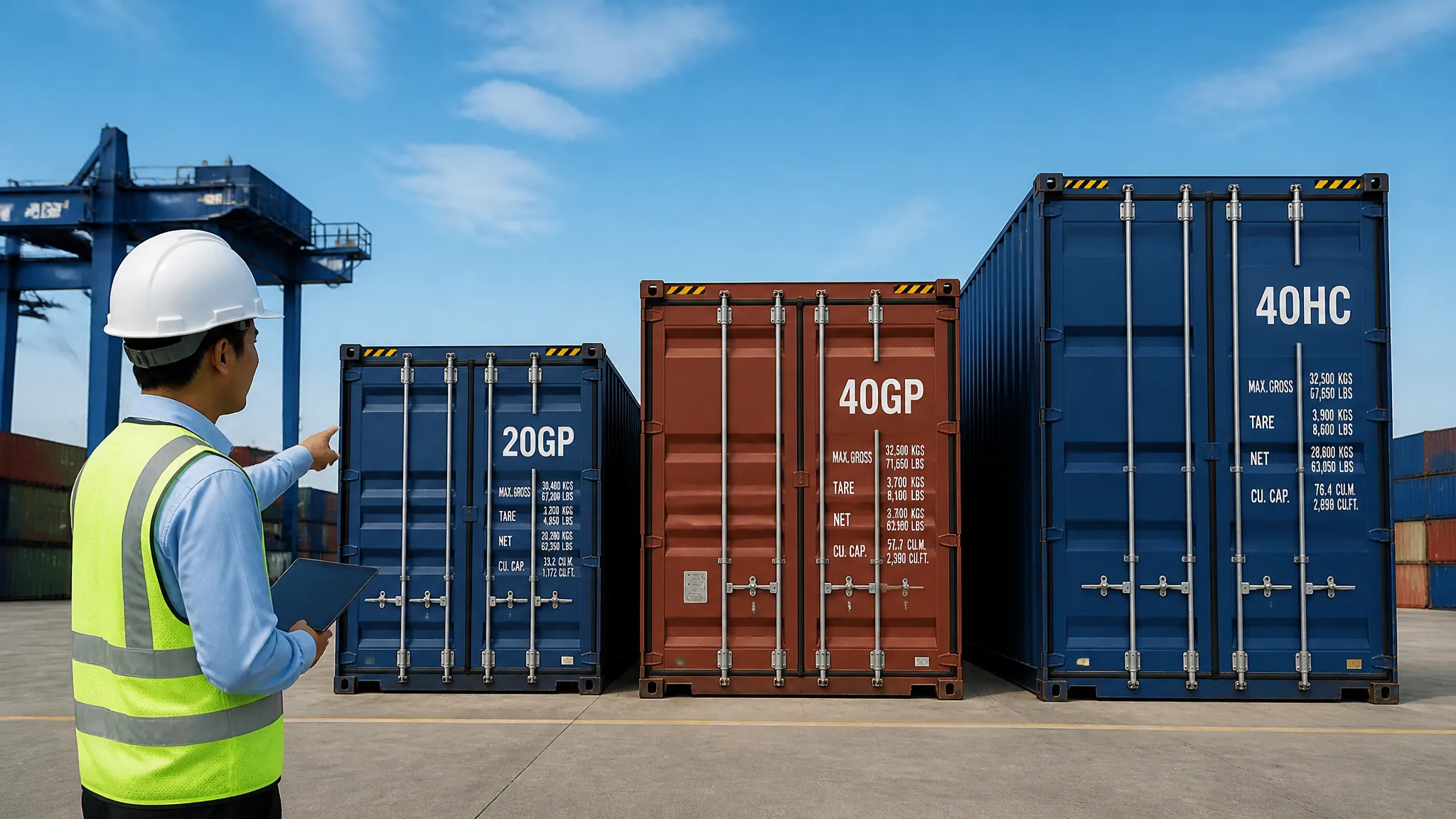
20GP vs 40GP vs 40HC: Which Container to Choose
Here’s a quick decision guide based on order quantity for 42-inch crates:
| Order Quantity (42-inch) | Recommended Container | Why |
|---|---|---|
| Under 300 units | 20GP | Fits in one 20GP with room to spare |
| 300-700 units | 40GP | Too much for 20GP, not enough for 40HC |
| Over 700 units | 40HC or 2× 20GP | Two 20GP gives flexibility for split destinations |
For smaller crates (24-36 inch), a 20GP holds 460-850 units. Most first-time buyers order one 20GP to test the market before scaling up.
Who Actually Loads the Container
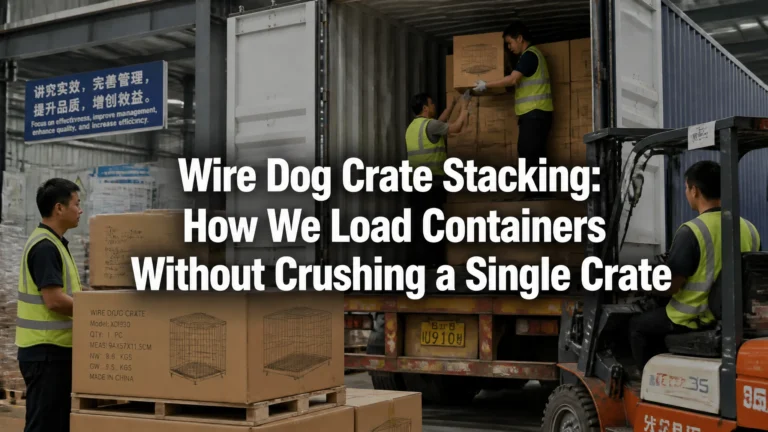
You don’t need to worry about how the container gets loaded. That’s our job.
At our facility, we have dedicated container loading workers. They load containers every day. They know the stacking patterns, the weight distribution, and how to pack crates tight without damage.
In our manufacturing area — where multiple factories are clustered together — there’s also a network of professional container loading teams. These teams do nothing but load containers. Factories book them in advance, and they show up, load the container tight, and leave. It’s a specialized job, and they’re very good at it.
The buyer doesn’t need to specify loading methods. You say “fill the container.” We fill it.
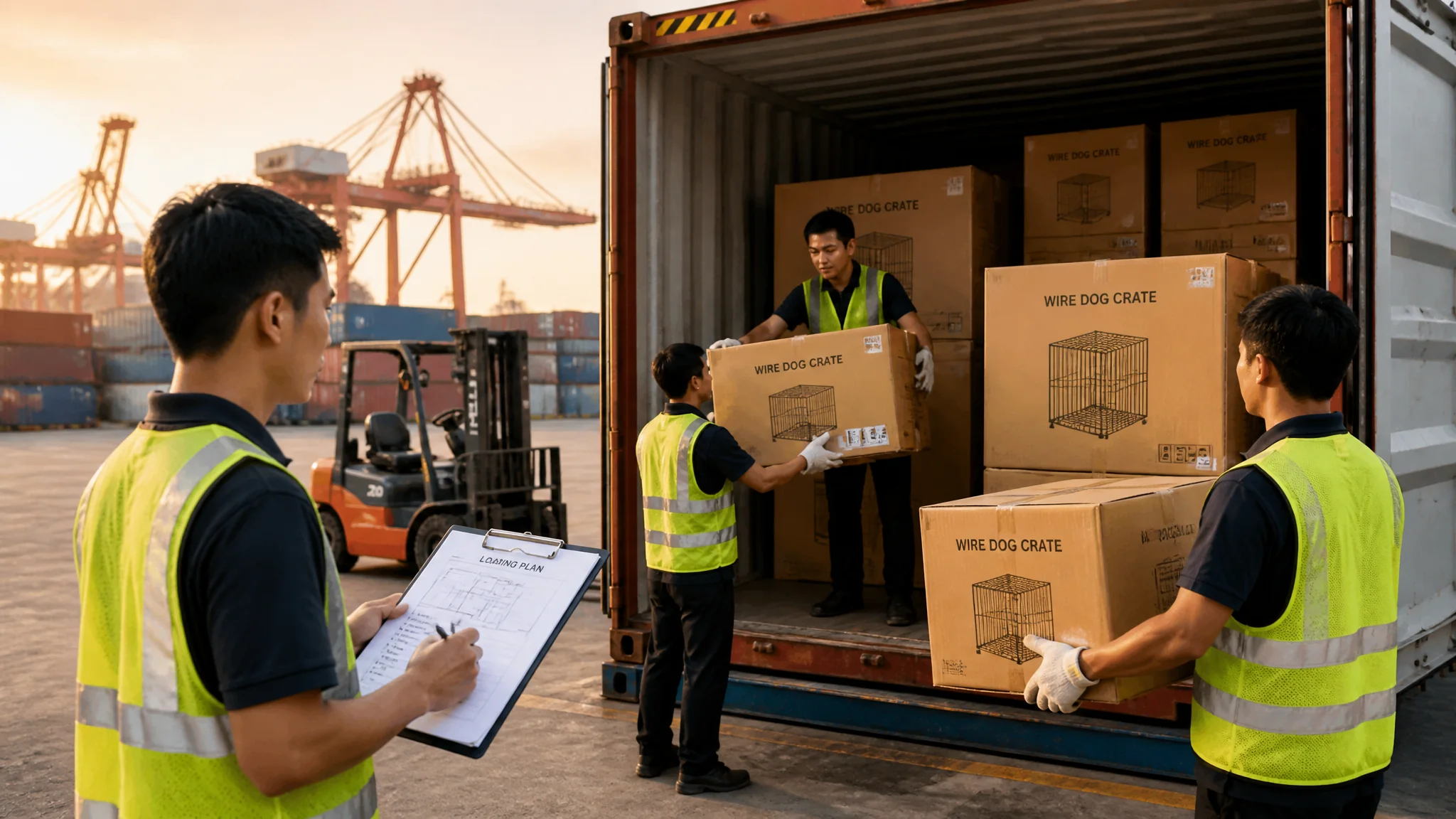
Order Planning: From Container Math to Restocking Schedule
Here’s a real example of how the math drives the business:
A German buyer sells 200 units of 42-inch crates per month. One 40HC holds 844 units. That’s 4.2 months of inventory. Ocean freight from Ningbo to Hamburg takes about 35 days.
Their restocking schedule:
- Month 1: Container 1 arrives. 4 months of stock on hand.
- Month 3 (week 2): Place order for Container 2. Stock remaining: ~6 weeks.
- Month 4 (week 3): Container 2 arrives. Stock never dropped below 2 weeks.
This buyer hasn’t had a stockout in two years. They didn’t need complex forecasting software. They just did the container math.
Container Loading Decision Framework
Know Your Carton Volume
Get the carton dimensions from your supplier. Multiply L×W×H in meters to get CBM.
Use Conservative Numbers
20GP=26, 40GP=56, 40HC=66 CBM. Subtract 2 CBM from actual capacity for clearance.
Match Order to Container
Under 300 units → 20GP. 300-700 → 40GP. Over 700 → 40HC or split.
Plan Reorders by the Math
Units per container ÷ monthly sales = months of inventory. Reorder 4-6 weeks before stockout.
How many dog crates can fit in a 20GP container?
It depends on the crate size. A 20GP holds approximately 852 units of 24-inch crates, 642 of 30-inch, 461 of 36-inch, 332 of 42-inch, or 265 of 48-inch. The formula: 26 CBM ÷ carton volume.
Should I use 20GP or 40GP for my order?
If your order is under 300 units (42-inch equivalent), a 20GP is enough. 300-700 units needs a 40GP. Over 700 units, consider a 40HC or two 20GP containers. For smaller crates, a 20GP holds more units — adjust based on your size mix.
How do I calculate loading quantity before ordering?
Get the carton dimensions from your supplier. Calculate carton volume in CBM (L×W×H in meters). Divide 26 (20GP), 56 (40GP), or 66 (40HC) by the carton volume. That’s your per-container quantity.
Who loads the container?
The factory handles loading. We have dedicated container loading workers and access to professional loading teams in our manufacturing area. The buyer doesn’t need to specify how to load — we fill containers tight as standard practice.
What if I’m mixing different sizes in one container?
Add up the total CBM of all crates in your order (quantity × carton volume per size). Compare to the container capacity. The math works the same — total volume divided by container volume gives you the loading percentage.
How does container loading help with restocking?
Once you know how many units fit per container, divide by your monthly sales to get months of inventory. Place your next order 4-6 weeks before you’ll run out, accounting for 30-45 day ocean transit time.