How to Choose a Dog Crate for Pets with Separation Anxiety: A B2B Sourcing Guide
A dog with separation anxiety can destroy a standard wire crate in under 30 minutes. We know this because we see the return data — crates come back with bent doors, snapped welds, and chewed-through latches. The customer didn’t buy the “wrong” crate; they bought a crate that wasn’t built for an anxious dog.
For B2B buyers, this creates both a problem and an opportunity. The problem: stocking the wrong crate specs for this segment means higher returns and negative reviews. The opportunity: buyers who explicitly stock “escape-proof” or “anxiety-ready” crates capture a high-intent, low-price-sensitivity customer segment — pet owners who will pay a premium for a crate their dog can’t destroy.
In this guide, we’ll break down exactly which crate specifications matter for dogs with separation anxiety — wire gauge, door security, sizing, and the features that turn a standard wire crate into a safe enclosure for an anxious dog.
Understanding What Separation Anxiety Does to a Crate
A dog with separation anxiety doesn’t just sit quietly in the crate. The behavior patterns we see from customer complaints and returns data include:
- Door attack: The dog pushes, paws, and bites at the door latch — the #1 failure point. A standard slide-bolt latch can be pushed open from the inside by a determined 40+ lb dog.
- Wire bending: The dog bites and pulls at individual wires. 3.0mm wire will bend; 4.0mm+ wire typically won’t.
- Weld breaking: Repeated pushing against corners and panel edges can snap weak welds. This is a manufacturing quality issue — a properly welded intersection should withstand 15kg+ of pull force.
- Tray escape: The dog pushes the plastic tray up from underneath, creating a gap at the bottom to squeeze through. Fixed by a secure locking clip.
- Chewing: The dog chews on wire coating, plastic tray edges, and plastic feet. Powder coating chips; ingested plastic is a vet emergency.
What the return data shows: Across our B2B clients, dog crates returned for “escape” or “destroyed” reasons cluster around three root causes — 52% door/latch failure, 28% wire bending or weld breakage, 20% tray-related escapes. Every one of these failures has a factory-level fix.
Wire Gauge: The Single Most Important Specification
If you only upgrade one spec for the separation anxiety segment, make it wire gauge. A dog biting and pulling on wires needs a crate that resists deformation.
| Wire Gauge | Suitable for Anxiety-Prone Dogs? | Max Dog Weight | Recommendation |
|---|---|---|---|
| 2.5mm | ❌ No | 15 lbs | Too thin — bends easily under biting/pulling |
| 3.0mm (Standard) | ⚠️ Borderline | 40 lbs | OK for small dogs (<25 lbs); not for medium+ breeds with anxiety |
| 3.5mm | ✅ Yes (minimum) | 70 lbs | Bare minimum for anxiety-prone dogs over 25 lbs |
| 4.0mm (Heavy-Duty) | ✅ Highly Recommended | 100 lbs | Best for marketing as “escape-proof” or “anxiety-ready” |
| 5.0mm+ | ✅ Maximum Security | 100+ lbs | Giant breeds; commercial boarding use; premium niche |
Cost impact for B2B buyers: Upgrading from 3.0mm to 4.0mm adds $2-3 to FOB cost for an M-size crate. But it lets you market the crate as “heavy-duty / escape-proof” — which commands a 40-60% retail price premium over standard crates in the same size category.
Pitfall: Marketing 3.0mm as “Heavy-Duty”
Some Amazon sellers list 3.0mm wire crates as “heavy-duty” — and then get destroyed in reviews when a 60 lb anxious Lab bends the door in 20 minutes. If you use the term “heavy-duty” or “escape-proof” on your listing, use 4.0mm+ wire. The return rate difference is 8-12% (3.0mm) vs 2-3% (4.0mm) for anxiety-prone dog owners.
Door Security: Double Latch Is Not Optional
The door is the #1 escape point — and a standard single slide-bolt latch simply isn’t enough for an anxious dog. Here’s the hierarchy of door security, from weakest to strongest:
| Latch Type | Dog Can Open? | Suitable for Anxiety Dogs? | Cost Add-On |
|---|---|---|---|
| Single Slide-Bolt | Yes — pushed open from inside | ❌ No | Baseline |
| Slide-Bolt + Safety Hook (Double Latch) | Very difficult | ✅ Minimum acceptable | +$0.50/unit |
| Double Slide-Bolt (Top + Bottom) | Extremely difficult | ✅ Recommended | +$1.20/unit |
| Heavy-Duty Slam Latch | Nearly impossible | ✅ Best available | +$2.50/unit |
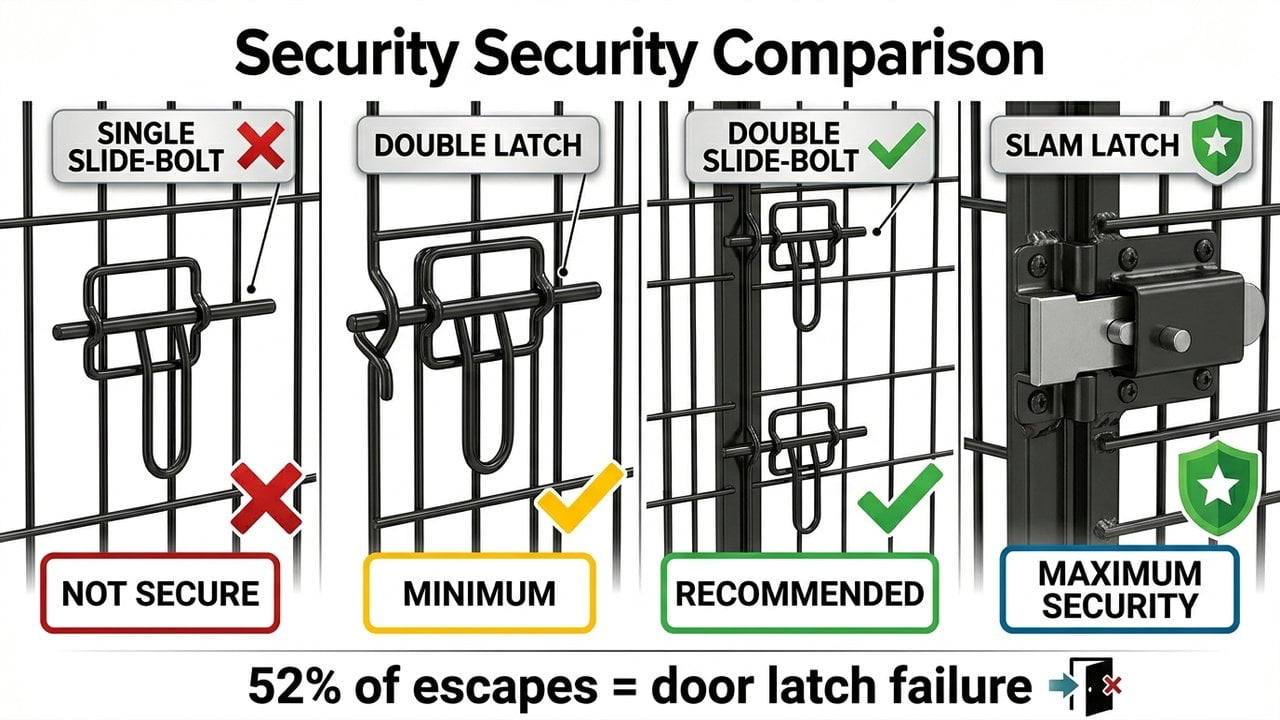
What we recommend for B2B buyers: The double slide-bolt (top + bottom) with safety hook is the sweet spot for the anxiety segment. It costs $1.70 over baseline and provides an escape-proof door that you can honestly market as “dog-tested escape-proof.” The slam latch option is for premium SKUs targeting the most determined escape artists.
Also important: door frame reinforcement. On standard crates, the door frame is the same wire gauge as the panels. For anxiety-prone dogs, we recommend reinforcing the door frame with the next gauge up (e.g., 4.0mm door frame on a 3.5mm body) — this prevents the door from being bent outward at the corners. Cost: +$0.80/unit.
Crate Cover: Turning a Wire Crate into a Den
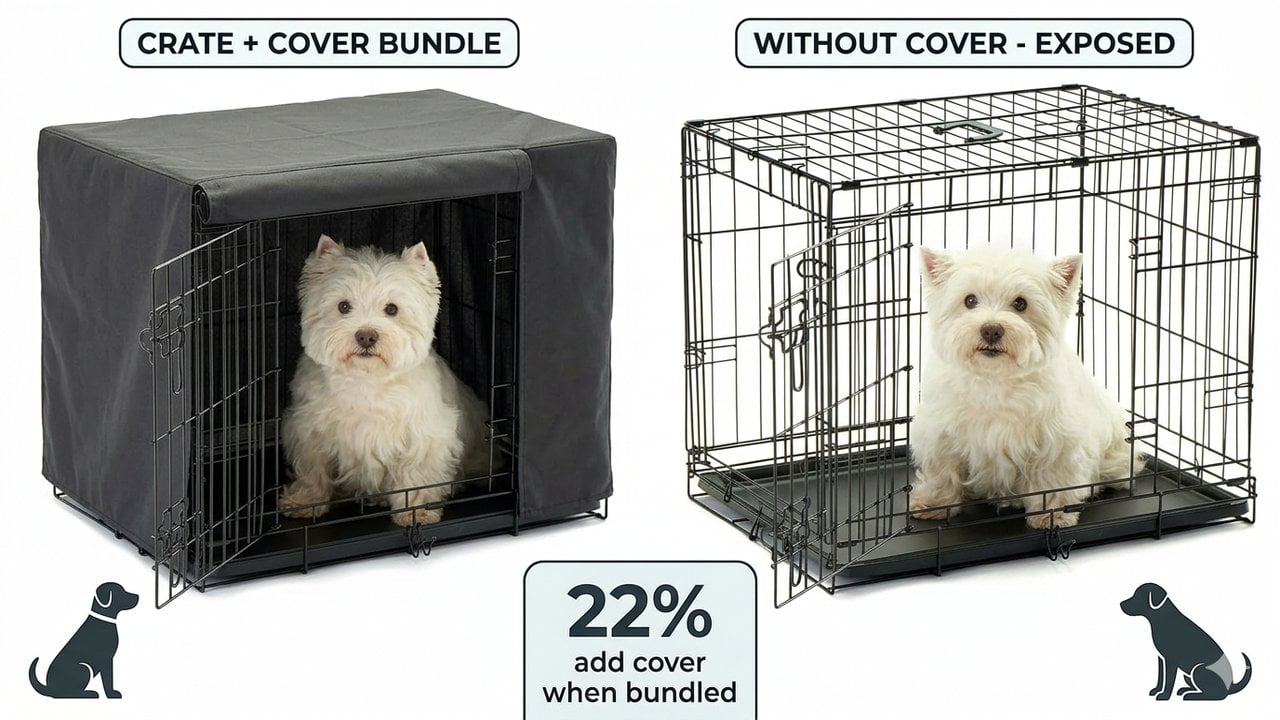
Many anxiety-prone dogs feel safer in an enclosed, den-like space. A wire crate alone — open on all sides — can actually increase anxiety in some dogs because they feel exposed.
This is where crate covers come in. A cover drapes over the wire crate, blocking visibility on 3-5 sides and creating a darker, more enclosed space. The cover itself is typically a fabric accessory (not manufactured in our facility), but the crate must be designed to work with one.
What this means for B2B buyers ordering crates:
- Bundle opportunity: Source covers separately and bundle them with the crate. The “crate + cover” bundle typically sells for $15-25 more than the crate alone, with the cover costing $5-8 wholesale.
- Crate design matters: If you plan to sell covers, the crate should have a flat top (no top door) — a top door makes the cover harder to fit and limits its effectiveness. Fixed-top crates are better for this use case.
- Amazon listing strategy: List the cover as a “frequently bought together” item. Our B2B clients who do this see 22% of crate buyers also purchasing the cover.
Factory insight: We’ve had B2B clients ask us to add small hooks or loops to the crate frame specifically for attaching covers. This is possible but requires custom tooling on the welding jig — MOQ 1,000 units, +$0.30/unit for the hooks. For most buyers, simply sourcing a well-fitting cover and letting the customer drape it is more than sufficient.
Size Selection: The “Just Right” Rule for Anxious Dogs
Conventional crate sizing advice says “the dog should be able to stand up, turn around, and lie down comfortably.” For anxious dogs, this advice changes slightly: the crate should be snug, not spacious.
An anxious dog in a too-large crate will pace — and pacing amplifies anxiety. A properly sized crate provides a sense of enclosure and security. Here’s what we recommend B2B buyers stock for this segment:
| Dog Weight | Recommended Crate Size | Interior Dimensions (L x W x H) | Divider Recommended? |
|---|---|---|---|
| 5-15 lbs | XS / 22″ | 22″ x 13″ x 16″ | No — already appropriately sized |
| 15-25 lbs | S / 24″ | 24″ x 18″ x 20″ | Optional — for puppies only |
| 25-40 lbs | M / 30″ | 30″ x 21″ x 24″ | Recommended — puppy-to-adult growth |
| 40-70 lbs | L / 36″ | 36″ x 24″ x 27″ | Recommended |
| 70-90 lbs | XL / 42″ | 42″ x 28″ x 30″ | Recommended |
| 90+ lbs | XXL / 48″ | 48″ x 30″ x 33″ | Recommended — giant breed puppies grow fast |
Key takeaway for B2B: When marketing to the separation anxiety segment, include a size selection guide in your product listing that specifically addresses anxious dogs. A simple line — “For anxious dogs, choose the smallest size your dog can comfortably stand and turn around in” — reduces wrong-size returns by an estimated 5-8%.
Tray and Bottom Security: Preventing the Under-Crate Escape
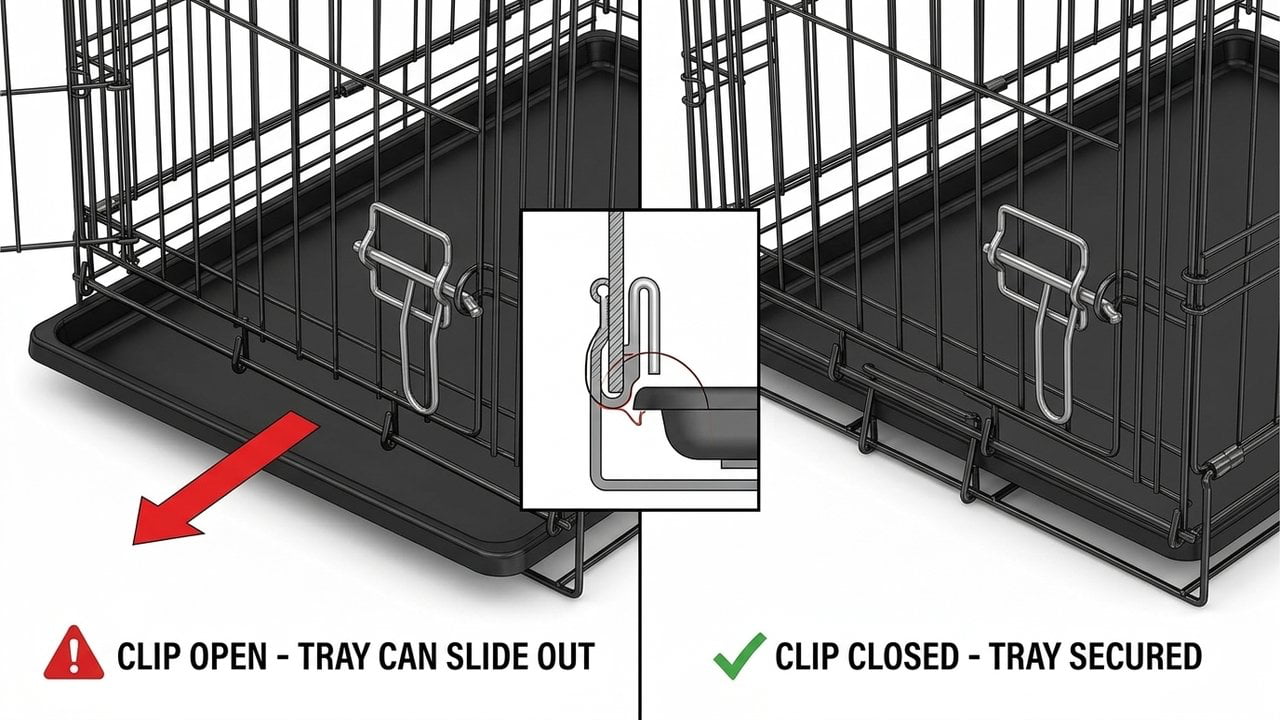
The tray escape is a less common but particularly dangerous failure mode: if the locking clip is loose or not fully engaged, a determined dog’s repeated pawing and lunging can gradually slide the tray forward, creating an opening at the back of the crate. Once the dog squeezes through, they’ll repeat the escape route. (Note: standard wire dog crates have a locking clip on only one side — the opposite side is a fixed frame bar that blocks the tray.)
Three factory-level fixes:
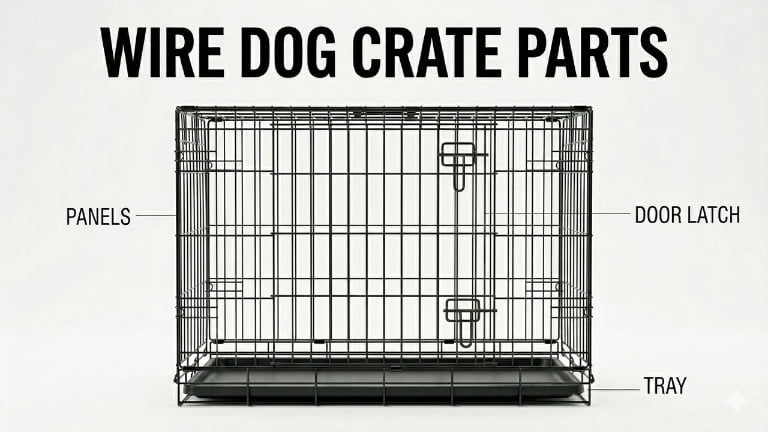
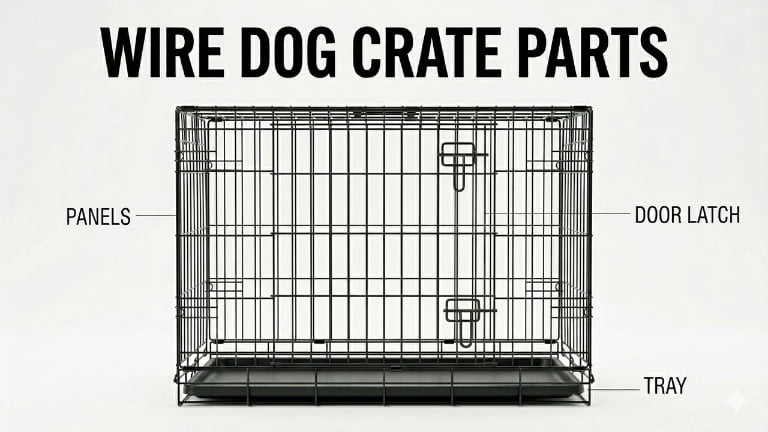
- Grid & Tray Locking Clip (standard): The U-shaped metal clip at the bottom of the crate that swings over the tray edge. Make sure it’s bent to the correct angle — a clip that’s too loose allows the tray to lift. Cost: included in standard production.
- Reinforced locking clip bracket: Upgrade the standard clip bracket from 1.5mm to 2.5mm steel. The thicker bracket holds the clip tighter against the tray edge and resists bending if the dog lunges forward repeatedly. Cost: +$0.25/unit. Recommended for anxiety-segment crates.
- Bolt-down tray: The tray has bolt holes that align with the bottom wire frame, secured with wing nuts. The tray literally cannot be pushed up. Cost: +$1.50/unit. Only for premium “maximum security” SKUs.
Factory quality check: Every crate we produce goes through a tray-fit test: the tray is inserted, the locking clip is engaged, and a technician pushes the tray from the front with 5kg of horizontal force. If the tray slides more than 5mm, the clip angle is adjusted before packaging.
Recommended B2B Spec Sheet: “Anxiety-Ready” Wire Dog Crate
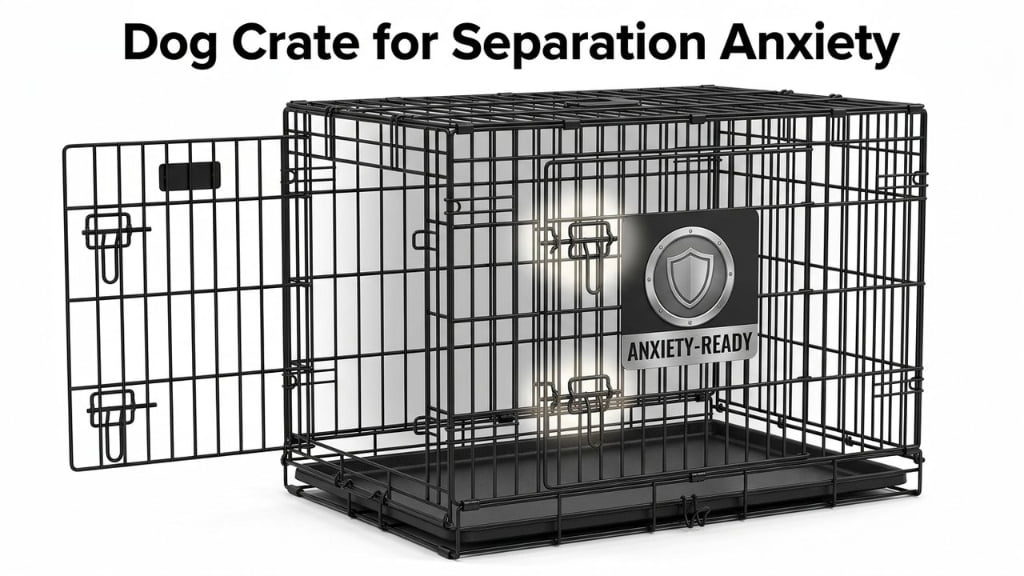
Here’s a complete specification template for B2B buyers who want to stock a crate specifically positioned for the separation anxiety segment. These specs minimize escape risk while keeping the FOB cost within a reasonable premium range:
| Specification | Standard Crate | “Anxiety-Ready” Crate | Cost Difference |
|---|---|---|---|
| Wire gauge (body) | 3.0mm | 4.0mm | +$2.50 |
| Door frame wire | Same as body (3.0mm) | Reinforced (4.0mm) | +$0.80 |
| Door latch | Single slide-bolt | Double slide-bolt + safety hook | +$1.70 |
| Tray locking | Standard locking clip | Reinforced locking clip bracket | +$0.25 |
| Coating | Standard powder coat | Heavy-duty double coat | +$1.00 |
| Divider panel | Not included | Included | +$3.50 (M size) |
| Total FOB (M size) | $15.80 | $25.55 | +$9.75 (+62%) |
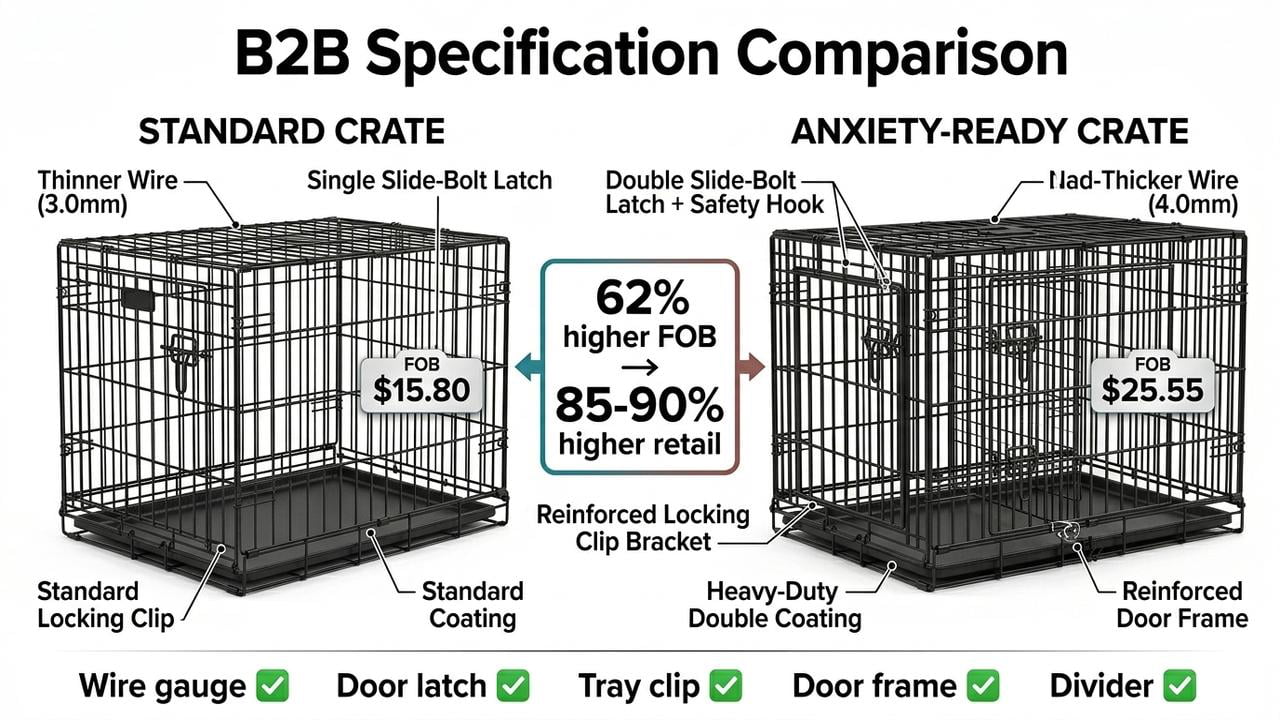
The ROI math: An “anxiety-ready” crate at $25.55 FOB can retail for $120-150 on Amazon (positioned as “escape-proof heavy-duty crate for anxious dogs”), compared to $65-80 for a standard crate. That’s an 85-90% retail price premium on a 62% FOB increase — and you’re targeting a high-intent customer who isn’t price-shopping.
FAQ: Dog Crates for Separation Anxiety
What wire gauge is strong enough for a dog with separation anxiety?
3.5mm minimum for dogs 25-70 lbs. 4.0mm is strongly recommended for dogs over 40 lbs with any history of escape behavior. 3.0mm wire is not sufficient — it will bend when a determined dog bites and pulls at the wires.
Can a wire crate be escape-proof?
No crate is 100% escape-proof, but a properly spec’d wire crate (4.0mm wire, double latch, reinforced door frame, double tray clips) makes escape extremely unlikely for all but the most determined dogs. For maximum security, the heavy-duty slam latch adds another layer of protection.
Should I stock crate covers for the anxiety segment?
Yes. Crate covers turn a wire crate into a den-like enclosure, which helps many anxious dogs feel more secure. Bundle the crate and cover together — our B2B clients see 22% of crate buyers also purchasing the cover when listed as “frequently bought together.” Source covers separately (we don’t manufacture fabric products).
Is a larger crate better for an anxious dog?
No. Anxious dogs in oversized crates tend to pace, which amplifies anxiety. The crate should be just large enough for the dog to stand up, turn around, and lie down comfortably — but not larger. A divider panel allows the owner to size down the interior for a puppy that’s still growing.
What is the #1 reason anxious dogs escape wire crates?
Door latch failure (52% of escape returns). The dog pushes or paws at the latch from inside and the slide bolt moves. A double slide-bolt with safety hook is the minimum effective solution. Add a reinforced door frame to prevent the door corners from being bent outward.
Related Reading
For more product sourcing guides, explore our related articles:
- What Are the Parts of a Wire Dog Crate? A B2B Buyer’s Complete Breakdown — Learn every component of a wire dog crate before you order.
- Folding vs Fixed Wire Dog Crate: B2B Buyer’s Guide — Which construction type holds up better for determined dogs?
- Dog Crate Divider Panel: Is It Worth the Extra Cost? — The divider helps anxious puppies feel secure in a right-sized space.
External references: ASTM International | American Kennel Club (AKC)