What Are the Parts of a Wire Dog Crate? A B2B Buyer’s Complete Breakdown
“I want to order wire dog crates, but I don’t know what to specify.” This is the #1 thing new buyers tell us when they first contact our factory. They know they want a “wire crate” — but when we ask about door type, wire gauge, coating, or tray material, they go blank.
Every component on a wire dog crate has a name, a function, and a cost implication. Knowing these parts doesn’t just help you sound professional — it helps you spec exactly what you need, avoid paying for features you don’t need, and catch quality issues before they become customer complaints.
In this guide, we’ll walk through every major part of a wire dog crate — from the wire mesh body to the smallest plastic foot cap — using our factory’s production knowledge so you can order with confidence.
1. Wire Mesh Panels: The Crate Body
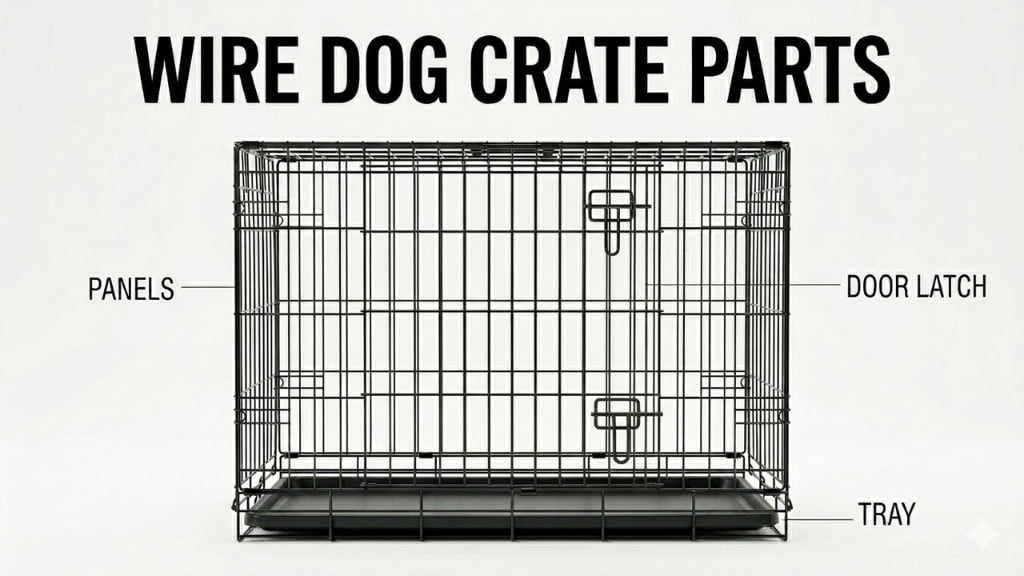
The crate body is made of 5-6 wire mesh panels: front (with door), back, left side, right side, top, and sometimes a separate bottom panel. Each panel is a grid of horizontal and vertical steel wires, welded at every intersection.
| Panel | What It Does | Key Spec to Know |
|---|---|---|
| Front Panel | Contains the door; this is the panel the dog and owner interact with most | Door type, door size, latch design |
| Back Panel | Solid wire mesh; some models have a second door here | Single vs double door |
| Side Panels (Left & Right) | Form the left and right walls; provide ventilation | Wire spacing (smaller spacing for small breeds) |
| Top Panel | Covers the top; some models have a top door | Top door option (yes/no) |
| Bottom Panel | Supports the tray; the dog does not stand directly on this | Wire grid vs cross-bar support |
What to specify when ordering: The most important panel specs are wire gauge (thickness) and wire spacing (grid size). Standard spacing is 38mm x 76mm for medium-large crates; small breed crates use 25mm x 50mm to prevent puppies from squeezing through.
What the factory checks on every panel: Weld strength at every intersection (tested with a 15kg pull test), wire straightness (no visible bends), and coating uniformity (no bare spots). A single weak weld can cause the entire panel to deform under a dog’s weight.
2. Door Types: Single, Double, and Top Entry
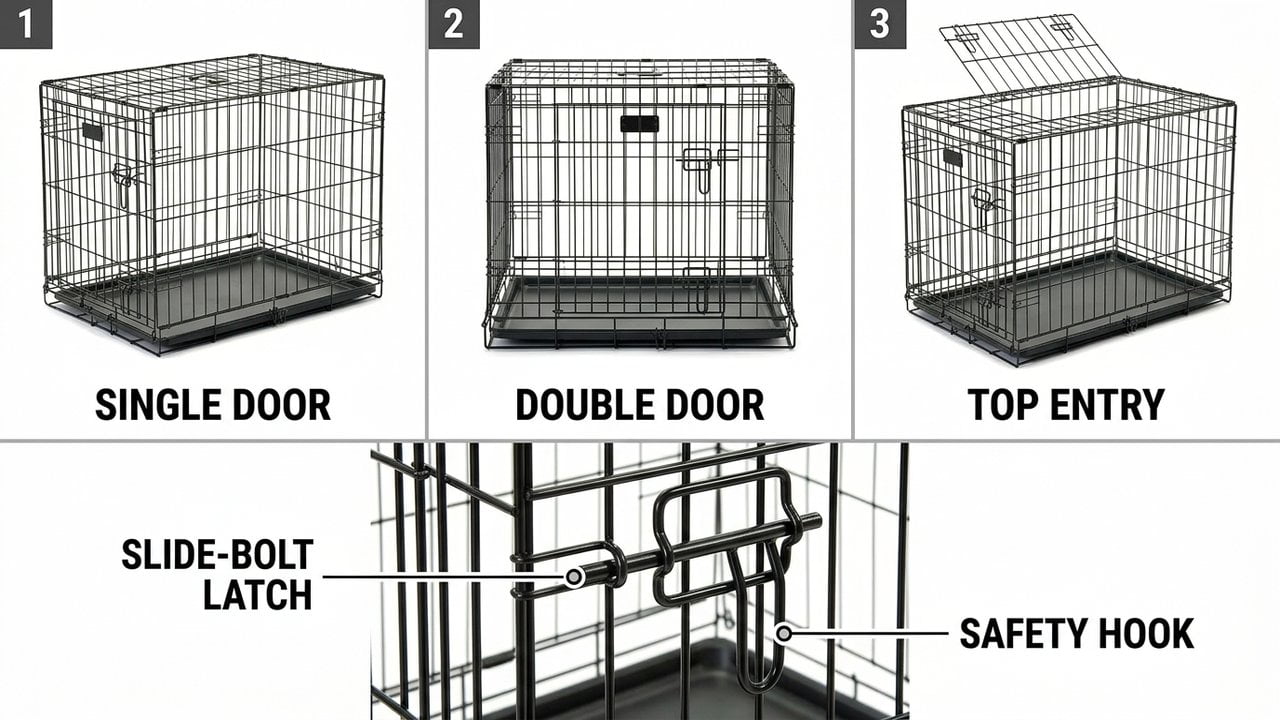
The door is the most-used component on the crate — and the #1 source of quality complaints if not built right. There are three common door configurations:
| Door Type | Description | Best For | Cost Impact |
|---|---|---|---|
| Single Door (Front) | One door on the front panel. Opens left-to-right or right-to-left. | Most common; 70%+ of orders | Baseline cost |
| Double Door (Front + Side) | Two doors: one front, one on a side panel. More access flexibility. | Multi-dog households; tight spaces | +$1.50-2.00 FOB |
| Top Entry | Door on the top panel. Opens upward. | Veterinary clinics; hard-to-reach spaces | +$2.00-3.00 FOB (requires reinforced top frame) |
Door Latch Design: The Small Part That Causes Big Complaints
The latch is what keeps the door closed. A poorly designed latch is the #1 cause of negative Amazon reviews for wire crates — buyers complain that their dog “escaped” or the latch is “too hard to open with one hand.”
There are two main latch types:
- Slide-bolt latch: A metal rod slides into a hole in the door frame. Simple, effective, but can be noisy. Cost: baseline.
- Double-latch (slide-bolt + safety hook): Adds a secondary hook that prevents the dog from pushing the slide bolt open from the inside. Recommended for medium-large breeds. Cost: +$0.50/unit.
Pitfall: Ordering the Wrong Door Swing Direction
By default, our doors open left-to-right. Some buyers don’t realize this until the product photos arrive — and their competitor’s crate opens right-to-left. This sounds trivial, but it changes the customer’s first impression of “quality.” Specify door swing direction when you place your order.
3. The Bottom Tray: Plastic vs Wire Mesh
The bottom tray sits on top of the bottom wire panel. Its purpose: catch spills, contain mess, and provide a smooth surface for the dog to stand on. The dog does NOT stand directly on wire.
| Tray Type | Material | Cost (M size) | Pros | Cons |
|---|---|---|---|---|
| Standard Plastic Tray | PP (polypropylene), 1.5-2mm thick | $1.80 | Lightweight, easy to clean, does not rust | Can crack if dog chews edges; may warp in direct sun |
| Heavy-Duty Plastic Tray | PP, 3mm thick, reinforced edges | $3.20 | Chew-resistant; holds shape better | Heavier (adds shipping weight) |
| Wire Mesh Tray | Steel wire, same coating as body | $2.50 | Virtually indestructible; good for heavy chewers | Mess passes through; needs a separate mat underneath |
| Stainless Steel Tray | 304 stainless steel, 0.6mm | $7.50 | Rust-proof; vet-clinic grade | Expensive; only for premium SKUs |
What we recommend: 85% of our B2B clients choose the standard plastic tray. It’s the best price-to-performance ratio for most markets. Upgrade to heavy-duty only if you’re explicitly targeting the “heavy chewer” segment.
4. Wire Clips (Jia Ma Kou): The Folding Mechanism
If you’ve ever unfolded a wire dog crate in 10 seconds, you’ve used wire clips (夹马扣, jia ma kou) — the small metal fasteners that make folding possible.
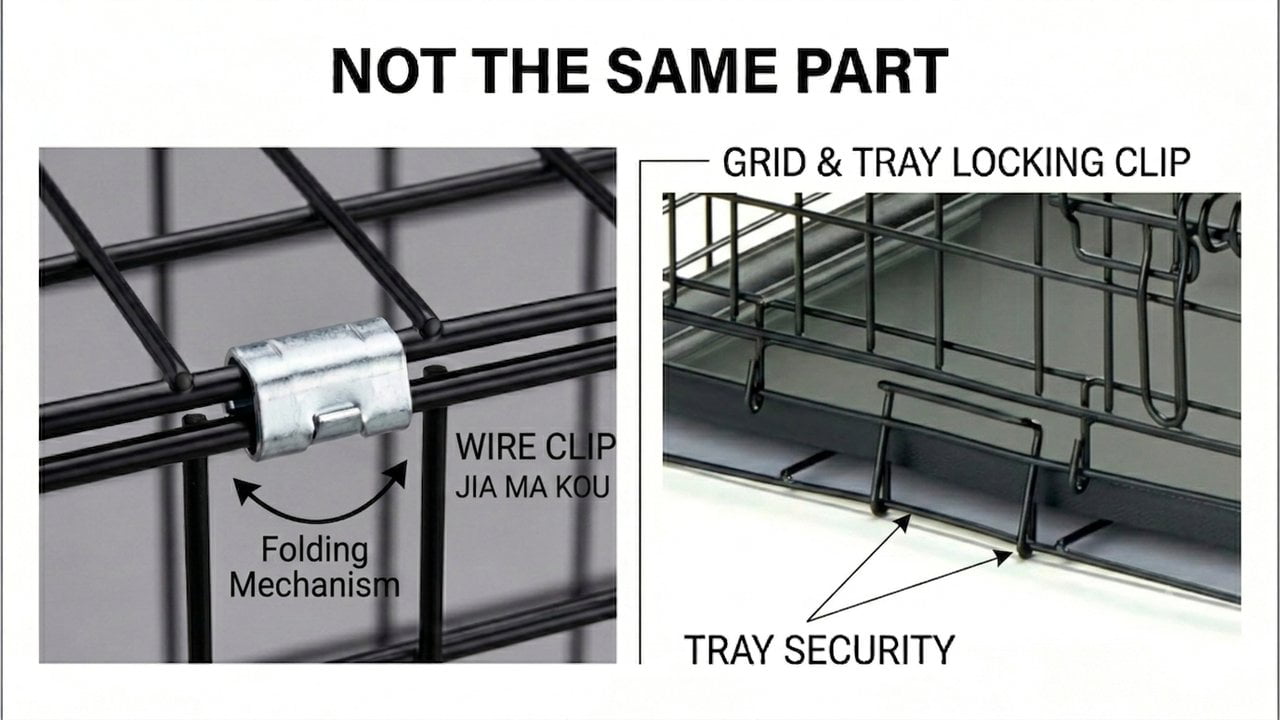
Here’s how they work: wire clips fasten two adjacent horizontal frame wires (the outermost wires of each panel) together. Because the two wires can rotate relative to each other at the clip, the panels can fold flat. Each clip allows the two wires it connects to rotate like a hinge — no additional hardware needed.
A standard 4-panel folding crate uses 4-6 wire clips (at each corner where two panels meet). The clips themselves cost $0.30-0.50 each, so $1.20-3.00 per crate — one of the smallest line items on the BOM.
Important distinction: Wire clips (夹马扣) are NOT the same as the Grid & Tray Locking Clip (the U-shaped metal piece at the crate base that holds the tray in place). Wire clips are on the frame wires between panels; the locking clip is at the bottom edge of the crate. Two completely different parts with completely different functions.
5. Grid & Tray Locking Clip: Not to Be Confused with Wire Clips
The Grid & Tray Locking Clip is a U-shaped metal piece attached to the bottom wire of the crate. Its function: lock the bottom wire grid panel in place and prevent the plastic tray from sliding out.
This part is connected to the bottom wire (the lowest horizontal frame wire) of the crate, not to the tray itself. When the crate is set up, you swing the locking clip over the tray’s edge to hold everything secure.
Common confusion among new B2B buyers: they call this the “jia ma kou” (夹马扣) — but in the factory, these are completely different parts. Wire clips are for folding; the Grid & Tray Locking Clip is for securing the bottom assembly.
6. Powder Coating: Protection and Color
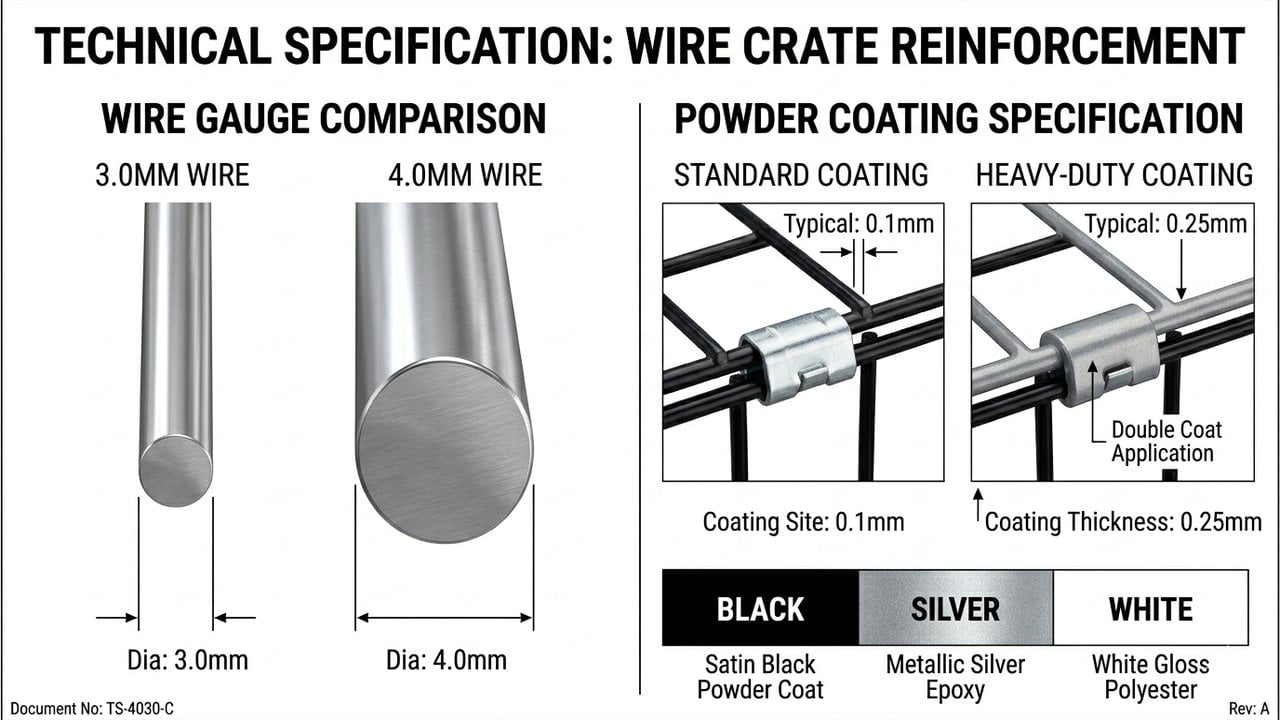
Every wire crate part (panels, door, clips) goes through a powder coating process after welding. The coating serves three purposes:
- Rust prevention: Bare steel wire rusts within weeks in humid environments. Powder coating seals the surface.
- Dog safety: Coating smooths rough wire edges and weld points, preventing cuts and scratches.
- Appearance: Color options (black, silver, white, custom RAL colors) determine how the crate looks in a home.
| Coating Type | Durability | Best For |
|---|---|---|
| Electrostatic Powder Coating (Standard) | 5-8 years in dry indoor environments | 95% of orders; best performance-to-cost ratio |
| Heavy-Duty Double Coating | 8-12 years; more chip-resistant | Premium SKUs; outdoor-adjacent use (garage, covered porch) |
| E-Coating (Electrocoating) Underlayer + Powder Top | 10-15 years; maximum rust protection | Coastal markets; veterinary/boarding use |
Color options: Black and silver are standard (no cost premium). White, beige, and custom RAL colors require a minimum 500-unit order to justify the powder changeover on the coating line.
Pitfall: Assuming All “Black” Coatings Are the Same
Not all black powder coating is created equal. Low-cost suppliers use epoxy-based powder, which fades to gray within 2-3 years and can chalk (leave residue on hands). We use polyester-based powder, which retains color and does not chalk. The cost difference is $0.30/unit — but the review impact is huge. Faded/chalky crates get 1-star reviews.
7. Wire Gauge: Why Thickness Matters
Wire gauge is the most important specification that determines a crate’s strength and weight. Gauge is measured in millimeters (wire diameter), not the American Wire Gauge (AWG) system commonly used for electrical wire.
| Wire Diameter | Grade | Max Dog Weight | Typical Use |
|---|---|---|---|
| 2.5mm | Light | Up to 15 lbs | XS/S crates; toy breeds; divider panels |
| 3.0mm | Standard | Up to 40 lbs | M-size crates; most common spec |
| 3.5mm | Medium-Heavy | Up to 70 lbs | L-size crates; active medium breeds |
| 4.0mm | Heavy-Duty | Up to 100 lbs | XL crates; large/giant breeds |
| 5.0mm+ | Extra Heavy-Duty | 100+ lbs | Giant breeds; commercial/boarding use |
Cost impact: Increasing wire diameter by 0.5mm (e.g., 3.0mm → 3.5mm) adds approximately $2.00-3.00 to the FOB cost for an M-size crate, due to higher raw material weight and slightly longer welding time. But it also allows you to market the crate as “heavy-duty” — which commands a 30-50% retail price premium.
Factory insight: Some B2B buyers specify the same heavy gauge for every size in their product line — that’s a mistake. A 2.5kg Chihuahua does not need 4.0mm wire. Over-spec’ing adds unnecessary cost and weight (higher shipping). Match the gauge to the target dog weight range for each size.
8. Divider Panel: The Growth Feature
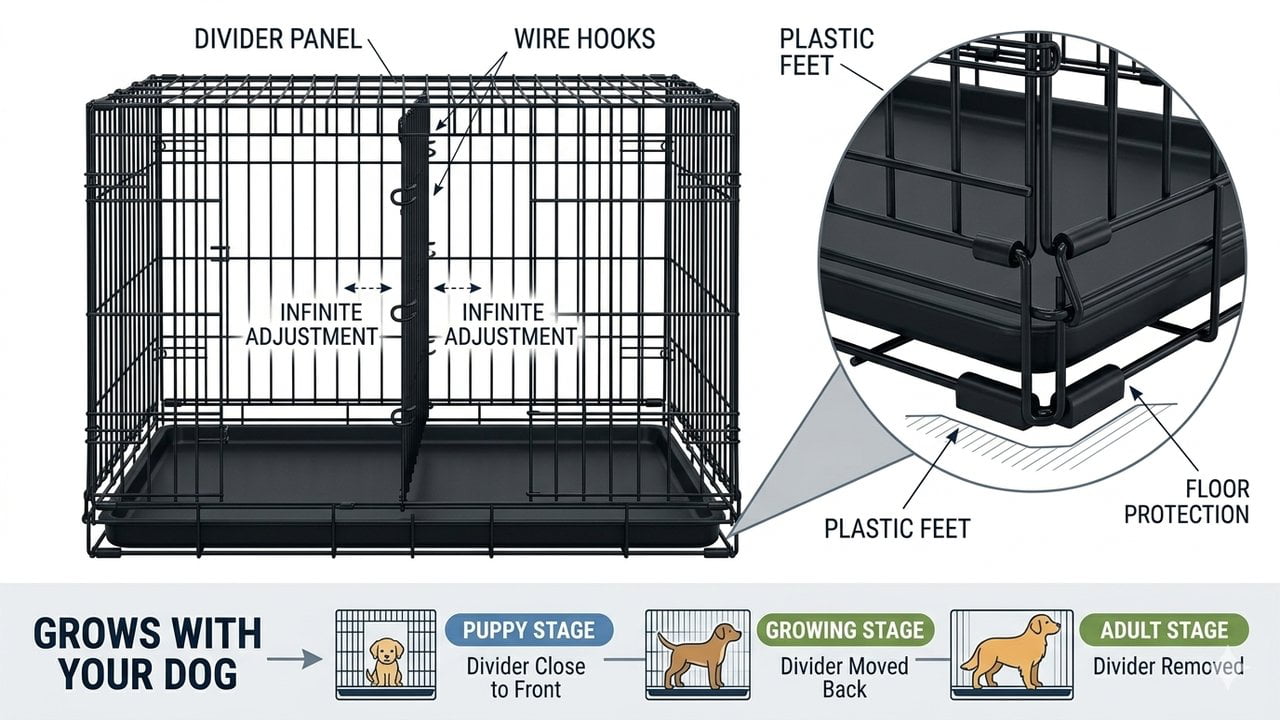
A divider panel is a wire mesh panel (same material as the crate body) that splits the internal crate space into two sections. Its main value: as a puppy grows, the owner moves the divider to enlarge the space — so they buy one crate, not three.
The divider attaches via wire hooks bent from the panel’s left and right edge wires. These hooks engage with the crate’s front and back vertical wires at any position, enabling “infinite adjustment” — not just 2-3 preset positions. No tools, no clips, no screws.
Cost: $2-6 FOB add-on depending on crate size (S: $2-3, M: $3-4, L: $4-5, XL: $5-6). The divider ships inside the folded crate body, so it adds zero additional packaging volume and zero additional shipping cost.
B2B recommendation: If you’re targeting puppy owners (the majority of first-time crate buyers), include the divider panel. The “one crate grows with your dog” marketing angle consistently outperforms “divider sold separately” in Amazon conversion rates. For markets focused on adult/rescue dogs (e.g., Australia), the divider is optional.
9. Feet and Floor Protection
A small detail with a big review impact: the plastic feet on the bottom of the crate.
Standard crates have 4-6 plastic caps pressed onto the bottom wire ends. These serve two purposes:
- Floor protection: The metal wire ends would scratch hardwood, tile, and vinyl floors without plastic caps
- Stability: Rubber-tipped caps prevent the crate from sliding on smooth floors
The standard plastic cap costs pennies per unit. But a missing cap at the customer’s end can result in a scratched hardwood floor — and a 1-star review. This is one of the cheapest quality checks we do: every crate is inspected for all foot caps before packaging.
FAQ: Wire Dog Crate Parts
What is the difference between wire clips (夹马扣) and the Grid & Tray Locking Clip?
Wire clips (夹马扣) fasten two adjacent horizontal frame wires between panels, allowing them to rotate so the crate folds. The Grid & Tray Locking Clip is a U-shaped metal piece at the bottom of the crate, connected to the lowest horizontal wire, that locks the bottom grid and tray in place. Two completely different parts.
Which wire gauge should I choose for my market?
For general home use in the US/Europe, 3.0-3.5mm is the sweet spot. It’s strong enough for dogs up to 40-70 lbs while keeping the crate lightweight and shipping-efficient. For premium “heavy-duty” SKUs targeting large breeds, go with 4.0mm. Avoid 2.5mm except for XS crates and divider panels.
Is a plastic tray or wire mesh tray better?
For 85% of B2B buyers, the standard plastic tray is the best choice. It’s cost-effective, easy to clean, and the customer expectation for most markets. Wire mesh trays make sense for heavy-chewer segments, but most customers will still buy a separate mat. Stainless steel is only for premium or veterinary-grade SKUs.
How do the wire hooks on the divider panel work?
The divider panel (metal wire mesh) has wire hooks bent from its left and right edge wires. These hooks engage with the crate’s front and back vertical wires at any position — enabling “infinite adjustment.” No tools, clips, or screws needed. The owner simply hooks the divider into place and removes it to reposition.
Can I customize the door swing direction?
Yes. Default is left-to-right swing, but we can set it to right-to-left. Specify this before production — changing it after the welding jig is set up requires a new production run. No additional cost for the change itself.
Related Reading
Now that you know the parts, explore our product comparison guides to make informed sourcing decisions:
- Wire vs Wood-Combo Dog Crate: Which Is Right for Your Market? — Cost breakdown, market preference, and margin analysis.
- Folding vs Fixed Wire Dog Crate: B2B Buyer’s Guide — Understand the real difference between folding and fixed crates.
- Dog Crate Divider Panel: Is It Worth the Extra Cost? — Full ROI analysis on the divider panel add-on.
- How to Stock Wire Dog Crates That Actually Sell: A B2B Guide to Consumer Selection Logic
External references: ASTM International