First-Time Wire Dog Cage Importing: 8-Phase Process to Navigate China Sourcing Successfully
First-time wire dog cage importing from China can generate profit margins of 25-40% but also carries risks that cost inexperienced buyers $5,000-$20,000 in avoidable mistakes. A systematic approach reduces these risks dramatically while maintaining profitability. Many B2B buyers rush into China sourcing without proper planning, leading to quality issues, delayed shipments, and unexpected costs that erode profits.
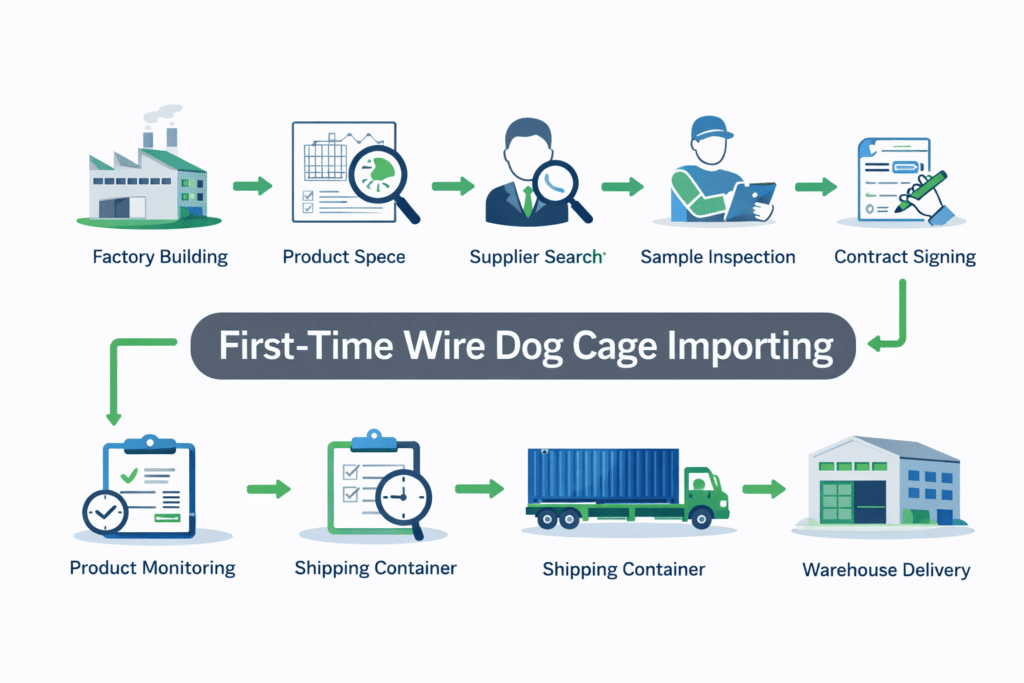
This comprehensive guide breaks down first-time wire dog cage importing into eight manageable phases spanning 60-90 days from initial research to warehouse delivery. Following this proven process transforms import complexity into predictable business operations. Each phase includes specific action steps, risk mitigation strategies, and decision checkpoints to ensure successful outcomes.
Phase 1: Market Research and Planning (Days 1-7)
Market research forms the foundation of successful first-time wire dog cage importing. Thorough planning prevents costly mid-course corrections and misaligned product specifications.
Target Market Positioning and Customer Analysis
Define your target customer segments before sourcing wire dog cages. Pet retailers, Amazon sellers, direct-to-consumer brands, and wholesale distributors each require different product specifications and pricing structures.
🐕 Dog Owner Segments
Small Breeds (Under 25 lbs): 24-36 inch cages, lighter gauge wire
Medium Breeds (25-60 lbs): 36-42 inch cages, standard wire thickness
Large Breeds (60-100+ lbs): 42-48 inch cages, reinforced wire construction
Multi-Dog Households: Double-door designs, divider panels
🏢 Buyer Types
Pet Retailers: Focus on display appeal and packaging
Amazon Sellers: Emphasize ratings and shipping efficiency
DTC Brands: Prioritize aesthetics and unboxing experience
Wholesalers: Target competitive unit pricing
Product Specifications Definition and Budget Planning
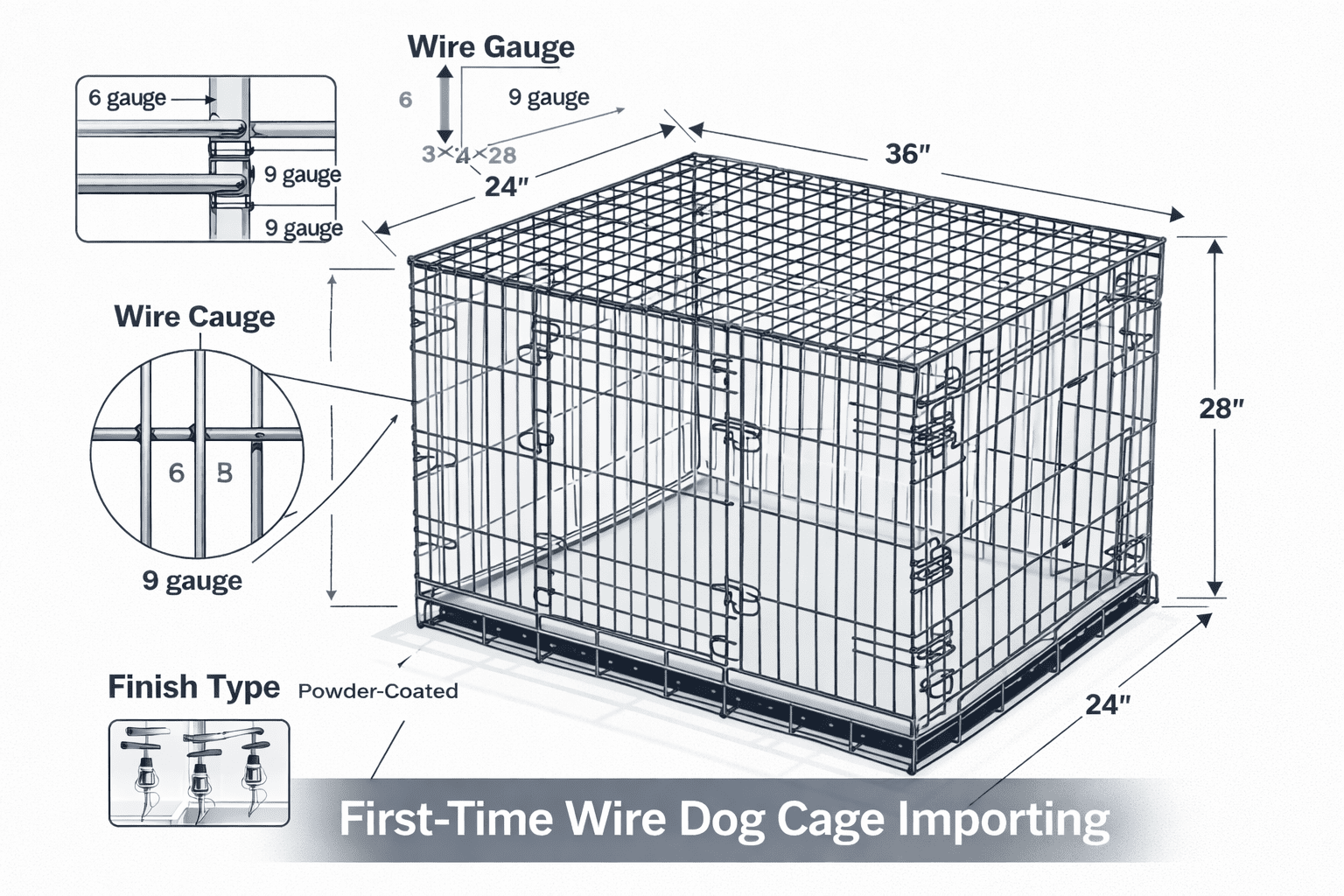
Establish clear product specifications before contacting suppliers. Wire dog cage specifications include dimensions, wire gauge (typically 6-9 gauge for standard cages), door type, latching mechanisms, finish type (powder-coated or galvanized), and floor tray material.
| Specification Element | Standard Options | Cost Impact | Decision Priority |
|---|---|---|---|
| Wire Gauge | 6-9 gauge (thinner to thicker) | $1-3 per unit difference | High – affects durability |
| Finish Type | Powder-coated, galvanized | $0.50-2 per unit | High – affects appearance |
| Door Configuration | Single door, double door, side door | $1-5 per unit | Medium – customer preference |
| Size Range | 24-48 inch sizes | $3-8 per unit per size step | High – target market fit |
| Floor Tray | Plastic, metal, removable | $1-3 per unit | Medium – cleaning convenience |
Calculate initial budget ranges for first-time wire dog cage importing. Factor in product cost, shipping, customs duties, warehousing, and quality control expenses. A typical first order of 200-500 wire dog cages requires $10,000-$25,000 total investment including all landed costs.
Wire dog cage sample evaluation helps validate specifications before full production. Testing samples with target customers provides critical feedback on design preferences and quality expectations.
Day 1-7 Phase 1 Checklist
- Define target customer segments and buyer types
- Document product specifications including sizes, wire gauge, finish type
- Calculate budget ranges for initial order quantities
- Identify competitor products and pricing benchmarks
- Determine target unit price and profit margin requirements
Phase 2: Supplier Discovery (Days 8-14)
Supplier discovery involves finding qualified Chinese manufacturers capable of producing wire dog cages to your specifications. First-time importers should identify multiple supplier options for comparison and leverage.
Multi-Channel Supplier Search Strategy
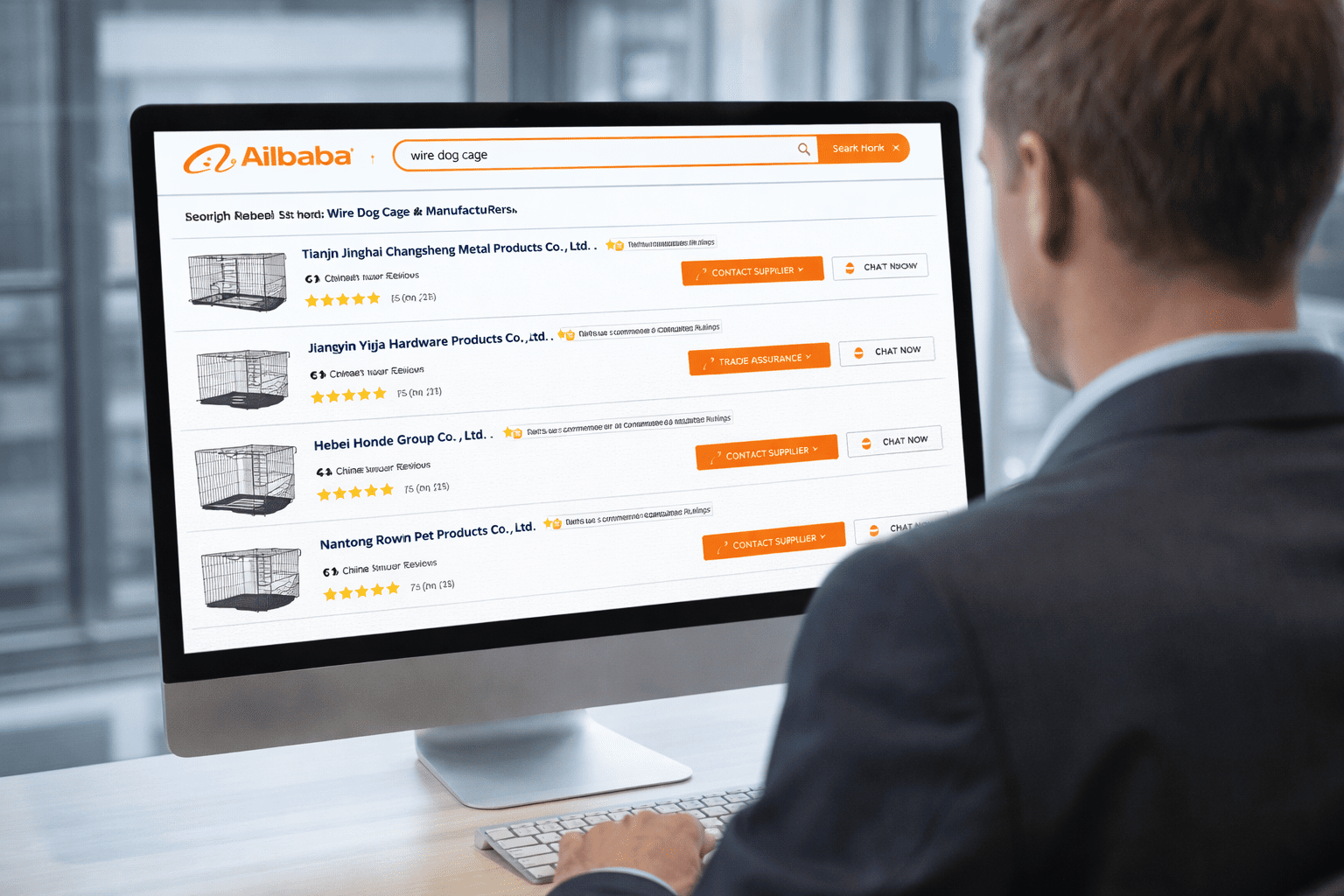
Utilize multiple channels for comprehensive supplier discovery. Alibaba provides extensive supplier listings with verified company profiles and transaction histories. Global Sources focuses on export-oriented manufacturers with quality certifications. Canton Fair trade shows enable direct factory visits and product inspections.
Search for suppliers using specific keywords: “wire dog cage manufacturer,” “metal pet crate factory,” “dog kennel manufacturer China.” Review supplier profiles focusing on business type (manufacturer vs. trading company), export experience years, and customer reviews.
💡 Pro Tip
Prioritize manufacturers over trading companies for first-time wire dog cage importing. Manufacturers typically offer 5-15% lower prices and greater control over production quality. However, trading companies can provide additional services like smaller MOQs and quality assurance for higher prices.
Initial Screening and Background Research
Conduct initial screening of 15-20 potential suppliers before deep engagement. Request company information including business licenses, export certifications, product catalogs, and customer references. Verify supplier claims through independent research.
Red flags during initial screening include vague responses to technical questions, reluctance to provide samples, unusual payment terms, and lack of export experience. Supplier selection frameworks provide systematic evaluation criteria for first-time importers.
| Screening Criteria | Green Flags | Red Flags | Action |
|---|---|---|---|
| Business Type | Direct manufacturer | Trading company with no factory | Prioritize manufacturers |
| Export Experience | 5+ years, verified references | Less than 2 years, no references | Request customer contact |
| Response Quality | Detailed, technical answers | Vague, generic responses | Ask follow-up questions |
| Certifications | ISO, export licenses, quality certs | No verifiable certifications | Verify cert authenticity |
| MOQ Requirements | Reasonable, negotiable | Excessively high, rigid | Negotiate down |
Day 8-14 Phase 2 Checklist
- Identify 15-20 potential suppliers through multiple channels
- Request company information and product catalogs
- Conduct initial screening and background research
- Shortlist 5-8 suppliers for detailed evaluation
- Contact shortlisted suppliers with product specifications
Phase 3: Supplier Verification and Sampling (Days 15-30)
Supplier verification validates supplier capabilities before committing to production. Sample testing ensures product quality meets specifications and customer expectations.
In-Depth Supplier Verification Process
Request detailed company documentation including business license, export license, ISO certifications, and third-party audit reports. Verify business registration through Chinese government databases. Cross-reference supplier claims with independent sources.
Conduct video calls with supplier management teams. Request virtual factory tours showing production lines, quality control processes, and inventory management. Assess supplier professionalism and responsiveness during communications.
Supplier verification processes include background checks, factory audits, and reference verification. Schedule virtual or physical factory audits for promising candidates using our comprehensive audit framework to assess production capabilities and quality control systems. Third-party inspection companies like SGS and Intertek provide comprehensive supplier verification services.
✅ Verification Documents
Business license and registration
Export license and customs registration
ISO 9001 quality certification
Third-party audit reports
Product testing certificates
Insurance certificates
📞 Reference Verification
Contact 2-3 existing customers
Ask about quality consistency
Inquire about delivery performance
Verify communication reliability
Check payment terms compliance
Confirm product quality satisfaction

Sample Acquisition and Quality Testing
Order samples from top 2-3 suppliers after verification. Request production-quality samples, not showroom pieces. Evaluate samples against your specifications focusing on wire gauge, welding quality, finish coating, door functionality, and structural integrity.
Conduct practical testing including weight load testing, door operation cycles, corrosion resistance testing, and durability stress testing. Compare samples side-by-side identifying quality differences between suppliers.
Sample Budget: Budget $200-$500 for samples including shipping and customs. This investment prevents $5,000-$20,000 in quality problems on full orders. Sample testing provides ROI of 1000-5000% when catching quality issues early.
Day 15-30 Phase 3 Checklist
- Request and verify supplier documentation
- Conduct video calls and virtual factory tours
- Contact supplier references for verification
- Order production-quality samples from top suppliers
- Conduct comprehensive sample quality testing
Phase 4: Contract Negotiation (Days 31-45)
Contract negotiation establishes clear terms protecting both buyer and seller. Well-structured contracts prevent misunderstandings and provide recourse if problems arise.
Core Purchase Contract Terms
Develop comprehensive purchase contracts covering product specifications, pricing terms, quality standards, delivery schedules, payment terms, and warranty provisions. Specify acceptable quality tolerances and defect limits.
Include clear clauses addressing quality failures, delivery delays, and breach scenarios. Define dispute resolution mechanisms and applicable jurisdiction. Ensure contracts specify FOB, CIF, or EXW shipping terms clearly.
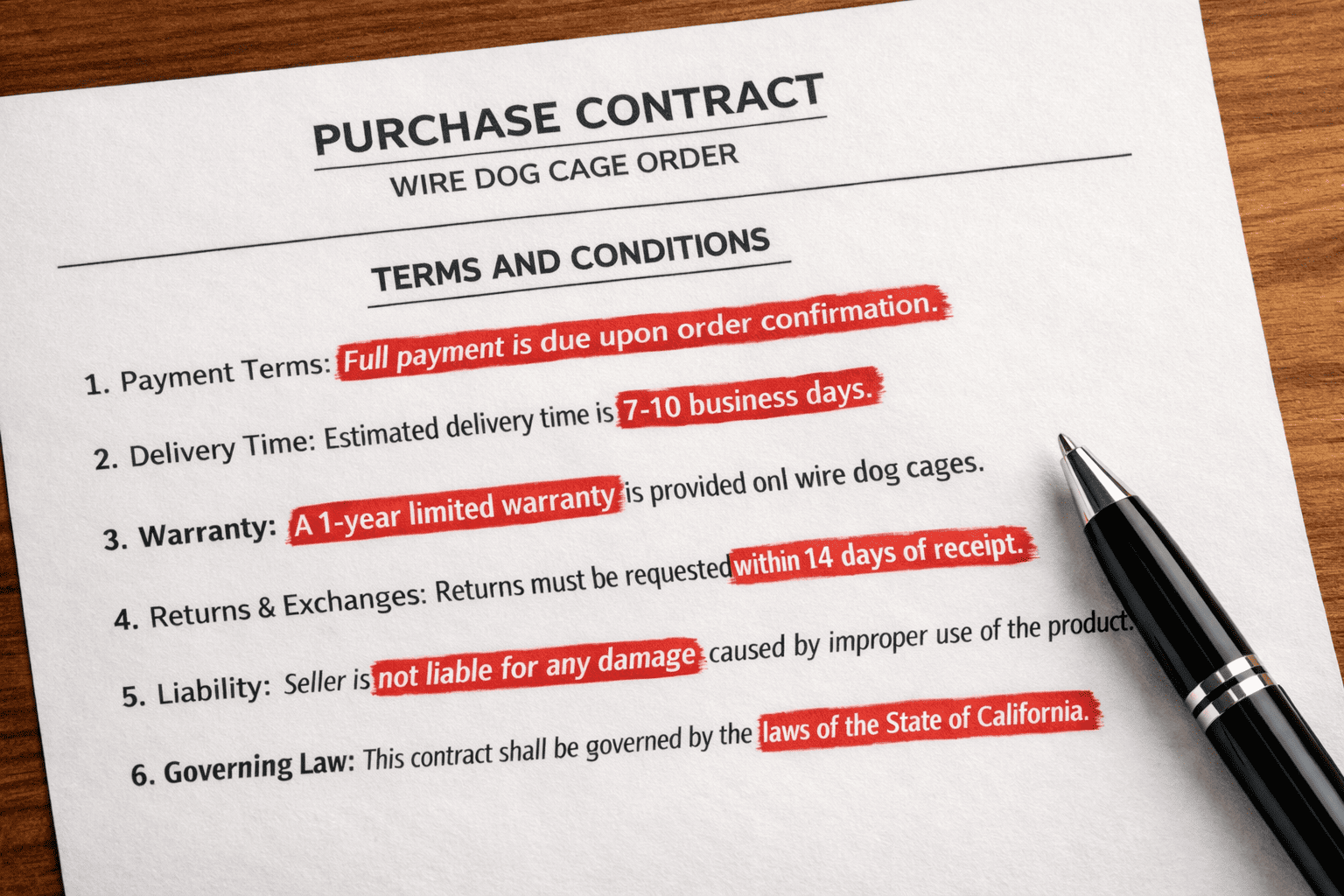
| Contract Element | Key Terms to Specify | Importance | Typical Terms |
|---|---|---|---|
| Product Specifications | Dimensions, wire gauge, finish type | Critical | Detailed technical drawings |
| Quality Standards | Defect tolerance, inspection criteria | Critical | AQL 2.5 for major defects |
| Pricing Terms | Unit price, FOB/CIF/EXW terms | Critical | FOB Shanghai: $25-35 |
| Delivery Schedule | Production time, shipping date | High | 30-45 days production |
| Payment Terms | Deposit, balance timing | High | 30% deposit, 70% before shipment |
| Warranty Provisions | Defect replacement, liability limits | Medium | 12-month quality warranty |
Price and MOQ Negotiation Strategies
Negotiate pricing based on order quantity, payment terms, and long-term partnership potential. Request tiered pricing for increasing order volumes. Standard wire dog cage pricing ranges from $20-$40 per unit depending on size and specifications.
Address MOQ requirements through negotiation strategies. First-time importers typically face MOQs of 200-500 units. Negotiate flexible MOQs using annual volume commitments, multi-SKU consolidation, or long-term contract arrangements.
Wire dog cage pricing structures help identify negotiation opportunities. Understanding cost breakdown (materials, labor, overhead) provides leverage in price negotiations.
💡 Pro Tip
Include price protection clauses in contracts. Suppliers sometimes increase prices mid-production citing raw material cost increases. Price protection locks in agreed pricing for 60-90 days, preventing unexpected cost escalations during your first order.
Day 31-45 Phase 4 Checklist
- Draft comprehensive purchase contracts
- Negotiate pricing and MOQ terms
- Establish payment schedule and terms
- Define quality standards and defect limits
- Specify delivery schedule and penalties
Phase 5: Production and Quality Control (Days 46-60)
Production monitoring ensures manufacturing meets quality standards. Quality control inspections catch defects before shipping, preventing costly returns and customer dissatisfaction.
Production Monitoring and Quality Control
Request production updates from suppliers throughout manufacturing. Request photos or videos during key production stages including material cutting, welding, finishing, and assembly stages.
Implement quality control inspections including raw material inspection, in-process inspection, and pre-shipment inspection. First-time importers should conduct third-party inspections rather than relying solely on supplier self-assessments.
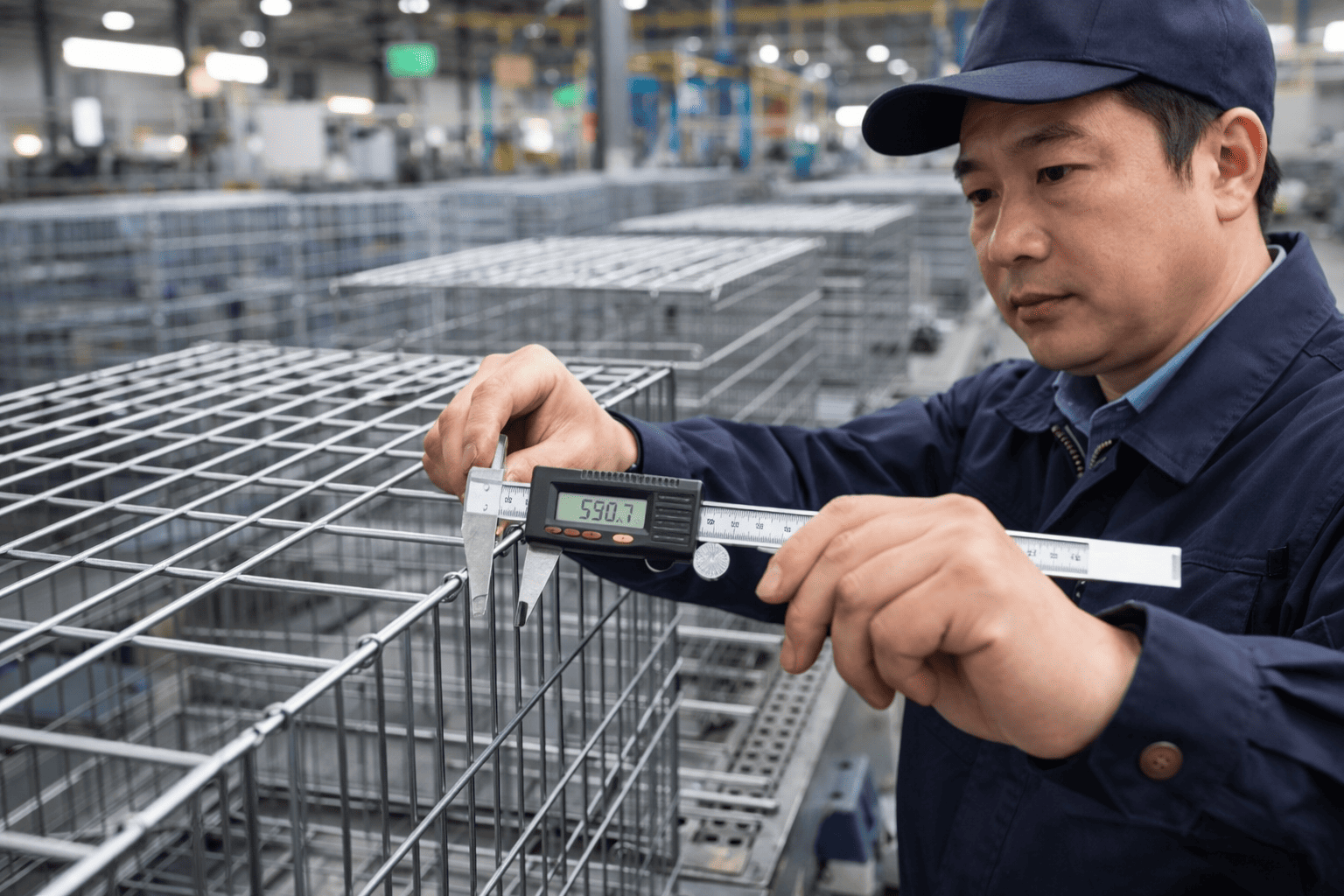
Establish acceptance quality limits (AQL) for different defect types. Typical AQL standards include 2.5% for major defects and 4.0% for minor defects. Define major defects versus minor defects clearly with suppliers.
📊 Quality Control Inspection ROI
Inspection Cost: $500-$1,000
Prevented Return Loss: $5,000-$20,000
ROI: 500-2000% return on QC investment
Pre-Shipment Inspection
Conduct comprehensive pre-shipment inspection before products leave the factory. Inspect finished products against specifications focusing on dimensions, finish quality, welding integrity, door functionality, and packaging.
Request defect correction before shipment if quality standards aren’t met. Negotiate replacement arrangements for units that don’t meet specifications. Document all inspection findings with photos for records.
| Inspection Type | Timing | Key Checks | Defect Actions |
|---|---|---|---|
| Raw Material Inspection | Production start | Wire gauge, coating materials | Reject substandard materials |
| In-Process Inspection | Mid-production | Welding quality, assembly | Correct process issues |
| Pre-Shipment Inspection | Before shipping | Finished product quality | Reject or replace units |
| Container Loading Inspection | Shipment loading | Packing, loading procedures | Correct loading issues |
Day 46-60 Phase 5 Checklist
- Request regular production updates
- Conduct raw material and in-process inspections
- Perform comprehensive pre-shipment inspection
- Document quality findings with photos
- Approve shipment or require corrections
Phase 6: Logistics and Shipping (Days 61-75)
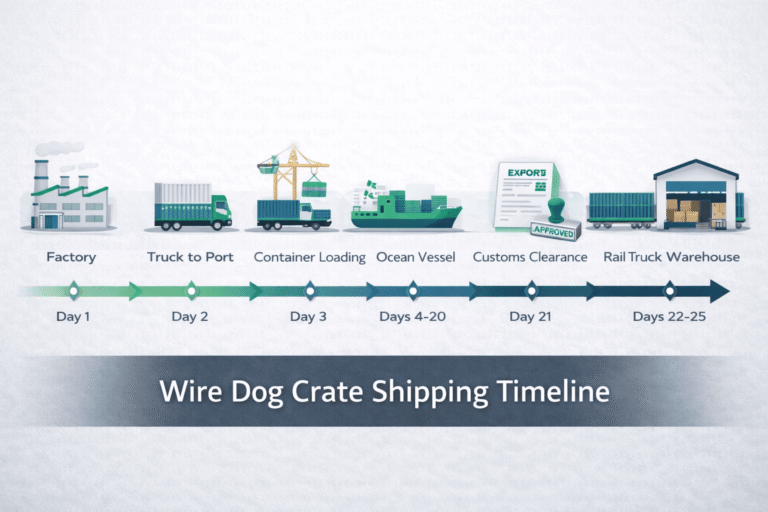
Logistics planning ensures efficient and cost-effective transportation. Proper shipping arrangements prevent delays and damage during transit. Understanding the complete shipping timeline with 7 critical milestones helps you coordinate production schedules and inventory planning effectively.
Shipping Method Selection and Cost Optimization
Choose appropriate shipping methods based on order size, urgency, and budget. Ocean freight offers lowest costs for large orders but requires 20-40 days transit time. Air freight provides fastest delivery (5-10 days) but costs 5-10 times more than ocean freight.
Compare full container load (FCL) versus less than container load (LCL) shipping. FCL shipping typically costs $1,200-$3,500 per 20ft container for 400-600 wire dog cages. LCL costs $40-$80 per cubic meter but increases per-unit costs.
🚢 Ocean Freight Options
FCL (Full Container): Best for 500+ units
LCL (Less Container): Best for 100-500 units
Transit Time: 20-40 days
Cost Range: $1,200-$3,500 per container
✈️ Air Freight Options
Best For: Urgent orders, 50-100 units
Transit Time: 5-10 days
Cost Range: $3-$5 per kg
When to Use: Time-critical needs
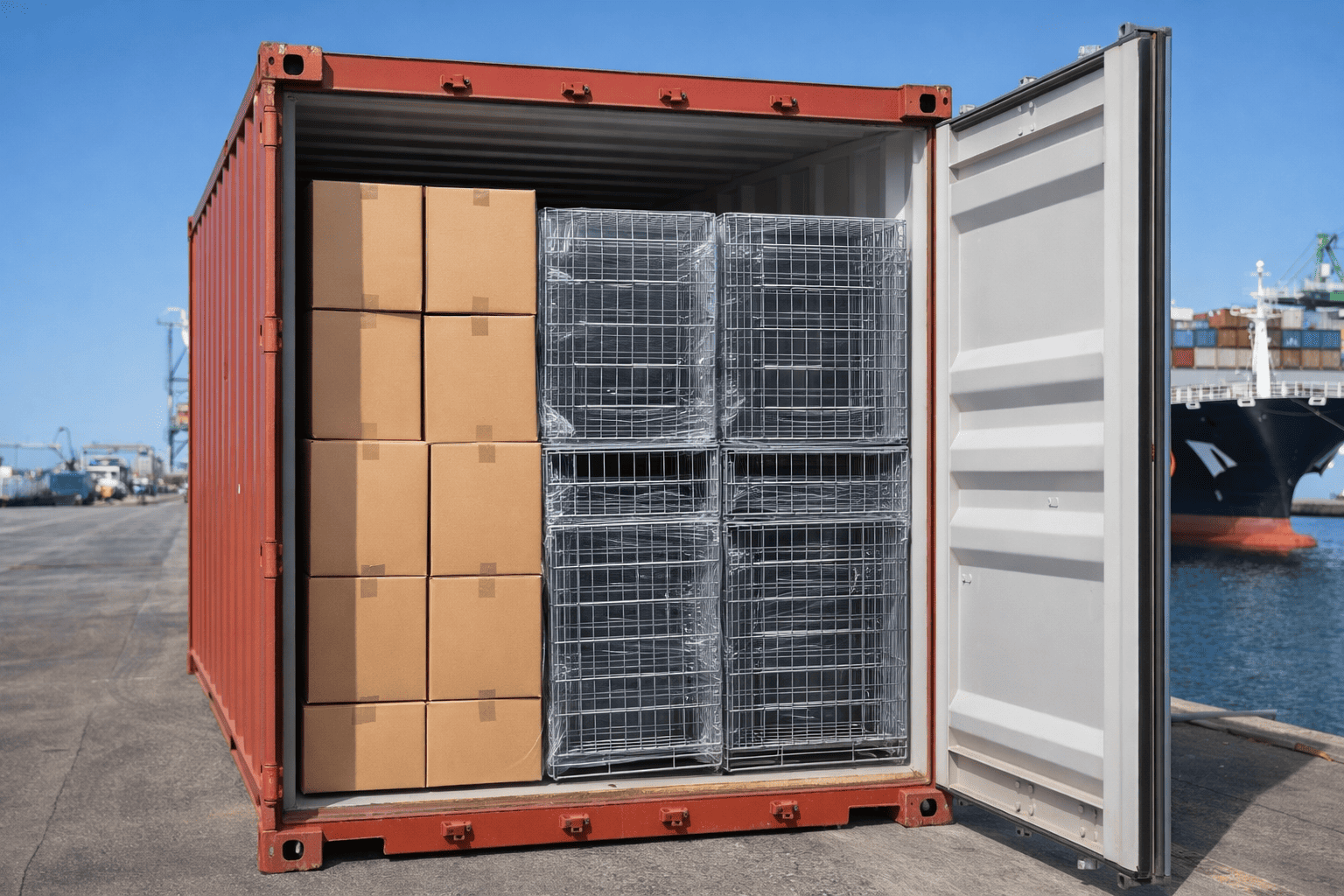
Logistics Arrangement and Tracking
Work with freight forwarders experienced in China-US or China-EU trade. Request multiple freight quotes comparing transit times, costs, and service levels. Consider inland transportation costs from port to final destination warehouse.
Obtain cargo insurance covering loss, damage, or theft during transit. Marine insurance typically costs 0.3-0.8% of cargo value. Additional coverage includes all-risk protection and warehouse-to-warehouse coverage.
Shipping Cost Optimization: Consolidate multiple orders into single shipments to achieve full container loads. FCL shipping reduces per-unit freight costs by 40-60% compared to LCL shipments for wire dog cages.
Day 61-75 Phase 6 Checklist
- Compare ocean freight vs. air freight options
- Obtain multiple freight forwarder quotes
- Arrange cargo insurance coverage
- Coordinate inland transportation logistics
- Establish shipment tracking procedures
Phase 7: Customs Clearance and Delivery (Days 76-85)
Customs clearance involves preparing documentation and complying with import regulations. Proper documentation prevents customs delays and avoids penalties.
Customs Clearance Process and Documentation Preparation
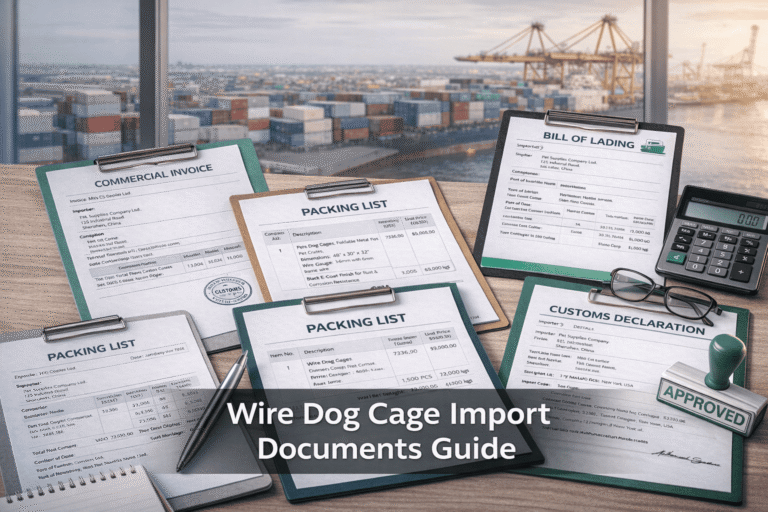
Prepare required customs documents including commercial invoice, packing list, bill of lading, and certificate of origin. Verify HS code classification (typically 7326.90.90 for wire dog cages) and confirm applicable duty rates. Follow our complete documentation checklist to ensure all necessary paperwork is prepared correctly and submitted on time.
Work with customs brokers for professional clearance assistance. Customs brokers understand specific requirements, prepare accurate documentation, and handle communication with customs authorities. Broker services typically cost $150-$400 per shipment.
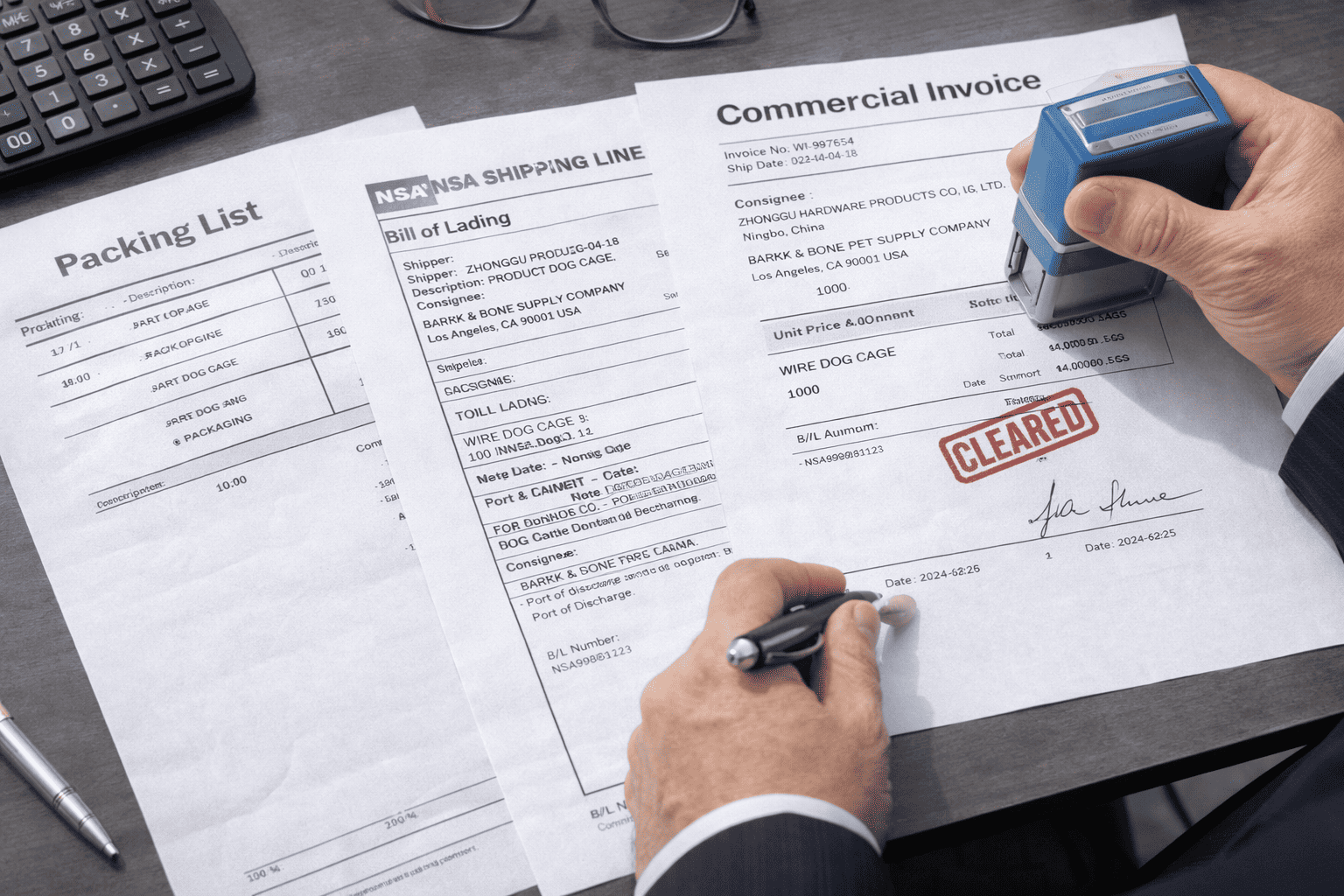
| Document Type | Purpose | Prepared By | Timing |
|---|---|---|---|
| Commercial Invoice | Value declaration and payment | Supplier | Before shipment |
| Packing List | Content specification | Supplier | Before shipment |
| Bill of Lading | Transportation contract | Freight forwarder | Shipment departure |
| Certificate of Origin | Country of origin verification | Supplier/Chamber | Before shipment |
| Import License | Import authorization | Importer | Before shipment |
Tariff and Import Tax Handling
Calculate and prepare payment for customs duties and import taxes. US duty rates for wire dog cages typically range from 2.5%-10% depending on specific classification. Additional fees include merchandise processing fees (0.3464%) and harbor maintenance fees (0.125%).
EU import costs include VAT (19-25% by country) plus duty rates of 2.5-4%. Total EU import costs range from 22-28% of CIF value depending on destination country.
Pricing calculations should include all landed costs including duties and taxes. Understanding total landed costs ensures accurate profit margin calculations.
💡 Pro Tip
Request HS code verification from customs brokers before shipment. Incorrect classification can lead to penalties of 2-10 times correct duty amounts plus shipment delays. Professional classification verification prevents costly mistakes.
Day 76-85 Phase 7 Checklist
- Prepare all required customs documentation
- Verify HS code classification and duty rates
- Engage customs broker for clearance assistance
- Calculate and prepare duty and tax payments
- Coordinate final delivery to warehouse
Phase 8: Post-Import Evaluation (Days 86-90+)
Post-import evaluation assesses success and identifies improvement opportunities. Systematic evaluation builds knowledge for future importing operations.
Quality Assessment and Supplier Feedback
Conduct thorough quality assessment upon delivery. Inspect received products for shipping damage, finish quality, welding integrity, and functional performance. Compare received products against approved samples.
Document all quality issues with photos and detailed descriptions. Provide constructive feedback to supplier including specific concerns and expectations for future orders. Track defect rates against quality standards specified in contracts.

Long-Term Partnership Development
Evaluate supplier performance against criteria including quality consistency, delivery timeliness, communication responsiveness, and price competitiveness. Score suppliers using objective metrics for future reference.
Develop long-term partnerships with top-performing suppliers. Negotiate better pricing and terms based on proven performance. Plan future orders increasing volumes to achieve volume discounts and improved service levels.
🎯 Success Metrics for First-Time Import
Quality Defect Rate: Below 3%
Delivery Timeline: Within agreed schedule (±5 days)
Total Landed Cost: Within budget ±10%
Customer Satisfaction: No returns for quality issues
Day 86-90+ Phase 8 Checklist
- Conduct comprehensive quality assessment
- Document and report quality issues to supplier
- Evaluate overall supplier performance
- Calculate total landed costs and profit margins
- Plan future orders based on lessons learned
Conclusion
First-time wire dog cage importing becomes manageable when broken into eight systematic phases spanning 60-90 days. Each phase builds on the previous one, creating a structured approach that reduces risk while maximizing profitability. Successful first-time importers establish foundations for sustainable China sourcing operations.
The key to success lies in thorough preparation, systematic execution, and continuous learning throughout the import process. Following this proven process transforms complex international trade into predictable business operations supporting growth and profitability.
📋 Key Takeaways
Invest 7 days in market research preventing costly specification mistakes
Dedicate 7-14 days to supplier discovery and initial screening
Allocate 15-30 days for supplier verification and sample testing
Spend 15 days on contract negotiation protecting your interests
Monitor production for 15 days with quality control inspections
Plan logistics and shipping for 15 days optimizing costs
Allocate 10 days for customs clearance and delivery coordination
Conduct post-import evaluation refining processes for future orders
Ready to begin your first-time wire dog cage importing journey? Start with Phase 1 market research establishing clear specifications and target market understanding. Each subsequent phase becomes more manageable with proper preparation.