
Shipping Routes from China: Transit Times and How to Avoid Stockouts
Stage 3 of the Logistics Series — Master transit times to prevent stockouts and plan inventory like a pro.
1. Major Chinese Departure Ports: Where Your Cargo Leaves China
Your dog crates leave China from three main ports: Ningbo, Shanghai, and Shenzhen. Each has different characteristics.
Ningbo is where most of our clients book space. It is deep-water, handles heavy containers well, and has the most frequent weekly departures to US West Coast — typically 4-5 direct sailings per week. The port congestion here is usually lower than Shanghai during peak season.
Shanghai is the largest port in China. If your supplier is in Jiangsu or Anhui provinces, trucking to Shanghai often makes sense. But “Shanghai” shipping can sometimes mean your container gets transshipped through Ningbo anyway — ask your forwarder to confirm the actual departure port.
Shenzhen serves factories in Guangdong province. Direct sailings to US West Coast are less frequent, so your cargo might route through Hong Kong or transship in Singapore. That adds 2-4 days to transit time before the vessel even leaves Chinese waters.

2. Routes to US West Coast: The Fastest Lane from China
The US West Coast is the most common destination for dog crate shipments. Transit times are relatively predictable, making it easier to plan inventory.
Ningbo to Los Angeles (direct): 12-14 days in normal season. This is your baseline number. Los Angeles (LAX) and Long Beach (LGB) are the primary ports, with Oakland (OAK) used for Pacific Northwest deliveries.
Ningbo to Seattle: 14-16 days. Seattle works well if your customer base is in the Pacific Northwest — Washington, Oregon, parts of Idaho. Seattle port congestion is typically lower than LA/LB, which can matter during peak season.
Peak season impact: August through October is peak season. During these months, expect 5-7 additional days. That is right — your 12-day transit becomes 17-21 days. We have seen containers sit at anchor outside LA for 6 days waiting for a berth. Book 3-4 weeks earlier during these months.
Freight rates for a 40ft container from Ningbo to Los Angeles run approximately:
| Season | 40ft Container Rate |
|---|---|
| Low season (January-April) | $1,800-2,500 |
| Peak season (August-October) | $3,500-5,000 |
Ocean freight is charged by volume (CBM), not by weight. A 40ft container holds roughly 120-140 CBM. Your dog crates are relatively lightweight but voluminous — so you are paying for space, not weight.
3. Routes to US East Coast: Two Paths, Very Different Timelines
US East Coast shipping is significantly longer and more complex. Your cargo has two route options, each with tradeoffs.
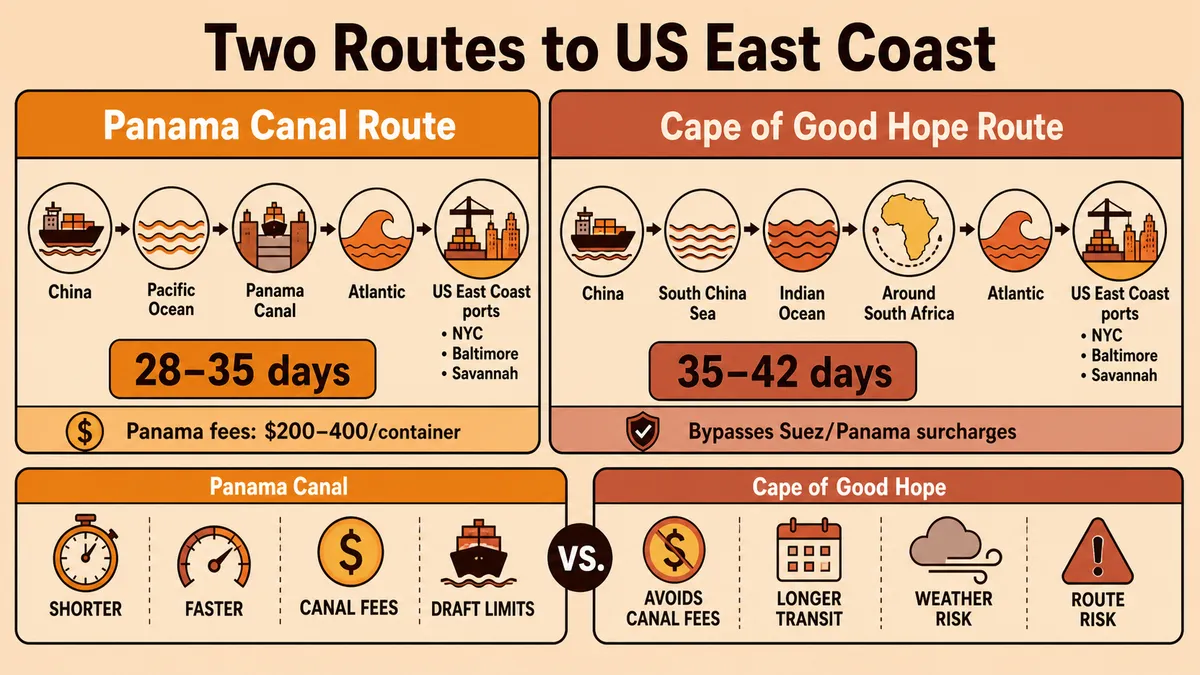
Panama Canal route: China → Pacific → Panama Canal → Atlantic → US East Coast ports (NYC, Baltimore, Savannah). Transit time: 28-35 days.
Cape of Good Hope route: China → South China Sea → Indian Ocean → Around South Africa → Atlantic → US East Coast. Transit time: 35-42 days. This route bypasses Suez and Panama Canal surcharges but adds significant distance.
Why would anyone take the longer Cape route? When Panama Canal transit fees spike — they can add $200-400 per container during high-demand periods — the Cape route sometimes becomes cheaper overall despite the longer transit. Your freight forwarder should quote both options.
US East Coast ports: New York (NYC), Baltimore (BAL), Savannah (SAV). Savannah has been gaining market share due to shorter inland rail times to the Midwest. Baltimore handles heavier volumes for Mid-Atlantic markets.
4. Routes to Major European Ports: The Atlantic Crossing
Europe shipping is predictable but slow. Major destination ports handle the bulk of China-to-Europe cargo.
Rotterdam (Netherlands): The largest European port, serving Northern Europe. Transit time from China: 28-35 days. Rotterdam handles massive volumes and has excellent inland waterway connections to Germany, Belgium, France.
Hamburg (Germany): Central Europe’s gateway. Transit time: 28-35 days. Hamburg is particularly strong for Central European distribution (Germany, Austria, Switzerland, Czech Republic).
Zeebrugge (Belgium): Smaller but efficient. Transit time: 28-33 days. Often used for rolling stock and project cargo.
UK ports (Felixstowe, Southampton): 35-40 days from China. Post-Brexit customs procedures add complexity — expect additional documentation and potential delays at UK borders.
Europe customs clearance takes longer than US: typically 5-10 days. US clearance runs 3-5 days. Factor this into your inventory planning — European shipments need more lead time buffer.
5. Routes to Australia: The Southern Ocean Route
Australia shipping connects Chinese factories to the Pacific Southwest market. Transit times are moderate.
Shanghai/Ningbo to Sydney/Melbourne: 20-25 days. These are the primary Australian ports, serving the major population centers on the east coast.
Shanghai/Ningbo to Perth: 25-30 days. Perth is geographically isolated — it is closer to Singapore and the Indian Ocean trade routes. If your customer is in Western Australia, budget extra transit time.
Trans-Tasman to New Zealand: From Australian east coast ports, add 3-5 days for New Zealand (Auckland, Christchurch). From West Australia, New Zealand adds 5-7 days.
Australia has strict biosecurity customs requirements. Dog crates — even metal ones — may face inspection. Ensure all packaging materials are declaration-compliant. Undeclared wood pallets can result in fumigation at $200-500 per pallet.
Australian port congestion is generally lower than US ports. Melbourne and Sydney occasionally experience congestion during February-March (post-Chinese New Year restocking) and August-September (pre-Christmas). Book accordingly.
6. Planning Inventory Based on Route Transit Time: The Stockout Prevention Framework
This is the most important section of this blog. If you are only going to remember one number, make it this:
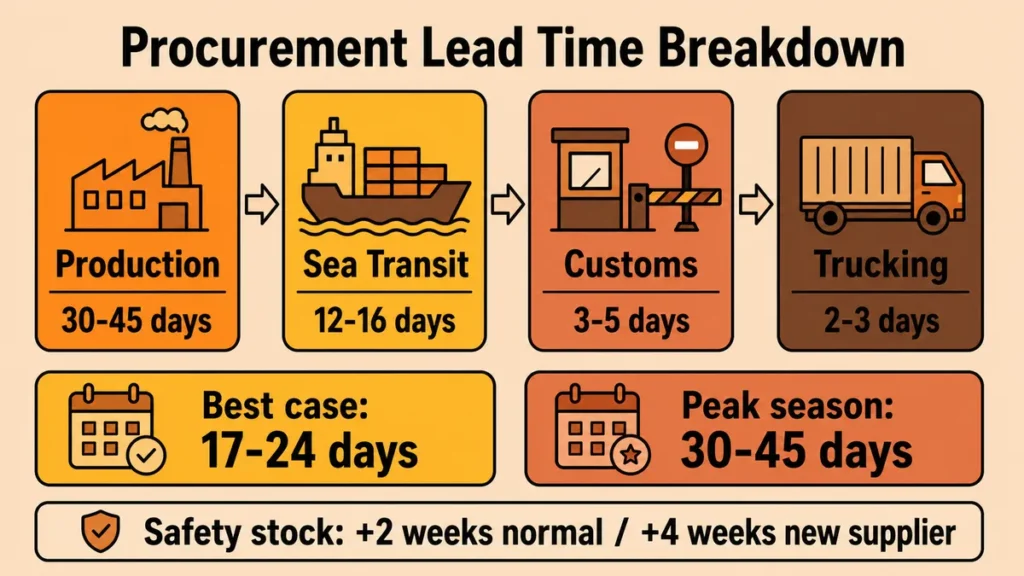
From departure to saleable inventory, US market takes approximately 30-45 days
That breaks down as:
| Stage | Time Range |
|---|---|
| Sea transit (US West Coast) | 12-16 days |
| Customs clearance | 3-5 days |
| Trucking to warehouse | 2-3 days |
| Total (best case) | 17-24 days |
| Total with peak season (worst case) | 30-45 days |
The formula for procurement lead time:
To back-calculate your shipping date: When do you need inventory on shelf? Count backward using the longest scenario (peak season + potential delays).
Safety stock calculation:
- For reliable suppliers with consistent transit: maintain 2-week safety stock beyond your calculated lead time
- For new suppliers or routes with variability: maintain 4-week safety stock
- During peak season: add 3 weeks buffer to normal lead time calculations
Peak season shipping calendar:
- August-October shipments: Book space 4-6 weeks in advance. Rates are 50-100% higher than low season.
- January-February: Chinese New Year factory closures. Ship finished goods 2-3 weeks before CNY to maintain inventory.
- March-April: Post-CNY restocking surge. Space is available but factory production is ramping up.
7. Shipping Route Comparison Table
| Route | Transit Time | Peak Season Delay | Customs Time | Total to Warehouse |
|---|---|---|---|---|
| Ningbo → Los Angeles | 12-14 days | +5-7 days | 3-5 days | 17-26 days |
| Ningbo → Seattle | 14-16 days | +3-5 days | 3-5 days | 20-26 days |
| Ningbo → New York (Panama) | 28-35 days | +5-10 days | 3-5 days | 36-50 days |
| Ningbo → Rotterdam | 28-35 days | +5-7 days | 5-10 days | 38-52 days |
| Ningbo → Sydney | 20-25 days | +3-5 days | 3-5 days | 26-35 days |
Pitfall Prevention Checklist
- Planning shipments based on short transit times: Think sea freight only takes 2 weeks, but peak season delays push it to 4 weeks, causing stockouts. Plan based on longest possible transit time. Reserve 2-week buffer.
- Ignoring customs clearance time: Cargo arrives at port, but customs issues arise — demurrage accrues at $50-150/day. US customs takes 3-5 days, Europe 5-10 days.
- Not shipping early enough before peak season: Waiting until August to ship peak season cargo, resulting in schedule delays.
Frequently Asked Questions
Q1: How long does sea freight from China to the US take?
US West Coast direct: 12-16 days. US East Coast: 28-42 days depending on route (Panama Canal vs. Cape of Good Hope). Add customs and land transport — from departure to warehouse plan for 30-45 days total for US market.
Q2: How long does sea freight from China to Europe take?
To Hamburg/Rotterdam: 28-35 days. To UK ports: 35-40 days. Plus 5-10 days customs clearance. Total from departure to warehouse: 38-52 days for Europe.
Q3: How much delay does peak season cause?
Peak season (August-October) may cause 5-10 days delay. We recommend shipping 2-3 weeks earlier than your normal calculation during these months. August bookings may not arrive until October.
Q4: How do I calculate procurement lead time?
Lead time = Production time (30-45 days) + Sea transit time + Customs clearance time + Land transport to warehouse. Back-calculate from your needed inventory date using the longest scenario.
Q5: How long does shipping to Australia take?
To Sydney/Melbourne: 20-25 days. To Perth: 25-30 days. Add 3-5 days for New Zealand. Total to warehouse: 26-35 days for Australia, 30-40 days for New Zealand.
