
How to Choose a Reliable Freight Forwarder: A Pet Crate Buyer’s Guide
Stage 4 of the Logistics Series — The final piece of the landed price puzzle.
1. Why You Need a Freight Forwarder
You have seen the FOB price. You have calculated ocean freight. You have estimated duties. And then a freight forwarder calls with a quote — and you have no idea if that number is reasonable.
That is exactly where most buyers get stuck. The forwarder is the single point that coordinates ocean freight, destination port handling, customs clearance, and delivery. Their quote ties together every cost layer covered in the Logistics Series. FOB vs Landed Price
A freight forwarder is not just a logistics booking service. Their value in the procurement chain is:
- Consolidation: Grouping your cargo with other buyers’ cargo to fill containers at better rates
- Customs expertise: HS Code pre-confirmation, duty estimation, clearance procedure
- Destination port handling: Managing DDC, AMS, ISPS, THC so you do not have to
- Problem escalation: When cargo gets held at customs or demurrage starts accumulating, a good forwarder is your first call
A forwarder who knows your product category — pet crates, wire cages — will know the right HS Code classification before you ship. That alone saves you from penalty risk if the wrong code is declared.
Self-clearing is cheaper than using a forwarder for customs clearance but more troublesome. If you do not have a licensed customs broker in-house, the forwarder’s clearing network is worth the fee. Shipping Routes from China
The question is not whether to use a forwarder. The question is how to tell a good one from a bad one before you sign.
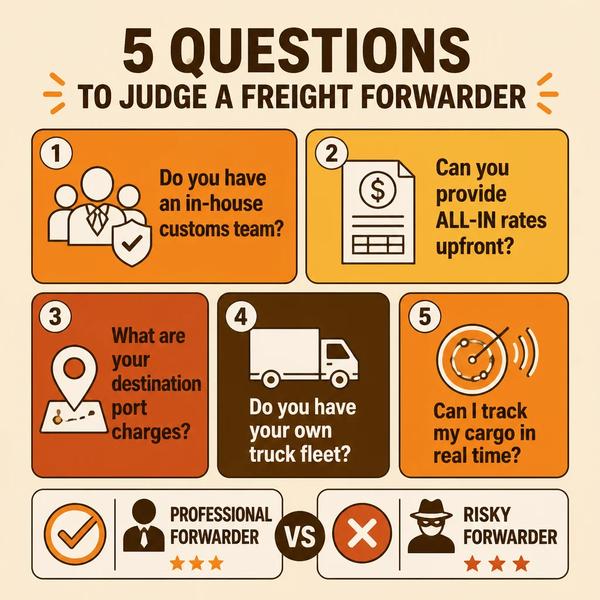
2. 5 Key Questions to Judge Forwarder Professionalism
A forwarder’s professionalism shows in how they answer questions, not just that they answer yes. Here are the 5 questions that separate experienced forwarders from brokers who book cargo and hope for the best.
Question 1 — What is the all-in rate from port arrival to warehouse delivery?
If a forwarder cannot give you a single number that covers DDC, AMS, ISPS, and THC, their quote is incomplete. A professional forwarder will itemize every fee and give you a total land-and-deliver number. If they say “it depends,” keep asking.
Question 2 — Can you confirm the HS Code with supporting rationale?
A forwarder who can provide HS Code pre-confirmation with supporting rationale is typically more experienced. If they misclassify, you carry the penalty — not them. A forwarder who knows your product category will have seen your HS Code before and can cite the tariff basis.
Question 3 — Do you have an in-house customs clearance team?
A forwarder with in-house customs clearance team is 1-2 days faster than one who outsources. During urgent restock situations, that 1-2 days matters. When cargo is sitting at port accumulating demurrage at $50-150/day, speed is money. Ask specifically: “Do you file customs yourself or use a third-party broker?”
Question 4 — What are your demurrage and detention policies?
Demurrage starts after 3 free days at $50-150/day. You need to know the free-day window and the daily rate before cargo arrives. A forwarder who proactively explains demurrage policy is a forwarder who plans ahead. One who never mentions it until the invoice arrives has a different business model.
Question 5 — Can you confirm that in writing?
Only what can be confirmed in writing is truly no problem. Verbal assurances on HS Code classification, all-in pricing, or demurrage policy are not enforceable. A professional forwarder will put the key terms in writing without hesitation.
Customs broker fees are typically a fixed fee plus percentage of cargo value, around $500 total. When a forwarder quotes you customs clearance, compare this benchmark. A quote significantly below $500 with no explanation may be cutting corners.
Ocean freight is charged by volume — CBM, not weight. When a forwarder quotes you ocean freight, make sure the volume calculation is based on actual cargo dimensions, not estimated. A crate of dog crates — large, empty, relatively light — takes up far more volume than weight. If a forwarder quotes by weight, that is a warning sign they do not know your product.

3. Forwarder Quote Breakdown: Where the Traps Are
A freight forwarder quote has layers. Some forwarders count on you not knowing the difference. Here is how to read one carefully.
| Fee Item | Included in “Ocean Freight”? | Included in “All-In”? |
|---|---|---|
| Ocean freight (port to port) | Yes | Yes |
| BAF (Bunker Adjustment Factor) | Usually not | Varies |
| DDC (Destination Delivery Charge) | No | Yes |
| AMS (American Manifest System Fee) | No | Yes |
| ISPS (Ship Security Charge) | No | Yes |
| THC (Terminal Handling Charge) | No | Yes |
| Customs broker fee | No | Usually not |
| Import duty | No | No |
Here is the trap: Forwarder A quotes $2,600 ocean freight. Forwarder B quotes $2,850. Forwarder A looks cheaper. But Forwarder A’s “all-in” excludes $350 in destination port charges. Forwarder B’s all-in includes everything. Forwarder B is actually $200 cheaper — and more transparent.
Freight forwarder “all-in rates” often exclude destination port DDC, AMS, ISPS. Always ask for a complete fee schedule, not just a bottom-line quote. The “all-in” number is only reliable if it actually includes everything from port arrival to your door.
Another trap: consolidation quotes. LCL consolidation can be 30% cheaper on ocean freight but misc fees are proportionally higher. Per-unit costs may not differ much from a full container when you factor in documentation fees, handling, and customs filing. Always calculate both before deciding. FCL vs LCL Shipping
80% of buyers miss destination port charges on their first inquiry. Ask specifically about DDC, AMS, ISPS, and THC before signing. These fees typically add $150-700 per container on top of ocean freight — real money on a large dog crate order.
The forwarder who explains their quote line by line is the forwarder who will not surprise you at destination. That forwarder is worth the slightly higher ocean freight, every time.
4. The Right Way to Compare Multiple Forwarders
You have collected 3 or 4 forwarder quotes. They all look different. How do you compare them fairly?
First, normalize the comparison baseline. All quotes must cover the same thing:
- Same cargo volume (CBM) and weight
- Same origin port and same destination port
- Same shipping method (full container vs. LCL)
- Same delivery terms (port delivery vs. warehouse delivery)
Second, request itemized fee schedules from each forwarder. Do not compare bottom-line numbers — compare line items. The forwarder with the lowest bottom line may have the most exclusions.
| Comparison Dimension | What to Check |
|---|---|
| Ocean freight | Per CBM or per container? Port to port or inclusive? |
| Destination charges | DDC, AMS, ISPS, THC — itemized or lump sum? |
| Customs clearance | Included or separate quote? In-house or outsourced? |
| Free demurrage days | 3 free days is standard — verify before comparing |
| Insurance | Do they arrange it? At what rate? Typically 0.1-0.3% of declared value |
| Payment terms | L/C costs 1-2% more than T/T. Factor this in |
What about a 20% price difference on the same shipment? Is that normal? Yes — and it usually reflects one of these:
- Different consolidation levels (some forwarders add consolidation fees others waive)
- Different carrier contracts (major carriers vs. budget lines)
- Different clearance networks (in-house vs. third-party broker, reflected in speed and cost)
- Hidden fees deferred to destination (the cheapest ocean freight hides the highest destination charges)
A 20% spread on a $3,000 ocean freight quote is $600 — that is real money. But if the cheaper quote excludes $400 in destination charges and the more expensive quote includes everything, the real gap is $200, not $600. Always read the footnotes.
When in doubt, ask for a mock landed price calculation. A professional forwarder will take your FOB price, add their fees, and show you the estimated total. That is the forwarder who understands your business.
5. Emergency Response When Problems Occur
Even with a professional forwarder, problems happen. Customs holds cargo. Weather delays ships. Demurrage clock runs longer than expected. What do you do?
Scenario 1 — Cargo held at customs for inspection
Wrong HS Code classification can result in a penalty. If customs flags your shipment, do not let the forwarder handle it alone. Ask for a copy of the customs hold notice and the specific reason. Contact your customs broker directly. If the issue is classification, provide the supporting technical documentation for your product. Clearance time — US roughly 3-5 days, Europe 5-10 days — may extend by 2-3 days during an inspection.
Scenario 2 — Demurrage clock is running
Demurrage starts after 3 free days at $50-150/day. The moment you know your cargo has arrived and your truck cannot pick up, escalate to the forwarder. Ask if they can request a free day extension from the port or arrange alternative pickup. Every day you delay costs $50-150 directly. A good forwarder will proactively suggest solutions — a reactive one will wait for the invoice.
Scenario 3 — Extra charges appear after arrival
Return or abandonment handling fee is typically 20-30% of import cost. If you receive an unexpected invoice from the forwarder after cargo delivery, request a line-item breakdown. Compare it against their original quote. If charges were not disclosed, push back in writing. Only what can be confirmed in writing is truly no problem — verbal promises without documentation are unenforceable. A reputable forwarder will have disclosed all fees before cargo moved.
Scenario 4 — Forwarder is non-responsive during a problem
Non-responsiveness during a problem is a professionalism signal on its own. A forwarder who goes quiet when cargo is stuck is a forwarder who is managing a crisis at your expense. Set an escalation protocol before you sign: who do you call, what is the response time, who is the backup contact? If a forwarder cannot give you a direct contact for urgent issues, that is a red flag for the relationship.
Emergency Response Checklist
- Customs hold: Get the hold notice in writing; contact your broker directly; provide technical docs for your product HS Code.
- Demurrage risk: Call forwarder immediately when you know pickup will be delayed; request extension or alternative arrange.
- Unexpected charges: Request line-item breakdown; compare against original quote; push back in writing if undisclosed.
- Non-responsive forwarder: Escalate to backup contact; document all communication; consider switching forwarder for next shipment.
A good forwarder relationship is built before problems occur. The forwarder who explains their HS Code rationale, puts all-in pricing in writing, and answers your five questions clearly — that forwarder will also be responsive when something goes wrong. Choose on the front end, not when you are in a crisis.

Frequently Asked Questions
Q1: Is a forwarder who says “all-in rate” trustworthy?
Q2: Why ask if a forwarder has an in-house customs team?
Q3: Is a 20% price difference on the same shipment normal?
Q4: My forwarder suggests consolidation — should I agree?
Q5: What if I discover extra charges after cargo arrives?
Q6: What forwarder should I use for samples and small orders?
Continue Reading – Logistics Series
- FOB vs Landed Price — The Complete Cost Breakdown — Every cost between factory and door, explained.
- FCL vs LCL Shipping — How Many Dog Crates Fit in a 20ft/40ft Container?
- Shipping Routes from China — How to Calculate Import Duties for US and Europe
/* Cagesilo 图片完整显示修复 – 强制覆盖所有主题样式 */
html body .post-inner img,
html body .entry-content img,
html body article.post img,
html body .single-post .post-content img,
html body .blog-content img {
max-width: 100% !important;
width: auto !important;
height: auto !important;
max-height: none !important;
min-height: 0 !important;
object-fit: contain !important;
object-position: center !important;
display: block !important;
margin-top: 20px !important;
margin-bottom: 20px !important;
margin-left: auto !important;
margin-right: auto !important;
overflow: visible !important;
clip: auto !important;
clip-path: none !important;
-webkit-clip-path: none !important;
}
/* 修复图片容器不允许溢出 */
html body .post-inner div,
html body .entry-content div,
html body article.post div {
overflow: visible !important;
}
/* 移除 WordPress 可能添加的宽高属性限制 */
html body img[width],
html body img[height] {
width: auto !important;
height: auto !important;
}
