What ASTM Standards Ensure Wire Dog Cage Safety & Performance?
For serious importers, wire dog cage ASTM standards are the technical backbone of safety and performance. They translate vague promises like “strong” or “durable” into measurable benchmarks for weld strength, corrosion resistance, and impact performance.
Understanding the right wire dog cage ASTM tests helps you filter out risky suppliers before problems reach your customers. When a factory can provide clear, accredited ASTM reports, you gain hard evidence that the cage will hold up under real-world use.
This guide explains which ASTM standards matter most for wire dog cages, how they are tested, and how you can use those results to protect both pets and your brand reputation.
Core Insight
Introduction: Ensuring Pet Safety through ASTM Standards
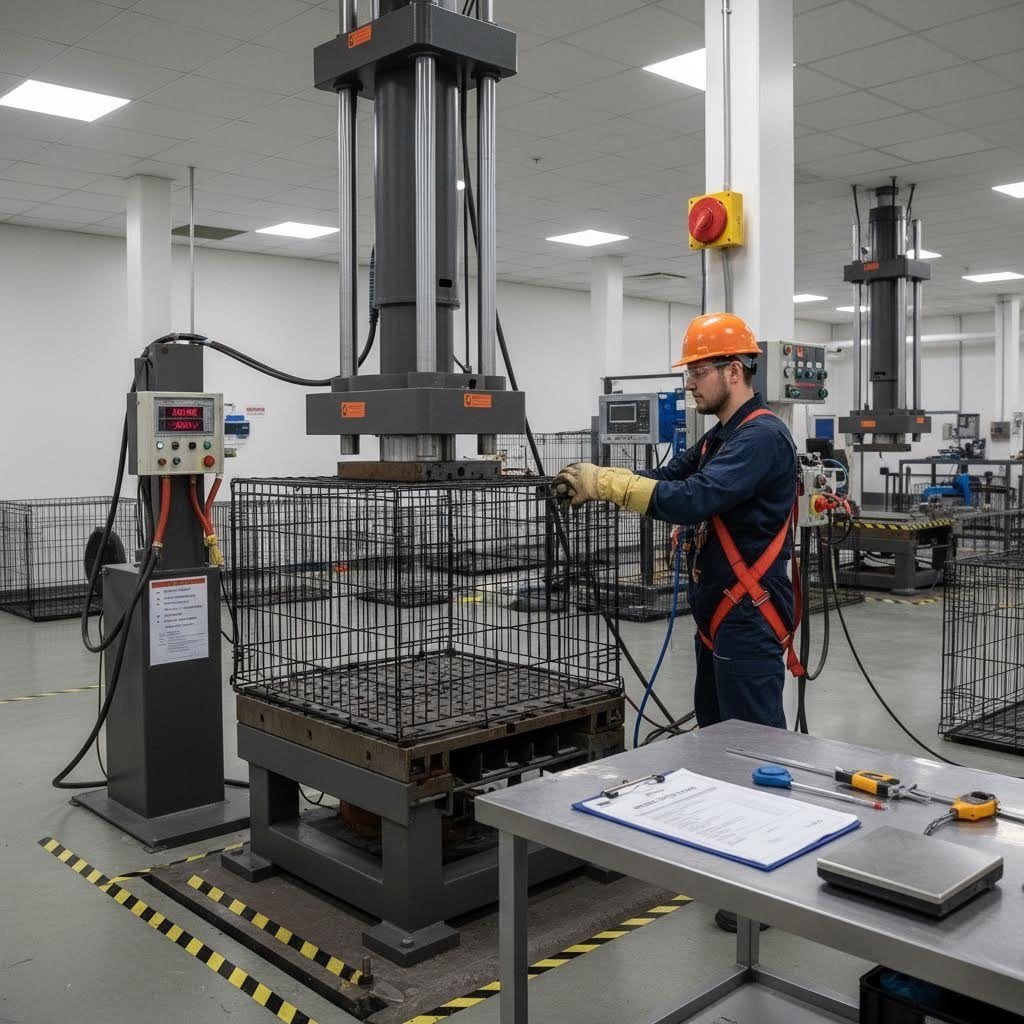
The wire dog cage market is crowded with products that look similar in photos but behave very differently in real life. Without a technical framework, it is almost impossible to judge whether a cage will bend, rust, or create injury risks after a few months of use.
Wire dog cage ASTM standards offer that framework. Instead of trusting marketing claims or visual inspection alone, you can rely on standardized tests for load-bearing capacity, coating durability, and chemical safety. These tests compress years of wear and tear into days or weeks of lab exposure.
For importers, using ASTM-aligned testing as an entry requirement dramatically reduces returns, complaints, and the risk of high-profile safety incidents. Rather than reacting to problems, you proactively design risk out of the product.
Key ASTM Standards Relevant to Wire Dog Cages
ASTM International publishes thousands of standards, but only a focused subset directly shapes wire dog cage safety and performance. Together, these standards address the surface chemistry, mechanical strength, and design details that matter for pets and end users.
The most important group of wire dog cage ASTM standards covers three areas: toxicity of coatings and plastics, resistance to corrosion, and resistance to chipping or peeling under stress. Selecting a factory that routinely tests against these standards is the fastest way to raise your product baseline.
ASTM Test Methods Overview
Below is a simplified map of the core wire dog cage ASTM standards importers should know:
| ASTM Standard | Focus Area | Why It Matters for Wire Dog Cages |
|---|---|---|
| ASTM F963 | Heavy metals, sharp points, sharp edges | Ensures coatings and exposed surfaces are safe if chewed or touched. |
| ASTM B117 | Salt spray (corrosion) testing | Predicts how fast the cage will rust in humid or coastal environments. |
| ASTM D3359 | Coating adhesion | Checks if powder coating stays attached when the wire flexes or is scratched. |
For many buyers, requesting test reports that clearly reference these wire dog cage ASTM methods is the minimum reasonable baseline. Without them, you are relying on the factory’s internal standards, which may be uneven or undocumented.
Structural Integrity and Load-Bearing Standards
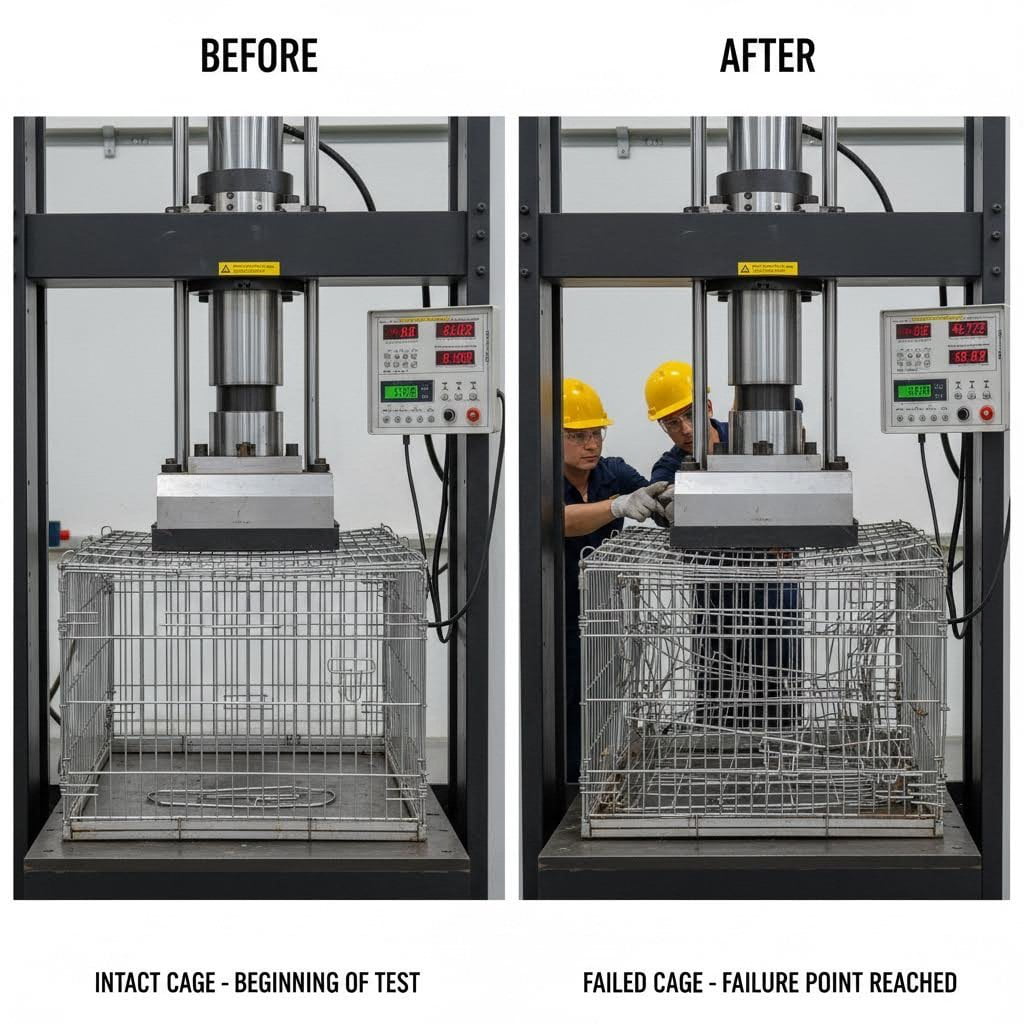
Even if materials are safe, a wire dog cage fails its job if it buckles, bends, or collapses under the weight and movement of a real animal. Structural integrity standards define how much load a cage should withstand without permanent deformation or weld failure.
In practice, factories will apply wire dog cage ASTM-aligned procedures even if there is no single “cage-only” standard. They adapt load tests from furniture, racks, and consumer products to create a defensible test matrix for each size and configuration.
Cage Weight Capacity Testing
The table below shows a typical internal specification sheet used by ASTM-aware factories when rating wire dog cage capacity:
| Cage Size | Static Load Test | Dynamic Impact Scenario |
|---|---|---|
| Small (24″) | 150 lbs uniformly distributed on top panel | 10 lb weight dropped from 12″ height |
| Medium (36″) | 300 lbs on top and floor panel | 25 lb weight dropped from 12″ height |
| Large (42″+) | 500 lbs on top and corners | 50 lb weight dropped from 12″ height |
During these wire dog cage ASTM-style tests, inspectors look for weld cracking, frame twisting, and permanent deformation exceeding a small tolerance (often 5% of original dimensions). Passing such tests is a strong indicator that the cage will stay square and secure in daily use.

Material Safety: Lead and Heavy Metal ASTM Testing
Dogs explore the world with their mouths. When a pet chews the bars of a cage, any lead, cadmium, or other restricted heavy metals present in the coating can migrate into the animal over time. That is why material safety is a non-negotiable part of wire dog cage ASTM compliance.
ASTM F963 defines strict limits for soluble heavy metals in surface coatings. An ASTM-aligned lab will take cage bar samples, expose them to a simulated gastric solution, and then measure how much metal dissolves into that solution. The result must fall below the limits stated in the standard for the cage to be considered safe.
| Substance | Typical Limit (ppm) | Relevance to Wire Dog Cages |
|---|---|---|
| Lead (Pb) | < 90 | Common in low-grade pigments and primers; critical to control. |
| Cadmium (Cd) | < 75 | Sometimes present in cheap colorants and plating baths. |
| Arsenic (As) | < 25 | Rare but highly toxic; must be actively screened out. |
For importers, the practical step is simple: insist on recent heavy-metal test reports for every coating formulation used on your wire dog cage ASTM product line, not just a single “golden” sample from years ago.
Sharp Edge and Corner Safety Standards for Dog Cages
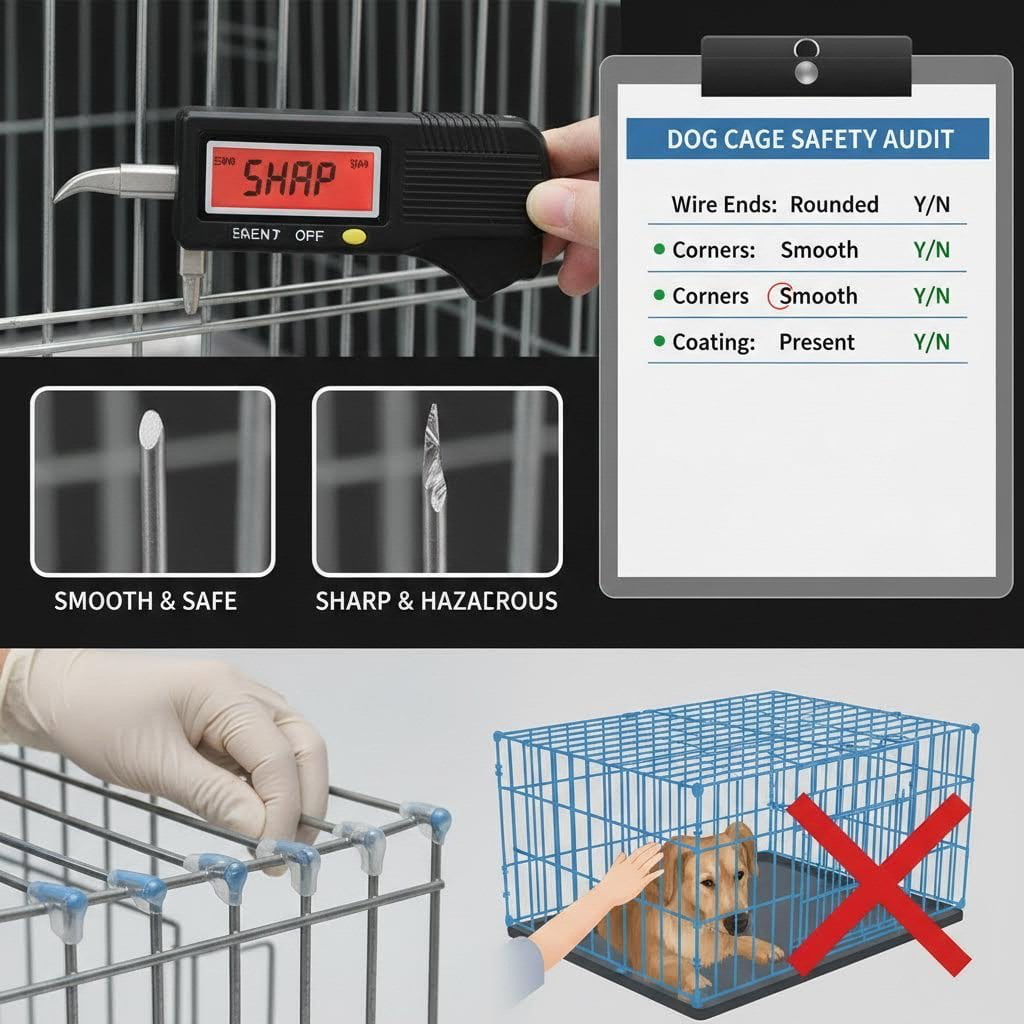
Even if a cage is strong and chemically safe, poor finishing can still injure a dog. Burrs on welds, exposed wire ends, and inconsistent gaps between bars can all lead to cuts or trapped paws. Sharp edge and corner checks are therefore a critical part of wire dog cage ASTM-oriented inspections.
Using ASTM-style sharp edge tests, inspectors run a standardized tool along each potentially hazardous area. If the tool catches, tears a test tape, or leaves visible marks, that point is classified as a sharp edge and must be corrected before mass production.
- Wire Ends: All cut ends should be turned, ground, or covered so that no bare tip points toward the animal.
- Weld Beads: Excess weld material should be smoothed to remove spikes that can scratch noses or paws.
- Gap Consistency: Spacing between vertical and horizontal wires should avoid both head entrapment and limb entrapment zones.

How ASTM Testing Reduces Liability for Cage Importers
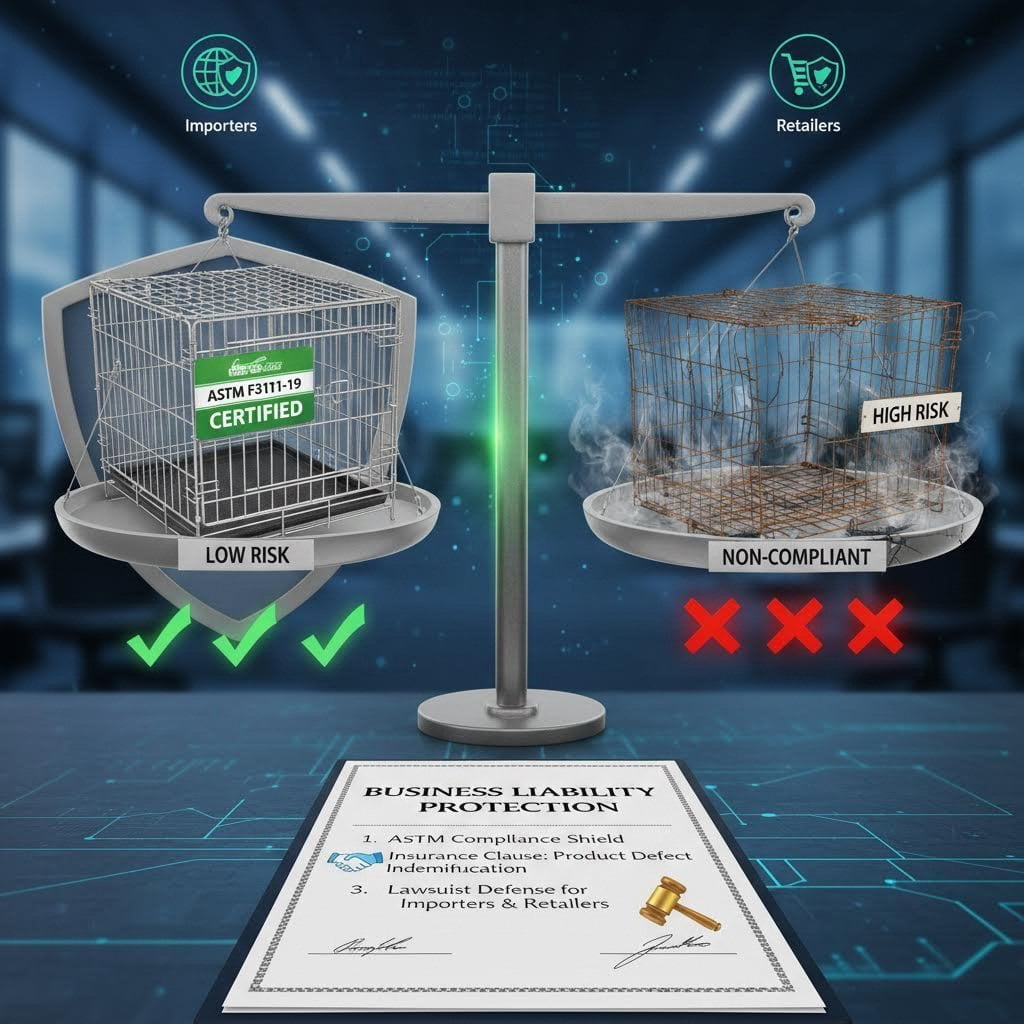
From a business perspective, the biggest value of wire dog cage ASTM testing is risk transfer. Instead of relying on subjective factory assurances, you can show insurance providers, marketplaces, and regulators that your products meet objective third-party standards.
In a dispute or incident, this documentation often becomes the difference between a manageable claim and a damaging recall. Demonstrating that you specified, monitored, and verified ASTM-aligned testing shows that you exercised due diligence as an importer or brand owner.
Define Minimum Test Scope
List the specific wire dog cage ASTM methods (F963, B117, D3359) that every new model must pass.
Align on Sampling Plan
Agree with the factory on how often samples will be pulled and which accredited lab will test them.
Store and Review Reports
Keep structured records of each wire dog cage ASTM report so you can respond quickly to questions from customers or regulators.
Common Pitfall
FAQ: Common Wire Dog Cage ASTM Questions
Conclusion: Implementing ASTM Standards in Your Supply Chain
Key Takeaways
• Focusing on structural integrity, material safety, and sharp edge control eliminates the most common field failures.
• Building a testing plan into your sourcing process reduces liability and strengthens your brand position.
When you treat wire dog cage ASTM standards as a built-in part of product design—rather than an afterthought—you create a safer experience for pets and a more predictable business for yourself. The upfront effort to define tests, work with accredited labs, and review reports pays off many times over in lower return rates and higher customer satisfaction.
As global competition increases, cages that can prove their performance with solid ASTM data will stand out from look-alike products. Importers who adopt this mindset now will be better positioned to win and retain the trust of demanding retailers and end users.
In practical terms, that means building wire dog cage ASTM checkpoints into your supplier scorecards, onboarding processes, and ongoing audits. The more consistently you demand and review structured test data, the more predictable your quality outcomes become across different factories, models, and price points.
Ready to Source Quality Wire Dog Crates?
Our 25+ years of OEM manufacturing experience ensures consistent quality for your wire dog crate needs. Request a sample or get a custom quote today.

Mr. Deng Jiang
Hi, I'm Mr. Deng Jiang, a professional in the pet products industry. With years of experience in designing and manufacturing pet crates, I focus on helping brands improve product quality and meet industry standards. My work is driven by a passion for pets and innovation, and I’m committed to sharing insights that help both manufacturers and consumers make informed decisions.