7 Wire Dog Cage Volume Discount Tactics to Reduce Your Unit Cost by 15-30%
Wire dog cage volume discount strategies can reduce your per-unit costs by 15-30% when negotiated effectively with Chinese manufacturers. Understanding how to structure volume commitments and leverage competitive pricing enables B2B buyers to maximize savings without overcommitting capital or creating inventory management challenges. Before implementing volume discounts, ensure you understand how wire dog cage pricing is calculated to identify optimization opportunities.
Whether you’re an Amazon seller scaling operations, a DTC brand expanding product lines, or a wholesale distributor optimizing margins, these proven volume discount tactics help you secure better pricing while maintaining healthy cash flow and inventory turnover.
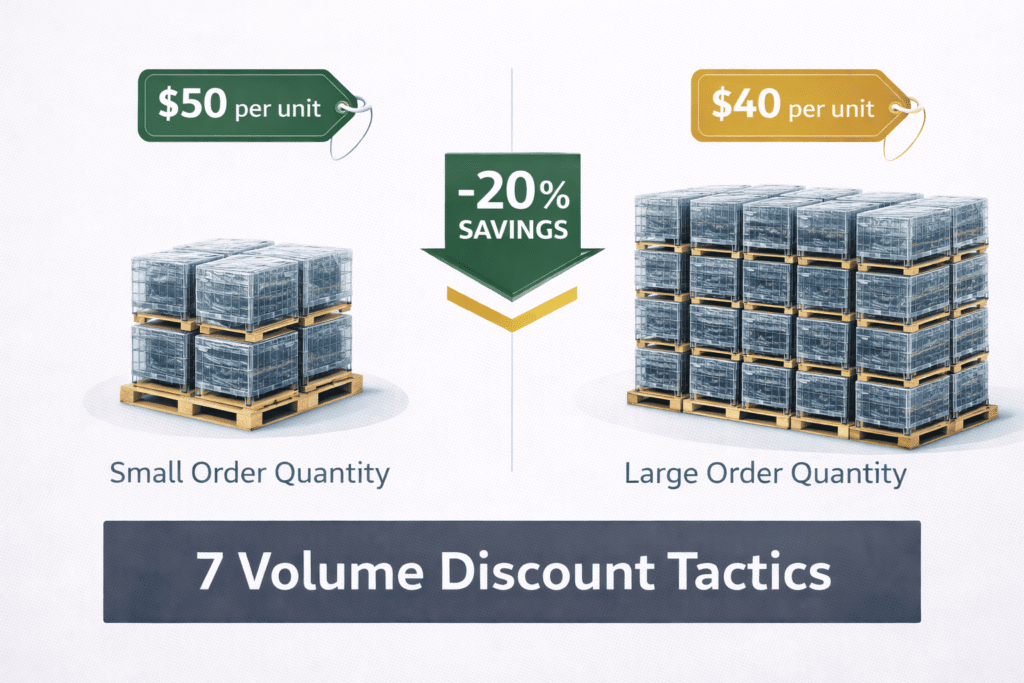
Volume Discount Impact Overview
Increasing order quantities from 100 to 500 units typically reduces per-unit costs by 12-18%. Orders of 1,000+ units can achieve 20-30% savings through economies of scale and reduced per-unit production overhead. However, high volume orders may require addressing MOQ challenges and considering hidden costs beyond unit price.

Tactic #1: Tiered Pricing Negotiation
Tiered pricing structures create clear incentives for volume purchasing while providing flexibility for buyers. Negotiate multiple price breaks at specific quantity thresholds rather than accepting a single volume price.
| Order Quantity | Typical Discount | Unit Price (Example) | Total Savings |
|---|---|---|---|
| 100-199 units | Base price | $25.00 | – |
| 200-499 units | 8-12% off | $22.00-$23.00 | $400-$600 |
| 500-999 units | 15-18% off | $20.50-$21.25 | $1,875-$2,250 |
| 1,000+ units | 20-25% off | $18.75-$20.00 | $5,000-$6,250 |
Present tiered pricing as a win-win scenario. Manufacturers benefit from predictable production runs and reduced setup costs per unit. Buyers gain flexibility to choose quantities that match their cash flow and storage capabilities.

When negotiating tiered pricing, request written confirmation of price breaks and ensure discounts apply to future orders within the same calendar year. This protects your pricing advantage for repeat purchases.
Tactic #2: Annual Volume Commitments
Annual volume commitments secure preferential pricing without requiring large single orders. Negotiate a total annual quantity split across multiple shipments, achieving volume discounts while managing cash flow and inventory.
Annual Commitment Example
Commitment: 2,400 units annually
Delivery: 200 units monthly
Discount: 18% off base price
Benefit: Volume pricing without $50,000+ single order
Structure annual agreements with flexibility clauses allowing quantity adjustments within 15-20% of committed volumes. This accommodates market fluctuations while maintaining pricing advantages.
Request quarterly review meetings to assess volume progress and discuss market changes. Manufacturers appreciate proactive communication and may offer additional incentives for consistent order patterns.
Tactic #3: Multi-SKU Bundling for Better Rates
Multi-SKU bundling combines different wire dog cage models into a single volume calculation, achieving higher discount tiers without overstocking any single product. This strategy works particularly well for sellers offering multiple sizes or configurations.
| Strategy | Single SKU Approach | Multi-SKU Bundling | Advantage |
|---|---|---|---|
| Order Structure | 500 units of 36″ crate | 200 units each: 24″, 36″, 42″, 48″ | Product variety maintained |
| Total Units | 500 units | 800 units | Higher tier discount |
| Discount Level | 15% off | 18% off | 3% additional savings |
| Inventory Risk | High (single SKU) | Lower (diversified) | Better risk distribution |
When proposing multi-SKU bundling, emphasize the total order value and long-term partnership potential. Manufacturers value diverse product relationships that reduce dependency on single-model demand fluctuations.
Tactic #4: Seasonal Ordering Strategies
Seasonal ordering leverages manufacturing capacity fluctuations to secure better pricing. Chinese wire dog cage manufacturers often experience lower demand during Chinese New Year (January-February) and may offer incentives to maintain production levels.

Plan annual purchasing calendars to align with seasonal manufacturing cycles. Place larger orders during traditionally slower production periods, negotiating 3-5% additional discounts beyond standard volume breaks.
Optimal Ordering Calendar
- Q1 (Jan-Mar): Negotiate annual contracts, place post-Chinese New Year orders
- Q2 (Apr-Jun): Standard production period, moderate volumes
- Q3 (Jul-Sep): Peak season preparation, larger orders for holiday inventory
- Q4 (Oct-Dec): Plan next year’s commitments, negotiate renewal terms
Tactic #5: Payment Terms Trade-offs
Payment terms represent significant negotiation leverage. Offering favorable payment conditions can secure volume discounts equivalent to 2-4% of order value.
Standard wire dog cage payment terms require 30% deposit with order and 70% before shipment. Improving these terms creates negotiation opportunities.
| Payment Term Improvement | Manufacturer Benefit | Equivalent Discount Value |
|---|---|---|
| 50% deposit (vs. 30%) | Improved cash flow | 1-2% additional discount |
| Payment upon B/L copy | Faster payment receipt | 1-2% additional discount |
| Letter of Credit at sight | Payment security | 0.5-1% additional discount |
| Combined improvements | Multiple benefits | 2-4% total additional discount |
Calculate the true cost of improved payment terms before negotiating. A 2% discount on a $20,000 order equals $400 savings, but 50% deposit requires $10,000 upfront capital versus $6,000 under standard terms.
Tactic #6: Long-Term Partnership Agreements
Long-term partnership agreements create mutual commitment that justifies preferential pricing. Manufacturers offer better rates to buyers demonstrating consistent ordering patterns and growth potential.

Structure 2-3 year agreements with annual volume growth commitments. Example: Year 1: 1,200 units, Year 2: 2,400 units, Year 3: 4,800 units. Each year achieves higher discount tiers while building supplier relationship depth.
Include performance incentives in partnership agreements. Offer to increase order volumes by 10-15% if the manufacturer maintains quality standards and on-time delivery rates above 95%.
Partnership Agreement Framework
Term: 3 years
Minimum Annual Volume: 1,200 units
Base Discount: 15% off list price
Growth Incentive: Additional 3% discount for 20%+ volume increase
Quality Guarantee: Defect rate below 2% or replacement at manufacturer cost
Tactic #7: Competitive Bidding Leverage
Competitive bidding creates pricing pressure that motivates manufacturers to offer their best volume discounts. Requesting formal quotations from 3-4 suppliers establishes market benchmarks for negotiation.
When using competitive bidding, maintain transparency about the process without revealing competitor pricing details. State clearly: “We’re evaluating multiple suppliers and seeking the best long-term partnership opportunity.”
Leverage competitive quotes to negotiate improved terms with preferred suppliers. If a secondary supplier offers 22% discount versus 18% from your preferred manufacturer, request the preferred supplier to match or improve their offer.

How to Calculate True Volume Discount ROI
True volume discount ROI requires calculating total cost impact beyond per-unit price reductions. Factor in inventory carrying costs, storage expenses, and capital opportunity costs.
Volume Discount ROI Calculation
Scenario: Comparing 500-unit vs. 1,000-unit order
500-Unit Order:
- Unit price: $21.25 (15% discount)
- Total cost: $10,625
- Storage cost (6 months): $450
- Capital cost (10% annually): $531
- Total: $11,606
1,000-Unit Order:
- Unit price: $20.00 (20% discount)
- Total cost: $20,000
- Storage cost (6 months): $900
- Capital cost (10% annually): $1,000
- Total: $21,900
Per-Unit True Cost: 500-unit = $23.21 | 1,000-unit = $21.90
Net Savings: $1.31 per unit (5.6% effective savings)
Use this calculation methodology to determine optimal order quantities that maximize true savings without creating inventory management challenges.
Inventory Management Strategies for Bulk Purchases
Volume discounts create inventory management challenges requiring strategic planning. Implement inventory management systems that balance cost savings against storage costs and product obsolescence risks. High MOQ requirements can compound inventory challenges—refer to flexible MOQ solutions for strategies to manage inventory efficiently.
| Inventory Strategy | Best For | Implementation | Risk Level |
|---|---|---|---|
| Just-in-Time (JIT) | High-turnover SKUs | Monthly deliveries, minimal storage | Low |
| Safety Stock Buffer | Seasonal demand | 60-90 day inventory coverage | Medium |
| Wave Ordering | Growth phase businesses | Quarterly large orders | Medium-High |
| Cross-Docking | 3PL fulfillment | Direct manufacturer to fulfillment | Low |
Calculate inventory turnover ratios monthly. Target 6-8 turns annually for wire dog cages, ensuring volume purchases don’t create stagnant inventory that erodes discount benefits through storage costs.
Be mindful of hidden costs such as warehousing, insurance, and time costs when calculating the true ROI of volume discounts. Ensure storage savings don’t get offset by increased holding costs.
Action Plan for Implementing Volume Discounts
Implement these volume discount tactics systematically to achieve maximum cost savings while maintaining operational efficiency.
Phase 1: Assessment (Week 1-2)
- Analyze current order volumes and pricing
- Calculate true costs including storage and capital
- Identify optimal volume tiers for your business
- Research manufacturer capacity and pricing structures
Phase 2: Negotiation (Week 3-4)
- Request formal quotations from 3-4 suppliers
- Propose tiered pricing structures
- Negotiate annual volume commitments
- Discuss payment term improvements for additional discounts
Phase 3: Implementation (Month 2-3)
- Execute first volume order with negotiated terms
- Implement inventory management systems
- Monitor quality and delivery performance
- Track actual savings versus projections
Review volume discount performance quarterly. Adjust order quantities, negotiate improved terms based on performance history, and explore additional cost reduction opportunities with established suppliers.

Conclusion
Effective wire dog cage volume discount tactics combine strategic negotiation with operational efficiency to achieve 15-30% cost reductions. Success requires understanding manufacturer motivations, calculating true ROI including all costs, and implementing inventory management systems that support bulk purchasing.
The seven tactics presented—tiered pricing, annual commitments, multi-SKU bundling, seasonal ordering, payment term trade-offs, partnership agreements, and competitive bidding—provide a comprehensive framework for cost optimization.
Remember that volume discounts only create value when the total cost impact is positive. Calculate storage costs, capital requirements, and inventory turnover impact before committing to large orders.
Start with smaller volume increases and proven tactics like tiered pricing negotiation. As supplier relationships strengthen and operational systems mature, implement more advanced strategies like annual commitments and partnership agreements.
The most successful B2B buyers treat volume discount negotiation as an ongoing process rather than a one-time event. Continuous evaluation, quarterly reviews, and adaptive strategies ensure sustained cost advantages in competitive markets.