What Are the Best Flexible MOQ Solutions for Wire Dog Cage Importing?
Wire dog cage MOQ requirements often present significant challenges for small B2B buyers, but flexible solutions exist that can help you navigate minimum order quantity constraints without compromising quality or increasing risk. When importing wire dog cage products from Chinese manufacturers, small buyers frequently encounter MOQ barriers ranging from 100 to 500 units per SKU. These requirements tie up substantial capital before market testing is complete. Understanding wire dog cage pricing structures helps you calculate total costs including MOQ-related expenses.
For Independent DTC brands and Amazon sellers launching new product lines, high MOQs can paralyze cash flow and delay market entry. Understanding flexible MOQ strategies enables you to start importing wire dog cages with manageable inventory levels while building supplier relationships for future growth.
The Critical Need for Flexible MOQ Strategies
Small B2B buyers often face wire dog cage MOQ requirements that exceed initial market demand projections, creating inventory pressure before sales validation is complete.
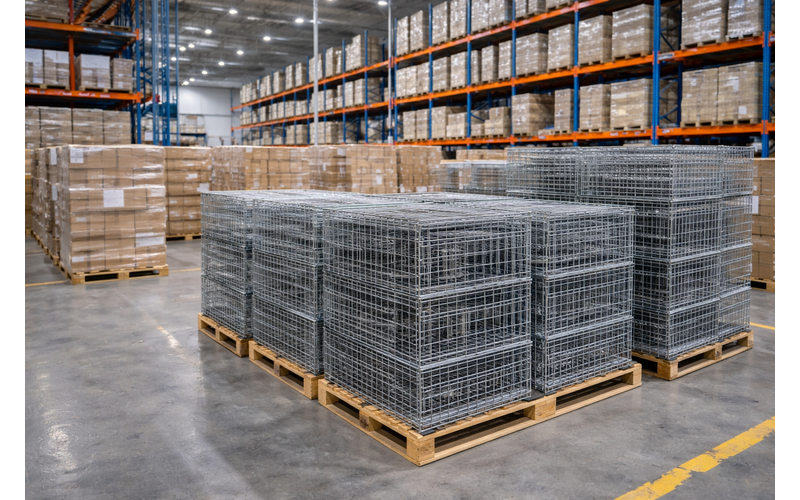
Traditional wire dog cage supplier relationships typically follow rigid MOQ models designed for large-scale importers and wholesale distributors. Manufacturers set high minimum order quantities to cover production setup costs, material procurement efficiency, and shipping container optimization.
However, this model doesn’t accommodate the needs of emerging DTC brands testing new market segments or Amazon sellers expanding their product catalog. By understanding the hidden costs of high MOQs and exploring flexible alternatives, small B2B buyers can structure wire dog cage import deals that align with cash flow realities.
The Hidden Cost of High Wire Dog Cage MOQ
Inventory Capital Tied Up in Unsold Stock
High wire dog cage MOQ requirements lock substantial working capital into inventory before market demand is proven. When a wire dog cage manufacturer requires 200 units as minimum order quantity at $25 per unit, buyers must commit $5,000 upfront. Understanding hidden costs of importing helps you calculate total landed costs accurately before committing to high MOQs.

This capital sits idle in warehouse storage for months while sales gradually materialize. For bootstrapped DTC brands operating with limited cash reserves, this inventory tie-up can prevent investment in marketing, website optimization, or other growth initiatives.
Cash Flow Impact on Small Businesses
Wire dog cage MOQ payments create significant cash flow strain for small importers without established banking relationships or revolving credit facilities. Typical payment terms—30% deposit with order placement and 70% before shipment—require substantial upfront capital before any revenue is generated.
⚠️ Cash Flow Warning
High MOQ commitments can deplete cash reserves needed for marketing, customer acquisition, and operational expenses. Always model cash flow scenarios before committing to wire dog cage minimum order quantities.
When minimum order quantities are set at 300 units per wire dog cage model, total outlay including freight, customs duties, and local delivery can easily exceed $10,000. For startups generating $50,000-100,000 in monthly revenue, this represents 10-20% of working capital committed to a single product line.
Warehouse and Storage Overhead
High wire dog cage MOQs generate substantial warehouse storage costs that erode profit margins over time. Wire dog cages are bulky items requiring significant floor space. A 48-inch double-door wire crate occupies approximately 12-15 cubic feet.
For DTC brands partnering with fulfillment centers, wire dog cage inventory storage costs alone can add $2-5 per unit to total landed cost over six months. These overhead expenses further reduce profitability of products that already carry thin margins due to shipping costs. Combine comprehensive hidden cost analysis with volume discount strategies to optimize your total landed cost.
| MOQ Quantity | Average Warehouse Space Required | Monthly Storage Cost (Estimated) | 6-Month Storage Cost |
|---|---|---|---|
| 100 units | 150-200 cubic feet | $150-$250 | $900-$1,500 |
| 200 units | 300-400 cubic feet | $300-$400 | $1,800-$2,400 |
| 500 units | 750-1,000 cubic feet | $750-$1,000 | $4,500-$6,000 |
When MOQ requirements force buyers to stock 300-500 units per SKU, warehouse space demands multiply rapidly. Third-party logistics (3PL) providers charge based on cubic footage, storage duration, and handling frequency.
For DTC brands partnering with fulfillment centers, wire dog cage inventory storage costs alone can add $2-5 per unit to total landed cost over six months. These overhead expenses further reduce the profitability of products that already carry thin margins due to shipping costs.
7 Practical Flexible MOQ Solutions
Solution 1: Staggered Ordering Schedule
Staggered ordering breaks high wire dog cage MOQ requirements into smaller, manageable shipments spread across multiple production cycles. Instead of committing to 500 units in a single shipment, negotiate with your wire dog cage manufacturer for 5 shipments of 100 units each over 6 months.
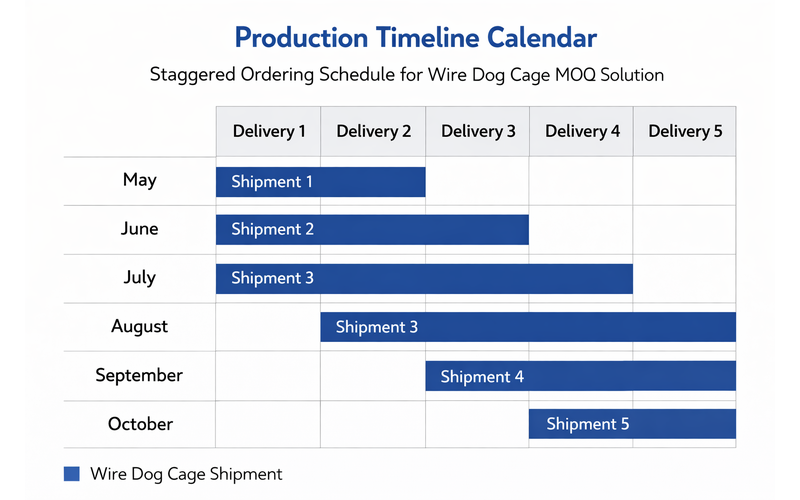
This approach maintains production efficiency for manufacturers while reducing immediate capital outlay and storage pressure for buyers. Manufacturers benefit from predictable production schedules and continuous cash flow.
Buyers gain flexibility to adjust order quantities based on actual sales performance and market feedback. Implementing staggered ordering requires clear communication with suppliers about production lead times and shipment schedules.
Solution 2: Consolidated Group Buys
Consolidated group buying pools multiple wire dog cage buyers’ orders to meet supplier MOQ requirements while each participant receives smaller quantities. This strategy works particularly well for Amazon sellers operating in related pet product categories who can coordinate orders through industry associations.
✓ Group Buy Success Factors
- Find buyers with compatible wire dog cage specifications and quality standards
- Establish clear agreements on order timing, payment terms, and shipping arrangements
- Coordinate with supplier to ensure unified production runs and quality control
- Plan logistics for container consolidation and final distribution to each buyer
When five buyers each commit to 100 units of wire dog cages, the combined 500-unit order satisfies manufacturer MOQ thresholds. Each buyer receives 100 units, paying proportionate costs without individually meeting high minimum order quantities.
Group buying requires careful coordination to ensure all buyers receive products meeting their specific quality requirements and delivery schedules. Wire dog cage specifications must align across participants, including dimensions, gauge thickness, door configurations.
Solution 3: Pre-Order with Multiple Customers
Pre-order campaigns allow wire dog cage buyers to secure customer commitments before placing inventory orders with manufacturers. DTC brands launching new wire crate models can use email marketing, social media promotions, and pre-order landing pages to collect customer orders and deposits in advance.
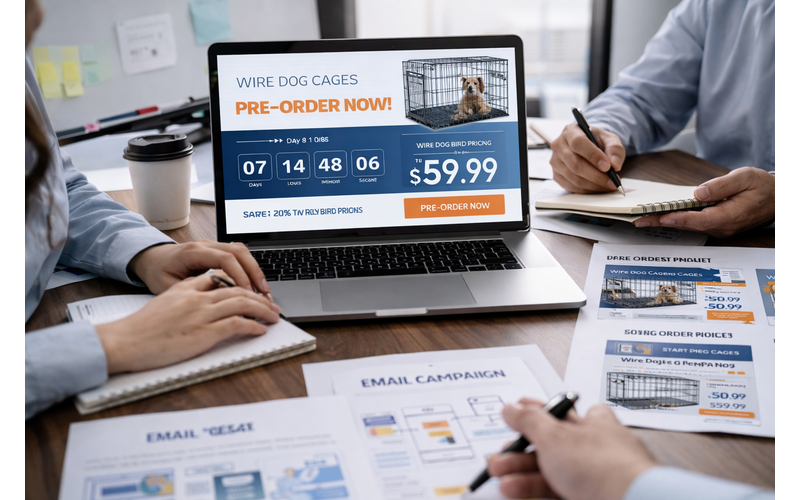
This customer-funded approach validates market demand while generating upfront capital to meet supplier MOQ requirements. Amazon sellers can implement similar strategies using FBA inventory tools or external crowdfunding platforms to gauge interest before committing to large wire dog cage production runs.
Effective pre-order strategies require compelling product positioning and transparent communication about delivery timelines. Wire dog cage buyers must clearly communicate production lead times, quality specifications, and any risks associated with new product launches.
Solution 4: Hybrid MOQ Structure (Base + Customization)
Hybrid MOQ structures separate base wire dog cage models from customized variations, allowing buyers to meet MOQ requirements through standardized products while adding customized elements in smaller quantities. Negotiate with your wire dog cage supplier to accept 200 units of standard black powder-coated crates (meeting base MOQ) plus 50 customized units.
💡 Hybrid MOQ Negotiation Strategy
Emphasize that standard wire dog cage units enable faster production setup while customized variations add value through brand differentiation. Frame hybrid structures as win-win solutions: you meet total MOQ, supplier benefits from production efficiency, both parties avoid costly re-tooling.
Customized units with different colors or door configurations can be ordered below customization MOQ. This approach enables product differentiation and brand-specific features without committing to full custom production quantities for each variation.
Solution 5: Layered Purchasing: From Samples to Trial Runs to Bulk
Layered purchasing implements progressive scaling from sample evaluation to trial production runs to bulk orders, enabling wire dog cage buyers to validate quality, build trust, and demonstrate market demand before committing to large MOQs. This phased approach starts with sample units for quality verification and market testing.
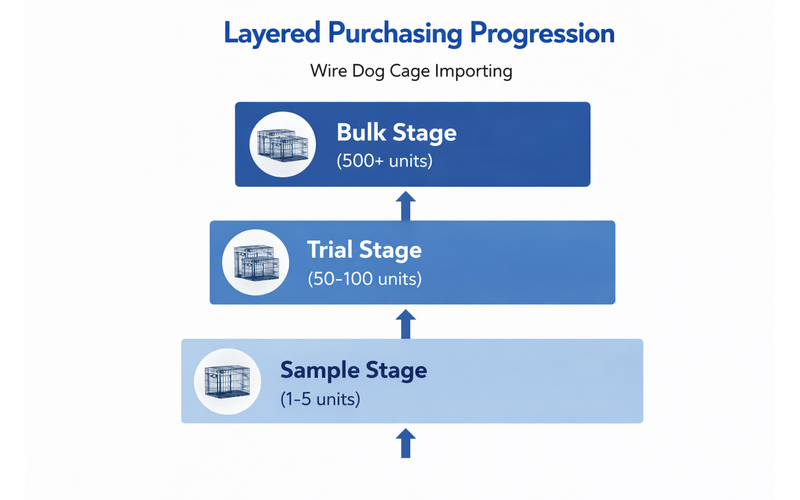
Based on sample evaluation results, place a small trial production run of 50-100 units to assess supplier production consistency and customer response. Only after successful trial runs commit to full bulk orders meeting standard MOQ requirements.
Layered purchasing aligns with progressive risk management principles. Wire dog cage sample evaluation provides initial quality verification without substantial capital commitment. Understanding sample costs and ROI analysis helps you justify smaller initial investments.
Solution 6: Trial Production Orders with Quality Gates
Trial production orders with built-in quality gate checkpoints allow wire dog cage buyers to assess manufacturing consistency before committing to full-scale production. Comprehensive quality testing protocols should be established before placing trial orders. Negotiate with your wire dog cage supplier for a 50-unit trial production run with specific quality acceptance criteria.
| Quality Gate | Testing Method | Acceptance Criteria | Sample Size for Verification |
|---|---|---|---|
| Weld Integrity | Visual inspection + pull testing | No cracks, minimum 200 lbs pull strength | 10% of trial run (5 units) |
| Powder-Coat Thickness | Coating thickness gauge | 80-120 microns uniform coverage | 15% of trial run (7-8 units) |
| Dimensional Tolerance | Caliper measurements | ±2mm tolerance on all dimensions | 20% of trial run (10 units) |
| Structural Load Test | Weight loading test | No deformation at 3x rated capacity | 5% of trial run (2-3 units) |
Define measurable quality gates: weld integrity inspection results, powder-coat thickness measurements, dimensional tolerance verification, and structural load testing results. Only when trial units pass all quality gates proceed with full MOQ production orders.
Solution 7: Targeted Solutions for DTC Brands and Amazon Sellers
Flexible MOQ strategies require tailoring to specific business models and sales channels. DTC brands and Amazon sellers face distinct challenges and opportunities when managing wire dog cage inventory and supplier relationships.
DTC Brand Strategies
- Test-Marketing First: Launch wire dog cage products with small pre-order campaigns before committing to full MOQ quantities. Use landing pages, email marketing, and social media to validate demand.
- Product Bundling: Combine wire dog cages with complementary pet products to increase average order value and accelerate inventory turnover, improving cash flow despite higher MOQ commitments.
- Customer Feedback Loops: Collect detailed customer reviews and feedback on initial wire dog cage sales. Use insights to refine specifications before placing larger production orders.
- Direct Manufacturer Relationships: Build direct relationships with wire dog cage manufacturers rather than trading companies. Direct communication enables more flexible MOQ negotiations based on growth projections.
Amazon Seller Strategies
- FBA Inventory Optimization: Use Amazon FBA inventory planning tools to calculate optimal wire dog cage stock levels balancing storage costs with sales velocity. Maintain 30-60 days of inventory rather than large overstock.
- Seasonal Demand Planning: Align wire dog cage inventory replenishment with seasonal demand peaks. Reduce MOQ commitments during slow seasons by negotiating flexible ordering schedules with suppliers.
- Multi-Channel Inventory Deployment: Distribute wire dog cage inventory across multiple sales channels—Amazon FBA, Shopify store, and wholesale channels—to accelerate turnover and reduce storage duration.
- Automated Reorder Points: Set automated reorder triggers based on sales velocity and lead times. Place new wire dog cage orders when inventory reaches reorder points rather than arbitrary timing.
How to Negotiate Lower MOQ With Chinese Manufacturers
Cultural Nuances in MOQ Negotiation
Chinese wire dog cage manufacturers approach MOQ negotiations through specific cultural frameworks emphasizing long-term relationship building and mutual benefit. Direct confrontation or aggressive MOQ reduction demands often backfire, causing suppliers to perceive buyers as transactional rather than partnership-oriented.

Instead, frame MOQ negotiation requests within relationship-building contexts. Emphasize growth projections, repeat order potential, and shared success scenarios. Wire dog cage suppliers respond more favorably to buyers who demonstrate understanding of production costs.
Data-Driven Negotiation Approach
Data-driven MOQ negotiations with wire dog cage manufacturers replace emotional arguments with objective business case analysis. Prepare comprehensive documentation showing market research, sales projections, and growth plans. Present data demonstrating that lower initial MOQs accelerate revenue growth.
✓ Data-Driven MOQ Negotiation Framework
- Market Research Data: Search volume trends for wire dog cage keywords, competitor sales estimates, target customer demographics
- Financial Projections: Revenue forecasts based on conversion rates, average order values, and customer acquisition costs
- Growth Trajectory: Month-by-month order quantity projections showing path from initial trial orders to sustained bulk orders
- Supplier Benefits: Quantified benefits to supplier including predictable cash flow, reduced inventory risk, and shared marketing opportunities
Use spreadsheet models showing how 100-unit initial orders can grow to 500-unit monthly orders within 6-12 months based on marketing investments and customer acquisition rates. When suppliers see objective evidence that accommodating lower MOQs accelerates path to higher long-term revenue, they become more flexible.
Offering Long-Term Purchase Contracts
Long-term purchase contract commitments provide wire dog cage suppliers with revenue predictability in exchange for lower initial MOQs. Negotiate contracts specifying minimum annual order quantities across multiple production runs rather than requiring high quantities in single orders.
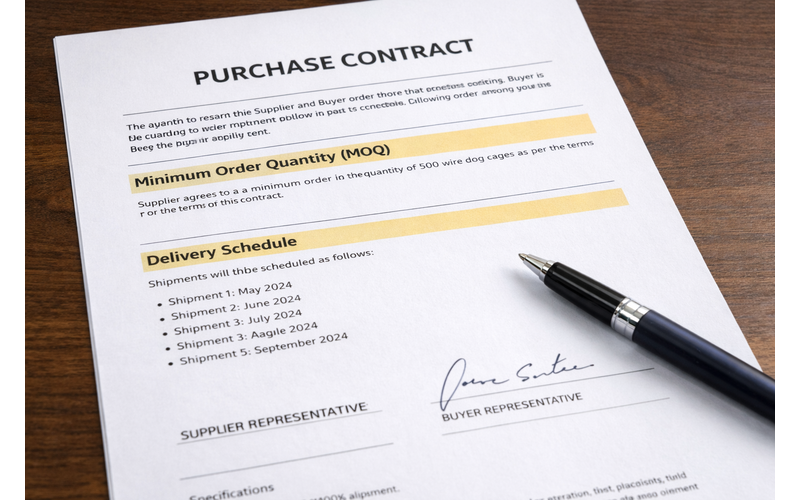
For example, commit to 2,400 units annually delivered in 200-unit monthly shipments instead of requiring 500-unit initial order. Suppliers value predictable revenue streams and production scheduling stability even when individual order quantities are below standard MOQ thresholds.
Wire dog cage buyers can negotiate price tiers tied to order volume growth—reduced unit prices as cumulative order quantities increase. Professional wire dog cage manufacturers are more likely to offer flexible MOQs when formal contracts provide legal protections. Combine long-term contracts with volume discount negotiation tactics to maximize cost savings.
Risk Assessment When Choosing Flexible MOQ Options
Progressive Risk Management: Start Small, Scale Gradually
Progressive risk management principle dictates that wire dog cage buyers should begin with small order quantities and scale incrementally based on validated performance indicators. Ensuring sample-to-production consistency is critical before scaling up. Start with sample units for quality verification. Progress to small trial production runs for market testing.
| Stage | Order Quantity | Capital Investment | Key Success Indicators | Decision Criteria for Next Stage |
|---|---|---|---|---|
| Sample Stage | 1-5 units | $100-$500 | Quality approval, specification match | Proceed if quality meets specifications |
| Trial Stage | 50-100 units | $2,500-$5,000 | Customer satisfaction, sales conversion | Proceed if 70%+ customers satisfied |
| Growth Stage | 200-300 units | $10,000-$15,000 | Sales velocity, profit margins | Proceed if positive cash flow |
| Bulk Stage | 500+ units | $25,000+ | Market demand, supplier reliability | Proceed when demand stabilizes |
Scale to larger orders only after confirming supplier reliability, product quality consistency, and customer demand. This layered approach limits financial exposure at each stage while providing decision-making data before committing to larger investments.
Quality Consistency in Small Batches
Small batch wire dog cage production carries quality consistency risks that large-scale production processes mitigate through statistical process control. When negotiating flexible MOQs for smaller orders, implement additional quality assurance measures to compensate for reduced production volume.
⚠️ Small Batch Quality Risks
- Production line setups for small wire dog cage batches may lack optimization, increasing defect rates
- Material suppliers may prioritize larger orders, potentially delaying small batch production
- Workers assigned to small batch runs may have less experience with specific wire dog cage models
- Quality control sampling rates may be insufficient to detect defects in small production batches
Require third-party inspection services such as SGS or Intertek to verify production quality before shipment. Specify detailed inspection criteria covering weld integrity, coating thickness, dimensional accuracy.
Supplier Reliability Indicators
Supplier reliability assessment becomes critical when establishing flexible MOQ relationships with wire dog cage manufacturers. Small buyers negotiating lower MOQs depend heavily on supplier trustworthiness and performance consistency.
| Reliability Indicator | Assessment Method | Warning Signs | Positive Indicators |
|---|---|---|---|
| Financial Stability | Business registration check | Frequent address changes, legal disputes | Established business 5+ years, stable ownership |
| Production Capacity | Factory audit, facility tour | Outdated equipment, limited space | Modern machinery, multiple production lines |
| Quality Track Record | Reference checks, sample evaluation | Inconsistent quality, vague specifications | ISO certification, detailed quality reports |
| Communication | Response time, clarity of information | Delayed responses, evasive answers | Prompt responses, transparent information |
Qcc.com provides Chinese company registration data and financial information. Dun & Bradstreet offers business credit checks and supplier risk assessments.
Conclusion
Flexible wire dog cage MOQ solutions enable small B2B buyers to import quality products without sacrificing working capital or assuming excessive inventory risk. High minimum order quantities present significant barriers for DTC brands, Amazon sellers, and small wholesale distributors.
However, multiple strategies exist for navigating these constraints effectively. Staggered ordering, consolidated group buys, pre-order campaigns, hybrid MOQ structures, layered purchasing, trial production with quality gates, and channel-specific approaches provide actionable paths to importing wire dog cages on manageable terms.

By combining these flexible MOQ solutions with data-driven negotiation, progressive risk management, and thorough supplier assessment, small buyers can build sustainable import businesses that scale gradually based on validated market performance.
The most successful wire dog cage importers approach MOQ challenges strategically rather than accepting rigid supplier terms as immutable. They understand that production economics and supplier business models create legitimate reasons for MOQ requirements.
Importers starting with small trial runs and scaling based on performance establish credibility that leads to more favorable MOQ terms on future orders. Long-term supplier relationships built on trust and demonstrated growth potential enable increasing flexibility over time.
Choosing the right flexible MOQ strategy depends on your specific business model, sales channels, capital resources, and risk tolerance. Regardless of strategy preference, implementing progressive risk management principles provides universal protection against overcommitment and inventory overstock.
External Link Sources:
- SGS: https://www.sgs.com/ – Third-party quality inspection and certification services for verifying wire dog cage production quality
- Intertek: https://www.intertek.com/ – Product testing and inspection services providing quality assurance for imported pet products
- Qcc.com: https://www.qcc.com/ – Chinese company registration database for verifying wire dog cage manufacturer credentials
- Dun & Bradstreet: https://www.dnb.com/ – Business credit checks and supplier risk assessment services for vetting overseas manufacturers
- U.S. Customs and Border Protection: https://www.cbp.gov/ – Official guidance on import procedures, customs clearance, and compliance requirements for wire dog cage imports