
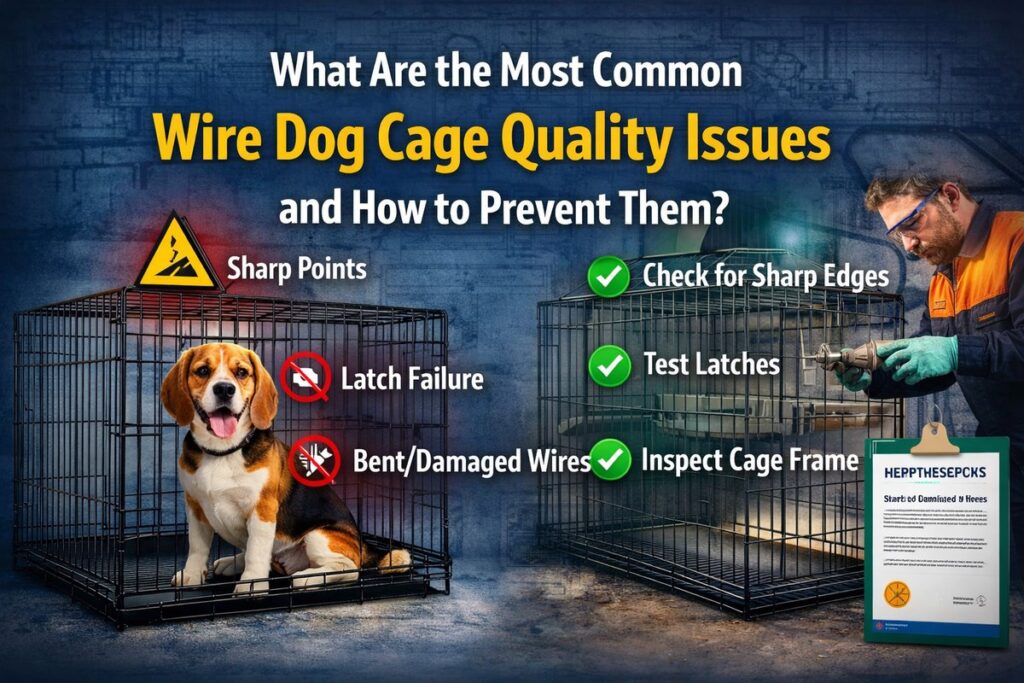
What Are the Most Common Wire Dog Cage Quality Issues and How to Prevent Them
For B2B buyers, wire dog cage quality issues can cost thousands in returns, reputation damage, and lost customers. In our experience, a single batch of defective cages can trigger negative reviews that destroy months of brand building for DTC pet brands and Amazon sellers. Traditional wholesale distributors serving large retail chains face even higher stakes when quality defects disrupt supply agreements.
Prevention-focused procurement reduces defect rates by 60-80% compared to reactive approaches. When you systematically address quality issues at the sourcing stage, you eliminate problems before they reach customers. According to Quality Magazine, prevention-based quality systems deliver 3x ROI compared to inspection-only approaches. Investing time in quality prevention upfront delivers compounding returns through reduced returns, higher customer satisfaction, and stronger supplier relationships.
The True Cost of Wire Dog Cage Quality Issues
✓ Direct Costs
Returns, refunds, replacement products, shipping fees
✓ Indirect Costs
Reputation damage, lost customers, platform penalties
Introduction: The Cost of Wire Dog Cage Quality Issues in B2B
Quality failures in wire dog cage manufacturing create ripple effects throughout the entire supply chain. For B2B buyers importing from overseas manufacturers, understanding the financial impact is essential for making informed procurement decisions. Research from American Society for Quality (ASQ) shows that quality failures cost companies 15-20% of sales revenue annually. A single defective batch can cost importers $10,000 to $50,000 in direct losses, not counting long-term brand reputation damage.

Amazon sellers face unique quality challenges. When customers receive cages with broken welds or peeling coatings, negative reviews appear within days. These reviews permanently damage product rankings and conversion rates. As noted by Amazon Seller Central, product quality directly impacts account health metrics. Recovering from a 1-star review wave caused by quality issues can take 6-12 months of aggressive marketing investment.
The financial math strongly favors prevention over reaction. Implementing systematic quality prevention during sourcing costs approximately 3-5% of order value. This investment typically reduces defect rates from industry averages of 8-15% down to 2-3%. For a $50,000 order, spending $2,500 on quality control saves $8,000-15,000 in potential defect-related costs.
A Complete Taxonomy of Dog Cage Defects
Understanding the full spectrum of defects enables systematic quality planning. Quality issues in wire dog cages fall into two primary categories: structural defects that compromise safety and functionality, and surface defects that affect appearance and longevity. Each category requires different detection methods and prevention strategies.
| Defect Category | Common Issues | Impact Level |
|---|---|---|
| Structural Defects | Weak welds, broken wires, misaligned frames | High |
| Surface Defects | Peeling coating, rust spots, scratches | Medium |
| Dimensional Defects | Incorrect sizing, assembly problems | Medium |
| Hardware Defects | Faulty latches, missing parts, poor hinges | High |
Structural vs Surface Quality Issues
Structural quality issues present the highest risk to both pet safety and business viability. Welding defects—including cold welds, incomplete penetration, and burn-through—affect approximately 12% of imported wire dog cages. These issues can lead to cage collapse during use, creating liability exposure for sellers and endangering pets.

Surface defects, while less immediately dangerous, significantly impact customer satisfaction and product longevity. Coating failures—including orange peel, pinholes, and premature peeling—occur in roughly 18% of imported cages. These issues lead to rust formation, aesthetic complaints, and shortened product lifespans that trigger warranty claims and negative reviews.
Most Common Wire Dog Cage Quality Issues by Frequency
🎯 Coating Defects (18%)
Peeling, orange peel, uneven coverage
🎯 Welding Issues (12%)
Cold welds, weak joints, burn-through
🎯 Dimension Errors (10%)
Sizing inaccuracies, assembly problems
🎯 Hardware Failures (8%)
Faulty latches, missing components
Root Cause Analysis: Why Cage Quality Fails
Quality failures in wire dog cage manufacturing stem from specific, identifiable causes that systematic buyers can address during supplier selection and production oversight. Understanding these root causes enables targeted prevention strategies that address problems at their source rather than catching defects after production.
The 5 Root Causes of Wire Dog Cage Quality Issues
- Inadequate Welding Parameters: Incorrect current, speed, or pressure settings create weak joints
- Poor Surface Preparation: Insufficient cleaning before coating leads to adhesion failures
- Substandard Raw Materials: Low-grade steel or improper wire gauge causes structural weakness
- Inconsistent Process Control: Lack of standardized procedures creates batch-to-batch variation
- Insufficient Quality Checks: Missing inspection points allow defects to reach customers
💡 From Our Experience: 80% of quality issues can be traced to just 3 root causes—focus your prevention efforts there
Manufacturing vs Design Defects
Manufacturing defects occur when production processes fail to execute design specifications correctly. These include welding inconsistencies, coating application errors, and dimensional variations. Manufacturing defects typically affect individual units or batches rather than entire product lines, making them detectable through sampling and inspection programs.

Design defects represent fundamental flaws in product specifications that affect every unit produced. These include inadequate wire gauge for intended load, insufficient coating thickness specifications, or poor structural engineering. Design defects require engineering changes and cannot be solved through manufacturing process improvements alone.
Established B2B buyers distinguish between these defect types because prevention strategies differ significantly. Manufacturing defects respond to supplier audits, process documentation requirements, and inline inspections. Design defects require engineering reviews, specification changes, and often switching to suppliers with stronger technical capabilities. Factory audit checklists should evaluate both manufacturing capability and design engineering competence.
Building a Quality Prevention-First Procurement Strategy
Prevention-focused procurement shifts quality control upstream from receiving inspection to supplier selection and production oversight. This approach requires systematic planning but delivers 60-80% reductions in quality issues compared to reactive quality management.
Quality Prevention Strategy Framework
✓ Pre-Sourcing Phase
- Define quality standards
- Establish acceptance criteria
- Document specifications
✓ Supplier Selection
- Audit quality systems
- Verify certifications
- Assess technical capability
✓ Production Phase
- Inline inspections
- First article approval
- Process monitoring
The foundation of quality prevention lies in clear, detailed specifications. Many quality issues stem from vague requirements like “heavy-duty construction” or “quality coating.” Professional buyers specify exact wire gauge ranges (e.g., 8-10 gauge for large cages), coating thickness minimums (e.g., 80μm powder coat), and welding standards (e.g., resistance welding with minimum pull strength of 200 lbs).

Supplier capability assessment forms the second pillar of prevention. Not all manufacturers can consistently produce to the same quality standards. Buyers should evaluate welding equipment age and maintenance, coating line capabilities, and quality control infrastructure. Established suppliers with ISO 9001 certification and documented quality procedures typically deliver 40-50% fewer quality issues than uncertified competitors.
Developing a Wire Cage Quality Standards Agreement (QSA)
A Quality Standards Agreement transforms vague quality expectations into enforceable contractual requirements. This document becomes the foundation for supplier accountability and provides objective criteria for accepting or rejecting shipments. For B2B buyers, the QSA represents one of the highest-ROI investments in quality prevention.
| QSA Component | Specification Example | Inspection Method |
|---|---|---|
| Wire Material | Q195 steel, 8-10 gauge ±0.1mm | Caliper measurement, mill cert |
| Welding Standards | Resistance weld, min 200 lbs pull | Destructive testing, visual |
| Coating Thickness | Powder coat 80-120μm | Coating thickness gauge |
| Dimensional Tolerance | ±3mm on all dimensions | Tape measure, go/no-go gauge |
| Acceptable Quality Level | AQL 2.5 Major, 4.0 Minor | ANSI/ASQ Z1.4 sampling |
Effective QSAs specify measurable criteria rather than subjective judgments. Instead of “good weld quality,” the agreement states “all welds must show complete penetration with no visible cracks, cold spots, or burn-through; random destructive testing must achieve minimum 200 lbs pull force.” These specifications eliminate disputes about whether defects exist.

The QSA should also establish inspection protocols, acceptance criteria, and remediation procedures. Include provisions for third-party inspection rights, rework requirements for defective units, and financial responsibility for quality failures. Many experienced buyers tie payment terms to inspection results, retaining 10-20% of payment until quality verification completes.
How to Handle Quality Issues Disputes with Cage Suppliers
Even with prevention strategies, quality issues occasionally occur. How buyers handle these disputes determines whether problems resolve quickly or escalate into costly conflicts. Professional dispute management protects business interests while preserving supplier relationships for future orders.
Quality Dispute Resolution Process
Document
Photos, measurements, defect counts
Reference
Compare to QSA and approved sample
Communicate
Formal notification with evidence
Resolve
Rework, replacement, or credit
Documentation forms the foundation of successful dispute resolution. When quality issues appear, immediately photograph defects from multiple angles, record specific measurements, and document defect quantities by type. This evidence package becomes the basis for all subsequent discussions with the supplier.

Reference the Quality Standards Agreement in all communications. Point to specific clauses that defective units violate. This approach transforms disputes from subjective arguments (“the quality isn’t good”) into objective discussions about contractual compliance (“the coating measures 45μm versus the required 80μm minimum”).
💡 What We Usually Recommend: Maintain professional, factual communication throughout disputes. Emotional accusations damage relationships without advancing resolution. Focus on the QSA, the evidence, and mutually acceptable remedies.
When suppliers dispute findings, third-party inspection reports provide objective resolution. Professional inspection companies photograph defects, measure non-conformances, and provide detailed reports that most suppliers accept. The cost of third-party inspection (typically $200-400 per man-day) is usually recoverable when significant quality issues exist.
Common resolution options include supplier rework in China (lowest cost but requires delay), partial shipment acceptance with price credit (fastest resolution), or return and replacement (most thorough but slowest). The best option depends on defect severity, order timing, and customer commitments. For a complete guide on handling quality disputes and supplier negotiations, explore our negotiation psychology principles.
FAQ: Common Wire Dog Cage Quality Questions
Conclusion: Mastering Quality Issue Prevention
Wire dog cage quality issues management requires shifting from reactive inspection to proactive prevention. By understanding the taxonomy of common defects, identifying their root causes, and implementing systematic prevention strategies, B2B buyers can reduce defect rates by 60-80% while strengthening supplier relationships.
Quality Prevention Investment ROI
Investment
3-5%
Of order value for prevention
Defect Reduction
60-80%
Fewer quality issues
Net Savings
15-20%
Total cost reduction
The investment in quality prevention—through detailed specifications, supplier capability assessment, Quality Standards Agreements, and inspection programs—typically costs 3-5% of order value while delivering 15-20% net savings through avoided defects, returns, and reputation damage.
For comprehensive guidance on implementing systematic quality control throughout your procurement process, review our complete quality control framework guide. Understanding specific defect types helps target prevention efforts—explore detailed guides on weld quality issues, coating defect prevention, and dimensional accuracy standards.
Related Reading: 20-Point Quality Inspection Checklist | Laboratory & Field Testing Methods | Quality Certifications Guide


