
{
“@type”: “FAQPage”,
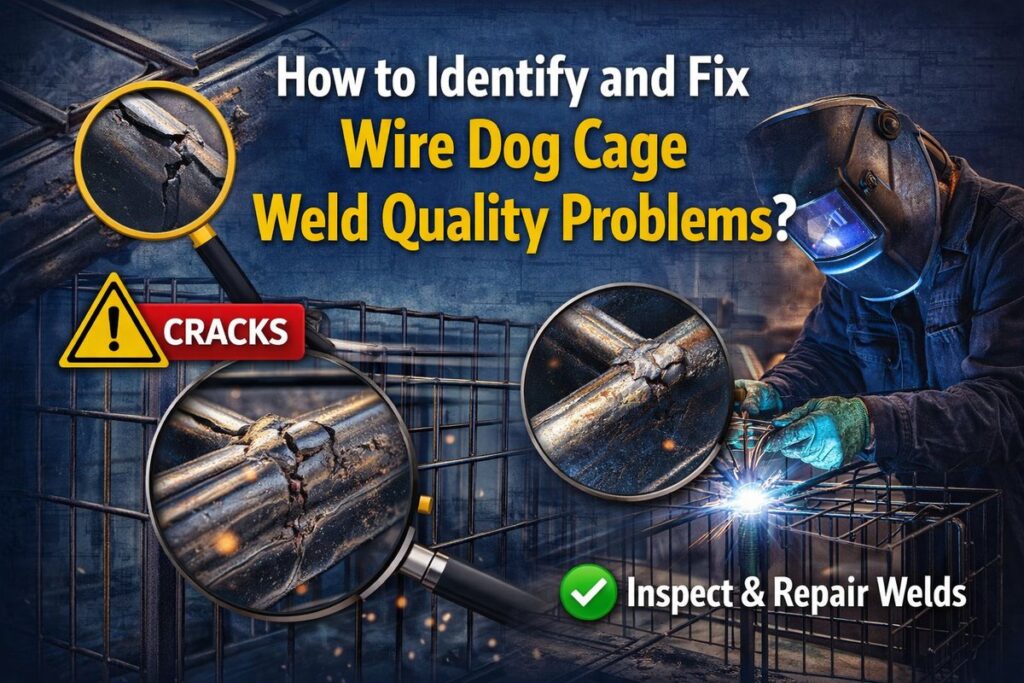
How to Identify and Fix Wire Dog Cage Weld Quality Problems: Complete B2B Guide
Wire dog cage weld quality directly determines the structural integrity and safety of the final product. Understanding how to identify and fix welding defects before shipment helps B2B importers avoid catastrophic failures. For Amazon sellers and pet brands, a single cage collapse due to welding defects can trigger product recalls, lawsuits, and permanent brand damage. Traditional distributors risk losing retail contracts when weld failures disrupt supply chains.
Product recalls, replacements, legal liability, shipping fees
Proactive weld inspection during production reduces structural defect rates by 70-85% compared to post-delivery checks. Prevention-focused welding control costs 2-3% of order value but saves 15-20% by avoiding returns, replacements, and reputation damage. Smart buyers know that investing in weld quality upfront delivers compounding returns through stronger supplier relationships and higher customer satisfaction.
The Cost of Poor Weld Quality
✓ Direct Costs
Product recalls, replacements, legal liability, shipping fees
Introduction: The Cage Structure Depends on Weld Quality
✓ Indirect Costs
Brand damage, lost customers, platform suspension
Understanding welding fundamentals empowers B2B buyers to evaluate suppliers effectively. You don’t need to become a welding engineer, but knowing the difference between resistance welding and MIG welding helps you ask the right questions during factory audits. Recognizing common weld defects enables you to specify appropriate quality controls and inspection protocols.
Introduction: The Cage Structure Depends on Weld Quality
In our experience auditing dog crate manufacturers, welding represents the most critical structural connection in wire dog cage manufacturing. Unlike mechanical fasteners that can loosen over time, properly executed welds create permanent joints that transfer loads throughout the cage structure. When weld integrity fails, the entire product becomes unsafe for its intended purpose.

The financial impact of weld failures extends far beyond replacement costs. Pet owners trust dog cages to contain their animals safely—when welds break and pets escape or get injured, emotional distress drives aggressive legal action. Insurance claims for pet injuries caused by defective cages can reach substantial amounts when negligence is proven.
Understanding welding fundamentals empowers B2B buyers to evaluate suppliers effectively. You don’t need to become a welding engineer, but knowing the difference between resistance welding and MIG welding helps you ask the right questions during factory audits. Recognizing common weld defects enables you to specify appropriate quality controls and inspection protocols.
Types of Welding Used in Wire Dog Cage Manufacturing
Different welding processes produce different joint characteristics, quality levels, and cost structures. Understanding these differences helps buyers specify appropriate welding methods for their wire dog cage requirements.
| Welding Type | Best Application | Quality Level | Cost |
|---|---|---|---|
| Resistance (Spot) Welding | Wire mesh joints, overlapping wires | High | Medium |
| MIG (GMAW) Welding | Frame corners, thick sections | High | Higher |
| TIG (GTAW) Welding | Precision work, thin materials | Very High | Highest |
| Manual Arc (SMAW) | Repair work, field welding | Variable | Low |
Note: Quality level reflects consistency when properly calibrated and operated.
Resistance vs MIG Welding
Resistance welding dominates wire dog cage production because it excels at joining overlapping wire sections. The process passes electrical current through the joint, creating localized heat that fuses the metals together. Advantages include consistent quality, high speed, minimal heat-affected zone, and no filler material requirements. Quality resistance welding requires precise control of current, pressure, and timing. Minimal heat-affected zone means less coating damage and fewer weak points that lead to field failures—something B2B buyers should verify during factory audits.

MIG welding uses a continuous wire electrode and shielding gas to create strong, ductile joints. While more expensive than resistance welding, MIG excels at joining thick materials and frame corners where multi-directional loading occurs. The process allows for better penetration control and produces welds that withstand dynamic stresses better than spot welds.
Welding Process Selection Guide
🎯 Use Resistance Welding
Wire mesh panels, overlapping joints, high-volume production
🎯 Use MIG Welding
Frame assemblies, thick materials, corner joints
Common Weld Defects: Cold Welds, Burn-Through, Weak Joints
Understanding defect types enables targeted prevention strategies. Each weld defect has distinct visual characteristics, root causes, and prevention methods.
| Defect Type | Visual Signs | Root Cause | Prevention & Buyer Action |
|---|---|---|---|
| Cold Weld | Dark, rough surface; poor fusion | Insufficient heat/pressure | Increase current, check electrodes → Verify supplier maintains daily calibration logs |
| Burn-Through | Holes, excessive penetration | Too much current/time | Reduce current, increase speed → Request weld parameter documentation |
| Weak Joint | Small weld nugget, easy to break | Low pressure, contaminated surface | Clean surfaces, increase pressure → Ask to see surface preparation procedures |
| Porosity | Small holes, gas bubbles | Moisture, dirty base metal | Dry electrodes, clean materials → Inspect material storage conditions during audit |
| Cracks | Visible fractures, stress lines | Rapid cooling, poor fit-up | Controlled cooling, proper gaps → Review supplier’s cooling protocols and fit-up standards |
Visual Quality Inspection Tips
Visual inspection identifies approximately 70% of weld defects and should be the first quality control step. Professional inspectors examine welds under adequate lighting (500+ lux, similar to standard office lighting) to ensure small cracks and surface defects are visible. Insufficient lighting causes inspectors to miss critical defects.
Key visual indicators of quality welds include uniform width and height, smooth transition to base metal, absence of cracks or porosity, and proper penetration. Defective welds show irregular profiles, discoloration, spatter, or visible discontinuities.

Document all inspection findings with photographs showing the defect location and type. Reference samples of acceptable and unacceptable welds help maintain consistent standards across inspection teams. Third-party inspection services like ASQ certified inspectors provide objective quality assessments.
💡 Pro Tip: Train your inspection team using actual defect samples. Theoretical knowledge helps, but hands-on experience with real defective welds develops the pattern recognition needed for consistent quality control.
Non-Destructive Testing (NDT) for Weld Integrity
When visual inspection cannot verify internal weld quality, non-destructive testing provides deeper insight without damaging the product. Understanding available NDT methods helps buyers specify appropriate quality verification protocols.
NDT Methods for Wire Dog Cage Weld Quality
- Visual Testing (VT): Basic surface examination, catches 70% of defects [Low cost, always recommended]
- Dye Penetrant Testing (PT): Reveals surface cracks invisible to naked eye [Low cost, practical for routine use]
- Magnetic Particle Testing (MT): Detects surface and near-surface defects in ferrous metals [Medium cost, requires trained technician]
- Ultrasonic Testing (UT): Finds internal defects using sound waves [Higher cost, for critical structural welds]
- Radiographic Testing (RT): X-ray inspection for comprehensive internal analysis [Highest cost, specialized applications only]
💡 Recommendation: VT + PT for routine inspection, UT for critical structural welds
For most wire dog cage applications, visual inspection combined with periodic dye penetrant testing provides adequate quality assurance at reasonable cost. The penetrant process applies colored liquid to weld surfaces, allowing capillary action to draw the dye into cracks. After removing surface excess, developer powder reveals defect locations as visible indications.
Magnetic particle testing works specifically with ferromagnetic materials like carbon steel cages. The process magnetizes the weld area and applies iron particles that cluster at defect locations, making cracks and inclusions visible. This method detects defects that surface-only methods miss.
Factory Floor Solutions for Improving Cage Weld Consistency
From our supplier audits, equipment calibration represents the foundation of weld consistency. Systematic process improvements at the manufacturing level prevent defects rather than catching them after formation. Buyers should verify that suppliers implement these fundamental quality controls.

Equipment calibration represents the foundation of weld consistency. Resistance welding machines require daily verification of electrode alignment, pressure settings, and current output. Electrodes wear over time, producing inconsistent joints if not maintained. Quality manufacturers replace electrodes at scheduled intervals rather than waiting for defect occurrence.
Material preparation significantly impacts weld quality. Oils, rust, and coatings prevent proper fusion and create porosity. Suppliers should implement surface cleaning processes including degreasing, wire brushing, and chemical preparation before welding. Storing raw materials in controlled environments prevents moisture absorption that causes hydrogen-induced cracking.
⚠️ Critical Control: Environmental conditions affect weld quality significantly. Temperature below 5°C (41°F) or humidity above 80% requires preheating and special procedures.
Verify that suppliers monitor and control welding environment conditions through documented daily logs.
Welder certification ensures that personnel possess necessary skills. AWS certification programs validate theoretical knowledge and practical capability. Even certified welders require periodic recertification and skill updates. The best manufacturers maintain ongoing training programs and track individual welder performance metrics.
Weld Quality Inspection Checklist for Importers
Systematic inspection protocols transform subjective quality judgments into objective pass/fail criteria. This checklist provides a framework for evaluating wire dog cage weld quality during production and before shipment.
| Inspection Item | Acceptance Criteria | Method |
|---|---|---|
| Weld Appearance | Uniform width, smooth profile, no cracks | Visual inspection |
| Weld Size | Minimum 3mm throat thickness | Weld gauge measurement |
| Penetration | Full fusion, no cold laps | Cross-section sampling |
| Pull Strength | ≥200 lbs (large cages), ≥150 lbs (medium) | Destructive testing |
| Surface Defects | No cracks, porosity, or inclusions | Dye penetrant testing |
Buyer tip: Request to see actual weld gauge tools and witness measurement during factory audits.
Sampling plans determine inspection frequency based on production volume and quality history. New suppliers require higher inspection rates (AQL 1.0 for critical defects) until establishing quality records. Proven suppliers may use reduced inspection (AQL 2.5) while maintaining vigilance for process changes.

Documentation creates accountability and enables trend analysis. Record inspection results by supplier, production batch, and defect type. Over time, this data identifies systematic issues and validates supplier improvement efforts. Digital inspection tools streamline documentation while ensuring consistent data capture.
FAQ: Common Wire Dog Cage Weld Questions

Wire Dog Cage Weld Quality Implementation Playbook
Step 1: Define acceptance
Write a buyer standard that references measurable pull strength and bead profile so suppliers know exactly how to pass audits.
Step 2: Train teams
Hold weekly weld samples review with inspectors and operators so weld standards are tied to real defects and pass/fail examples.
Step 3: Monitor data
Track weld nugget size, pull-force, and defect Pareto charts in quality dashboards so trends stay visible to executives.
Require suppliers to show welding calibration logs and weld coupons every shift. A clear weld quality policy keeps production teams aligned.
Link your SOP to AWS welding standards so external auditors see objective references instead of opinion-based criteria.
Process discipline
Document current, pressure, and time settings that stabilize weld consistency across shifts.
Incoming checks
Inspect wire diameter and coating; small deviations quickly erode structural integrity and lead to rework.
Operator coaching
Coach operators to flag spatter, burn-through, or porosity that threaten weld reliability before cages move downstream.
Weld quality must be monitored like a safety KPI. Mentioning weld standards in dashboards and checklists keeps leaders focused on prevention.
Reference ISO 3834 welding quality guidance to show buyers you follow globally recognized practice.
Audit trails should include photos, lot IDs, and inspector names so recurring issues are traceable to shifts or machines. When each non-conformance form documents weld quality criteria, it trains the team to think structurally rather than cosmetically.
This habit also reassures any dog crate manufacturer that their OEM partner takes weld reliability seriously.
Communication cadence
Send weekly reports that highlight weld quality trends, NDT findings, and corrective actions. Pair these with side-by-side photos so brand managers see continuous improvement.
Use consistent weld terminology in POs, PPAP documents, and pre-shipment reports so the supply chain hears a single message: structural integrity is the gating factor for payment and delivery.
Conclusion: Ensuring Structural Quality Through Better Welding
Mastering weld quality requires understanding welding processes, recognizing defect types, and implementing the inspection protocols outlined above. By specifying appropriate welding methods, requiring supplier certifications, and conducting thorough quality verification, B2B buyers establish a foundation for consistent product reliability.
Weld Quality Investment ROI
Based on our experience with supplier audits and quality programs
Investment
2-4%
Of order value for weld QC
Defect Reduction
70-85%
Fewer structural failures
Net Savings
12-18%
Total cost reduction
Weld integrity is the gating metric for shipment release. Capture every NCR with clear weld criteria so finance and quality teams speak the same language.
When executive reviews tie bonuses to weld quality escapes, suppliers prioritize structural reliability over cosmetic fixes.
The investment in weld quality control—through supplier audits, NDT inspection, and process monitoring—typically costs 2-4% of order value while delivering 12-18% net savings through avoided structural failures, returns, and liability exposure.
For comprehensive guidance on implementing quality control throughout your procurement process, review our quality control framework guide. Understanding weld defects helps target prevention efforts—explore detailed guides on general quality issues, coating defect prevention, and dimensional accuracy standards.
For complete quality control coverage, review these related guides: 20-Point Quality Inspection Checklist | Laboratory & Field Testing Methods | Quality Issues Overview
More Insights: Factory Audit Checklist


