
Wire Dog Cage Lead Time: How Long Does Production Really Take?
Every week at our Yuyao facility, we receive urgent requests from buyers who need cages delivered in impossible timeframes. An Amazon seller once placed an order on March 1st and asked: “Can I have these by March 20th for my spring promotion?” When we explained why that wasn’t possible, he seemed genuinely confused—he’d assumed wire dog cages could be produced as quickly as ordering stock items from a warehouse.
Understanding production lead times is fundamental to successful importing. Wire dog cage manufacturing isn’t instantaneous—it requires procuring materials, scheduling production lines, completing multiple quality checks, and preparing shipments. Rushing these processes compromises quality and often leads to delays rather than faster delivery.
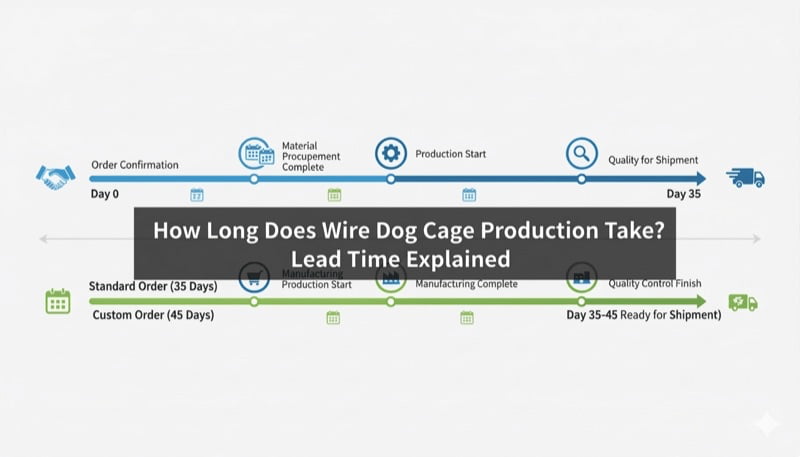
This guide reveals the reality behind our 35-45 day standard lead time, explains what factors can extend delivery, and shows you how to plan orders to avoid costly stockouts or rushed shipments. You’ll learn why factories can’t deliver in 20 days without cutting corners, and how proper planning eliminates the need for expensive rush orders.
What Is the Standard Lead Time for Wire Dog Cages?
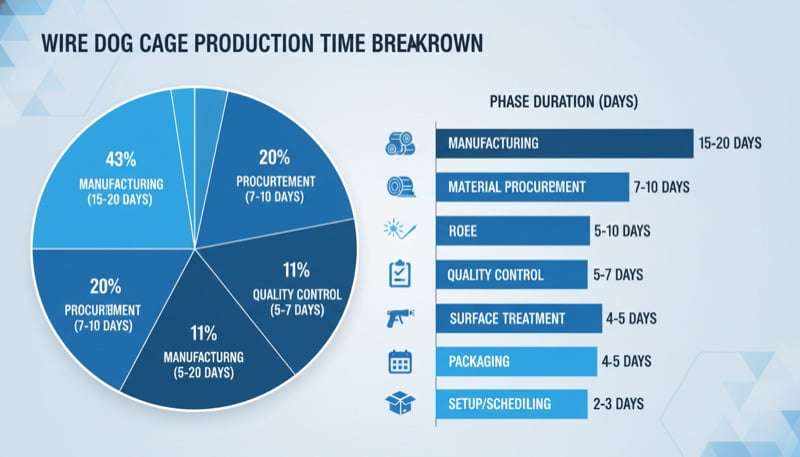
Our standard lead time is 35-45 days from deposit payment to ready-for-shipment. This timeline is based on 10 years of production data tracking thousands of orders. It’s not arbitrary—every phase serves a specific quality or logistical purpose.
Complete Lead Time Breakdown
| Phase | Duration | Percentage | Key Variables |
|---|---|---|---|
| Order Confirmation | 1-2 days | 3% | Payment processing, specification finalization |
| Material Procurement | 7-10 days | 20% | Steel availability, powder coating supplier lead time |
| Production Setup | 2-3 days | 6% | Tooling preparation, line scheduling, wire cutting templates |
| Manufacturing | 15-20 days | 43% | Order quantity, customization complexity, queue position |
| Quality Control | 3-5 days | 11% | Inspection depth, rework requirements, testing protocols |
| Packaging | 2-3 days | 6% | Packaging type, labeling requirements, pallet configuration |
| Warehouse & Shipping Prep | 3-5 days | 11% | Documentation preparation, container booking, loading |
| Total Standard Lead Time | 35-45 days | 100% | For standard orders of 300-1000 pieces |
Why 35-45 days and not a fixed number? The 10-day range accounts for normal variations in material availability, production scheduling, and order complexity. Simple standard orders tend toward the 35-day end; complex or first-time custom orders tend toward 45 days.
What Each Phase Actually Involves
Material Procurement (7-10 days): We don’t stockpile steel because specifications vary by order—wire gauge, quantity needed, quality grade. We order steel after receiving your deposit to ensure fresh material and avoid tying up capital in inventory. Powder coating colors are procured based on your specifications (standard colors ship faster than custom colors).
Manufacturing (15-20 days): This is actual production time—cutting, welding, coating, assembly. A 500-piece order requires approximately 3-4 days of pure production time on our lines, but we don’t run single-product batches. We schedule multiple orders to optimize efficiency, so your 500 pieces might be distributed across 2 weeks of production slots mixed with other orders.
Quality Control (3-5 days): Multiple inspection checkpoints throughout production, plus final comprehensive inspection. Cannot be rushed without increasing defect rates.
What We Usually See at Our Ningbo Facility
Three years ago, we attempted a “fast track” program promising 28-day delivery. We procured materials before orders, ran dedicated production lines, and reduced quality check time. Result: defect rate increased from 0.8% to 2.3%, material waste increased 15% (pre-ordered steel that didn’t match actual orders), and we still missed deadlines 40% of the time due to unforeseen issues.
We abandoned that program and returned to our proven 35-45 day timeline. Customers prefer consistent, predictable delivery over optimistic promises we can’t keep. Now our on-time delivery rate is 92% within the 35-45 day window.
How Does Order Quantity Affect Lead Time?
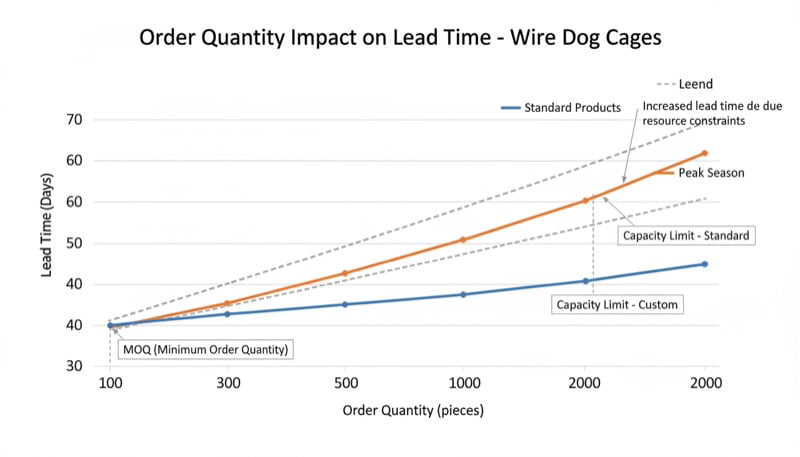
Order size impacts lead time through production scheduling and capacity allocation. Larger orders require more production days and sometimes multiple batch runs.
Lead Time by Order Quantity
| Order Quantity | Lead Time | Production Days | Reasoning |
|---|---|---|---|
| 300 pcs (MOQ) | 35-38 days | 15-16 days | Minimum batch, fits single production run |
| 301-500 pcs | 35-40 days | 16-18 days | Single production run, standard processing |
| 501-1000 pcs | 38-43 days | 18-20 days | 1.5 production runs, slight scheduling complexity |
| 1001-2000 pcs | 42-48 days | 20-23 days | 2 production runs, requires advance scheduling |
| 2001-3000 pcs | 48-55 days | 23-27 days | 3 production runs, significant scheduling coordination |
| 3000+ pcs | 55-65 days | 27-32 days | Multiple runs, requires 60-90 days advance planning |
Our monthly capacity: Approximately 10 containers (3,000-4,000 cages depending on size mix). Orders exceeding 30% of monthly capacity require advance scheduling to avoid disrupting other committed orders.
Production Capacity Reality
We can produce about 150-200 standard cages per day on one production line. However, this doesn’t mean a 600-piece order takes only 3-4 days:
- Mixed scheduling: We run multiple orders simultaneously to optimize efficiency. Your 600-piece order might occupy 30-40% of line capacity over 2 weeks, with other orders filling the remaining capacity
- Batch processing: Welding, coating, and assembly happen in batches. A cage doesn’t move linearly through the factory—it waits in queue between stages
- Quality gates: Inspection checkpoints create natural pauses in production flow
- Efficiency vs. speed trade-off: Running dedicated single-product lines is faster but less efficient, increasing costs 20-30%
What We Usually See
The answer is batching and scheduling efficiency. If we ran dedicated lines for each order, costs would increase 25% and we’d need to raise prices. Instead, we batch similar operations across multiple orders—welding several orders together, coating multiple orders in one oven run, etc.
For example, last week we produced portions of seven different orders simultaneously: Order A (black 36″), Order B (black 42″), Order C (silver 36″), Order D (black 30″), Order E (custom brown 36″), Order F (black 36″ with divider), Order G (black 48″). By grouping black orders through coating together and standard 36″ orders through welding together, we optimized equipment utilization by 40% compared to dedicated sequential production.
This approach extends individual order time slightly but reduces overall costs significantly—savings we pass to customers through competitive pricing.
What Factors Can Extend Lead Time?
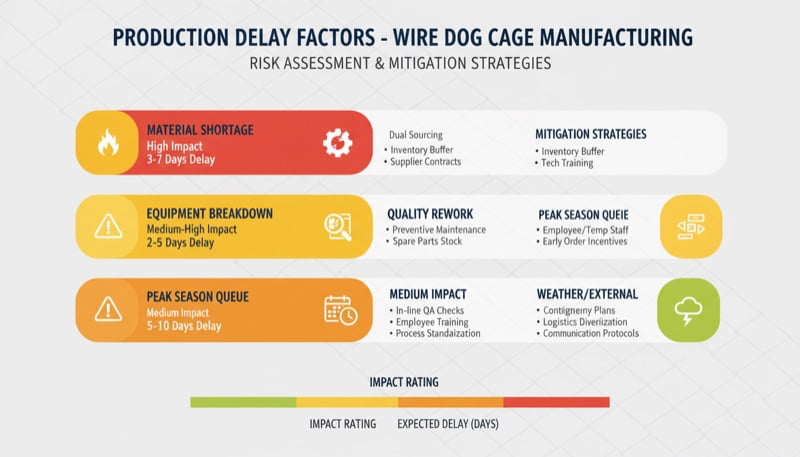
While 35-45 days is our standard, certain factors can extend delivery. Understanding these helps you anticipate and plan for potential delays.
Common Delay Factors and Impact
| Delay Factor | Frequency | Typical Impact | Mitigation Strategy |
|---|---|---|---|
| Steel Price Spike | Occasional (1-2x/year) | +3-7 days | Pre-order materials, lock pricing with deposit |
| Chinese New Year | Annual (Jan-Feb) | +15-25 days | Plan orders 60-90 days before CNY |
| Custom Requirements | 30% of orders | +5-15 days | Finalize specifications early, approve samples quickly |
| Quality Issues | 2-3% of orders | +3-7 days | Strict QC prevents; rework adds time when issues found |
| Coating Weather Issues | Winter months | +3-5 days | Humidity control in coating area; schedule buffer |
| Client Spec Changes | 10% of orders | +7-14 days | Lock specs before production starts; charge for changes |
| Container Shortage | Seasonal (peak times) | +5-10 days | Book containers 2-3 weeks before ready date |
| Payment Delays | 5% of orders | +2-5 days | Prompt balance payment when goods ready |
The Most Disruptive Delay: Client Specification Changes
The single most preventable cause of delays is clients changing specifications after production starts. Examples we’ve encountered:
- Client changed door latch specification after we’d welded 300 cages → had to disassemble doors, install new latches, re-weld → +8 days
- Client changed powder coating color after we’d coated 200 units → had to strip coating, re-coat → +10 days
- Client added packaging requirement after cages were packed → had to unpack, relabel, repack → +4 days
To prevent this, we now require written specification approval before starting production. Changes after production begins incur restart fees ($500-2000) plus time delays.
What We Usually See
Six months later, they came back. The new supplier had promised 30-day delivery but actually delivered 52 days late with 3% defective products. They realized our 35-45 day standard lead time was honest and our communication about delays was transparent, whereas the other supplier overpromised and underdelivered.
This taught us that setting realistic expectations upfront, even if longer than competitors promise, builds more trust than optimistic timelines we can’t meet. We now prominently display “35-45 days standard, no shortcuts” in our quotations.
How Does Customization Impact Production Time?
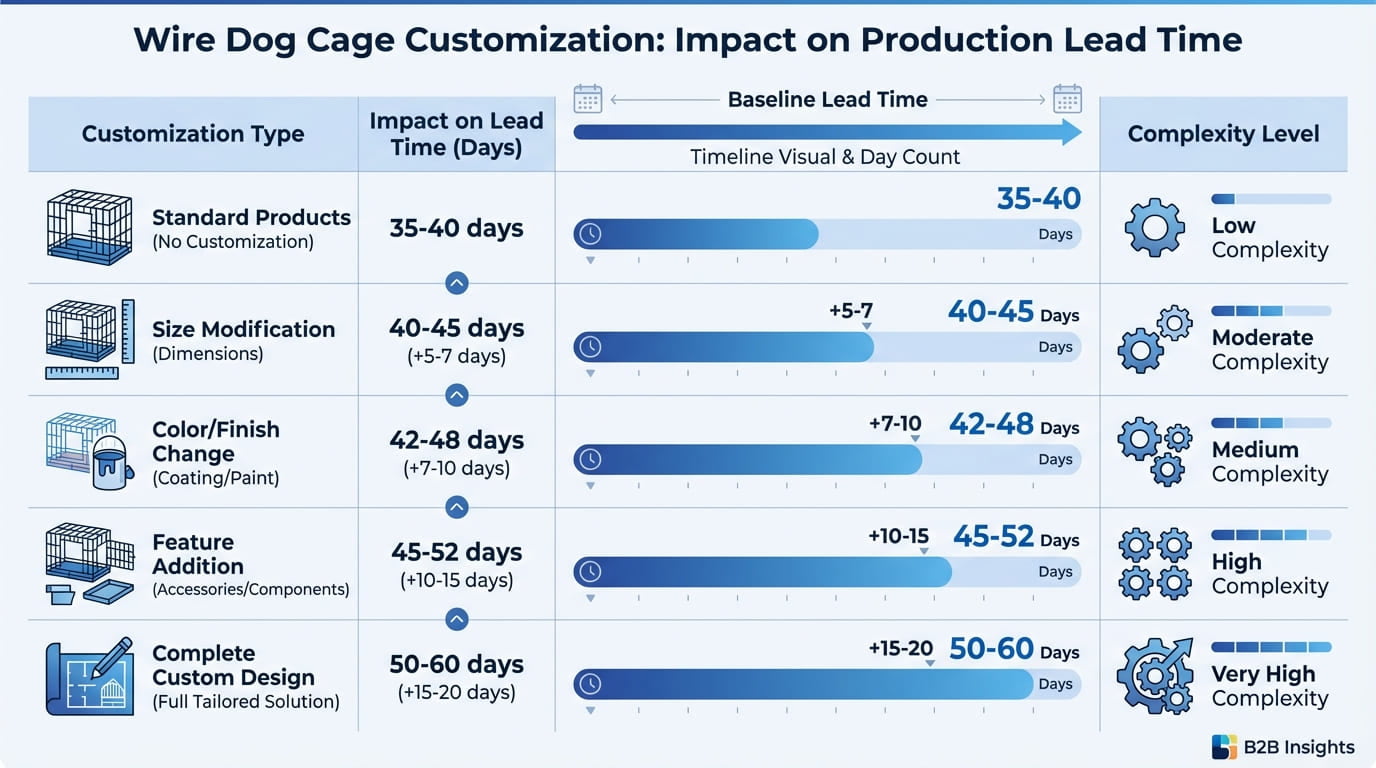
Custom orders require additional time for sample approval, special materials procurement, and process adjustments. The degree of impact depends on customization complexity.
Customization Lead Time Impact
| Customization Type | Additional Time | Reason | Total Lead Time |
|---|---|---|---|
| Standard Product | 0 days | Baseline process | 35-45 days |
| Size Modification | +5-7 days | Template adjustment, test cuts, dimensional verification | 40-52 days |
| Color Change | +7-10 days | Custom powder procurement, color matching, sample approval | 42-55 days |
| Feature Addition | +10-14 days | Tooling modification, assembly process changes, testing | 45-59 days |
| Complete Custom Design | +15-20 days | Prototyping, sample approval, new tooling, process development | 50-65 days |
| First-Time Custom | +10-15 days | Sample production, client approval cycle, process documentation | 45-60 days |
| Repeat Custom Order | +0-5 days | Process already established, slight material procurement delay | 35-50 days |
The Sample Approval Bottleneck
For custom orders, we always produce 2-3 sample units before starting full production. This adds time but prevents expensive mistakes:
- Sample production: 7-10 days to make and inspect samples
- Shipping to client: 3-5 days express courier
- Client review: Variable (1-14 days depending on client responsiveness)
- Revisions if needed: +7-10 days per iteration
Total sample approval cycle: 11-29 days depending on how quickly clients respond and how many revisions are needed. Responsive clients who approve samples within 24 hours significantly accelerate their orders.
What Is the Fastest Possible Lead Time?
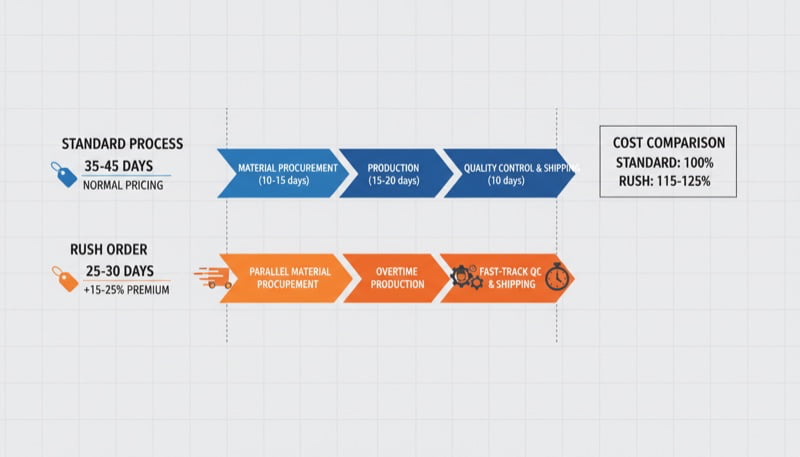
While 35-45 days is standard, we can accommodate rush orders under specific conditions—but at premium cost and with limitations on what’s feasible.
Rush Order Options and Costs
| Rush Level | Lead Time | Requirements | Premium Cost | Availability |
|---|---|---|---|---|
| Standard | 35-45 days | Normal queue, standard process | 0% | Always |
| Priority | 30-35 days | Jump production queue, limited overtime | +10% | Subject to capacity |
| Rush | 25-30 days | Dedicated line slots, significant overtime | +15% | Limited availability |
| Emergency | 20-25 days | All resources prioritized, 24/7 if needed | +25% | Rare, case-by-case |
Conditions for accepting rush orders:
- Standard products only—no customization possible in rush timelines
- Order size 300-800 pieces (larger orders cannot be rushed)
- Required materials already in stock
- Production schedule has available capacity
- Client accepts that we cannot compromise quality for speed
Why We Rarely Recommend Rush Orders
Rush orders create multiple problems:
- Quality risk increases: Rushing any phase—material procurement, production, QC—statistically increases defect rates
- Schedule disruption: Jumping queue affects other clients’ orders, potentially causing their delays
- Staff fatigue: Overtime and rushed work increase worker fatigue and error rates
- Higher costs: Premium pricing covers overtime wages, expedited material procurement, and disruption costs
- Limited flexibility: If issues arise during rush production, we have no time buffer to fix them without missing deadline
What We Usually See
Last year, a client needed 500 cages in 25 days for a trade show. We ran two shifts (16 hours/day) for 2 weeks straight to deliver on day 24. We charged 15% premium and made it clear this was an exception, not our normal service.
The result: We delivered on time, but the rush disrupted three other orders, causing 3-5 day delays for those clients. One of those clients complained, and we had to offer compensation. The rush order profit was consumed by the disruption costs and goodwill gestures to affected clients.
Now we only accept rush orders if: (1) the client genuinely has an unavoidable emergency (not just poor planning), (2) our production schedule has genuine slack capacity, and (3) it won’t disrupt other committed orders. This happens maybe 2-3 times per year.
How Should Buyers Plan Their Order Timing?
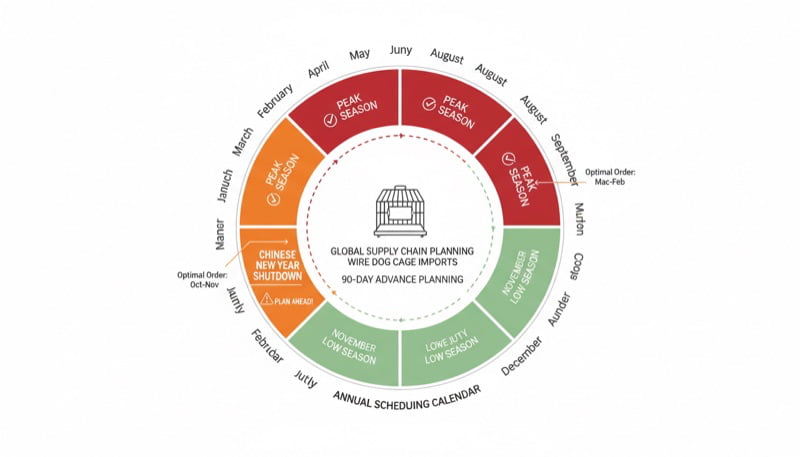
Proper order timing prevents stockouts, avoids rush premiums, and ensures you receive goods when needed. Strategic planning is more effective than reactive scrambling.
Seasonal Planning Calendar
| Selling Season | Order Placement Window | Production Period | Arrival Target | Planning Notes |
|---|---|---|---|---|
| Spring (Mar-May) | Nov-Dec | Dec-Jan | February | Order before CNY closure |
| Summer (Jun-Aug) | Feb-Mar | Mar-Apr | May | Post-CNY rush period, add buffer |
| Fall (Sep-Nov) | May-Jun | Jun-Jul | August | Prepare for holiday season |
| Holiday/Winter (Dec-Feb) | Aug-Sep | Sep-Oct | November | Peak season, order 90 days ahead |
Chinese New Year Impact (Critical Planning Factor):
- Factory closure typically 2-3 weeks in January/February
- Orders placed within 30 days of CNY start will be delayed 15-25 days
- Post-CNY period (February-March) sees 40% surge in orders → longer lead times
- Material suppliers also close for CNY, creating cascading delays
Recommended planning buffers:
- First-time orders: Add 15-20 days buffer to standard lead time (total 50-65 days)
- Repeat standard orders: Add 10-15 days buffer (total 45-60 days)
- Custom orders: Add 20-25 days buffer (total 55-70 days)
- Peak season orders (Mar-May, Aug-Oct): Add 15-20 days to normal buffers
Our Busiest and Slowest Months
Peak season (orders 40-60% above average):
- March-May: Clients restocking after winter slowdown, preparing for summer sales
- August-October: Holiday season preparation, everyone wants November delivery
During peak months: Production schedule books 6-8 weeks out. Orders placed in early September for October delivery will likely slip to November. Plan ahead.
Slow season (orders 30-50% below average):
- January-February: Chinese New Year disruption, buyers hesitant to order
- June-July: Post-spring season lull before holiday preparation
During slow months: Lead times trend toward faster end of range (35-38 days). Excess capacity means we can accommodate special requests more easily.
What We Usually See
The clients who succeed are those who plan seasonally. For example, one of our top customers places four orders per year like clockwork: early November (for March delivery), early February (for June delivery), early May (for August delivery), early August (for November delivery). They never experience stockouts, never pay rush premiums, and never stress about inventory. Their forecasting isn’t perfect, but their lead time planning is excellent.
In contrast, we have clients who order reactively—they stock out, panic order with 3-week requested delivery, get frustrated when we explain reality, grudgingly wait 6 weeks, and then repeat the same pattern 4 months later. These clients pay more (rush premiums when we can accommodate), receive late (when we can’t rush), and constantly experience inventory gaps. Better planning would solve all these problems.
What Happens If Production Is Delayed?
Despite our best planning, delays occasionally occur. How we handle them separates professional manufacturers from unreliable ones.
Our Delay Communication Protocol
- Early warning system: If we identify potential delays more than 3 days, we notify clients immediately with cause and projected new timeline
- Root cause transparency: We explain exactly what caused the delay (material shortage, equipment malfunction, quality issue, etc.)
- Mitigation efforts: We explain what we’re doing to minimize delay impact (overtime, alternative materials, priority processing)
- Updated timeline: We provide realistic revised delivery date with buffer, not optimistic promises
- Regular updates: Weekly status updates until order ships
Recent Delay Case Studies
Case 1: Coating equipment breakdown (7-day delay):
- Situation: Powder coating oven temperature controller failed, affecting 5 orders
- Communication: Notified all affected clients within 4 hours of discovering issue
- Solution: Rented backup coating equipment from partner factory 80km away, transported cages for coating
- Result: Kept delay to 2 days instead of projected 7 days, absorbed extra transportation cost
Case 2: Steel supplier shortage (10-day delay):
- Situation: Primary steel supplier experienced production shutdown, couldn’t deliver on time
- Communication: Notified clients 5 days before expected material arrival when supplier informed us
- Solution: Sourced emergency steel from secondary supplier at 8% premium cost
- Result: 3-day delay instead of 10 days, absorbed premium cost difference
Case 3: Quality issue discovery (5-day delay):
- Situation: Found door alignment issues during final inspection on 200-unit batch
- Communication: Immediately informed client with photos showing the problem
- Solution: Reworked all affected units rather than shipping defective products
- Result: 5-day delay, but zero defective units reached customer
FAQ: Wire Dog Cage Lead Time
Conclusion: Planning for Predictable Wire Dog Cage Delivery
Understanding production lead times transforms importing from stressful crisis management to predictable business operations. Our 35-45 day standard lead time reflects the reality of quality manufacturing—material procurement, careful production, thorough quality control, and proper packaging all take time.
Key takeaways for lead time planning:
- 35-45 days is standard for good reason: Every phase serves quality or logistical purposes. Factories promising 20-day delivery are cutting corners or overpromising
- Order 60-90 days before you need goods: This accommodates 35-45 day production plus 15-25 days shipping/customs, with buffer for unexpected issues
- Customization adds 5-20 days: Sample approval cycles and special materials procurement extend timelines. First-time custom orders need 50-70 days total
- Peak season requires advance planning: March-May and August-October production books 6-8 weeks out. Order early or accept longer lead times
- Chinese New Year creates 15-25 day delays: Plan orders 60-90 days before CNY if you need February/March delivery
- Rush orders cost 10-25% premiums: And they’re only possible for standard products under specific conditions. Better planning eliminates rush needs
The most successful importers don’t try to compress lead times—they plan around them. They forecast demand 90 days ahead, place orders systematically, and never experience stockouts or rush premiums. This approach costs nothing extra but requires discipline and forward planning.
Realistic expectations, transparent communication, and advance planning create reliable wire dog cage supply chains that support sustainable business growth.
External References: Incoterms Rules | ISO Quality Management
