

How to Implement Wire Dog Cage Quality Control: Complete Framework
When importing wire dog cages from Chinese manufacturers, implementing a robust quality control framework is critical for ensuring consistent product quality, preventing costly defects, and protecting your brand reputation. Quality issues in wire dog cage imports affect approximately 35% of first-time B2B buyers, resulting in product returns, customer complaints, and potential legal liabilities. Without systematic quality control processes, you risk receiving substandard products that fail to meet specifications, compromise pet safety, and damage your business relationships.
The reality of international wire dog cage sourcing is that quality control cannot be left to chance or supplier promises alone—it requires proactive implementation of structured inspection protocols, documented quality standards, and continuous improvement processes. This comprehensive quality control framework provides B2B importers with a complete roadmap for implementing multi-stage QC systems, from incoming material inspection through final shipment verification. By establishing these proven quality control measures, you can minimize defect rates, ensure consistent product quality, and build strong partnerships with reliable Chinese manufacturers.
The Critical Importance of Quality Control for Wire Dog Cage Importing
✓ Defect Prevention
Identify quality issues before products ship from factory
✓ Cost Savings
Reduce returns, rework, and warranty claims by 40-60%
Why Quality Control Matters in Wire Dog Cage Importing
Quality defects in wire dog cage imports represent one of the most significant risks for B2B buyers engaging in international sourcing. Industry data indicates that approximately 35% of first-time wire dog cage importers encounter quality-related problems ranging from structural defects and finish inconsistencies to dimensional inaccuracies and packaging failures. These quality issues directly impact customer satisfaction, lead to increased return rates, and can damage your brand reputation in the competitive pet products market.

The financial impact of quality problems extends far beyond the immediate cost of defective products. Buyers face additional expenses including return shipping costs, product replacement fees, storage charges, and potential penalties from downstream retailers. More importantly, recurring quality issues can lead to customer churn, negative reviews, and loss of market share—all of which significantly impact long-term business profitability.
Effective quality control implementation requires understanding that wire dog cage manufacturing involves multiple quality-critical processes including welding strength, coating thickness, dimensional accuracy, and safety features. Each of these process areas presents potential failure points that must be systematically monitored through structured inspection protocols.
What remains consistent across successful wire dog cage import operations is comprehensive quality control implementation across the entire production cycle. They establish clear quality specifications, conduct systematic inspections at critical control points, and maintain detailed documentation for traceability and continuous improvement.
Understanding the Four-Stage Quality Control Framework
The most effective quality control framework for wire dog cage importing consists of four systematic inspection stages: Incoming Quality Control (IQC), In-Process Quality Control (IPQC), Final Quality Control (FQC), and Outgoing Quality Control (OQC). This multi-stage approach ensures quality verification occurs at every critical point in the production process, from raw material arrival through final shipment preparation.
Systematic inspection checklists provide practical implementation of these QC stages, while laboratory and field testing methods validate quality performance objectively. For comprehensive quality assurance, understanding manufacturer certifications helps evaluate supplier quality capabilities before production begins. By establishing inspection checkpoints throughout production, you can identify and address quality issues before they cascade into costly rework or product failures.
| QC Stage | Inspection Point | Key Check Items | Defect Impact |
|---|---|---|---|
| IQC | Raw Materials | Wire gauge, coating thickness, material certification | High – affects entire production |
| IPQC | During Production | Weld strength, dimensions, assembly quality | Medium – can be corrected in process |
| FQC | Finished Products | Final inspection, functional testing, finish quality | High – requires rework or scrap |
| OQC | Before Shipment | Packaging, documentation, random sampling | Very High – products already shipped |
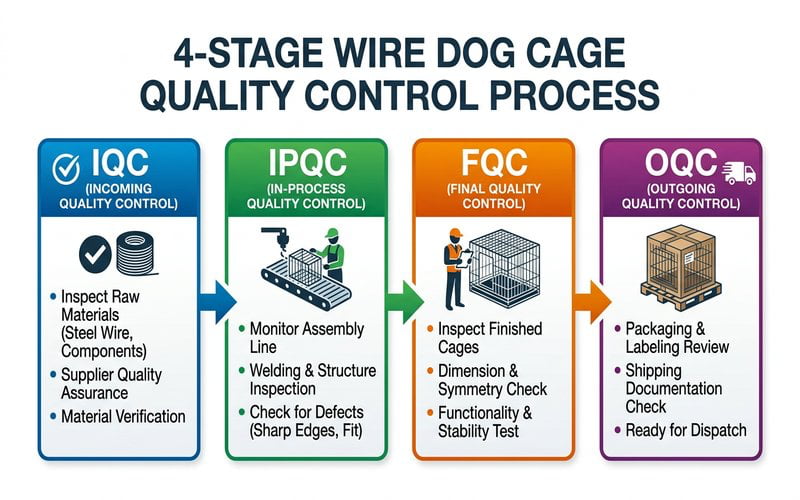
Incoming Quality Control (IQC) serves as the first critical defense against quality defects by verifying that all raw materials and components meet specified requirements before production begins. This includes inspection of steel wire gauge and coating thickness, verification of material certificates, and assessment of packaging materials. IQC typically uses AQL (Acceptable Quality Limit) sampling standards to determine inspection intensity based on order quantities.
In-Process Quality Control (IPQC) monitors production quality during manufacturing operations to catch and correct issues before they affect large quantities of finished products. IPQC inspections typically occur at critical production stages such as after welding operations, during coating application, and during final assembly. This stage is crucial for identifying process variations that could lead to consistent quality defects across multiple units.
Final Quality Control (FQC) provides comprehensive inspection of finished products before they are released for packaging and shipment. FQC evaluates complete products against all quality specifications including dimensional accuracy, weld strength, coating integrity, and functional requirements. This stage often involves 100% inspection for critical safety features and sampling-based inspection for cosmetic requirements.
Outgoing Quality Control (OQC) represents the final verification before products leave the factory, focusing on packaging integrity, documentation completeness, and final random sampling to confirm that FQC findings remain valid. OQC ensures that products are properly protected for international shipping and that all required certifications and documentation are complete and accurate.
Quality Control vs. Quality Assurance: Key Differences
Understanding the distinction between Quality Control (QC) and Quality Assurance (QA) is essential for implementing an effective wire dog cage quality management system. While both concepts focus on product quality, they address quality from different perspectives and require different implementation approaches.
QC vs. QA: Key Differences
🎯 Quality Control (QC)
Inspection-focused: Detect defects in products
🎯 Quality Assurance (QA)
Process-focused: Prevent defects from occurring
🎯 Reactive Approach
QC identifies problems after they occur
🎯 Proactive Approach
QA prevents problems before they occur
Quality Control focuses on inspection and testing activities designed to identify defective products or components. QC activities include visual inspection, dimensional measurement, mechanical testing, and other verification methods that assess whether products meet specified requirements. The goal of QC is to detect quality issues and prevent defective products from reaching customers.
Quality Assurance focuses on process design and implementation to prevent quality defects from occurring in the first place. QA activities include developing quality management systems, establishing standard operating procedures, training production personnel, and implementing process controls that ensure consistent quality. The goal of QA is to create processes that consistently produce quality products.
Critical insight: Effective wire dog cage quality management requires both QC and QA approaches working together. QC catches defects that slip through process controls, while QA improves processes to reduce the frequency of defects requiring QC intervention.
Implementing Stage 1: Incoming Quality Control (IQC)
Incoming Quality Control (IQC) represents the critical first line of defense in your wire dog cage quality control framework. By thoroughly inspecting raw materials and components before production begins, you prevent quality issues from propagating through manufacturing processes and affecting large quantities of finished products.
IQC Key Inspection Requirements
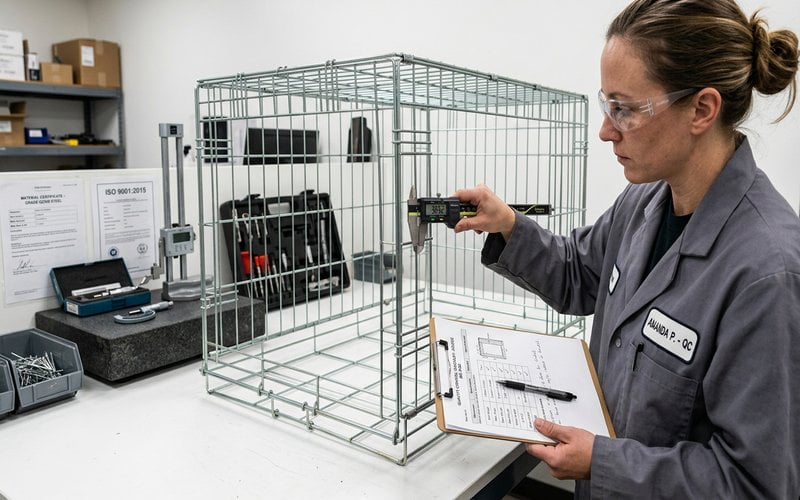
Material Verification: Confirm steel wire material type (typically low-carbon steel), wire gauge accuracy (commonly 2.0mm-4.0mm for dog cages), and material certification compliance. Request mill certificates for critical orders and verify wire tensile strength meets specified requirements.
Coating Inspection: Measure coating thickness using appropriate gauges to ensure specified coating application (typically 60-80 microns for powder coating, 15-25 microns for electroplating). Verify coating type matches specifications and conduct basic adhesion tests when required.
Component Inspection: Inspect additional components including plastic parts, metal fasteners, and accessories for dimensional accuracy, material quality, and absence of visible defects. Verify that all components match approved sample specifications.
Documentation Review: Examine material certificates, inspection reports from raw material suppliers, and batch tracking documentation to ensure traceability. Verify that incoming materials are properly labeled with batch numbers and production dates.
IQC implementation requires establishing clear acceptance criteria for each material type and component. For steel wire, this includes acceptable gauge tolerances (typically ±0.05mm), tensile strength requirements, and coating thickness specifications. For plastic components, criteria include dimensional tolerances, absence of flash or sink marks, and color consistency.
Sampling for IQC inspections should follow AQL (Acceptable Quality Limit) standards. Common AQL levels for wire dog cage raw materials include AQL 2.5 for critical dimensions and AQL 4.0 for cosmetic requirements. Sample sizes are determined based on lot sizes using standard AQL sampling tables, ensuring statistically valid inspection results.
IQC Documentation Requirements: Maintain comprehensive records for all IQC inspections including inspection dates, lot numbers, sample sizes, defect classifications, and disposition decisions. This documentation provides traceability and supports root cause analysis when quality issues occur in production.
IQC Defect Handling Procedures
When IQC identifies defective materials, established handling procedures ensure consistent and appropriate responses. Non-conforming materials should be clearly identified with red tags or other markers indicating rejection status. A Material Review Board (MRB) or equivalent authority should evaluate whether materials can be accepted with deviation, reworked to meet specifications, or rejected and returned to suppliers.
For minor deviations that do not affect product safety or functionality, materials may be accepted with formal deviation authorization documented in the quality system. Materials requiring rework must undergo secondary inspection after rework completion before release to production. Severely defective materials must be rejected and returned to suppliers with clear documentation of non-conformance.
Implementing Stage 2: In-Process Quality Control (IPQC)
In-Process Quality Control (IPQC) monitors production quality during manufacturing operations, enabling early detection and correction of quality issues before they affect large quantities of finished wire dog cages. IPQC inspections occur at critical production stages throughout the manufacturing process.
IPQC Inspection Checkpoints
After Cutting Operations: Verify wire cut lengths meet dimensional specifications, confirm cut ends are smooth without sharp burrs, and check that wire identification marks remain legible for traceability.
After Bending/Forming: Inspect bend angles for accuracy, verify radius consistency across all bends, check for spring-back effects affecting dimensions, and confirm that formed parts match fixture specifications.
During Welding Operations: Monitor weld quality for proper penetration, verify weld bead appearance consistency, check for spatter or slag inclusions, and ensure weld placement accuracy. Periodically perform destructive weld strength tests on sample units.
During Coating Application: Monitor coating process parameters (temperature, spray pressure, line speed), verify coating thickness uniformity, check for coating defects such as runs or sags, and conduct adhesion testing on sample parts.
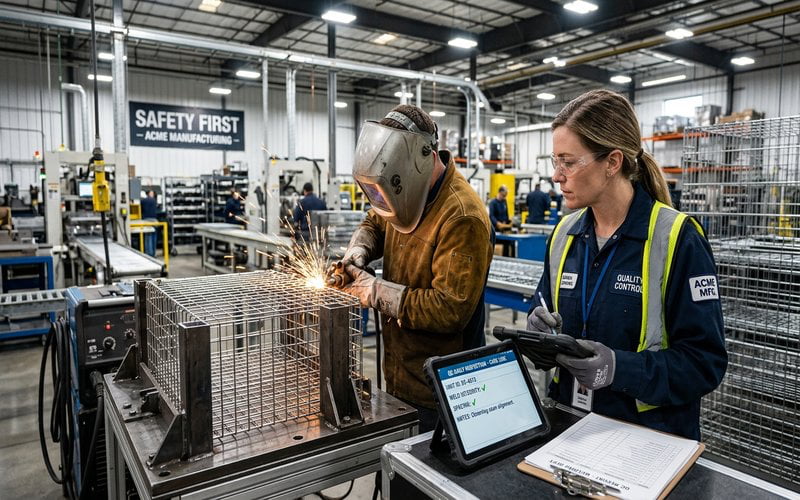
IPQC requires continuous monitoring rather than discrete inspection batches. Inspectors should conduct ongoing verification throughout production runs, typically checking samples at specified intervals (every 50-100 units or hourly depending on production volume). This approach enables rapid detection of process drift or equipment problems that could cause quality issues.
Statistical Process Control (SPC) techniques enhance IPQC effectiveness by monitoring process capability and identifying trends before they result in non-conforming products. Critical dimensions such as wire spacing, cage dimensions, and weld spacing should be monitored using control charts to detect process variations requiring intervention.
Critical IPQC Requirement: Establish clear stop-production criteria for serious quality issues. When IPQC identifies quality problems affecting product safety or critical specifications, production must be immediately halted, root cause analysis conducted, and corrective actions implemented before production resumes.
IPQC Defect Response Procedures
IPQC defect response requires immediate action combined with systematic analysis to prevent recurrence. When IPQC identifies defects, inspectors should segregate affected products, notify production supervisors immediately, and document the defect details including quantity affected, defect type, and suspected root cause.
Production supervisors should assess whether defect correction can occur in-process or whether affected products require scrapping or rework. For correctable defects, implement immediate process adjustments and verify effectiveness through additional IPQC inspections. For non-correctable defects, segregate affected products for quality disposition evaluation.
Root cause analysis should identify why quality systems failed to prevent the defect. Common root causes include inadequate operator training, equipment maintenance issues, incorrect process parameters, or inadequate raw material quality. Implement corrective actions addressing root causes rather than merely symptoms to prevent recurrence.
Implementing Stage 3: Final Quality Control (FQC)
Final Quality Control (FQC) provides comprehensive inspection of finished wire dog cages before packaging and shipment, serving as the last opportunity to identify quality defects before products leave manufacturing facilities. FQC evaluates complete products against all quality specifications established during product development.
FQC Inspection Categories
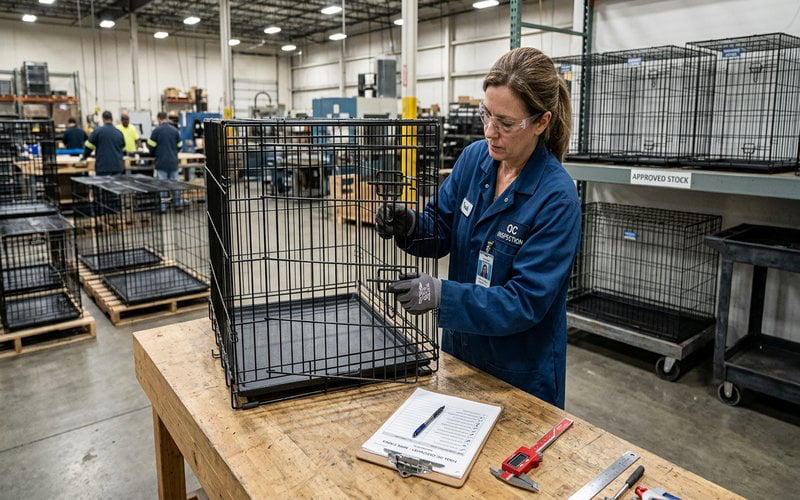
Dimensional Verification: Measure all critical dimensions including overall cage dimensions (length, width, height), door opening dimensions, wire spacing, and component attachment point locations. Use calibrated measuring tools including calipers, tape measures, and dimension gauges.
Weld Quality Inspection: Visually inspect all weld joints for proper penetration, absence of cracks or porosity, consistent weld bead appearance, and absence of excessive spatter. Conduct destructive weld strength tests on sample units to verify minimum strength requirements.
Coating Finish Inspection: Examine coating surface for uniformity, absence of scratches or dents, proper color consistency, and absence of coating defects such as runs, sags, or orange peel. Verify coating thickness meets specifications using appropriate gauges.
Functional Testing: Test door latches for secure operation, verify door opening and closing smoothness, check that all moving parts operate without excessive play or binding, and confirm that assembly hardware functions correctly.
FQC inspection intensity typically follows a mixed approach combining 100% inspection for critical safety-related features and sampling-based inspection for cosmetic and minor functional requirements. Critical safety features requiring 100% inspection include weld integrity at stress points, door latch security, and absence of sharp edges or protrusions that could injure pets.
Sampling for non-critical requirements should follow AQL standards appropriate for wire dog cage products. Common AQL levels include AQL 1.5 for critical dimensions (when not 100% inspected), AQL 2.5 for functional requirements, and AQL 4.0 for cosmetic requirements. Establish clear defect classification criteria to distinguish between critical, major, and minor defects.
| Defect Classification | Definition | Examples | AQL Level |
|---|---|---|---|
| Critical Defect | Affects safety or product function | Broken welds, sharp edges, failed latches | 0 (100% inspection) |
| Major Defect | Significantly affects use or appearance | Large scratches, bent components, coating runs | AQL 1.5-2.5 |
| Minor Defect | Minor appearance issues not affecting use | Small scratches, slight color variation, minor dents | AQL 4.0 |
FQC Acceptance and Release Procedures
FQC results determine whether production batches are accepted, reworked, or rejected. Establish clear acceptance criteria specifying maximum allowable defects by classification. For example, specifications may require zero critical defects, maximum 1% major defects, and maximum 4% minor defects for lot acceptance.
When FQC results meet acceptance criteria, products receive quality approval stamps or marks indicating release to packaging. Products must be clearly labeled with inspection completion dates, inspector identification, and any special handling requirements. FQC records must be maintained for traceability and support of quality analysis.
When FQC results fail to meet acceptance criteria, affected products undergo quality disposition evaluation. Minor defects may be corrected through rework processes followed by re-inspection. Major defects often require rework or scrap depending on defect severity and economics. Products with critical defects cannot be accepted and must be either corrected or scrapped.
Implementing Stage 4: Outgoing Quality Control (OQC)
Outgoing Quality Control (OQC) provides final verification before wire dog cages ship from the factory, ensuring that products remain conforming to quality specifications after packaging and that all required documentation is complete and accurate. OQC serves as the final gate preventing defective products from reaching customers.
OQC Inspection Focus
Packaging Integrity: Verify that packaging materials meet specifications, ensure adequate protection during international shipping, confirm that packaging withstands standard drop tests, and check that packaging labels include all required information.
Documentation Verification: Confirm that all required documentation is complete including packing lists, commercial invoices, certificates of origin, quality inspection reports, and any required certifications or test reports.
Random Sampling: Conduct final random sampling of packaged products to confirm that FQC quality levels remain valid after packaging. Open random packages to verify product integrity, check for damage occurring during packaging, and ensure correct product mix and quantities.
Marking and Labeling: Verify that product labels include correct product codes, dimensions, manufacturing dates, and batch numbers. Confirm that packaging includes required handling instructions, safety warnings, and country of origin markings.

OQC should verify that products are correctly loaded into shipping containers with appropriate dunnage and securing to prevent damage during transit. Inspectors should check container conditions, verify loading diagrams are followed, and ensure that products are protected from moisture, contamination, and mechanical damage during international shipping.
Documentation verification is a critical OQC function for international trade. Incomplete or inaccurate documentation can cause customs delays, additional inspection costs, or shipment rejection. OQC should cross-reference shipment documentation with product quantities, verify that certificates match production batches, and confirm that export documentation complies with destination country requirements.
OQC Best Practice: Implement container loading supervision for large wire dog cage orders. Quality personnel should observe and verify loading processes, ensuring proper stacking, adequate securing, and protection against transit damage. This final verification prevents quality issues occurring during loading and transport.
Establishing Quality Standards and Specifications
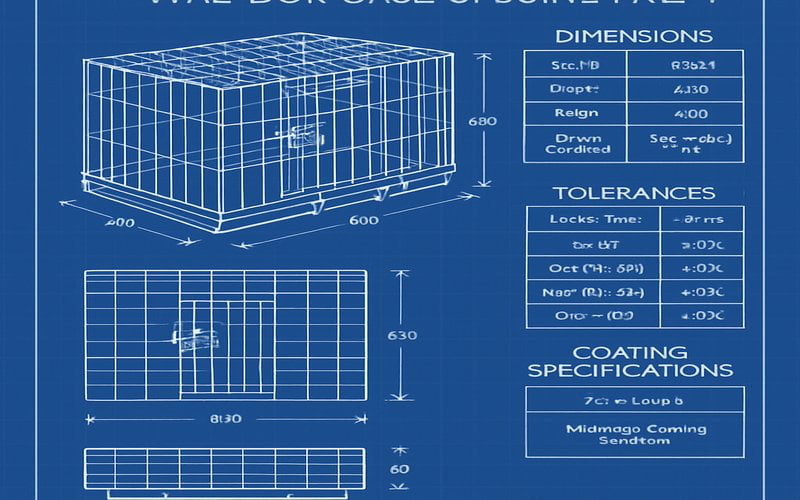
Effective quality control requires clearly defined quality standards and specifications for wire dog cages. These standards serve as the basis for all inspection activities and provide objective criteria for determining product acceptability. Quality specifications should be developed collaboratively between buyers and manufacturers, documented in written quality specifications, and approved by both parties.
Essential Quality Specification Categories
Dimensional Specifications: Define acceptable tolerances for all critical dimensions including overall cage dimensions, door opening sizes, wire spacing, and component dimensions. Tolerances should reflect functional requirements and manufacturing capability. For example, overall length tolerance might be specified as ±5mm for 1000mm cages.
Material Specifications: Specify steel wire type (typically low-carbon steel), wire gauge with tolerance, coating type (powder coating, electroplating, or zinc galvanizing), coating thickness range, and material certification requirements. Reference appropriate material standards where applicable.
Welding Specifications: Define weld quality requirements including minimum weld strength, acceptable weld appearance criteria, weld location requirements, and testing methods for weld verification. Specify any required destructive or non-destructive weld testing.
Performance Specifications: Define functional performance requirements including door latch strength, cage load capacity, door cycle life (number of opening/closing cycles), and any applicable testing methods for performance verification.
Quality specifications should include clear test methods for verifying each requirement. For example, coating thickness specifications should reference measurement method (e.g., magnetic gauge measurement, destructive cross-section measurement), measurement locations, and number of measurements required. Test methods provide consistency and ensure that different inspectors obtain comparable results.
Specifications should also establish acceptance criteria distinguishing between acceptable variations and non-conforming conditions. For dimensional specifications, this typically includes tolerance ranges. For qualitative criteria such as surface finish, this may include photographic standards or descriptive criteria defining acceptable and unacceptable examples.
AQL Sampling Standards for Wire Dog Cages
Acceptable Quality Limit (AQL) sampling provides statistically valid methods for determining appropriate sample sizes and acceptance criteria for quality inspections. AQL sampling balances inspection thoroughness with practicality, enabling efficient quality control while maintaining appropriate defect detection capability.
Important AQL Consideration: Select appropriate AQL levels based on defect severity and customer requirements. Common wire dog cage AQL levels include AQL 0 (zero acceptance) for critical safety defects, AQL 1.5 for major functional defects, and AQL 4.0 for minor cosmetic defects. AQL levels should be documented in quality specifications and communicated to manufacturers.
AQL sampling tables determine sample sizes based on lot sizes. For example, a lot of 1000-1500 wire dog cages might require sample sizes of 125-125 units depending on inspection level. Inspection levels range from Level I (reduced inspection) to Level III (normal inspection) to Level S (special inspection) with Level II being most common for standard quality control.
Acceptance numbers specify the maximum allowable defects within the sample for lot acceptance. For AQL 2.5 with a sample size of 125, the acceptance number might be 7 defects, meaning that lots with 7 or fewer defects in the sample are accepted while lots with 8 or more defects are rejected. Establish clear rejection handling procedures for lots failing AQL sampling.
Supplier Quality Collaboration and Communication
Effective quality control requires strong collaboration between buyers and suppliers. Quality control systems implemented unilaterally without manufacturer involvement often fail due to resistance, lack of understanding, or inadequate resources. Successful quality management requires partnership approaches where buyers and suppliers work together to achieve quality objectives.
Building Supplier Quality Capability
Quality System Assessment: Conduct initial assessments of supplier quality management systems to identify strengths, gaps, and improvement opportunities. This assessment provides baseline understanding of supplier capability and informs quality collaboration planning.
Joint Quality Planning: Collaboratively develop quality plans for wire dog cage production including inspection points, sampling requirements, documentation standards, and acceptance criteria. Joint planning ensures supplier buy-in and alignment with buyer quality expectations.
Training and Knowledge Transfer: Provide quality training to supplier personnel covering inspection methods, quality standards, documentation requirements, and problem-solving techniques. Training investment improves supplier capability and demonstrates buyer commitment to partnership success.
Regular Quality Reviews: Schedule regular quality review meetings with suppliers to discuss performance, identify issues, and plan improvements. These reviews should be constructive and solution-focused rather than purely punitive approaches.

Clear communication channels are essential for effective supplier quality collaboration. Establish designated quality contacts on both buyer and supplier sides, define communication protocols for quality issues, and establish escalation paths for resolving disagreements or contentious quality issues. Regular communication prevents misunderstandings and enables rapid response when quality issues arise.
Performance measurement provides objective basis for supplier quality assessment and improvement tracking. Establish key performance indicators (KPIs) measuring quality performance including defect rates, on-time delivery, response to quality issues, and continuous improvement activities. Share KPI results with suppliers regularly and use data to identify improvement opportunities.
Supplier Quality Partnership Principle: View suppliers as quality partners rather than adversaries. Quality collaboration built on mutual benefit and shared objectives produces better results than quality policing focused on blame and punishment. Invest in supplier quality capability development rather than continuously searching for new suppliers when problems occur.
Documentation and Traceability Systems
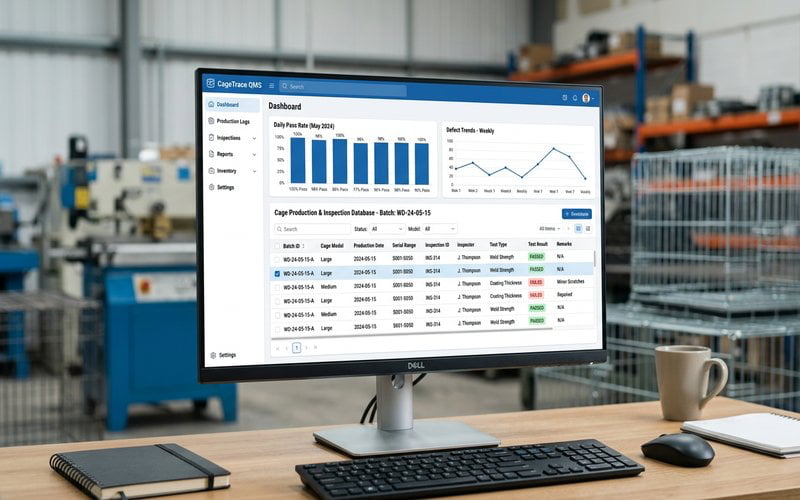
Comprehensive documentation and traceability systems provide critical support for quality control by enabling quality issue investigation, trend analysis, and continuous improvement. Documentation provides records of what was inspected, what results were obtained, and what decisions were made, enabling investigation when quality problems occur.
Traceability involves maintaining records linking products to specific raw material lots, production batches, and inspection results. When quality issues are identified, traceability enables investigation to identify root causes and determine which specific products are affected. This capability is particularly important for product recalls or quality investigations involving safety concerns.
Essential Documentation Requirements
Inspection Records: Maintain detailed records for all QC inspections including dates, inspector identification, lot or batch numbers, sample sizes, inspection results, defect descriptions, and disposition decisions. Records should be maintained for at least the warranty period and preferably longer.
Material Certificates: Collect and retain material certificates for all steel wire and coating materials including mill certificates, coating specifications, and test reports. These certificates provide material traceability and verification of material properties.
Test Reports: Document all test results including destructive weld tests, coating thickness measurements, functional test results, and performance testing. Test reports should include test methods, test equipment calibration data, and tester identification.
Non-Conformance Reports: Document all quality non-conformances including description of the issue, root cause analysis, corrective actions implemented, verification of corrective action effectiveness, and preventive measures implemented to prevent recurrence.
Documentation systems should support analysis and reporting capabilities enabling identification of quality trends, problem areas, and improvement opportunities. Regular analysis of inspection data can identify recurring defect types, specific processes producing quality problems, or raw material lots causing issues. This analysis enables proactive quality improvement rather than reactive problem solving.
Modern quality management software can significantly enhance documentation and traceability capabilities. These systems provide centralized databases for quality records, automated reporting and analysis, trend identification, and real-time quality dashboards. When implementing quality software, ensure systems are accessible to both buyers and suppliers for effective collaboration.
Continuous Quality Improvement
Quality control effectiveness depends on continuous improvement processes that systematically identify and address quality issues, prevent recurrence, and enhance overall quality capability. Static quality systems quickly become ineffective as production processes evolve, materials change, and market requirements change.
Quality Improvement Methodologies
Root Cause Analysis: Implement formal root cause analysis processes when quality problems occur using methodologies such as 5 Whys analysis, Fishbone (Ishikawa) diagrams, or Fault Tree Analysis. Root cause analysis identifies underlying causes rather than surface symptoms.
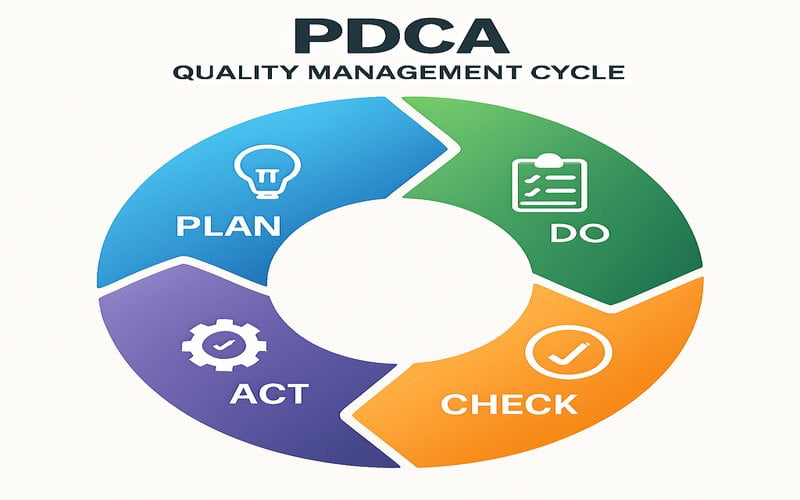
PDCA Cycle: Apply the Plan-Do-Check-Act (PDCA) cycle to quality improvement: Plan improvement actions, Do implement improvements, Check results of improvements, Act to standardize successful changes or try alternative approaches. Continuous PDCA application drives ongoing quality enhancement.
FMEA Analysis: Conduct Failure Mode and Effects Analysis (FMEA) to proactively identify potential failure modes, assess their severity and likelihood, and implement preventive measures before failures occur. FMEA prevents quality problems rather than reacting after problems.
SPC Monitoring: Implement Statistical Process Control to monitor process capability and detect variations before they result in non-conforming products. Control charts provide early warning of process changes requiring intervention.
Quality improvement requires measurement of performance over time to track progress and identify trends. Establish quality metrics including defect rates, first-pass yields, customer complaint rates, warranty claim rates, and cost of quality. Track these metrics over time to identify improvement progress and areas requiring additional attention.
Employee training and engagement are critical for continuous quality improvement. Quality systems depend on people implementing them correctly. Regular training reinforces quality requirements, provides skills improvement, and maintains awareness of quality priorities. Engaging employees in quality improvement by soliciting their suggestions and recognizing quality contributions creates culture of quality rather than compliance.
Continuous Improvement Insight: The most effective quality improvement comes from frontline production employees who observe processes daily and identify practical improvement opportunities. Create structured channels for employee quality suggestions, implement viable suggestions rapidly, and recognize contributors to maintain engagement.
Measuring Quality Control Effectiveness
Measuring quality control effectiveness provides objective assessment of whether quality systems are achieving their objectives and where improvements are needed. Quality metrics enable data-driven decision making and demonstrate return on investment for quality management efforts.
| Quality Metric | Measurement Method | Target Performance | Significance |
|---|---|---|---|
| Defect Rate | Defective units / total units inspected | <2% | Overall quality level |
| First Pass Yield | Units passing first inspection / total units | >95% | Process efficiency |
| Customer Complaint Rate | Complaints / units shipped | <0.5% | Customer satisfaction |
| Cost of Quality | Quality costs / total production value | <5% | Quality efficiency |
Defect rate measurement provides overall assessment of quality control effectiveness. Track defect rates by defect type, production line, and material lot to identify patterns and problem areas. Target defect rates should be based on industry benchmarks and customer requirements, typically below 2% for wire dog cage products.
First pass yield measures process efficiency by calculating the percentage of units passing initial inspection without requiring rework. High first pass yields indicate effective quality control during production, while low yields indicate process problems requiring attention. First pass yields above 95% typically indicate good process control.
Customer complaint rate provides ultimate measure of quality control effectiveness from the customer perspective. Customers receiving defective products result in complaints, returns, and potential loss of business. Customer complaint rates below 0.5% generally indicate effective quality control for wire dog cage products.
Cost of quality quantifies the total cost associated with quality management including inspection costs, rework costs, scrap costs, warranty costs, and quality management overhead. While quality investments have costs, effective quality management reduces costs associated with defects and customer issues. Cost of quality below 5% of production value typically indicates efficient quality systems.
Frequently Asked Questions About Wire Dog Cage Quality Control
Click questions below to view answers
Minimum quality control should include at least three stages: incoming material inspection (IQC), in-process inspection (IPQC), and final product inspection (FQC). IQC verifies raw materials meet specifications before production, IPQC monitors quality during manufacturing to catch issues early, and FQC inspects finished products before packaging. For first-time importers, also consider hiring third-party inspection services for objective quality verification until you establish trusted supplier relationships.
Related Quality Management Resources
Cluster 2.1: Quality Control Process
- Wire Dog Cage Inspection Checklist: 20-Point Quality Check – Practical inspection checklist for systematic quality verification
- Wire Dog Cage Testing Methods: Laboratory & Field Tests – Comprehensive testing protocols for quality validation
- Quality Certifications for Wire Dog Cage Manufacturers – Essential certifications and verification methods
Pillar 1: Wire Dog Cage Sourcing (Foundation Guides)
- Wire Dog Cage Sample Guide: Fees, Process, and ROI Analysis – Foundation guide for sample evaluation
- How to Choose Wire Dog Cage Manufacturers for B2B Buyers – Supplier selection frameworks
- How Is Wire Dog Cage Pricing Calculated? – Understanding wire dog cage pricing structures
- First-Time Wire Dog Cage Importing: 8-Phase Process – Complete importing process guide
External References
- ISO 9001:2015 Quality Management Systems – International standard for quality management requirements: https://www.iso.org/standard/62020.html
- American Society for Quality (ASQ) – Quality Control Resources – Quality control best practices and standards: https://asq.org/quality-resources
- Failure Mode and Effects Analysis (FMEA) – FMEA methodology for proactive quality risk assessment: https://asq.org/quality-resources/failure-mode-and-effect-analysis
- Statistical Process Control (SPC) – SPC methods for quality process monitoring: https://asq.org/quality-resources/statistical-process-control
- IATF 16949 Quality Management – Automotive quality management applicable to quality control principles: https://www.iatfglobal.com/

