2026 Wire Pet Crate Annual Market Report: Global Market Size, Trends & Procurement Guide
The global pet cages market reached USD 24.667 billion in 2024 and is projected to grow to USD 36.889 billion by 2032, representing a compound annual growth rate of 5.93%. Wire dog crates account for approximately 48% of the total pet cages market, making them the dominant product category in this space. For B2B procurement teams, understanding this market’s trajectory is the first step in making informed purchasing decisions for the year ahead.
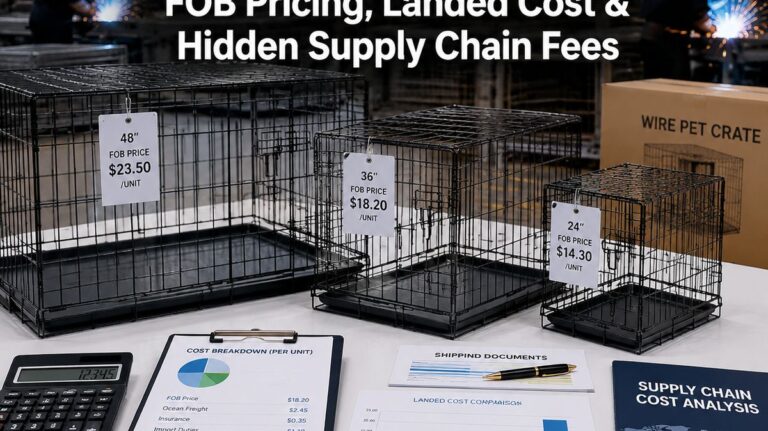
Whether you are an Amazon FBA seller evaluating new SKUs, a traditional wholesaler reviewing annual supply contracts, or a retail chain buyer planning seasonal inventory, the Asia-Pacific region is emerging as the fastest-growing market for wire pet crates at 7.2% CAGR, outpacing North America and Europe. This report breaks down the market data, competitive landscape, and actionable procurement insights you need for 2026. Wire Pet Crate Annual Cost Report: FOB Pricing, Landed Cost & Hidden Supply Chain Fees Wire Pet Crate Annual Buyer Profile Report: Who Is Buying? 4 Procurement Behaviors from Amazon FBA to Retail Chains
2026 Global Wire Pet Crate Market Size: Where Is USD 24.667 Billion Heading?
According to Verified Market Research (2026), the global pet cages market was valued at USD 24.667 billion in 2024 and is forecast to reach USD 36.889 billion by 2032, reflecting a CAGR of 5.93%. At our factory, we see this growth translating directly into increased inquiry volume from both existing buyers expanding SKUs and new buyers entering the category for the first time.
Market segmentation by pet type reveals that dog cages represent the largest sub-category at approximately 48% of total market value. Cat cages follow as the second-largest segment at approximately USD 2.23 billion in 2026, with small animal and bird cages representing smaller but niche-oriented segments. Resource concentration in dog crates is strategically sound, not a bet — this is a structural market share fact, not a trend prediction.

| Pet Type | Estimated Market Share | 2026 Market Value |
|---|---|---|
| Dog Cages | ~48% | USD ~11.8B |
| Cat Cages | ~15% | USD ~2.23B |
| Small Animal Cages | ~20% | ~USD 2.0B |
| Bird Cages | ~17% | ~USD 1.7B |
Common Pitfalls When Interpreting Market Size Data
- Pitfall 1: Confusing consumer market size (USD 24.667B) with B2B sourcing opportunity — MOQ 200+ units and 25–45 day lead times mean the consumer number does not directly translate to your procurement scale.
- Pitfall 2: Assuming the 5.93% average growth applies uniformly — some sub-segments (foldable wire crates, IATA travel crates) are growing at 2–3x the average rate, while low-end commodity crates face margin compression.
Why Wire Dog Crates Dominate the Pet Crate Market
Among all dog crate types — plastic, wooden, fabric, and wire — wire dog crates consistently outperform in the B2B channel. At our factory, we see this in the rising share of premium wire crate configurations — heavier gauge, powder-coated finish, and removable tray systems — compared to basic galvanized models five years ago. This shift drives both volume growth and value growth as buyers upgrading to higher-specification products.
The structural advantages of wire crate design are rooted in physical properties. Welded wire mesh provides superior ventilation compared to plastic crates — a critical factor for animal welfare compliance in European markets. Wire crates fold flat for ocean freight, reducing CBM per unit and cutting shipping costs. A 36-inch wire crate occupies 0.0564 m3, while a 48-inch model takes 0.0979 m3, a 73% difference that directly impacts your landed cost per unit.
For e-commerce sellers, wire crates score additional points on durability. Return rates related to damage-in-transit run significantly lower for wire crates than plastic crates in our client base — a key data point for Amazon FBA sellers where return rates affect account health metrics. Wire crate’s structural advantages are not subjective preferences — they are physics-based facts that translate into measurable logistics and compliance benefits.

4 Key Drivers Fueling Wire Pet Crate Market Growth in 2026
Driver 1: Pet Humanization — Pets Are Now Family Members
The trend of treating pets as family members has accelerated globally. In our factory, we see this in the rising share of premium wire crate configurations — heavier gauge, powder-coated finish, and removable tray systems — compared to basic galvanized models five years ago. This shift drives both volume growth and value growth as buyers upgrade to higher-specification products. The implication for B2B buyers: your product mix should tilt toward mid-tier and premium configurations, not entry-level commodity crates.
Driver 2: Rising Middle-Class Incomes in Emerging Markets
The global middle class is expanding, particularly in Asia-Pacific. Rising disposable incomes translate into greater pet ownership rates and increased willingness to invest in quality pet products. Verified Market Research data shows Asia-Pacific is the fastest growing region at CAGR 7.2% — this is being driven by urbanization and rising middle class income, not by pet ownership rate increases alone. For B2B buyers, this means the addressable market for mid-tier wire crates is expanding fastest in Asia-Pacific, not North America or Europe.
Driver 3: Urbanization and Small-Space Living
Global urbanization is expected to reach 68% by 2050, with apartment living becoming the dominant residential form in major Asian cities. Foldable wire crates solve the small-space storage problem — flat storage when not in use, functional containment when needed. Foldable wire crate configurations now represent the fastest-growing SKU category in our export order book — this is a product design trend that every B2B buyer should have in their catalog.
Driver 4: E-Commerce Channel Surge — Amazon, Chewy, and Beyond
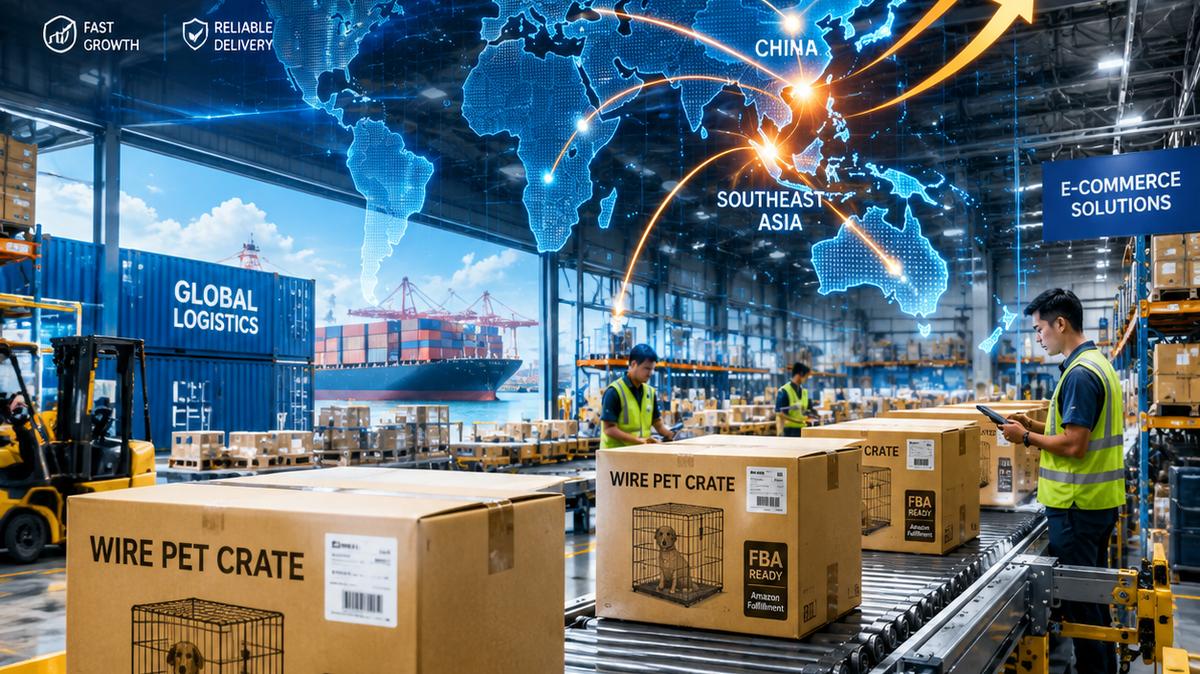
Online retail channels now account for 42% of pet product sales in 2026, growing at CAGR 8.5% — significantly outpacing offline channels. Amazon FBA sellers and pure-play pet e-commerce platforms are becoming the primary distribution channel for wire dog crates, which changes the procurement game entirely. If your supply chain is not optimized for e-commerce fulfillment — FBA-compatible packaging, consistent case-pack quantities, SKU labeling — you are leaving market share on the table.
2 Major Constraints Keeping the Wire Pet Crate Market in Check
Constraint 1: Secondhand Market Competition
Facebook Marketplace, Craigslist, and regional classifieds divert a meaningful share of entry-level demand. Secondhand wire crates typically sell at 40–60% of new product prices. However, B2B buyers need to understand: the secondhand market diverts end consumers, not your wholesale clients. Your target customers — FBA sellers, traditional wholesalers, retail chains — do not source from secondhand platforms. This constraint primarily affects the sub-$20 FOB price tier.
Constraint 2: Cultural and Regulatory Differences Across Regions
Pet crate usage norms vary significantly by region. European markets have higher animal welfare standards, requiring crates that comply with IATA Live Animal Regulations for travel. For European market entry, suppliers need REACH and EN 71 compliance at minimum — this adds 15–30 days to your supplier qualification timeline. In some Asian markets, free-roaming pet ownership remains common, limiting the addressable market for indoor containment products. Compliance is not optional in Europe — shipment rejection at port due to non-compliance typically costs the buyer, not the carrier.
Regional Opportunity Analysis: Asia-Pacific Fastest, North America Most Mature, Europe Highest Barrier
Global regional markets differ significantly in growth trajectory, competitive intensity, and entry requirements. Here is the procurement-relevant breakdown:
| Region | CAGR | Market Maturity | Key Buyer Type | Entry Barriers |
|---|---|---|---|---|
| Asia-Pacific | 7.2% | Growing | Amazon FBA sellers, local retailers | Low (domestic sales) |
| North America | 5.1% | Most mature | Amazon FBA, pet specialty chains | Moderate (Amazon channel competition) |
| Europe | 4.3% | Stable | Pet specialty retailers, brands | High (IATA, animal welfare compliance) |
| Latin America | 5.8% | Developing | Traditional wholesalers | Low-moderate |
Asia-Pacific: Fastest Growing at 7.2% CAGR
The Asia-Pacific region is the fastest-growing pet crate market globally, driven by urbanization and middle-class expansion in China, India, and Southeast Asia. City apartment living drives demand for foldable wire crates. For B2B buyers, the strategic insight is that the Asia-Pacific supply chain — particularly China — is the most mature sourcing base for wire pet crates globally. If you are sourcing, China is your primary manufacturing origin regardless of where you sell.
North America: Most Mature at 42% E-Commerce Channel Share
North America is the most mature pet crate market, with online channels accounting for 42% of sales at CAGR 8.5%. Amazon FBA sellers account for the majority of our North American inquiry volume — they are cost-sensitive, volume-driven, and require consistent sample quality. If you are sourcing for Amazon FBA, North America is your primary target market.
Europe: Highest Barrier, Highest Premium
European compliance requirements (REACH, EN 71, IATA standards) are significantly higher than other regions. European market entry requires animal welfare regulation compliance — larger wire spacing requirements, specific ventilation standards, and material safety certifications. The premium pricing in Europe can be 20–40% above FOB China prices, but the qualification timeline is 2–4 months longer. The Europe opportunity is real, but only for buyers who budget time and documentation cost for compliance.
Major Players and Market Share in the Wire Dog Crate Industry
The global wire dog crate market features six primary global players. Understanding who they are helps B2B buyers position their competitive landscape and identify where factory-direct sourcing offers a meaningful cost advantage over branded alternatives.
| Company | Headquarters | Market Position | Sourcing Characteristic |
|---|---|---|---|
| Petsfit | USA | Mid-to-premium pet furniture | Proprietary design + China ODM |
| Advantek | USA | Outdoor/travel crates | Procurement-focused |
| TRIXIE | Germany | European pet specialty | Europe local + import |
| Prevue Pet Products | USA | Mass merchandise value | High-volume import |
| The Hutch Company | UK | Premium indoor crates | Local + China import |
| Delton Pet Supplies | UK | Full pet supplies range | Import-focused |
The strategic implication: The branded market is dominated by these six players, but the ODM/OEM manufacturing base is heavily concentrated in China. The real production capability sits in your supplier’s factory, not in the brand names. Whether you sell under your own brand or a private label, your manufacturing partner’s production management quality is what determines your product quality — not the brand specifications you are buying against.
How to Vet a Wire Dog Crate Supplier: 8 Red Flags
- Red Flag 1: Factory has been in business less than 5 years without verifiable production history
- Red Flag 2: Cannot provide a Bill of Lading (B/L) sample from a previous shipment
- Red Flag 3: Refuses to conduct a live video factory tour before order confirmation
- Red Flag 4: Quotes a price significantly below market benchmark — FOB 36″ below $15.86 suggests wire gauge or coating compromise
- Red Flag 5: MOQ quoted below 200 units for standard configurations — likely a trading company, not a manufacturer
- Red Flag 6: Cannot produce BSCI, ISO 9001, or Sedex certification documentation
- Red Flag 7: Sample production uses different equipment or labor than mass production (the “golden sample trap”)
- Red Flag 8: Pressure to sign a PO before providing a pre-production sample
5-Stage Supplier Decision Framework for Wire Dog Crate Buyers
Based on the Cagesilo sourcing framework, B2B wire dog crate procurement follows a five-stage decision chain:
Stage 1 — Pre-Screening: Verify factory existence via video tour, check business registration, request B/L sample. Eliminate trading companies posing as factories at this stage. This is where 30–40% of problematic suppliers are caught — before any formal quotation is issued.
Stage 2 — Initial Inquiry: Request detailed quotation including FOB price, MOQ per SKU, lead time range, payment terms, and certification scope. The gap between a serious initial inquiry and a time-wasting inquiry is measured in the specificity of the SKU list provided.
Stage 3 — Sample Evaluation: Order pre-production samples and evaluate against your QA checklist: wire gauge (demand the spec in mm, not “standard gauge”), coating adhesion, hinge durability, fold mechanism smoothness, and tray fit. The golden sample trap costs buyers thousands: a factory owner hand-polishing a sample is not representative of production line output.
Stage 4 — Quotation Comparison: Compare FOB prices AND calculate landed cost per unit. A $1 lower FOB per unit on a 48″ crate can be entirely consumed by a 73% higher CBM difference versus a competitor’s product. Always ask for the CBM per unit before making final price comparisons.
Stage 5 — Order Confirmation: Confirm all terms in writing: price, MOQ, lead time, payment terms, inspection clause, packaging standard (RAL/Pantone for colors), and inspection fee responsibility. Inspection fee disputes — typically $300–500 per incident — are entirely preventable with one sentence in the purchase order.

What B2B Wire Pet Crate Buyers Should Focus on in 2026
Based on the market data and supplier landscape above, here are four strategic priorities for B2B wire pet crate procurement in 2026:
2026 B2B Wire Pet Crate Procurement Priorities
Judge Growth by CAGR, Not Absolute Market Size
A market growing at 7.2% CAGR in Asia-Pacific is more strategically relevant than a large market at 2% growth.
Verify Supplier Certifications — Do Not Take Them at Face Value
BSCI, ISO 9001, and Sedex are baseline requirements, not competitive advantages.
Calculate Landed Cost Before Comparing FOB Prices
CBM differences between crate sizes can add $2–4 per unit to your landed cost.
Align Supply Chain with E-Commerce Channel Requirements
With 42% of the market online, FBA-compatible packaging is a prerequisite.
The wire pet crate market in 2026 offers genuine growth opportunity for buyers who approach it with data-driven discipline rather than surface-level price comparisons. Buyers who conduct proper due diligence — pre-screening, sample evaluation with real specs, landed cost calculation — have a reorder rate 3x higher than buyers who select solely on FOB price. The market rewards buyers who understand what they are buying and why.
Frequently Asked Questions About the Wire Pet Crate Market
What is the wire pet crate market size in 2024?
The global pet cages market was valued at USD 24.667 billion in 2024, with dog crates accounting for about 48% of this total (roughly USD 11.8 billion). The market is projected to reach USD 36.889 billion by 2032, growing at a CAGR of 5.93%. Dog crates are the largest subcategory, followed by cat cages, small animal cages, and bird cages. For B2B procurement decisions, the key insight is not just the absolute size but the growth trajectory: CAGR 5.93% means the market is expanding consistently, creating reliable demand for established buyers while still admitting new entrants in growing sub-segments like foldable wire crates and e-commerce-optimized SKUs.
Which region has the fastest growing pet crate market?
Asia-Pacific has the fastest-growing pet crate market at a CAGR of 7.2%, driven by urbanization and expanding middle-class incomes in China, India, and Southeast Asian markets. However, “fastest growing” does not automatically mean “best market for every buyer.” North America remains the most mature and highest-value market per unit, with the most developed e-commerce infrastructure and highest average revenue per user. Europe is the most regulated but offers premium pricing for compliant products. The right regional priority depends on your target channel, compliance capacity, and logistics setup — not just CAGR rankings.
Who are the top wire dog crate manufacturers?
The six primary global players are Petsfit (USA, e-commerce focused), Advantek (USA, heavy-duty specialty), TRIXIE (Germany, European retail), Prevue Pet Products (USA, mass merchandise), The Hutch Company (UK, premium specialty), and Delton Pet Supplies (UK, full-range). For B2B buyers, these are competitive benchmarks for pricing and specification positioning. Most of these brands source from Chinese ODM/OEM factories — the real production capability sits in your supplier’s factory, not in the brand names. Use the 5-stage supplier evaluation framework to find the right manufacturing partner rather than relying on brand reputation.
What trends are shaping the wire pet crate market in 2026?
Four primary trends define 2026: (1) E-commerce channel dominance — online retail now accounts for 42% of pet product sales and is growing at CAGR 8.5%, making Amazon FBA compatibility a procurement requirement. (2) Smart crate integration — early-stage AI-enabled pet monitoring crates are entering the market, though mass adoption is likely 2–3 years away. (3) Foldable and stackable design dominance — space-efficient configurations are driving SKU mix shifts toward collapsible models. (4) Animal welfare compliance — European regulatory pressure is gradually raising quality standards globally, with IATA-compliant crate specifications becoming a de facto requirement for any buyer targeting European retail. The buyers who are winning in 2026 are those whose suppliers can deliver on all four dimensions simultaneously.
What is the typical MOQ for wire dog crates from a Chinese factory?
Standard MOQ for existing wire dog crate configurations ranges from 200–500 units per SKU, depending on the model and factory. Custom configurations — non-standard dimensions, custom colors (RAL/Pantone matched), or custom wire gauge specifications — typically require 500+ units per SKU, sometimes higher for first-order runs. If a supplier quotes MOQ below 200 units for standard configurations, this is typically a sign that they are a trading company sourcing from multiple factories rather than a manufacturer with their own production line. Understanding this distinction matters because trading company suppliers introduce quality consistency risk, longer lead times, and reduced traceability.
How do I evaluate a wire dog crate supplier’s reliability?
Use the 5-stage framework: (1) Pre-screen via video factory tour and B/L sample verification, (2) Issue a detailed initial inquiry with full SKU specifications, (3) Evaluate pre-production samples against written specifications — demand wire gauge in mm, coating thickness, and hinge cycle test results, (4) Calculate landed cost comparison including CBM impact, (5) Confirm all commercial terms in a written purchase order including inspection fee responsibility, packaging standards, and payment terms. The single most common evaluation mistake is skipping the video tour or accepting a “golden sample” that does not represent production quality. Use the 8 Red Flags checklist above to quickly eliminate unreliable suppliers before investing time in formal evaluation.