Do You Actually Need a Customs Broker for Wire Dog Crate Imports? The Real Cost of DIY vs. Professional
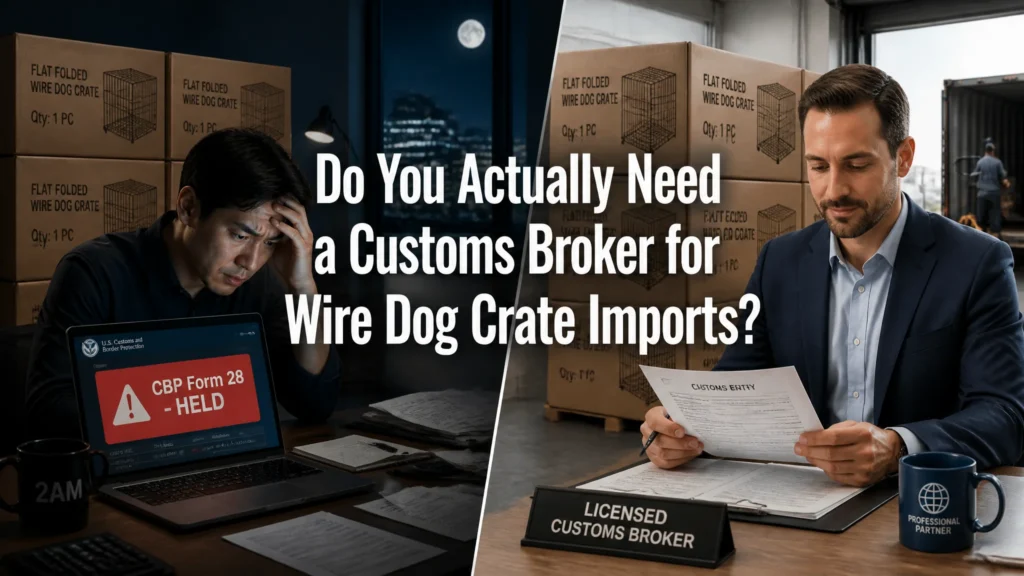
Two buyers. Same 40HC container of 42-inch wire crates. Same port. Buyer A uses a licensed customs broker who charges $125 per entry. His container clears in 36 hours. Buyer B files his own entry to save the fee. His container sits for 11 days while he Googles “CBP Form 28 response” at 2 AM. The demurrage bill hits $1,650 — 13x what the broker would have cost.
At our factory, we ship to 12+ countries and see roughly 50 containers go out every month. Almost every buyer uses a customs broker. The ones who don’t fall into two camps: experienced importers with in-house compliance teams, and first-timers who don’t know what they don’t know. The second group always calls us within 48 hours of the container arriving.
Common Pitfalls When Choosing a Customs Broker
- Pitfall 1: Picking the cheapest broker. A broker who charges $35 per entry and a broker who charges $150 are not doing the same job. The cheap one is filing papers. The expensive one is managing risk. We’ve seen buyers save $100 on broker fees and lose $2,000 in demurrage.
- Pitfall 2: Not asking if they’ve handled pet products or steel goods before. Wire dog crates sit at a weird intersection: they’re steel products (HS chapter 73) but they’re also pet supplies. A broker who only does textiles won’t know the classification nuances.
- Pitfall 3: Assuming the freight forwarder’s broker is the right choice. Forwarders often bundle brokerage as an add-on service. The broker works for the forwarder, not for you. When there’s a problem, their priority is clearing the forwarder’s container — not saving you money.
What a Customs Broker Does That You Can’t Do Yourself
On paper, customs clearance looks simple: submit forms, pay duty, get release. In practice, it’s a maze of country-specific rules, constantly changing tariff codes, and unwritten expectations from individual customs officers.
A customs broker handles four things that most importers can’t:
| Broker Task | What It Means for Wire Dog Crates | DIY Risk |
|---|---|---|
| HS Code Classification | Choosing between 7326.90 (iron/steel articles, 0-2% duty) and 9403.20 (metal furniture, 3-5% duty) — a $1,500 difference on a $50,000 shipment | Wrong code = back duties + penalties + potential audit trigger |
| Entry Filing | Submitting CBP Form 3461 (US) or equivalent with correct values, weights, and country of origin | Data mismatch = automatic hold. Even 2 kg weight discrepancy flags the system. |
| Regulatory Compliance | Checking if wire crates need CPSC certification (US), REACH compliance (EU), or quarantine inspection (Australia) | Missing cert = container held 7-21 days. You can’t file retroactively. |
| Issue Resolution | When customs flags your entry, the broker knows who to call, what evidence to provide, and how to escalate | You’re Googling “CBP Form 28 response” while demurrage accumulates at $150/day |
A good broker doesn’t just file papers — they prevent problems before the container arrives. Our most experienced buyers’ brokers review the packing list and commercial invoice before the vessel sails. If something looks wrong, we fix it at the factory in 30 minutes. If the broker sees it at the port, it’s days and dollars.
There’s a fourth thing brokers handle that’s harder to quantify: relationships. A broker who clears 50 containers a week at a specific port knows the officers, knows which documentation quirks trigger scrutiny at that particular terminal, and knows when to call a supervisor versus when to wait. This institutional knowledge is impossible to replicate as a DIY importer. At Long Beach, for example, certain exam stations are known for flagging steel products with vague descriptions. A local broker preemptively adds construction specs to the entry — something a first-time importer would never think to do.
The broker also handles payment logistics that most buyers don’t think about. Customs duties must be paid before the container is released — not 30 days later like a supplier invoice. Your broker can arrange periodic monthly statements with CBP (called “periodic monthly statement” or PMS) so you’re not wiring duty payments per shipment. For buyers importing 2-3 containers a month, this alone saves hours of administrative work.
DIY vs. Broker: Real Cost Comparison
Let’s put numbers on it. Here’s what a typical wire dog crate import looks like, with and without a broker:
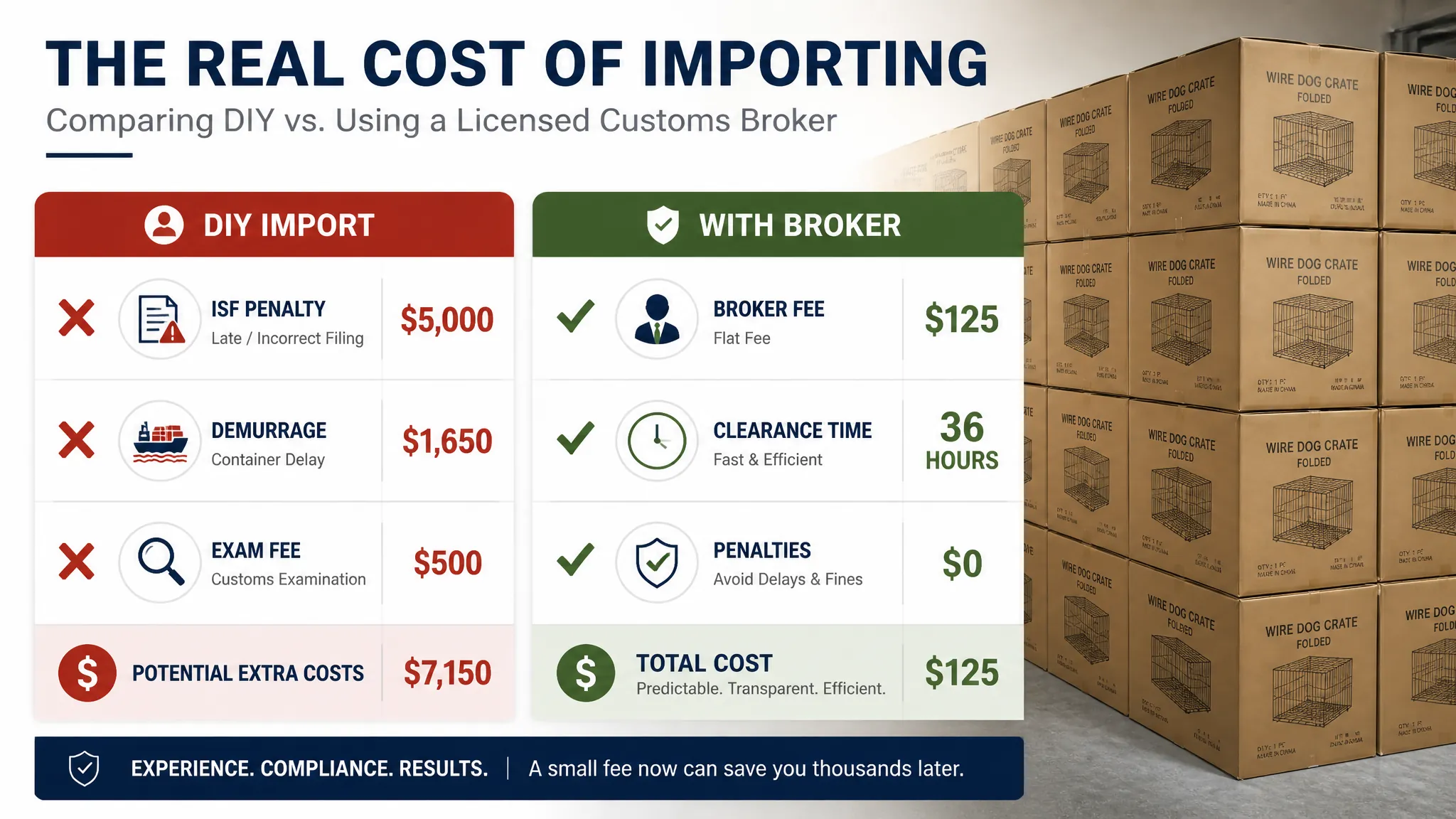
| Cost Item | With Broker | DIY (No Issues) | DIY (With Hold) |
|---|---|---|---|
| Broker fee | $75-150 | $0 | $0 |
| ISF filing (US only) | $35-75 (included) | $0 (if done correctly) | $5,000-10,000 (penalty if late) |
| Single entry bond (US) | $50-100 | $50-100 | $50-100 |
| Duty & taxes | $1,250-2,500 | $1,250-2,500 | $1,500-3,500 (if misclassified) |
| Demurrage (5-day hold) | $0 (released in 1-2 days) | $0 (if no issues) | $375-750 |
| Exam fees (if inspected) | $0 (broker resolves docs) | $200-1,000 | $200-1,000 |
| Total estimated | $1,410-2,825 | $1,300-2,600 | $7,125-15,350 |
With a broker, you save $75-150 per shipment compared to a perfect DIY run. But if anything goes wrong — and documentation errors cause about 40% of customs holds — the DIY route costs $5,000-12,000 more. That’s a 50x to 80x return on the broker fee.
Factory insight: A US buyer once asked us “do I really need a broker?” We said yes. He did it himself anyway. ISF filed 2 hours late — $5,000 penalty. HS code wrong — $800 in back duties. Total cost of skipping the $125 broker: $5,800. He uses a broker now.
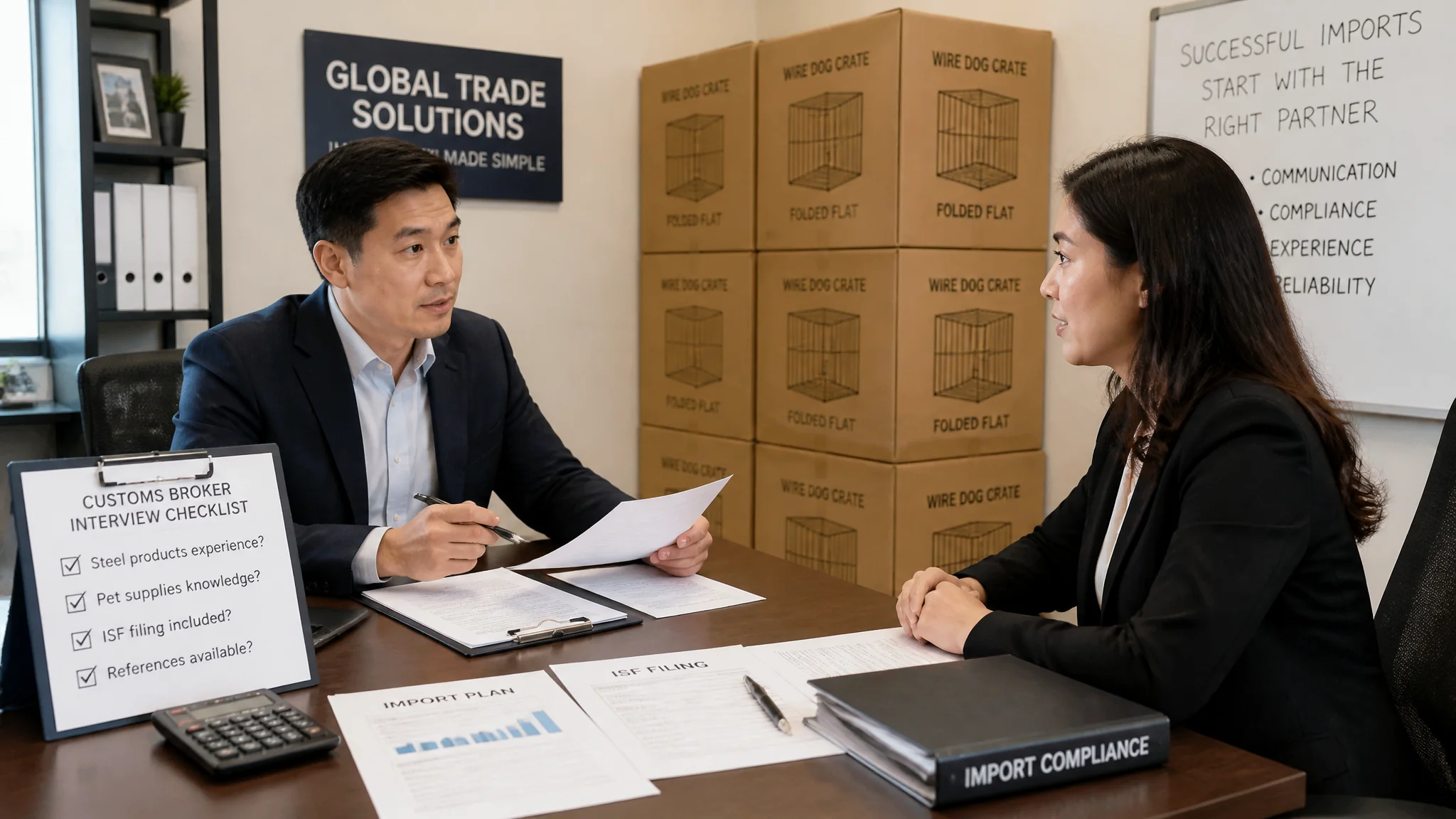
How to Vet a Broker Before Your First Shipment
Not all brokers are equal. Here’s how to find one who knows wire dog crates — or at least steel products and pet supplies:
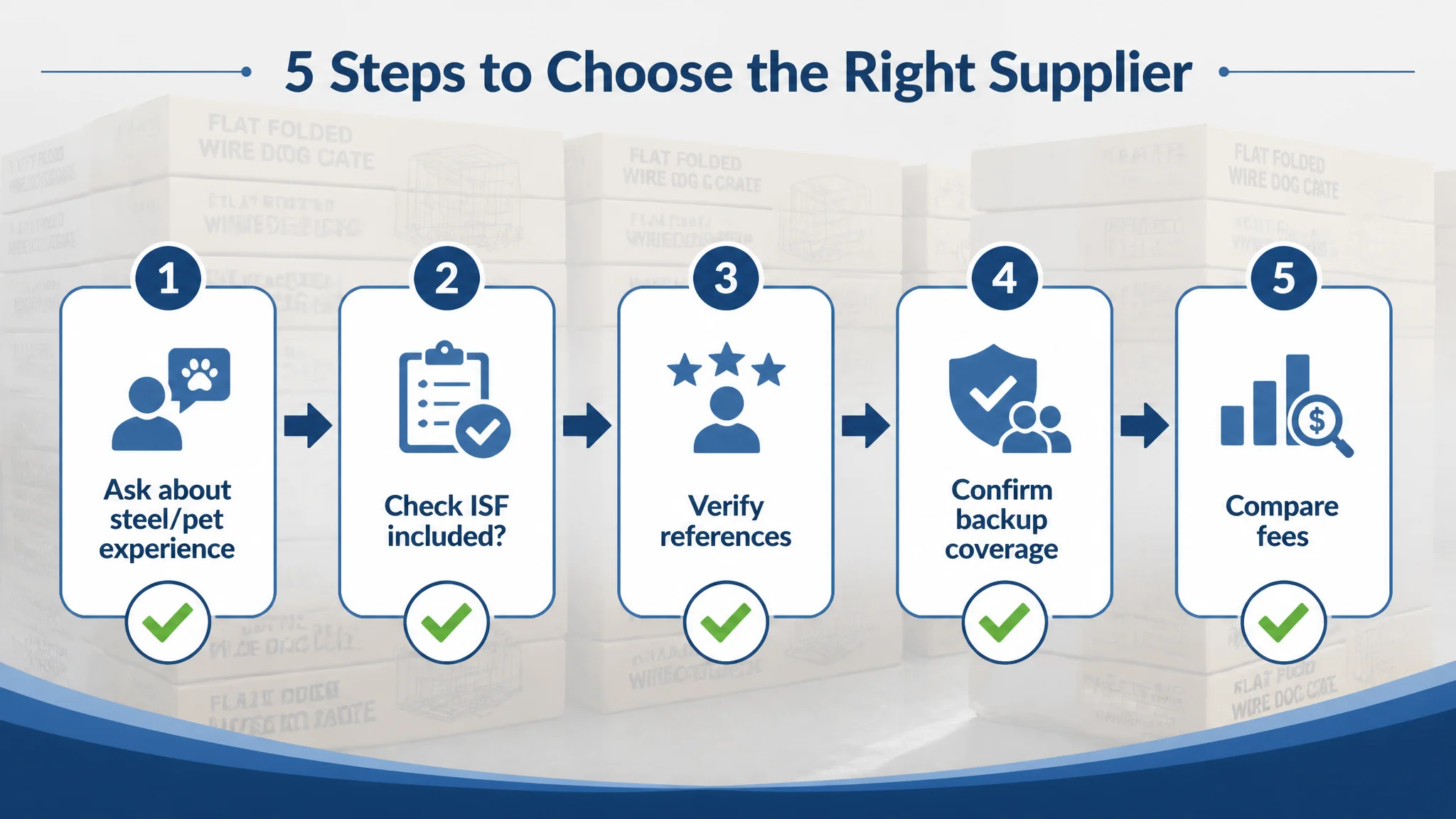
1. Ask: “Have you cleared steel wire products or pet cages before?” If they pause, move on. Wire crates cross multiple HS chapters and sometimes trigger quarantine inspection (Australia, NZ). Experience matters.
2. Ask: “What’s your process if customs flags my entry?” A good broker says: “I’ll call you within 2 hours, explain the issue, and tell you what documents I need. If it’s a documentation issue, I can usually resolve it same day.” A bad broker says: “We’ll handle it” without specifics.
3. Check: Are they a licensed customs broker or a “consultant”? In the US, brokers must be licensed by CBP. In the EU, they need AEO certification or equivalent. In Australia, they need a customs broker license from the ABF. Don’t use unlicensed operators.
4. Ask for a recent client reference — specifically someone importing metal products or pet supplies from China. Call them. Ask how the broker handled their last customs issue.
5. Verify their bond capacity. US imports over $2,500 require a customs bond. Your broker should arrange this as part of the service. If they tell you to get your own bond without explaining why, that’s a red flag.
6. Check their E&O insurance. Errors and omissions insurance covers penalties caused by broker mistakes. Ask for the coverage amount. A broker without E&O insurance is a broker you pay out of pocket when they mess up. At our factory, we’ve seen E&O insurance cover $500-2,000 in penalties that would otherwise come from the buyer’s margin.
6. Ask about their technology. Does your broker use ACE-compatible software (US) or the equivalent in your country? A broker who still files entries manually via a web portal is slower and more error-prone than one using integrated software that pre-validates entries against CBP’s error-checking rules. We’ve seen the difference: automated filing catches data mismatches before submission. Manual filing catches them when customs rejects the entry — which costs you a day of demurrage.
One more practical tip: ask the broker what happens when you have an urgent shipment that arrives on a Friday afternoon. Customs offices close on weekends, but some brokers have relationships with officers who can expedite releases before the weekend cutoff. A broker who says “we’ll try our best” versus one who says “we have a process for Friday afternoon releases, here’s how it works” — pick the second one. The difference between Friday release and Monday release is $225-450 in weekend demurrage.
When Your Broker Fails You — What We’ve Seen at the Factory
Even with a broker, things go wrong. Here are three real situations we’ve helped buyers navigate:
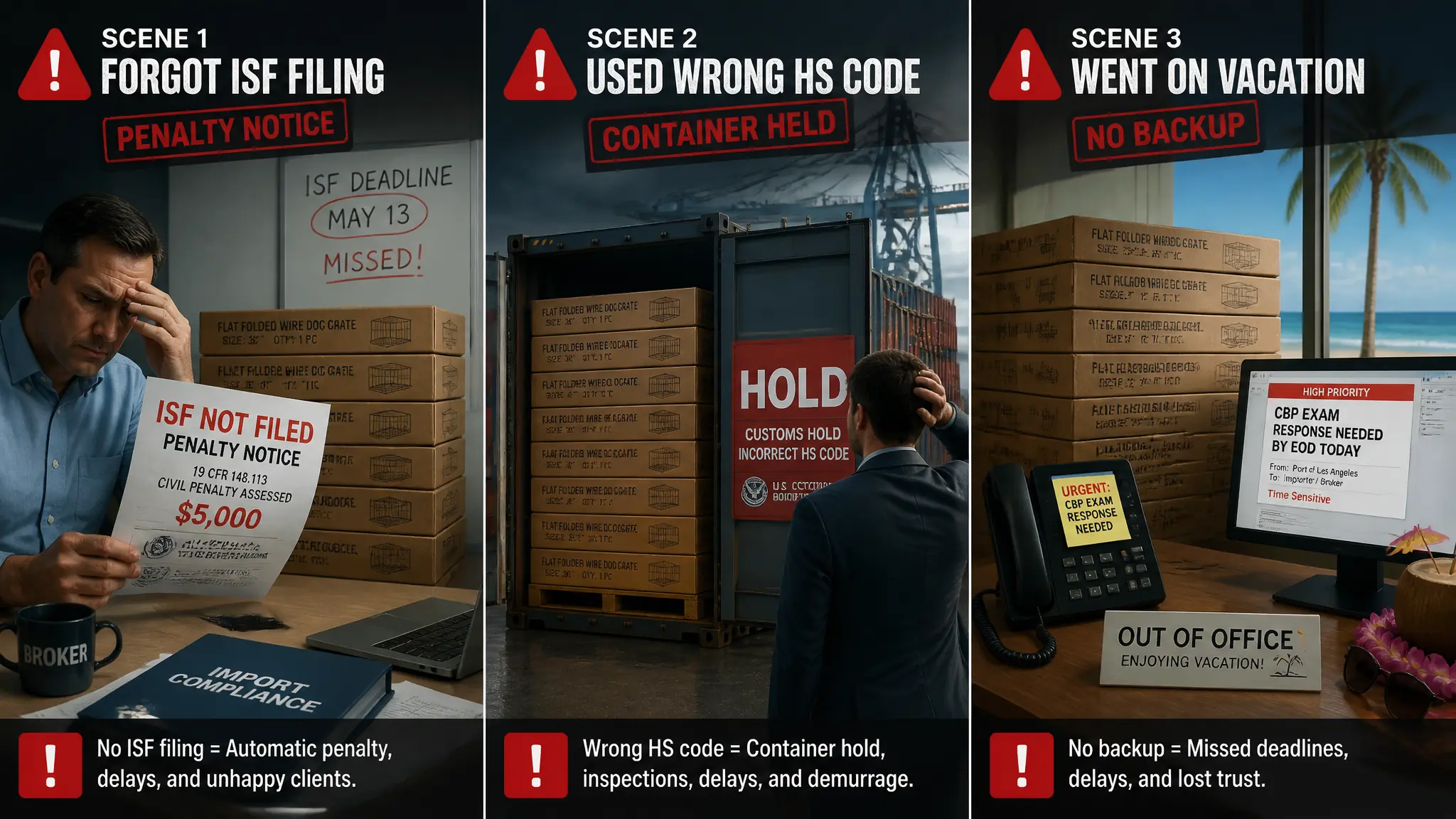
Case 1: The silent broker. A German buyer’s container arrived at Hamburg. The broker filed the entry but didn’t respond to a CBP-equivalent query about the HS code. For 6 days, the buyer emailed and called — no response. The broker had gone on vacation without arranging coverage. The buyer lost €900 in demurrage and switched brokers for the next shipment.
Case 2: The wrong HS code. A US buyer’s broker classified 42-inch wire crates under 9403.20 (metal furniture, 3% duty). The correct classification was 7326.90 (other iron/steel articles, 0% duty under GSP from certain countries). The buyer paid $1,500 extra on a $50,000 shipment before we caught it on the next order. Always ask your broker to explain their HS code choice — don’t just accept it.
Case 3: The bond expiry. A buyer’s continuous bond expired 2 days before the container arrived. The broker didn’t notify them. Customs rejected the entry. It took 4 days to renew the bond and refile. Cost: $600 in demurrage + $300 bond renewal rush fee. Check your bond expiration date. Put it in your calendar.
Broker Selection Decision Framework
How to Choose the Right Customs Broker
Check Experience
Ask: “Have you cleared steel products or pet cages?” If they haven’t, find someone who has.
Verify License
US: CBP licensed. EU: AEO certified. AU: ABF licensed. No license = no accountability.
Don’t Pick Cheapest
$35 broker vs $125 broker: the difference is risk management, not just paperwork.
Test Response Time
Email them on Friday afternoon. If they reply Monday morning, they’re not monitoring weekends.
Review Before Sailing
Good brokers review your docs before the vessel loads. Bad brokers see them at the port.
Have a Backup
Know one alternative broker. If your primary goes silent (vacation, sick, quit), switch immediately.
Do I really need a customs broker for importing wire dog crates?
Legally, you can self-file in most countries. Practically, the risk far outweighs the $75-150 savings. A wrong HS code costs $1,500+ in back duties. A late ISF filing costs $5,000-10,000. A documentation error triggers a hold at $75-150/day. For the cost of one dinner out, a broker eliminates these risks. Every experienced buyer we work with uses one. At our facility, we recommend brokers to first-time buyers — not because we get a commission (we don’t), but because we’ve seen too many containers stuck at port while the buyer figures out CBP Form 28.
How much does a customs broker cost?
$75-150 per entry for standard customs clearance, typically including ISF filing (US), entry summary, duty payment, and release coordination. Additional services like binding rulings, protests, or audit responses cost extra. Compare this to the potential cost of DIY mistakes: $5,000+ for an ISF penalty, $1,500+ for HS code reclassification, $375-750 for a 5-day demurrage hold.
How do I find a good customs broker for pet product imports?
Start with the national customs broker association directory (NCBFAA in the US, AEO database in the EU). Filter for brokers with experience in metal products or pet supplies. Interview at least three. Ask each: “Have you cleared steel wire products before? What HS code would you use for a folded wire dog crate? What’s your process when customs flags an entry?” The quality of their answers tells you everything.
What happens if my customs broker makes a mistake?
Legally, the importer of record (you) is ultimately responsible — even if the broker filed the wrong information. A good broker carries errors & omissions (E&O) insurance and will cover penalties caused by their mistakes. Ask about their E&O coverage before signing. If they don’t have it, don’t use them. At our factory, we’ve seen brokers cover $500-2,000 in penalties for their own errors. The ones who refuse to pay are the ones you leave.
Can I switch customs brokers mid-shipment?
Yes, but it’s messy. You need to file a power of attorney (POA) with the new broker and revoke the old one. If the container is already at the port, the transition adds 1-2 days. If it’s held by customs, changing brokers may reset the clock. Recommended approach: vet your broker before the first shipment, and have a backup identified but not activated. At our factory, we’ve seen buyers switch brokers between shipments without issue — it’s mid-shipment switches that get expensive.
Related Reading
- Why Your Wire Dog Crate Shipment Gets Stuck at Customs — And How to Get It Released Fast
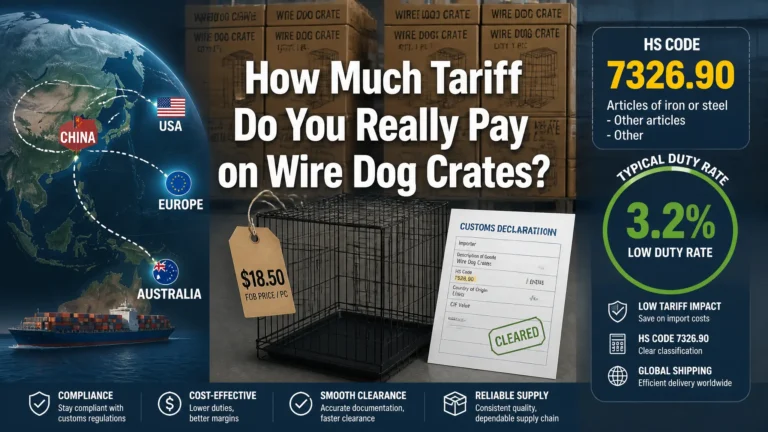
- How Much Tariff Do You Really Pay on Wire Dog Crates? HS Codes, Duty Rates, and Hidden Fees
- Wire Dog Crate Import Compliance: What Triggers an Audit and How to Stay Clean
- Real Case: Mixed Container Nightmare — How One Wrong Inspection Cost ¥41,000 in Demurrage
What about using a freight forwarder’s in-house broker versus an independent broker? Forwarders often pitch their brokerage service as “seamless” because they control both the shipping and the clearance. In practice, this creates a conflict of interest. When demurrage starts accumulating, the forwarder’s priority is getting the container returned to the shipping line — not minimizing your duty liability. An independent broker works for you, not the carrier. They’ll push back on questionable HS code classifications that a forwarder’s broker might accept to keep things moving. For your first 2-3 shipments, the forwarder’s broker is convenient. After that, find your own.
One cost item most buyers forget: the Merchandise Processing Fee (MPF) in the US. This is 0.3464% of the entered value, with a minimum of $29.66 and a maximum of $575.35 per entry. It’s automatic and non-negotiable — but it’s also often bundled into the broker’s “duty and taxes” estimate without being itemized. Ask for a line-item breakdown of all fees before your first shipment. If the broker can’t or won’t provide one, that’s a red flag. Transparency in billing is as important as competence in filing.
External References