Wire Dog Crate Import Compliance: What Triggers an Audit and How to Stay Clean
CBP maintains a database of every import entry you’ve ever filed. They know your declared values, your HS codes, your shipping frequency, and your broker’s name. If your declared value hasn’t changed in 18 months while steel prices moved 15%, you’re already on a list. The audit notice doesn’t come because you made a mistake yesterday — it comes because an algorithm noticed a pattern over two years.
At our factory, we’ve seen maybe 3-4 buyers go through customs audits in 15 years. None of them were doing anything intentionally wrong. They just didn’t know what triggers an audit — and by the time they found out, they were already on the radar. Most audit triggers are preventable with four basic compliance habits that cost almost nothing.
Common Pitfalls That Trigger Customs Audits
- Pitfall 1: Declaring the same value on every shipment for years. Steel prices fluctuate. Exchange rates move. If your declared value hasn’t changed in 18 months while the market moved 15%, customs algorithms flag it. Update your commercial invoice values to reflect actual transaction prices.
- Pitfall 2: Using a different HS code than your previous shipments. Switching between 7326.90 and 9403.20 between shipments is a red flag. It suggests you’re shopping for the lower rate rather than classifying correctly. Pick one code, document your reasoning, and stick with it.
- Pitfall 3: Not keeping records for the required period. US customs requires 5 years of records. EU requires 6 years. Australia requires 5 years. If you get audited and can’t produce invoices from 3 years ago, you lose by default — and the penalty is based on customs’ estimate, not yours.
What Makes Customs Flag a Wire Dog Crate Shipment
Customs agencies use risk algorithms, not random chance. Your shipment gets flagged when it matches a risk profile. Here’s what the algorithms look for — and how wire dog crate imports hit these triggers:
| Trigger | How Wire Dog Crates Hit It | Risk Level | How to Avoid |
|---|---|---|---|
| Value anomalies | Declared at $18/crate when market is $28-35. Or declared at exactly the same value across 6 shipments. | High | Declare actual transaction value. Vary values when actual costs vary. |
| HS code inconsistency | 7326.90 on Shipment 1, 9403.20 on Shipment 2. Customs sees both and asks why. | High | Pick one code. Document the reasoning. Don’t switch without a ruling. |
| Weight/quantity mismatch | Packing list says 844 units at 15kg each = 12,660kg. Bill of lading says 12,400kg. 260kg gap. | Medium | Verify packing list weights match B/L before container loads. |
| Country of origin issues | Made in China but labeled “Assembled in Vietnam” to avoid tariffs. Transshipment fraud. | High | Never falsify origin. Use correct country of origin on all documents. |
| New importer pattern | First shipment is unusually large ($100K+) or unusually frequent (monthly from day one). | Medium | Start with a 20GP test order. Build a compliance history gradually. |
| Anti-dumping category proximity | Wire crates are steel products. Some steel wire items face 200%+ AD duties. Customs verifies classification. | Medium | Include detailed product photos and construction specs with entry docs. |
Value anomalies are the #1 trigger we see. Customs agencies maintain databases of transaction values by HS code. If your declared value is 40% below the median, you’re getting flagged — not because they think you’re a criminal, but because the algorithm says “this needs a human to look at it.”
There’s a trigger that doesn’t show up in official documentation but matters in practice: the “too clean” profile. If you import 15 containers over two years with zero holds, zero exams, and zero discrepancies, you might think you’re doing everything right. But to a risk algorithm, a profile with zero flags is statistically unusual — especially for a product category (steel goods from China) that averages 3-5% exam rates. A routine exam after 15 clean shipments is not a sign something went wrong — it’s the algorithm verifying that the clean profile is legitimate. Don’t panic when it happens.
Another pattern we’ve observed: buyers who switch factories between shipments tend to trigger more exams. The reason is simple — a new manufacturer means a new manufacturer ID (MID) in CBP’s system. A new MID with no compliance history is a risk indicator. If you’re testing a new supplier, expect your first 1-2 containers from them to have a higher exam probability. Budget for it. Once the new MID establishes a clean history (3-4 shipments), the exam rate normalizes. This is one reason long-term supplier relationships save money beyond just unit pricing.
The 3 Levels of Customs Inspection — And What They Cost
Not all inspections are audits. Here’s what each level means for a wire dog crate importer:
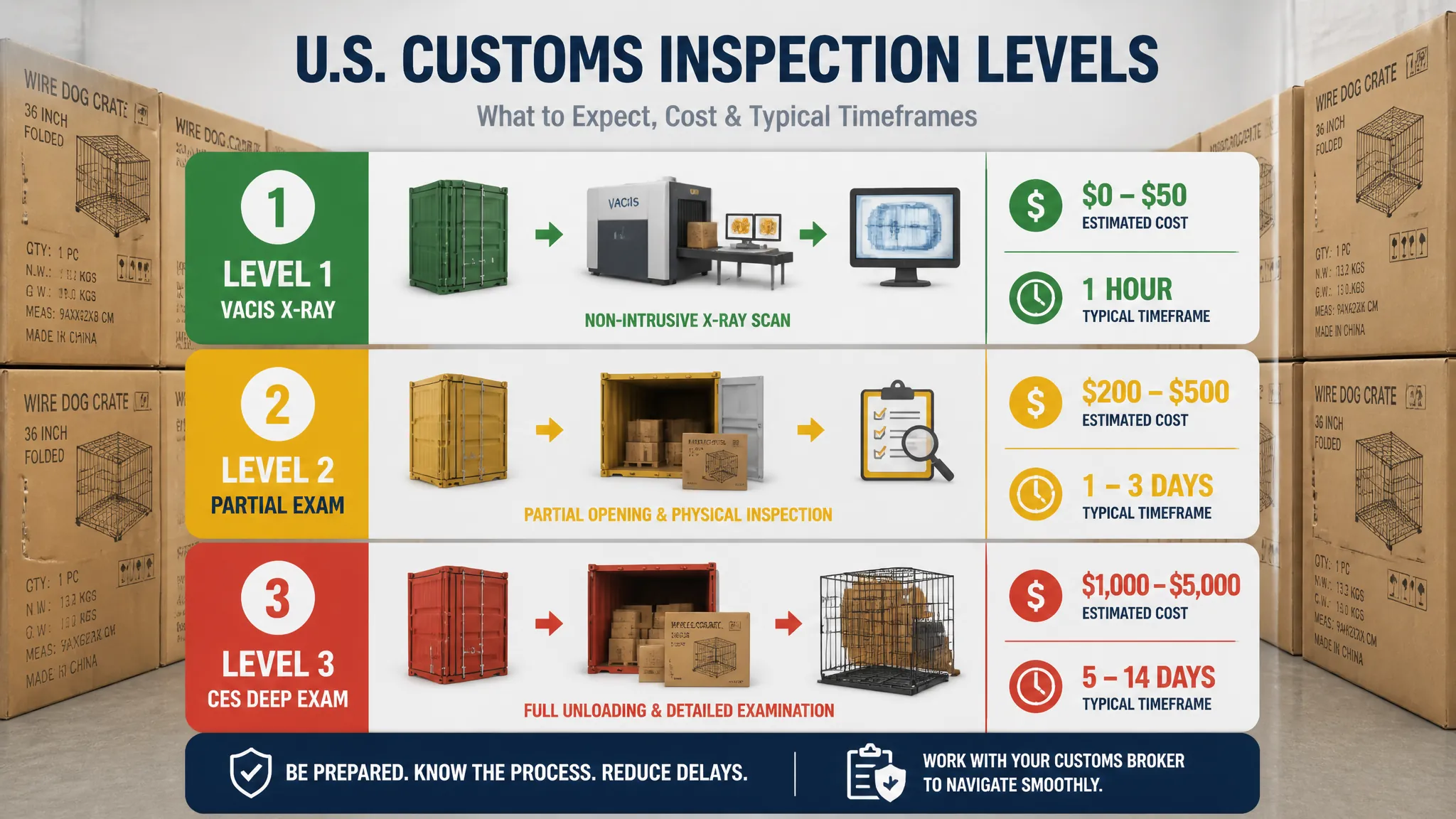
| Level | What Happens | Duration | Direct Cost | Your Action |
|---|---|---|---|---|
| VACIS / X-Ray | Container scanned without opening. Looks for anomalies in density, hidden compartments, or undeclared goods. | Hours | $0-50 (minimal delay) | Nothing. This is routine. 3-5% of all containers get scanned. |
| Partial / Tailgate Exam | Container opened. 1-3 pallets or cartons examined. Crate pulled out, checked for labeling, construction, weight verification. | 1-3 days | $200-500 (exam fee + labor + 1-3 days demurrage) | Provide packing list showing which cartons contain what. Label cartons clearly. |
| CES / Intensive Exam | Container fully unloaded at a Centralized Examination Station. Every carton opened, every crate inspected. Samples may go to lab for material analysis. | 5-14 days | $1,000-5,000+ (CES fee + labor + demurrage + potential repacking) | Get broker on-site. Provide all documentation immediately. Don’t argue — cooperate. |
At our factory, roughly 3-5% of our buyers’ containers undergo some form of inspection. The vast majority are VACIS scans — quick, non-invasive, and resolved in hours. Intensive exams are rare, but when they happen, the buyer needs to act fast.
Factory insight: A Brazilian buyer’s container was selected for intensive exam at Santos. The exam found exactly what was declared: 332 units of 42-inch wire crates. Nothing wrong. But the exam still took 12 days and cost R$6,500 in fees and demurrage. The lesson: an exam doesn’t mean you did anything wrong. It means the algorithm picked your number. Budget for the possibility.
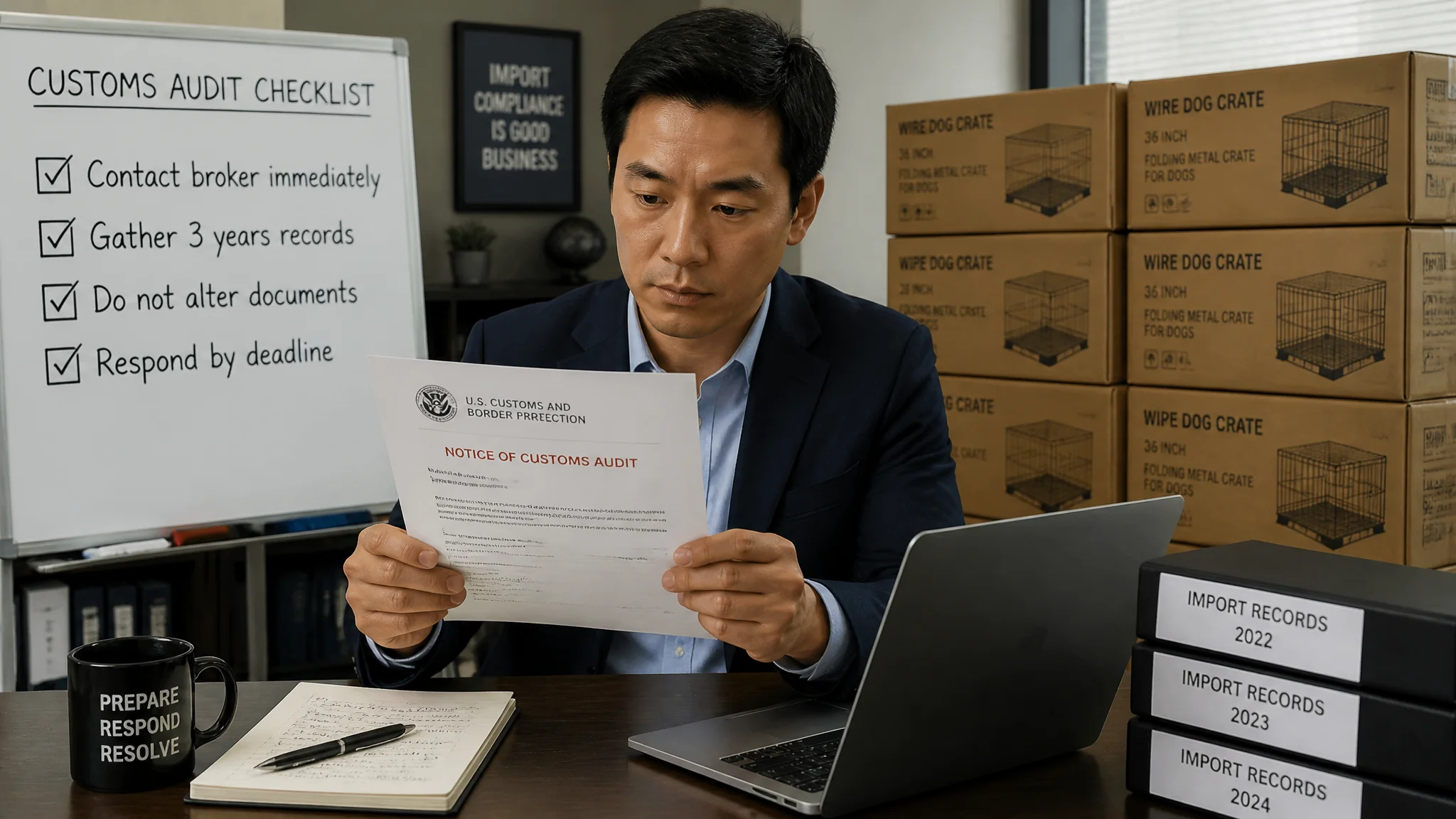
What to Do When You Get an Audit Notice — Don’t Panic
An audit notice is scarier than an inspection because it’s retrospective — customs wants to review years of past entries, not just the current shipment. Here’s the step-by-step response:
Day 1: Read the notice carefully. It will specify exactly what they want — which entries, which time period, which specific issues they’re examining (valuation, classification, origin, or all three). Don’t send more than they ask for. Don’t send less.
Day 1-3: Gather documents. Commercial invoices, packing lists, bills of lading, entry summaries, proof of payment (bank transfers to the factory), and correspondence with the supplier. Bank records are critical — they prove the declared value matches what you actually paid.
Day 3-5: Engage your broker or a customs attorney. If the audit involves more than $10,000 in potential duties or penalties, hire a customs attorney. The cost ($2,000-5,000) is usually less than the penalty for a poorly handled response.
Day 5-14: Submit your response. Organize documents by entry number. Include a cover letter explaining your classification methodology and valuation approach. If you have a binding ruling for your HS code, include it. If you don’t, now you know why you should get one.
After submission: Wait. Customs reviews can take 30-180 days. Continue importing normally during the review — an audit doesn’t freeze your imports unless customs specifically issues a hold order (rare for first-time audits).
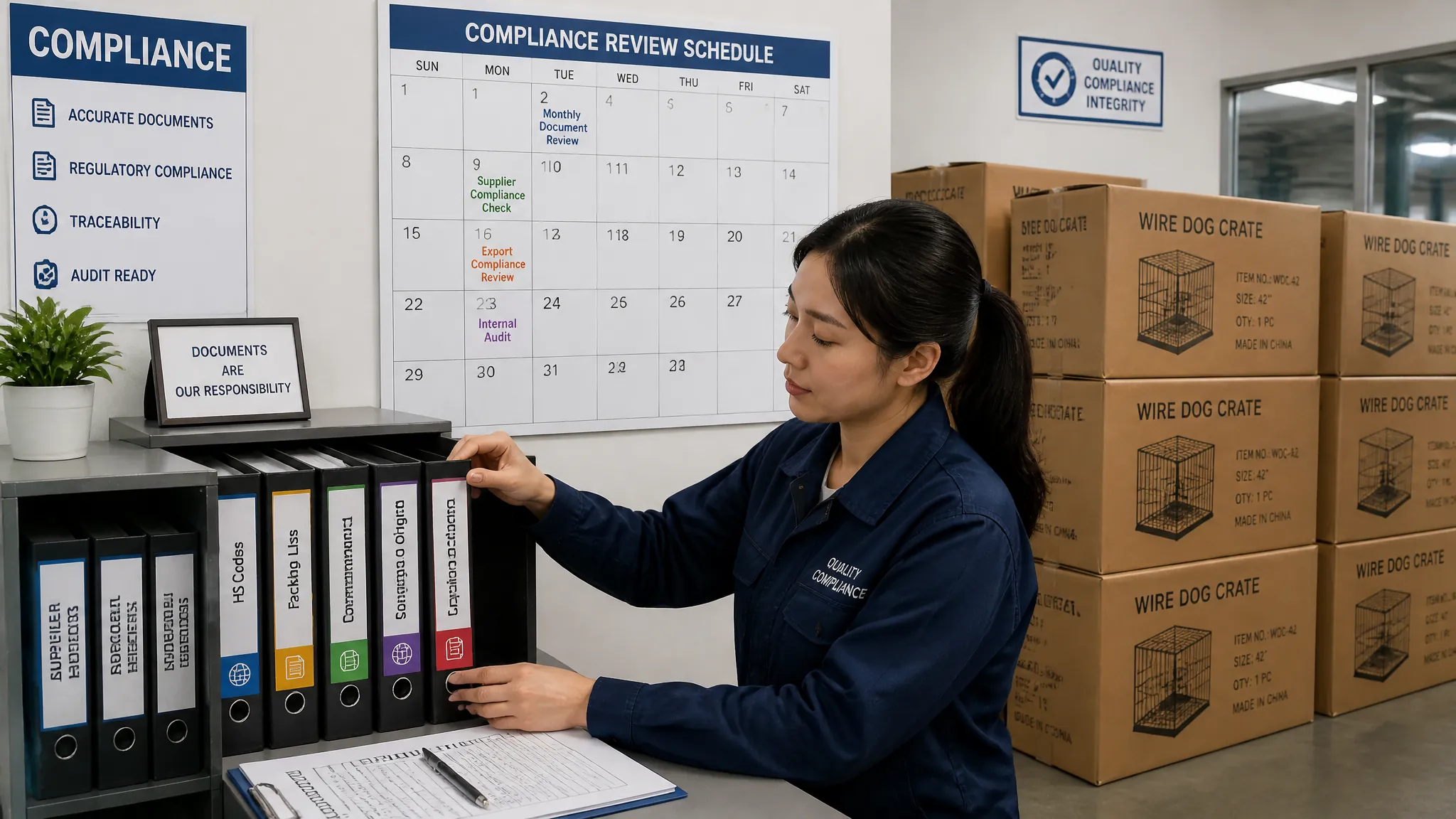
Building a Compliance System That Survives Any Audit
You don’t need a compliance department. You need three habits:
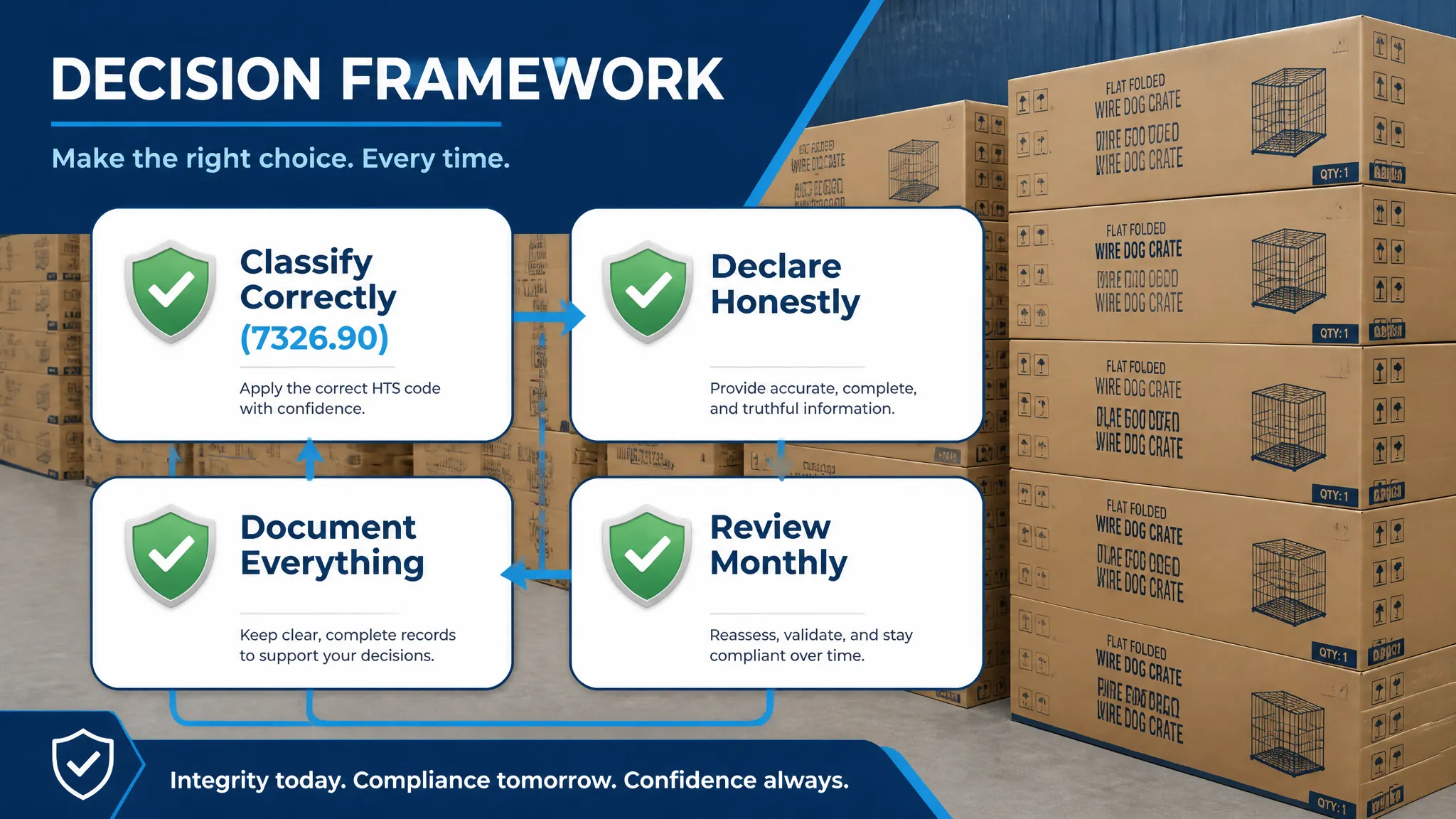
1. Document your HS code decision once. Write a one-page memo explaining why you classify wire dog crates under 7326.90 (or whichever code you use). Reference the product construction (welded steel wire), the Harmonized System Explanatory Notes, and any CBP rulings you’ve found. File it. Update it if anything changes. If you get audited, this memo is your defense.
2. Keep a shipment log. A simple spreadsheet: date, container number, HS code used, declared value, duty paid, broker name, and any issues. Update it within 48 hours of each shipment. We’ve had buyers reconstruct 3 years of import history from their shipment log in under an hour during an audit. Buyers without a log spent two weeks digging through email.
3. Match your declared value to your actual payment. The commercial invoice you submit to customs should match what you paid the factory — to the dollar. If you negotiated a discount after the invoice was issued, issue a credit note and declare the adjusted value. A $500 discrepancy between the customs declaration and the bank transfer is enough to trigger a valuation audit.
4. Retain everything for 5+ years. Invoices, packing lists, B/Ls, entry summaries, proof of payment, email correspondence with the factory, broker communications. Store digitally. Back up to two locations. An audit in year 4 is as enforceable as an audit in year 1 — and the records requirement is the same.
5. Run a self-audit once a year. Pick one container from the past 12 months. Pull every document: commercial invoice, packing list, B/L, ISF filing confirmation, entry summary (CBP Form 7501), and proof of duty payment. Check that every number matches across all documents. Check that the HS code on the entry summary matches the code on the commercial invoice. Check that the declared value matches your bank transfer to the factory. A one-hour self-audit once a year catches the kind of small discrepancies that, accumulated over 3 years, trigger a real audit.
If you do get audited, the single most valuable document you can produce is your bank transfer record showing the exact amount you paid the factory. This is the gold standard of valuation evidence — it proves the transaction value is real. Customs auditors trust bank records more than commercial invoices because invoices can be fabricated; SWIFT transfers cannot. We’ve had two buyers survive valuation audits purely because they kept every wire transfer confirmation. One audit was resolved in 14 days. The other — where the buyer couldn’t produce bank records — took 8 months and resulted in a $12,000 penalty.
Import Compliance Decision Framework
How to Build an Audit-Proof Import Compliance System
Document Your HS Code
One-page memo: why 7326.90. Reference product construction, HS notes, CBP rulings.
Keep a Shipment Log
Date, container, HS code, value, duty, broker. Update within 48 hours. Survive audits.
Match Value to Payment
Declared value = actual payment. $500 gap = audit trigger. Issue credit notes for discounts.
Retain 5+ Years of Records
Invoices, B/Ls, entries, payments, emails. Digital + backup. Required by US/EU/AU law.
Don’t Switch HS Codes
Pick one code. Stick with it. Switching between 7326.90 and 9403 triggers an audit.
Get a Binding Ruling
CBP ruling takes 30-90 days, free. EU BTI takes 120 days, €50-200. Worth the time.
What triggers a customs audit for dog crate imports?
The most common triggers: declaring the same value across multiple shipments while steel prices fluctuate, switching HS codes between shipments (7326.90 vs 9403.20), significant weight or quantity mismatches between packing list and bill of lading, and declared values significantly below market rates. Random audits also happen — about 3-5% of importers get selected for compliance reviews annually, regardless of their history.
What are the different levels of customs inspections?
Three levels: VACIS/X-ray (non-invasive scan, hours, $0-50), partial/tailgate exam (container opened, 1-3 pallets checked, 1-3 days, $200-500), and CES/intensive exam (full unload, every carton inspected, 5-14 days, $1,000-5,000+). Most wire dog crate shipments that get inspected receive VACIS scans. Intensive exams are rare but expensive when they happen.
What should I do if I get a customs audit notice?
Don’t panic. Read the notice — it specifies exactly what they want. Gather documents within 3 days: invoices, packing lists, B/Ls, entry summaries, proof of payment. Engage your customs broker. If potential liability exceeds $10,000, hire a customs attorney ($2,000-5,000). Submit organized documents with a cover letter explaining your classification and valuation approach. Customs reviews take 30-180 days. Continue importing normally during review.
How do I build a compliance system for wire dog crate imports?
Four habits: 1) Document your HS code decision in a one-page memo. 2) Keep a shipment log (date, container, HS code, value, duty) updated within 48 hours of each shipment. 3) Match your declared value to your actual payment — no gaps. 4) Retain all records for 5+ years in digital format with backup. These four habits cost almost nothing and make any audit manageable instead of catastrophic.
Can I be blacklisted by customs?
Yes. Repeated violations — especially valuation fraud, country of origin falsification, or anti-dumping duty evasion — can result in increased inspection rates, bond requirements, or import restrictions. CBP maintains a “repeat violator” list. Getting off it requires a clean record for 3+ years and often a compliance program review. It’s far easier to stay compliant from day one than to recover from being flagged. At our factory, we’ve seen one buyer get flagged after 4 consecutive value discrepancies — it took him 2 years and a customs attorney to clear his record.
Related Reading
- Why Your Wire Dog Crate Shipment Gets Stuck at Customs — And How to Get It Released Fast
- Do You Actually Need a Customs Broker for Wire Dog Crate Imports? The Real Cost of DIY vs. Professional
- How Much Tariff Do You Really Pay on Wire Dog Crates? HS Codes, Duty Rates, and Hidden Fees
- Real Case: Mixed Container Nightmare — How One Wrong Inspection Cost ¥41,000 in Demurrage
Let’s address a scenario that worries buyers but rarely happens: criminal investigation versus civil audit. The vast majority of customs issues are civil — they involve underpaid duties, penalties, and interest. Criminal investigations require evidence of intentional fraud: falsified invoices, deliberate misclassification to evade duties, or organized smuggling. If you declare actual transaction values, use a consistent HS code, and keep your records, you’re in the civil domain — not criminal. The threshold between civil and criminal is intent. Honest mistakes (wrong HS code, missed ISF deadline) are civil. Deliberate deception (fake invoices, transshipment fraud) is criminal. Stay honest and you stay safe.
One more practical compliance habit: photograph your container being loaded. We take photos of every container at our facility — the loading process, the carton labels, the container number, and the seal being applied. These photos serve as evidence if customs questions whether the declared goods match what was actually shipped. During one audit, a buyer produced loading photos showing the exact carton labels matching the packing list. The auditor closed the case in 20 minutes. Photos cost nothing to take and can save weeks of audit back-and-forth. Ask your factory to provide them as part of the standard pre-shipment documentation package.
External References