How Much Tariff Do You Really Pay on Wire Dog Crates? HS Codes, Duty Rates, and Hidden Fees
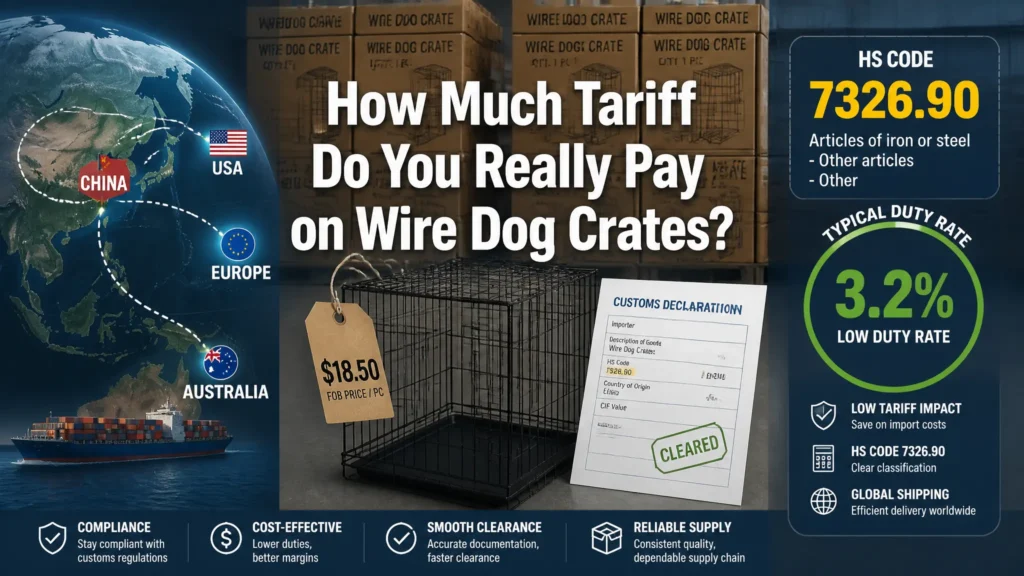
Most first-time buyers budget 10-15% for import duty on wire dog crates. They’re wrong — often by a factor of 3-5x. Under the correct HS code (7326.90), the actual rate is 0-2.9% for the US, 0% for the UK and Australia. Overestimating your tariff by $5 per crate doesn’t make you safe — it makes you uncompetitive.
At our factory, we’ve shipped wire dog crates to the US, Germany, UK, Brazil, Australia, Japan, and 6 other countries. The tariff question comes up in nearly every first inquiry. The real cost isn’t the duty itself — it’s the freight, port charges, and logistics that eat 14% of your landed cost. Duty is only 2-3%.
Common Pitfalls When Classifying Wire Dog Crate HS Codes
- Pitfall 1: Guessing the HS code without checking with your broker. Wire dog crates can fall under 7326.90 (iron/steel articles, 0-2%), 9403.20 (metal furniture, 3-5%), or even 4421.99 (wooden crates — wrong, but some brokers misclassify). The difference on a $50,000 shipment is $1,500-2,500.
- Pitfall 2: Using the “pet products” category rate. Some tariff databases show “pet products” at 39% (2026 US Section 301 rate for certain Chinese goods). But wire crates classified correctly as steel articles often avoid these additional tariffs. Don’t let a generic category rate scare you.
- Pitfall 3: Forgetting about anti-dumping duties. Certain steel wire products from China face anti-dumping duties (up to 200%+). Wire dog crates typically don’t — they’re finished consumer goods, not raw wire rod. But your broker must verify this before the first shipment. One wrong assumption = container seized.
HS Codes for Wire Dog Crates — Why 7326.90 vs 9403 Makes a $1,500 Difference
HS codes determine your duty rate. Get it wrong and you either overpay (bad for pricing) or underpay (bad for compliance). Here’s how the two main candidates compare:
| Factor | 7326.90 — Other Articles of Iron or Steel | 9403.20 — Metal Furniture |
|---|---|---|
| Typical duty rate (US MFN) | 0-2.9% | 0-5% |
| Duty on $50,000 shipment | $0-1,450 | $0-2,500 |
| Section 301 risk (China) | Lower — often excluded as steel articles | Higher — furniture category faces additional scrutiny |
| EU rate (TARIC) | 0-2.7% (7326.90.98) | 0-5.6% (9403.20.80) |
| Arguments for | Wire crate is a simple steel fabrication, not furniture. No wood, no cushion, no assembly beyond folding. | If the crate includes a plastic tray, some customs officers argue it’s “furniture” because it’s a complete enclosure system. |
| Arguments against | Some customs officers argue the crate has a “furniture-like” function (enclosure/containment) | Most rulings classify wire crates as steel articles because the primary material and construction method is steel fabrication |
In our experience, 7326.90 is the correct classification for a standard wire dog crate. It’s a welded steel wire product — no different in principle from a steel wire basket or shelf. The fact that a dog sits inside it doesn’t make it furniture. But always confirm with your broker — customs rulings can vary by port and officer.
The HS code decision has downstream effects beyond duty rates. Your HS code also determines whether you need additional certifications. Products classified under 9403 (furniture) in the EU may require formaldehyde emission testing and REACH compliance documentation that steel articles under 7326 don’t. For US imports, 9403 products face CPSC (Consumer Product Safety Commission) oversight, while 7326 products generally don’t. Choosing the wrong code doesn’t just cost you duty — it can trigger regulatory requirements you didn’t budget for.
If you’re unsure about classification, you can request a binding ruling from customs. In the US, CBP issues binding rulings within 30-90 days at no cost. In the EU, a BTI (Binding Tariff Information) decision takes up to 120 days and costs €50-200 depending on the member state. A binding ruling is the only way to get legal certainty on your HS code. Once issued, it’s valid for 3-6 years and protects you from reclassification during audits. For importers bringing in $100K+ annually, a binding ruling is the cheapest insurance you can buy.
Factory insight: A UK buyer’s first shipment was classified under 9403.20 by his broker — 2.7% duty. On his second order, we suggested he ask the broker to review the classification. The broker switched to 7326.90.98 — 0% duty. On a £40,000 order, that saved £1,080. The broker simply hadn’t considered the alternative because the buyer didn’t ask.
Country-by-Country Tariff Comparison: US, EU, Australia
Duty rates vary by destination. Here’s what you’ll actually pay on a standard wire dog crate (HS 7326.90), based on current rates and our shipping data:
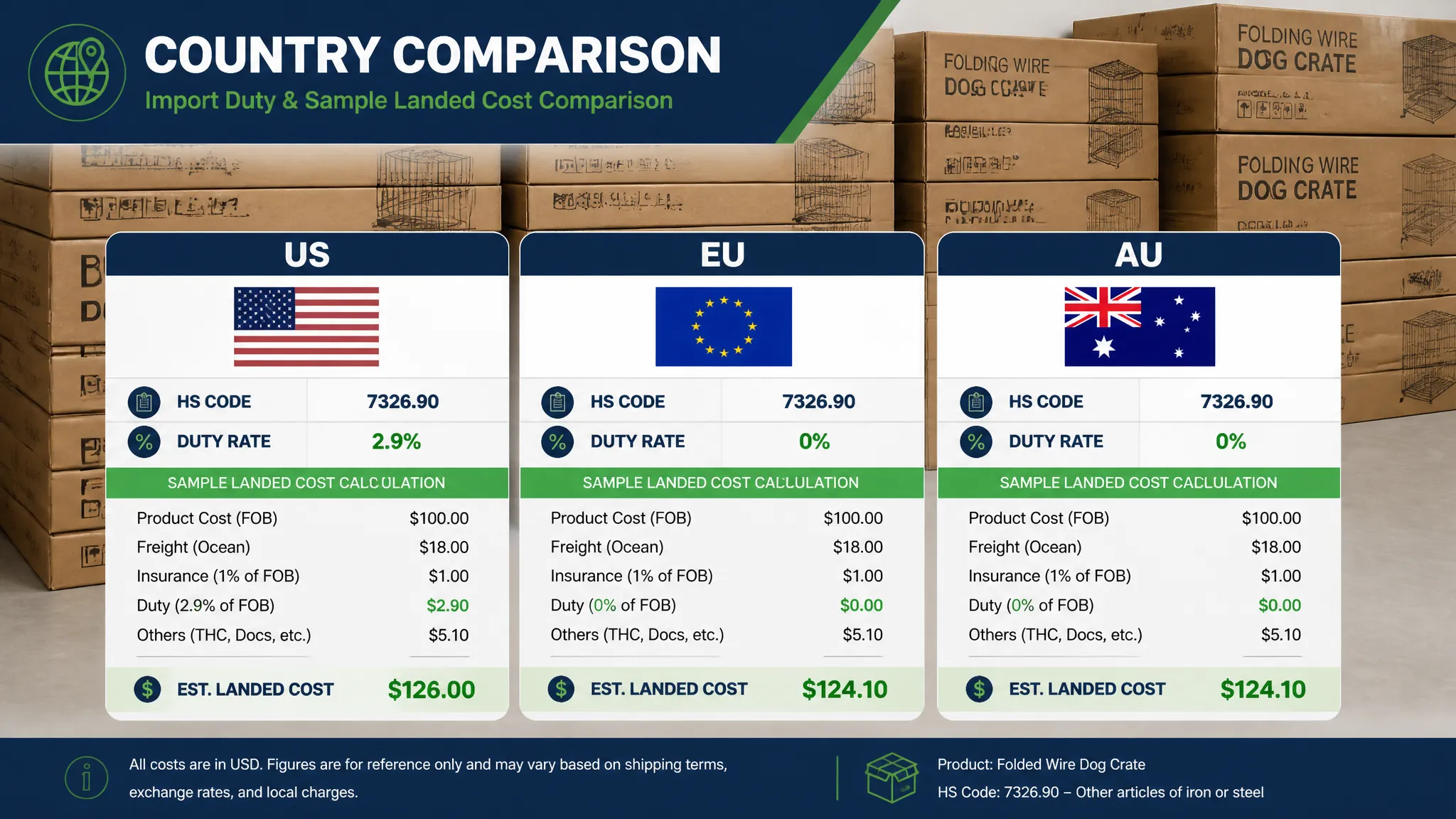
| Country | HS Code | MFN Duty Rate | FTA Rate (if applicable) | VAT/GST on Import | Effective Total on $50,000 |
|---|---|---|---|---|---|
| United States | 7326.90.8688 | 2.9% | 0% (GSP from certain countries) | N/A (sales tax at point of sale) | $0-1,450 |
| Germany (EU) | 7326.90.98 | 2.7% | 0% (no FTA with China) | 19% (VAT, recoverable) | $1,350 + VAT |
| United Kingdom | 7326.90.9890 | 0% | N/A | 20% (VAT, recoverable) | $0 + VAT |
| Australia | 7326.90.90 | 0% | 0% (ChAFTA eligible) | 10% (GST) | $0 + GST |
| Brazil | 7326.90.90 | 14-18% | N/A | Varies by state (ICMS 7-18%) | $7,000-9,000 + ICMS |
| Japan | 7326.90.90 | 0% | 0% (RCEP eligible) | 10% (consumption tax) | $0 + tax |
The UK, Australia, and Japan charge 0% duty on wire dog crates under the correct HS code. Brazil is the most expensive — factor in 14-35% total tax burden when quoting Brazilian buyers. US rates depend heavily on current trade policy; check Section 301 status before quoting.
A word on Section 301 tariffs for US importers: these are additional duties imposed on Chinese-origin goods, separate from the standard MFN rate. As of 2026, many steel articles under HS 7326 are subject to a 25% Section 301 tariff on top of the 2.9% base rate. However, exclusions exist — and they change frequently. Check the USTR exclusion list before each shipment. We’ve had buyers who qualified for exclusions they didn’t know about, saving 25% on three containers retroactively. Your broker should be monitoring this for you.
For EU importers, the antidumping risk is different but equally important. Certain steel wire products from China face AD duties of 24-64%. Wire dog crates are not currently subject to AD duties because they’re classified as finished consumer goods, not raw steel products. But this can change — the EU reviews AD measures every 5 years. If your broker ever suggests classifying your crates under a steel wire intermediate product code (like 7217 or 7223), stop immediately and get a second opinion. That classification puts you in AD territory.
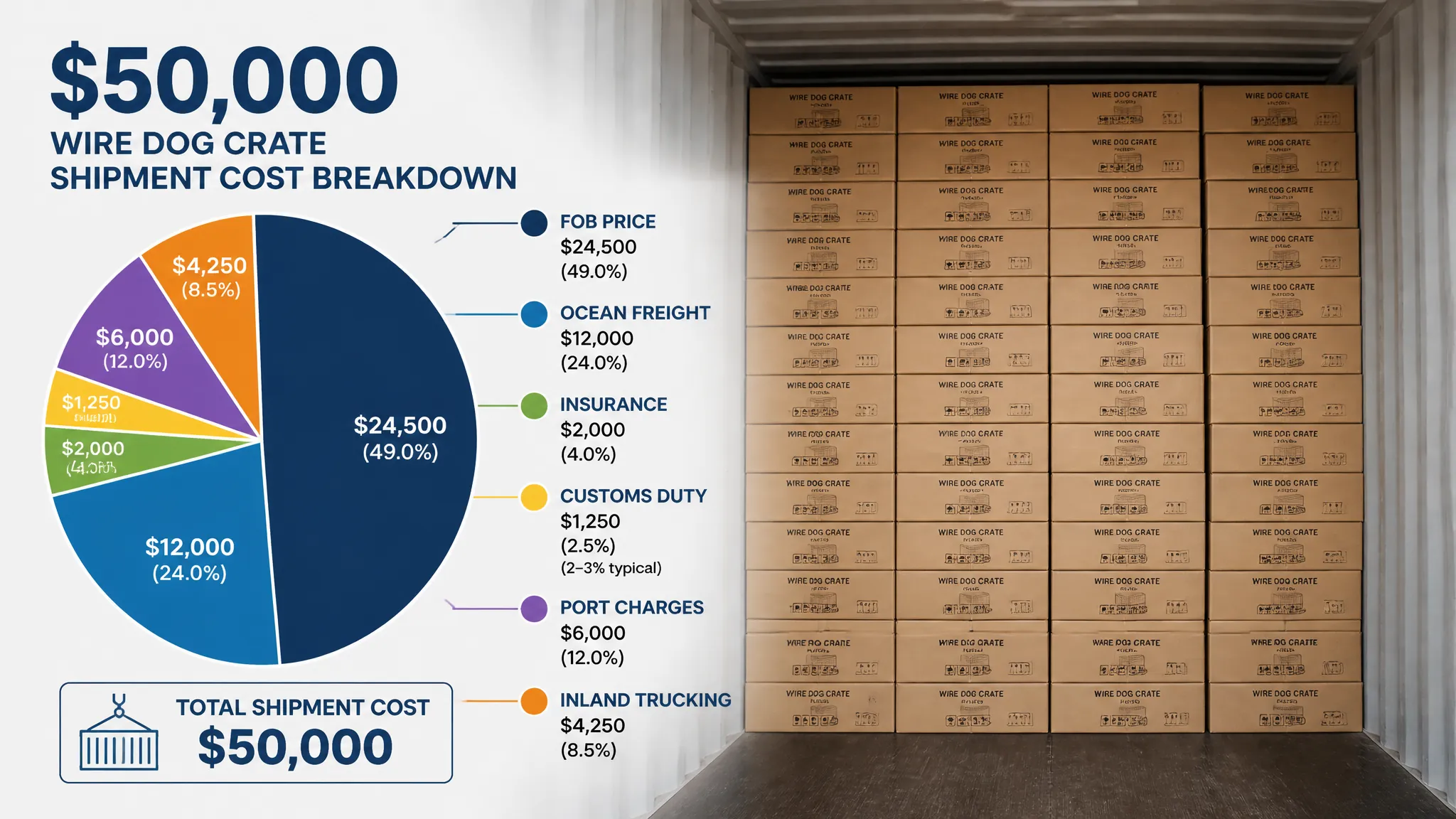
The $50,000 Shipment Cost Breakdown — Where the Money Actually Goes
Buyers focus on FOB price. Smart buyers focus on landed cost. Here’s what a real 40HC shipment of 42-inch crates actually costs, door to door:
| Cost Item | Amount (USD) | % of Total | Notes |
|---|---|---|---|
| FOB (844 units × $28) | $23,632 | 82.3% | Factory price, loaded on vessel |
| Ocean freight (Ningbo → LA) | $2,800 | 9.7% | 40HC, current spot rate |
| Marine insurance | $150 | 0.5% | 0.5% of CIF value |
| US customs duty (2.9%) | $771 | 2.7% | On CIF value ($26,582) |
| Customs broker fee | $125 | 0.4% | Entry filing + ISF |
| Single entry bond | $75 | 0.3% | Required for imports > $2,500 |
| Port charges + handling | $450 | 1.6% | Terminal handling, chassis fee |
| Inland trucking (LA → warehouse) | $700 | 2.4% | 200-mile radius estimate |
| TOTAL LANDED | $28,703 | 100% | $34.01 per crate landed |
Duty is only 2.7% of the total. Freight, port charges, and trucking together are 14.2% — nearly 5x the duty. Buyers who obsess over tariff rates while ignoring freight optimization are looking at the wrong number.
Factory insight: A buyer once asked us to under-declare the invoice value to save $200 in duty. We refused — it’s illegal, and if customs catches it, both the factory and the buyer face penalties. Instead, we showed him that switching from a 20GP to a 40HC saved $1,200 in freight per crate. The real savings are in logistics, not in faking documents.
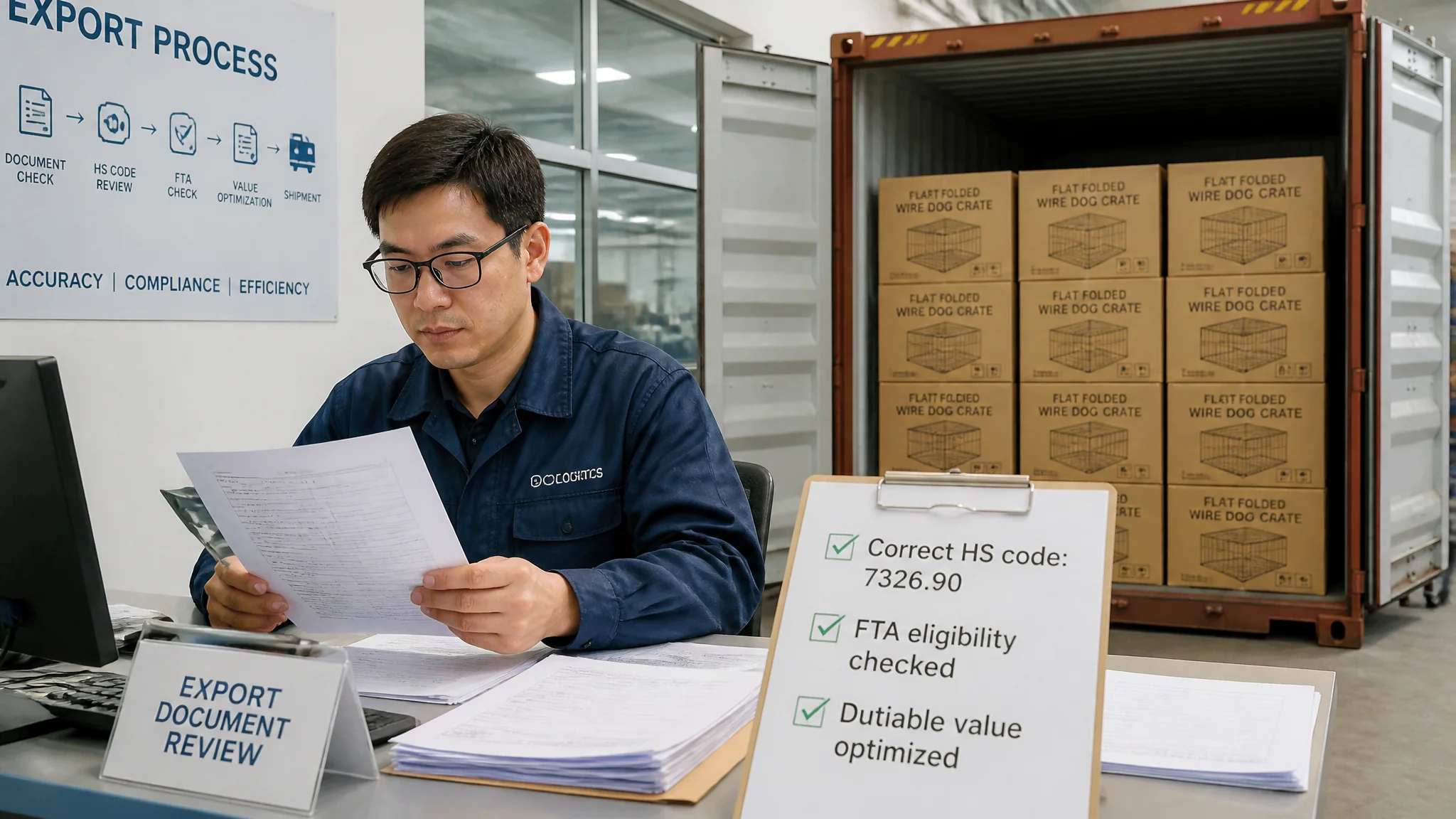
How We Help Buyers Reduce Tariff Costs at the Source
The factory can’t change your country’s tariff rates. But we can do things that affect the dutiable value and classification:
1. Accurate HS code on commercial invoice. We include the correct 6-digit HS code (7326.90) on every commercial invoice. This gives your broker a starting point that matches the product — reducing the chance they default to a higher-rate code.
2. Clear product description. Our invoices describe the product as “wire dog crate, welded steel wire construction, foldable” — not “pet furniture” or “dog cage furniture.” The description influences classification. The word “furniture” on an invoice is an invitation for a customs officer to apply the furniture tariff rate.
3. Separate pricing for accessories. If your order includes plastic trays or dividers, we list them as separate line items with separate values. The tray might attract a different HS code and duty rate — bundling everything under one code means paying the highest rate on everything.
4. Certificate of origin for FTA eligibility. For buyers in Australia (ChAFTA), Japan (RCEP), or other FTA partner countries, we provide the certificate of origin needed to claim preferential duty rates. This alone saves 0-5% — on a $50,000 shipment, that’s up to $2,500.
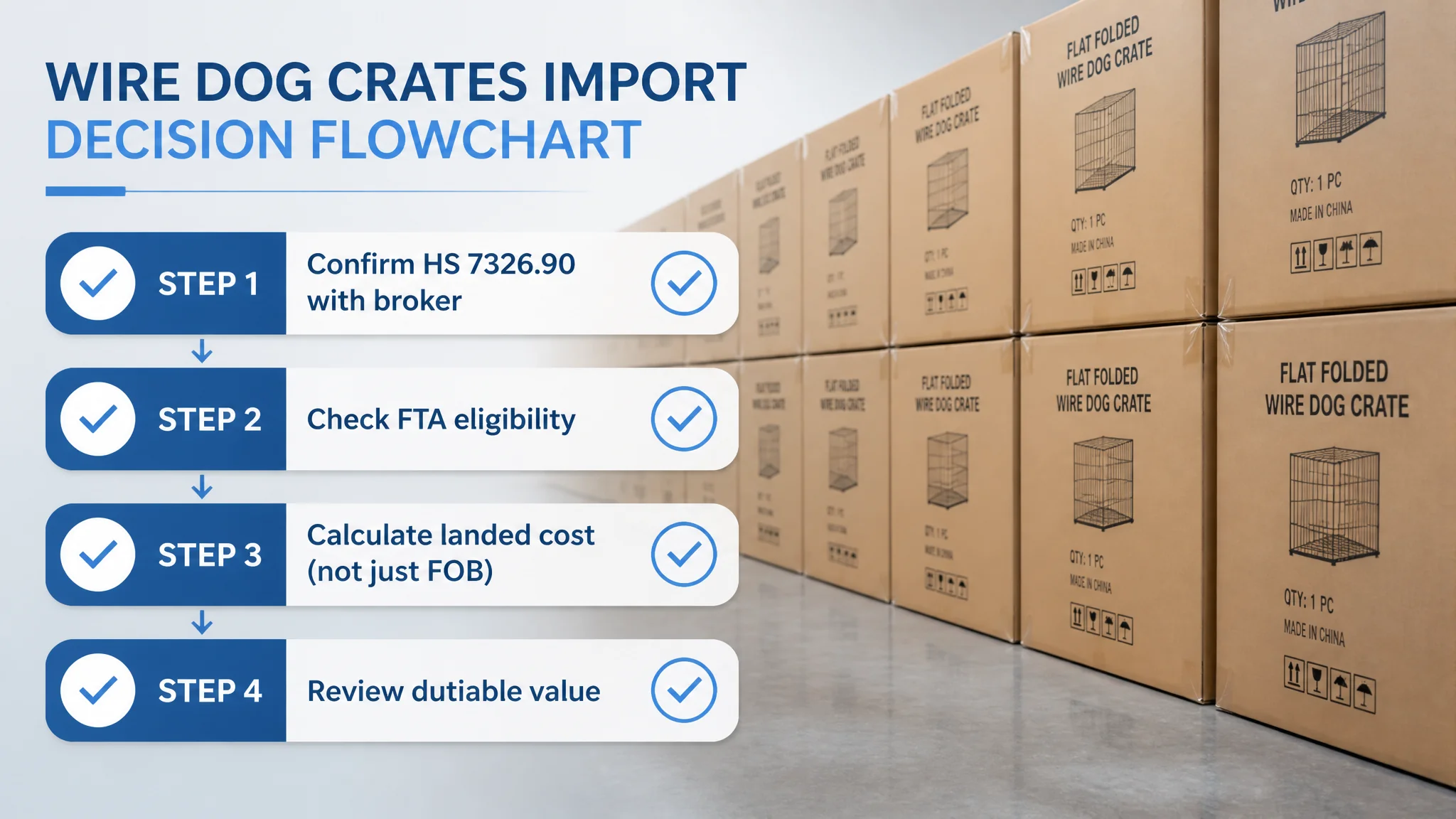
Tariff Calculation Decision Framework
How to Calculate and Minimize Your Wire Dog Crate Tariff
Get the Right HS Code
7326.90 for standard wire crates. Confirm with broker. Wrong code = $1,500+ difference.
Check FTA Eligibility
Australia (ChAFTA), Japan (RCEP) offer 0%. Certificate of origin required. Ask your factory.
Watch Your Invoice Wording
“Wire dog crate, welded steel” not “pet furniture.” Words on the invoice shape the tariff.
Separate Accessory Pricing
Plastic trays, dividers = separate line items. Don’t pay furniture rates on a $2 tray.
Focus on Freight, Not Just Duty
Duty is 2-3% of landed cost. Freight + handling is 14%+. Optimize the big number first.
Calculate Landed Cost Per Unit
FOB + freight + insurance + duty + broker + port + trucking = real cost. Quote from this number.
What HS code should I use for wire dog crates?
7326.90 (other articles of iron or steel) is the correct classification for standard wire dog crates. Some brokers use 9403.20 (metal furniture), which typically carries a higher duty rate. On a $50,000 shipment, the difference is $1,500-2,500. Always confirm with your broker, but start from 7326.90 — it’s the classification most consistent with the product’s material and construction.
How much import duty do I pay on dog crates from China?
It depends on the destination. US: 2.9% MFN (check Section 301 status). UK: 0%. Australia: 0% (ChAFTA eligible). Germany/EU: 2.7%. Brazil: 14-18%. Japan: 0% (RCEP eligible). These rates assume correct HS classification (7326.90). Always add VAT/GST in addition — that’s separate from duty and varies by country (10-20%).
Can I reduce import tariffs on wire dog crates legally?
Yes. Three legal ways: 1) Use the correct HS code — 7326.90 often has lower rates than 9403.20. 2) Claim FTA preferences if your country has a trade agreement (ChAFTA for Australia, RCEP for Japan). Your factory provides the certificate of origin. 3) Separate accessories (trays, dividers) on the invoice — they may qualify for different, lower rates. On a $50,000 shipment, these steps can save $0-2,500.
What’s the total landed cost of importing wire dog crates?
For a 40HC of 42-inch crates from Ningbo to US West Coast: FOB ~$23,600 (82%), ocean freight ~$2,800 (10%), insurance ~$150, duty ~$770 (2.7%), broker $125, port charges $450, inland trucking $700. Total landed: ~$28,700, or $34 per crate. Duty is a small fraction — freight and logistics are the bigger cost drivers. Focus optimization there.
Does the factory help with tariff classification?
We include the HS code on the commercial invoice and describe the product accurately (“welded steel wire construction”) to support correct classification. We also provide certificates of origin for FTA claims. The final classification decision rests with your customs broker — they’re legally responsible for the entry. But starting from the right code and description prevents 90% of classification issues.
Related Reading
- Why Your Wire Dog Crate Shipment Gets Stuck at Customs — And How to Get It Released Fast
- Do You Actually Need a Customs Broker for Wire Dog Crate Imports? The Real Cost of DIY vs. Professional
- Wire Dog Crate Import Compliance: What Triggers an Audit and How to Stay Clean
- Real Case: Mixed Container Nightmare — How One Wrong Inspection Cost ¥41,000 in Demurrage
Let’s talk about currency risk — something that affects your actual duty payment but is rarely discussed. Customs calculates duty based on the entered value converted to the destination currency at the official exchange rate on the date of entry. If you negotiated a EUR price with the factory but your customs entry is in USD, the exchange rate applied is the one customs uses — not your bank’s rate, not the spot rate. Over a $50,000 shipment, a 2% exchange rate swing changes your duty payment by $29 (at 2.9% rate). Small, but it’s one more reason to keep your commercial invoice in the same currency you’ll use for customs entry. We issue invoices in USD by default for US buyers, EUR for EU buyers, and AUD for Australian buyers — eliminating the conversion step entirely.
Another often-overlooked factor: the declared value for customs should include the freight and insurance costs if you’re using CIF terms. This is called the “customs value” versus the “transaction value.” If you buy FOB at $28 per crate but pay $2,800 in freight separately, the customs value is still $28 per crate (freight is added separately by customs). But if you buy CIF at $32 per crate, the $32 already includes freight — and duty is calculated on $32, not $28. That 4-dollar difference on 844 crates is $3,376 more in declared value, which at 2.9% duty adds $98 to your customs bill. Not huge, but it’s another reason FOB terms are generally cleaner for customs valuation.
External References