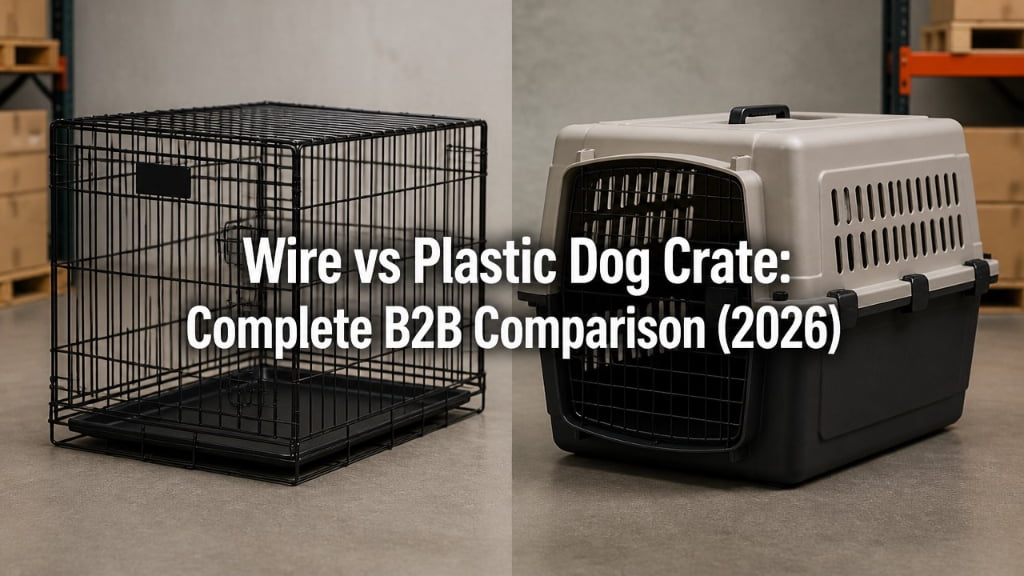
Wire vs Plastic Dog Crate: Complete B2B Comparison (2026)
Plastic dog crates need $30,000+ in injection molds before you produce a single unit. Wire crates don’t require injection molds, but do need $500-2,000 in tooling (tray molds, welding jigs, and custom fixture setup).
This fundamental difference shapes every other comparison between these two crate types — from MOQ requirements to how easily you can switch suppliers to whether a new product line is worth the investment at all.
In this guide, we’ll break down the real differences — using our factory’s production data and market feedback — to help you decide which material (or both) belongs in your product line.
Manufacturing Cost: The Mold Cost Barrier
The first thing to understand about plastic crates: they require injection molds, and molds are expensive.
For a standard-sized plastic dog crate (say, 36″ L), the mold cost is $28,000-42,000 (RMB 200,000-300,000). That’s a sunk cost before you produce a single unit.
| Cost Item | Wire Crate | Plastic Crate | Difference |
|---|---|---|---|
| Tooling cost (one-time) | $500-2,000 (tray mold + welding jigs) |
$28,000-42,000 (injection mold) |
Plastic tooling cost is 14-80x higher |
| MOQ to amortize mold | 100-500 pcs | 500-1,000 pcs | Plastic requires higher MOQ |
| FOB price (M size) | $15-35 | $20-45 | Plastic 20-30% higher |
| Assembly labor | $2.50-4.20 (depends on type) | $1.50-2.50 (injection molded, snap assembly) | Plastic slightly lower labor |
The implication for B2B buyers: if you want to test plastic crates as a new product line, you need to commit to 500-1,000 units minimum to amortize the mold cost. Wire crates have a much lower barrier — tooling is $500-2,000 vs $28,000-42,000 for plastic, so you can start with 100-500 units.
Pitfall: Assuming Plastic Is Cheaper Because It “Looks” Lighter
Plastic crates use more material by volume than wire crates use wire. A plastic crate shell is 2-3mm thick. The result: a plastic crate is actually 20-30% heavier than a wire crate of the same external dimensions. This increases ocean freight cost per unit, wiping out any material cost advantage.
Weight & Shipping: Plastic Is Heavier Than You Think
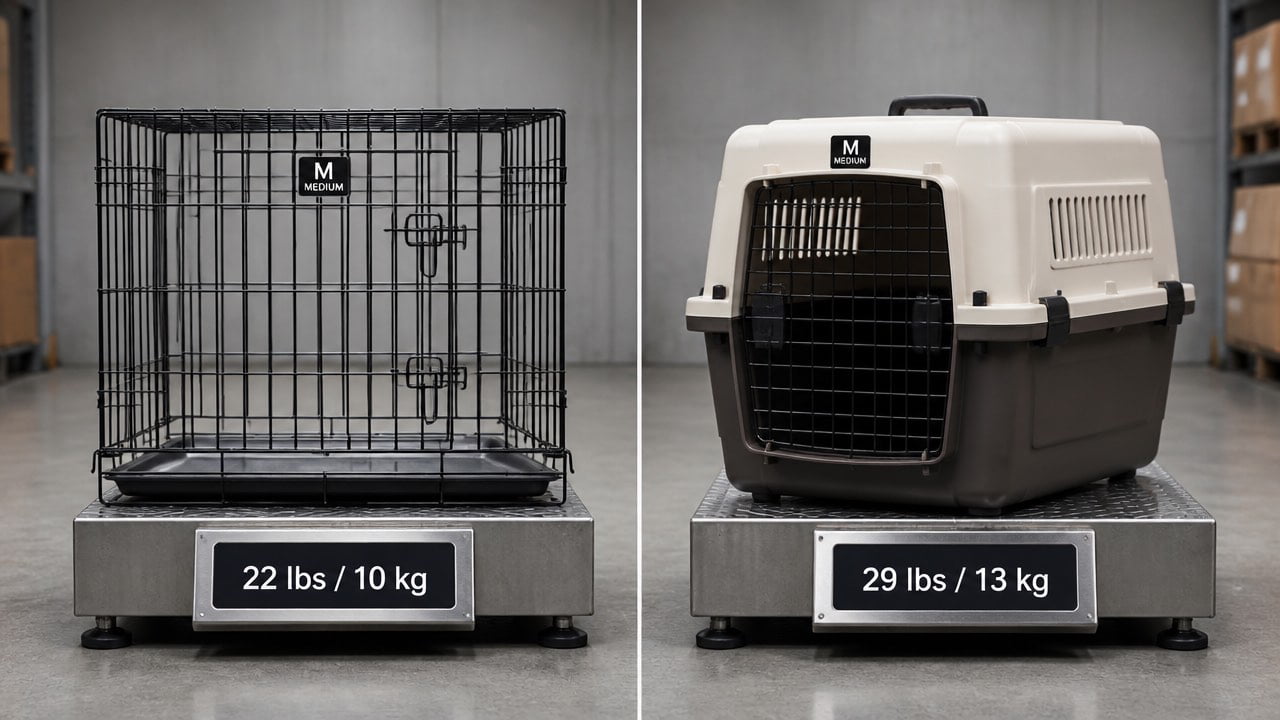
Let’s compare actual shipping weights for an M-size crate (36″ x 24″ x 27″):
| Specification | Wire Crate (M size) | Plastic Crate (M size) | Difference |
|---|---|---|---|
| Product weight | 22 lbs (10 kg) | 28-30 lbs (12.5-13.5 kg) | Plastic +20-30% |
| Packaging volume (CBM/unit) | 0.063 | 0.070-0.075 | Plastic +10-15% |
| Units per 40HQ container | 1,050 | 900-950 | Plastic -10-14% |
| Ocean freight per unit (US West Coast) | $2.10 | $2.40-2.60 | Plastic +14-24% |
The combination of higher product weight + larger packaging volume means plastic crates cost more to ship, not less. When calculating total landed cost, plastic adds $0.30-0.40 per unit in ocean freight alone.
What the numbers actually show: For a full 40HQ container to the US West Coast, plastic crates add about $270-360 in total ocean freight per container compared to wire crates — or $0.30-0.40 more per unit. It’s not a dealbreaker, but it contradicts the “plastic is cheaper to ship” assumption.
Durability: Which Lasts Longer?
The answer is: it depends on the usage environment.
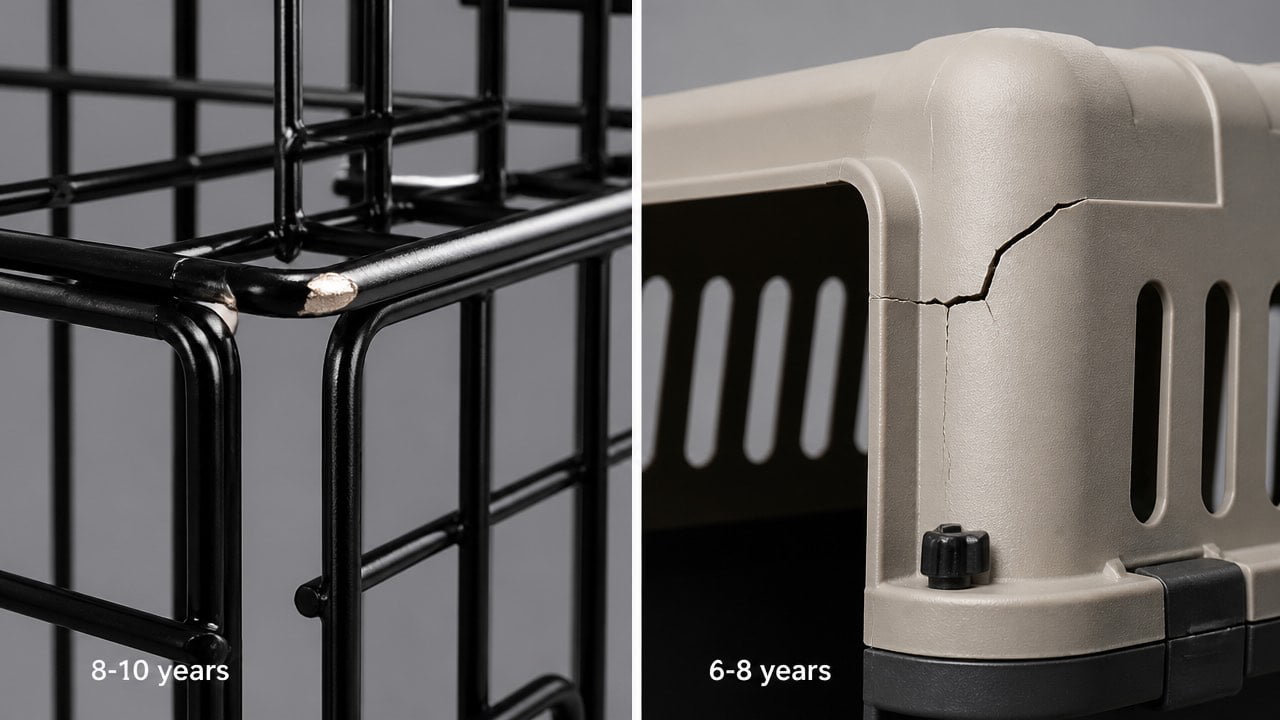
Wire Crate Durability
- Coating failure mode: Powder coating can chip if impacted heavily, then the underlying wire rusts. Lifespan: 8-10 years in dry environments, 5-7 years in humid environments.
- Structural failure mode: Wire can bend if a large dog repeatedly pushes against the same spot. Heavy-duty models (thicker wire gauge) mitigate this.
- Repairability: Individual panels can be replaced. Coating can be touched up.
Plastic Crate Durability
- Material failure mode: Plastic becomes brittle after 5-8 years of UV exposure and temperature cycling. It can crack if dropped.
- Structural failure mode: The shell can crack at stress points (corners, door frame) if a large dog pushes hard.
- Repairability: Difficult. Cracks can be patched but not structurally repaired.
Bottom line: In dry, indoor environments, both last similarly long (7-10 years). In humid environments or outdoor use, wire with proper coating outlasts plastic. In car-travel scenarios (where the crate may be dropped or bumped), plastic’s impact resistance is better.
Use Case Analysis: Which for Which Scenario?
The decision isn’t “wire vs plastic” as a general statement — it’s about matching material to use case.
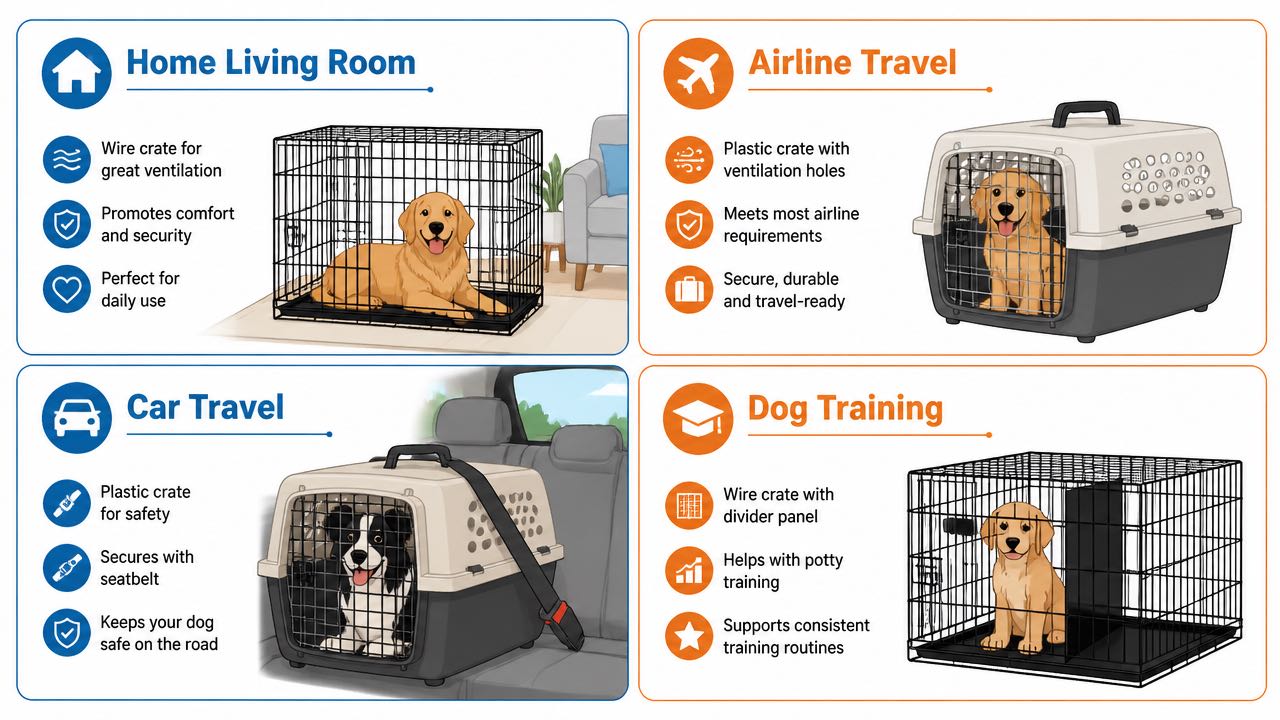
| Use Case | Recommended Material | Why |
|---|---|---|
| Home daily use (living room, bedroom) | Wire | Ventilation, visibility, adjustable divider, foldable |
| Air travel (airline checked baggage) | Plastic | Meets IATA requirements (closed shell, ventilation holes only) |
| Car travel | Plastic (preferred) | Impact-resistant, enclosed (some states require enclosed during transit) |
| Dog training / crate training | Wire | Visibility helps with training; divider panel adjusts as puppy grows |
| Anxious dogs (need enclosure) | Plastic | Enclosed shell provides den-like安全感 |
| Multi-dog households | Wire | Can zip-tie two crates side by side; better ventilation for multiple dogs |
For B2B buyers: if you’re targeting home-use markets (the largest segment in the US and Europe), wire crates are the dominant choice (80%+ market share). Plastic crates are a niche product for travel and airline use.
Market Data: What Sells Where?
Based on our order data and market research:
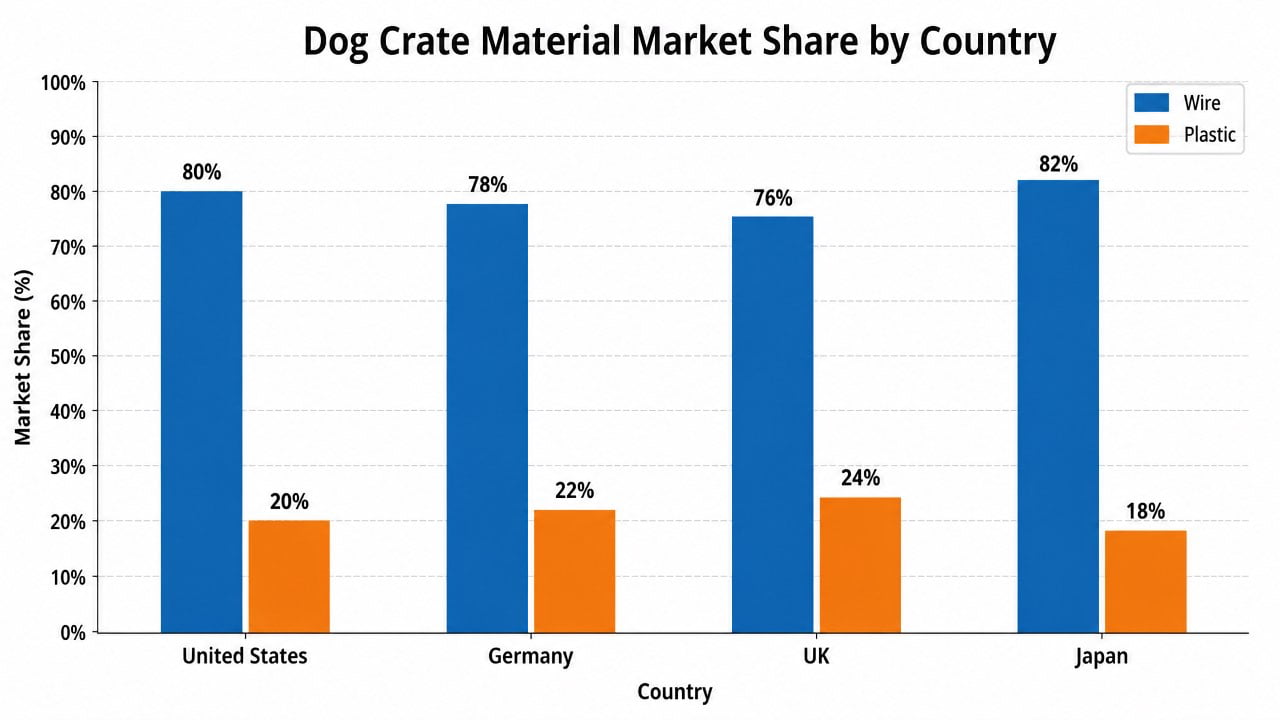
| Market | Wire Crate Share | Plastic Crate Share | Key Insight |
|---|---|---|---|
| United States (home use) | 82% | 18% | Wire dominates; plastic is travel/airline niche |
| United States (Amazon) | 75% | 25% | Plastic has stronger presence in travel segment |
| Germany | 78% | 22% | Similar to US; plastic for travel |
| UK | 80% | 20% | Wire preferred for home decor compatibility |
| Japan | 70% | 30% | Plastic more accepted (small apartments, travel culture) |
Note: CageSilo does not manufacture plastic crates. This comparison is provided to help B2B buyers make informed sourcing decisions — not to steer you toward wire, but to ensure you understand the tradeoffs if you’re considering plastic sourcing elsewhere.
What we usually check first with clients asking about plastic: Are you targeting home use or travel use? If home use, wire is the dominant choice in your market. If travel/airline, plastic may be worth sourcing separately.
FAQ: Wire vs Plastic Dog Crate
Is plastic lighter and cheaper to ship?
No. Plastic crates are 20-30% heavier than wire crates of the same size, due to the thickness of the shell (2-3mm). They also take more packaging volume. Ocean freight per unit is 14-24% higher for plastic.
Which lasts longer?
Similar lifespan (7-10 years) in dry indoor environments. In humid environments, wire with quality powder coating outlasts plastic. In car-travel scenarios, plastic’s impact resistance is better. The answer depends on usage environment.
Which is better for air travel?
Plastic. Airlines require IATA-compliant crates, which are enclosed shells with ventilation holes only (not open wire mesh). Wire crates are not accepted for checked baggage on most airlines.
Does CageSilo manufacture plastic crates?
No. We specialize in wire dog crates (and wood-combo). This comparison is provided to help B2B buyers make informed decisions if they are considering plastic crates from other suppliers.
Which material has higher market share in the US?
Wire crates have 82% market share for home use in the US. Plastic crates are a niche product (18%) focused on travel, airline, and car transport scenarios.
Related Reading
For more product comparison guides, explore our related articles:
- Wire vs Wood-Combo Dog Crate: Which Is Right for Your Market? — Compare wire crates with furniture-style wood-combo crates.
- Folding vs Fixed Wire Dog Crate: B2B Buyer’s Guide — Understand the real difference between folding and fixed crates.
- Dog Crate Divider Panel: Is It Worth the Extra Cost? — Analyze the ROI of divider panels for puppy growth.
External references: ASTM International | IATA (Airline Pet Travel)